Pugna Quin Percutias
One of my favorite things about board games is their ability to shine a spotlight on the undusted corners of history. Take Brad Smith’s Comet, a solitaire game about the titular resistance group and underground escape route that crossed from Belgium to Spain and helped over 700 Allied airmen escape back to Britain over the course of the war. It’s one of those tidbits I had an inkling of, but hadn’t given much consideration until I sat down at a table to reenact the smallest fraction of the hazards they faced.
Make no mistake, these were monumental acts of heroism, performed by civilian safe-house keepers and trail guides, under threat of arrest and execution, and conducted without firing a shot. Indeed, that was the Comet Line’s motto: Pugna Quin Percutias. To fight without arms. In many respects, an even more courageous proposition than taking up the rifle.
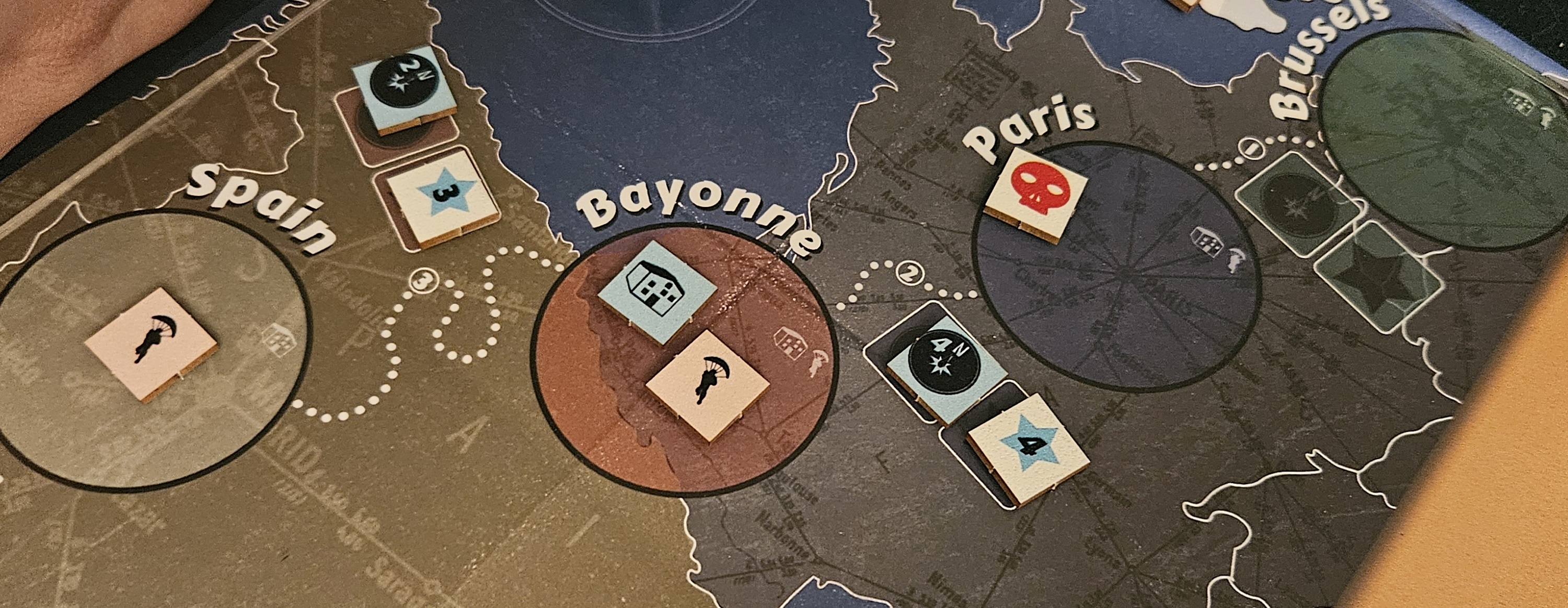
The escape pipeline.
And what better way to convey that courage than to establish the stakes? Smith doesn’t pander. Everything about Comet is unrelenting. Before your characters can get their bearings, the Nazi regime and its quislings are hard at work dismantling the few safe houses and escape routes available to you. Francoists in Spain, French collaborators in Bayonne and Paris, and the German occupation of Brussels can intrude into the internal workings of your movement. Every step along the route to Spain is fraught, both for the pilots you’re guiding and for the guides themselves. We haven’t even talked about the possibility of betrayal.
Smith bakes these threats right into the dough. Each turn opens with five event cards. Some of these are fortuitous: a co-conspirator willing to house escaped POWs in their farmhouse, a local huntsman who can guide escapees over the Pyrenees, a washroom backdoor in a train station for disguised pilots to bypass a Gestapo checkpoint. As the game progresses, new faces and opportunities enter the deck. Celebrity pilots whose return will guarantee additional funding. Covert aid from Section 9. Plans to hide downed pilots in the woods until D-Day can retrieve them.
But these cards won’t claim themselves. To activate them you need to spend organization points, itself a measure of which guide you’ve put in command of the Comet Line that season. Of course, your chosen organizer will be unavailable to actually shepherd any escapees, often leaving holes in your network. In the early stages of the game, your most competent leader is Andrée de Jongh, the historical founder of the Line. But she’s also your most comprehensive guide. Deciding whether to put her in charge of crucial administrative work or directly aiding soldiers is anything but easy.
Worse still, your draw deck isn’t only full of opportunities. It’s also chock-full of problems. Traitors eager to rat out your friends. Loose lips spreading your fame a little too widely. The weather. That’s right, the weather. When escape routes rely on crossing rivers in low-traffic areas, something as simple as a flood can force you to keep those pilots in place. That in turn might mean additional safe houses, suspicious grocery bills, further opportunities to slip up to the police.
It’s possible to prevent these events outright, but this further taxes your organizer’s action limit, not to mention permanently removes a beneficial card from the deck. And you need those actions! They’re the essential currency that lets you build safe houses, train new guides, and recover downed airmen. Comet is a game with plenty of culs-de-sac waiting to entrap those who spend their time mitigating unlucky draws.
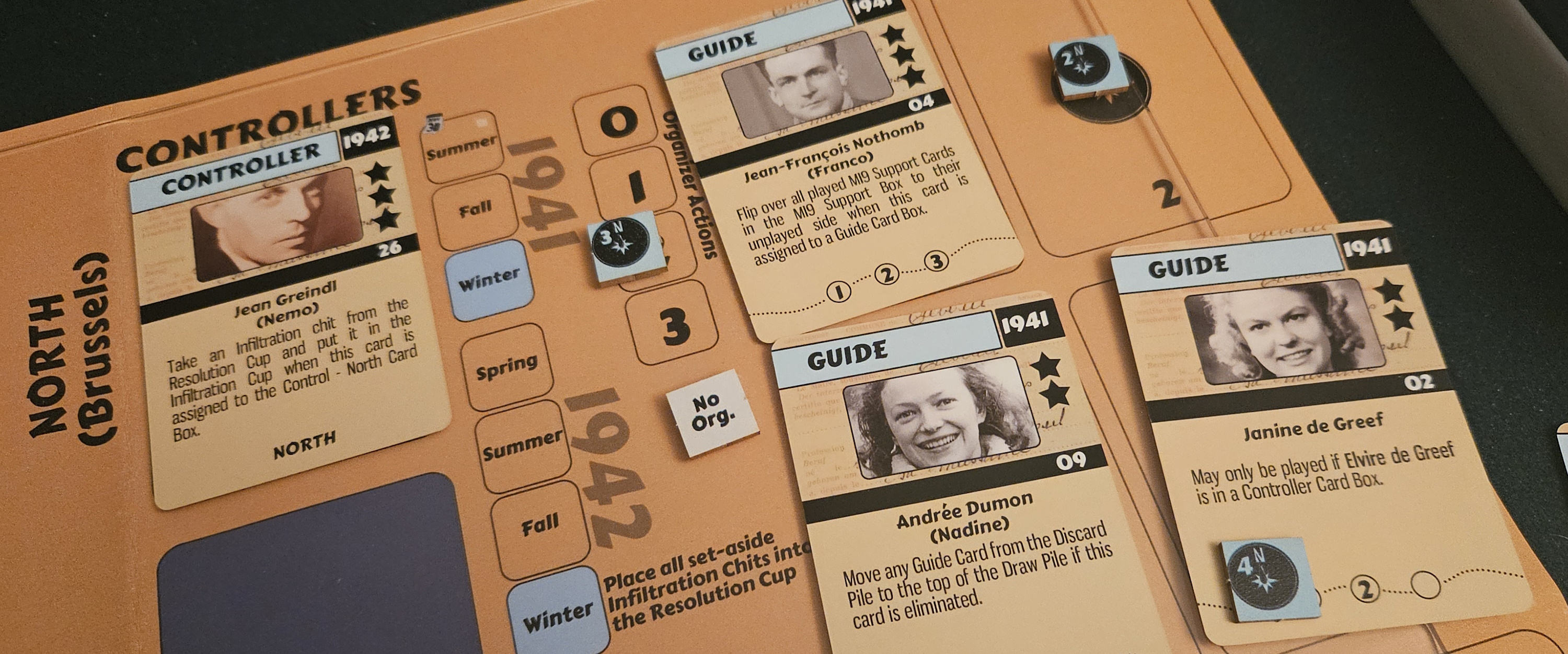
The tattered state of my escape line.
It’s also a game that can entrap players thanks to minor mishaps. Like many historical games, Comet puts its narrative first and everything else second. This isn’t often a problem, but it’s loaded with phases that must be executed in precise sequence and a good two or three mechanisms that are very nearly ancillary to your broader endeavors. Controllers work alongside guides to manage the Comet Line, but they aren’t given much to do. There’s a pool of resources that exists solely to buy downed airmen into better starting slots. Gestapo tiles eventually appear in cities to unravel your network, but their presence is defanged when they prove so easily mathed out.
Okay, so not every detail is drawn with the boldest of lines. Those that are, however, establish Comet as one heck of a compelling narrative. Your efforts are focused on a chit cup. Whenever you usher airmen from one portion of the line to another, you’re forced to draw from this cup to reveal whether you escaped the notice of the authorities. In most cases, your escape is successful. Those airmen are brought one step closer to freedom. Eventually, they’re returned to Britain via a “home run” from Spain.
At the same time, the skill of your guides might result in new dangers being added to the cup, and sooner or later one of these chits will be drawn. When that happens, disaster strikes. All airmen traveling that route are captured, your guide is imprisoned and very likely executed, and the Gestapo step up their activities in the corresponding city. These failures land like a hammer, undermining your organization at every level.
But these are also opportunities for terrific ludic storytelling. Not only is failure and capture essential to the memory of the Comet Line, but it also allows Smith to bring his cast to life with deft touches, imbuing characters with vital remnants of their namesakes’ true stories. One of my favorite cards, Florentino Goikoetxea, springs back into your deck after being captured. That’s because his real-life counterpart was hospitalized after being shot four times by border guards in 1944. While awaiting interrogation, the de Greef family, themselves operatives of the Comet Line, posed as Gestapo agents and drove him to safety in a stolen ambulance. Although the war ended a month later, his indefatigable spirit is communicated with little more than a picture, a simple ability, and a snippet in the rulebook.

It hurts when your event draw is full of terrible happenings.
Comet is full of little moments like that. Andrée de Jongh was 23 when her country was occupied. A year later, she founded the Comet Line with a group of friends. When she was captured in 1943, she openly copped to being the Line’s leader to draw Gestapo attention away from her compatriots. She survived Ravensbrück and the war. In game terms, the elimination of her card diverts one of those deadly chits from the cup, easing the pressure on the rest of your guides.
There’s Count Jacques Le Grelle, who was captured during the Belgian surrender. Being a nobleman had its perks. He had previously met the German officer overseeing his column while skiing in Austria, and received a certificate of liberation rather than sitting out the war in a POW camp. He escaped to Spain and eventually Britain, where Section 9 returned him to the continent to oversee the Paris sector of the Comet Line. In-game, he lets the player take every MI9 support card from the deck, padding your organization with powerful single-use abilities.
Or there’s Prosper de Zitter. Serving an extended sentence for embezzlement and marriage fraud, he was released by the Germans and put to work posing as a Canadian airman. He both infiltrated Comet and ran his own escape line, giving up resistance members and airmen to the Gestapo. This guy sticks around in your deck like the herp, removing airmen from the board and filling your cup with nasty chits. The first time you draw him is bad enough. The second time, his face is scarred into your memory as the rat he was.
It’s these brushes of humanity that make Comet worthwhile, jankiness and checklists and vestigial limbs and all. In my case, they also emphasize the game’s difficulty. Returning airmen isn’t difficult on its own, provided you’re cautious. It’s returning them in volume that demands risk. With Andrée de Jongh and her family and friends staring up at me, I become uncommonly averse to taking those risks. These are children, by my elderly standards at thirty-seven. I’d much rather spend my limited actions on counter-infiltration, removing dangerous chits from the cup, than cobbling together a robust escape line. My best score stands at twelve returned airmen. Victory awaits at fifteen. Does that speak to some flimsiness of character on my part, even outside of the game? Oh, no doubt about it. The bravery of Comet’s principals astounds me.

My best score. Not great.
This isn’t the first time I’ve been left speechless by one of Hollandspiele’s titles. Last year’s Endurance, by Amabel Holland, did something similar, emphasizing the capacity of human beings to weather disaster and tribulation. Comet centers a different sort of courage, a willingness to risk life and freedom in the struggle against manifest evil. To safekeep and guide those lost behind enemy lines. To fight without arms. I’m glad I played this one.
(If what I’m doing at Space-Biff! is valuable to you in some way, please consider dropping by my Patreon campaign or Ko-fi.)
A complimentary copy was provided.
Posted on July 17, 2024, in Board Game and tagged Alone Time, Board Games, Comet, Hollandspiele. Bookmark the permalink. 2 Comments.

 SPACE-BIFF!
Looks very cool, I like that the highlight real historical people. Often these types of games would abstract the people out, but here they are front and centre. A nice touch.
I agree! A few games have emphasized personal investment lately — No Motherland Without comes to mind, as do more fictional titles like Defenders of the Wild and Undaunted. It’s a good trend.