Choo Choo Choom

The concept behind Stephen Kerr’s Metrorunner seems like a misbegotten effort to put a finger on a pulse of what’s hot in board games. What are folks into these days? Trains. Netrunner. Oh my gosh. What if we made a game about trains and netrunning.
But it isn’t like some of my favorite board games aren’t about wackadoo topics. For all I know, some combination of turnstile-jumping and encryption-cracking is poised to become my favorite mashup of all time.
Still could be. Won’t be Metrorunner, though.
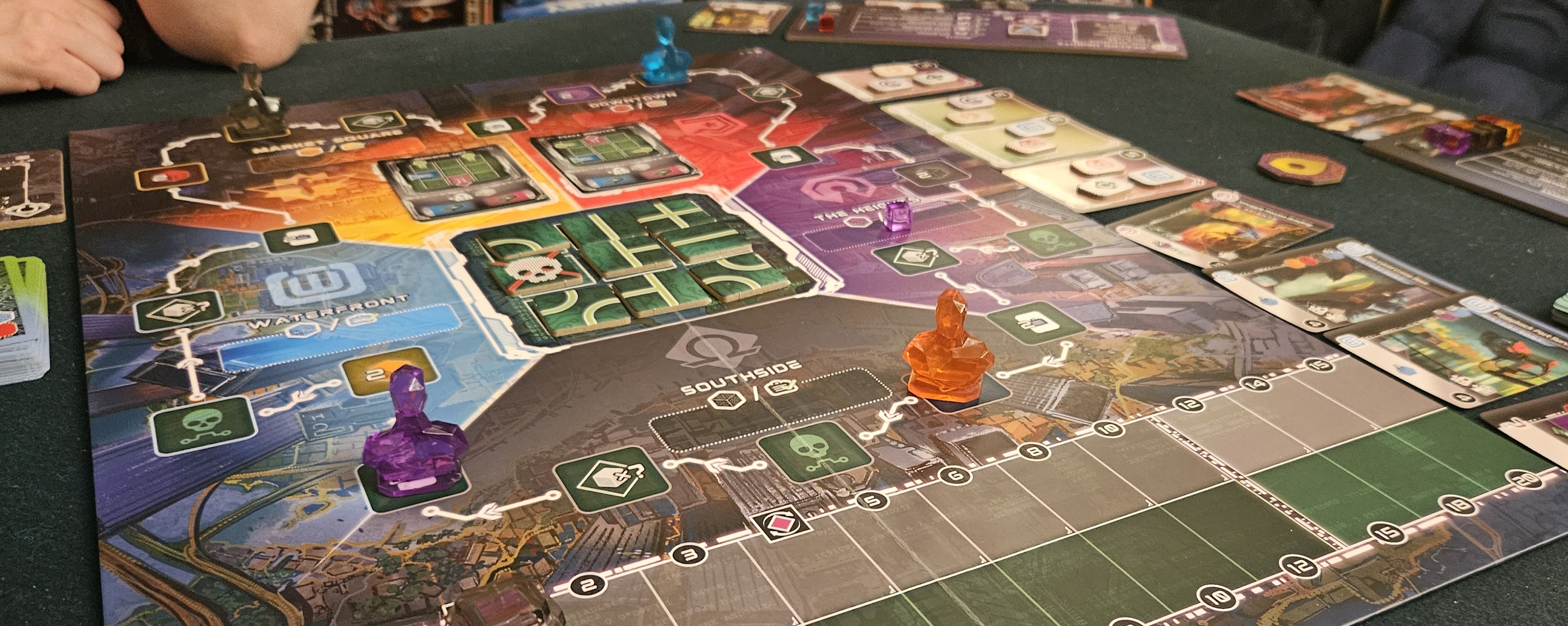
Round and round the rondel. I mean metro.
It isn’t a train reference when something “stumbles right out of the gate,” but Metrorunner makes it feel like one. This is a rondel game with perhaps the dullest rondel I’ve ever rounded, a hacking game that transforms blackhatting into a duller pipe-routing minigame than the one in BioShock, and a resource-gathering and recipe-fulfilling game that leaches the enjoyment from both activities. On the whole, it’s a shocking stumble from a studio that has given us Cartographers, Dawn of Ulos, and Dual Powers: Revolution 1917. Even middling efforts like Stonespine Architects come out shiny by comparison.
Let’s start with the rondel. Like most rondels, this one sees players circling the board to pick up various benefits. There’s the obligatory blocking, plus a two-layered set of actions to be claimed that allows for some flexibility when your desired space isn’t available. Only there’s a problem. Your desired space will be available. That’s because the board is divided into five zones, each with identical spaces. And that isn’t the worst of it. The rondel is so immense that you can ride this train for a whole game without colliding with anybody.
Maybe I sound nutty when I declare that it’s bad that you’ll always be able to reach a worthwhile space. But the thing about board games is that they’re as much about restriction as they are about permissibility. The entire purpose of a rondel is not merely to be moved around. It’s to be negotiated. Navigated. Picked through. The joy of a rondel lies in figuring out a way to maximize your movements despite meddling opponents getting in your way and despite spaces not always aligning quite the way you’d prefer. In Metrorunner, it’s a rare move that pinches your options. When those occasions do roll around, it’s trivial to bypass them by hiring a rideshare to zip you to the other end of the city.
The result is an entire portion of the game that’s barely there. You’re hackers who ride the metro. But apart from the odd restriction, there isn’t enough going on to justify the rondel’s inclusion. I guess it’s dystopian that the metro only goes clockwise.
It’s telling that the solitaire mode gets it. When running the metro solo, the A.I. deck slaps obstructions onto the spaces in front of your pawn. You’re more likely to have your plans foiled while playing against a robot than against fellow humans. Like I said. Dystopian. While I don’t recommend the solitaire game, at least it tosses some hurdles in your path.
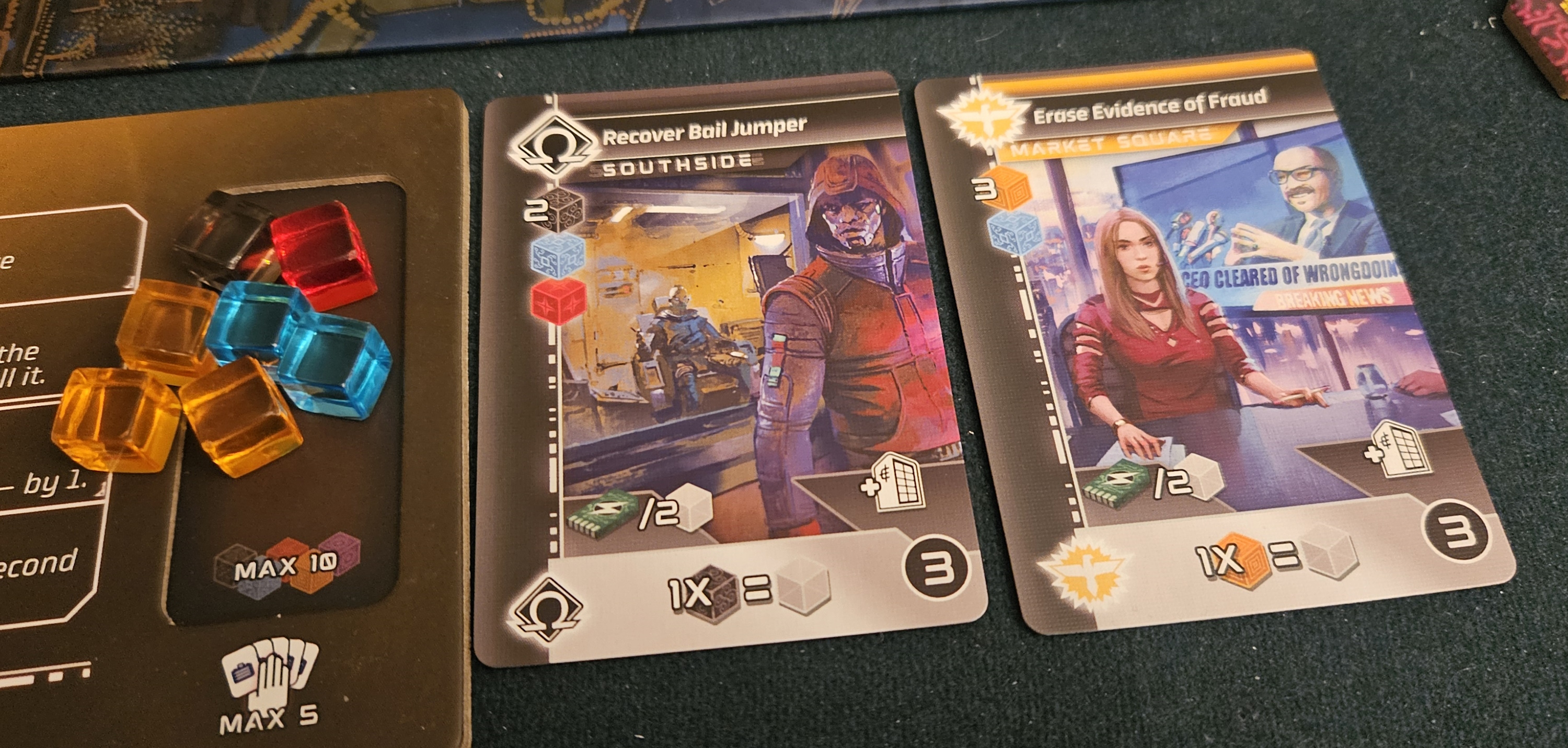
Some of these jobs don’t seem so punk to me…
I wish I could say the other parts worked better, but even the portions that are workmanlike have a certain shoddiness to them.
Much of your attention is focused on finishing jobs. There’s a card market for grabbing new gigs. Each offering is tied to a specific zone and requires an assortment of cubes to complete. But there’s no character to any of these activities. Gathering cubes is easy, almost flippant. You can pick up certain colors in corresponding zones, but each zone also has a space for grabbing whatever the heck you need right now. As the session progresses, your ability to pick up these cubes becomes even easier. It’s uncommon to be more than one or two moves out from gathering what you require to wrap a gig. The whole thing is airy and unfulfilling.
And when you do finish a job, you get more or less the same stuff. There are two tracks to move up, but neither one is especially exciting. Gathering cubes makes leaping into another gig effortless, while earning credits unlocks purchasable effects that mostly bypass the rest of the game. Want to skip the rondel altogether? Spend a credit. Want to take two actions instead of one? That’ll be a pair of creds, choom. Even the little abilities you earn from completed gigs exist solely to increase your cube efficiency. Remember, cubes come fast and easy as it is. Oh, now you get an extra orange cube. Oh, now you can spend black cubes as wilds. Oh, now gigs don’t require a blue cube. Please, let me get off this roller coaster.
I haven’t even mentioned the hacking yet.
Oof. The hacking.
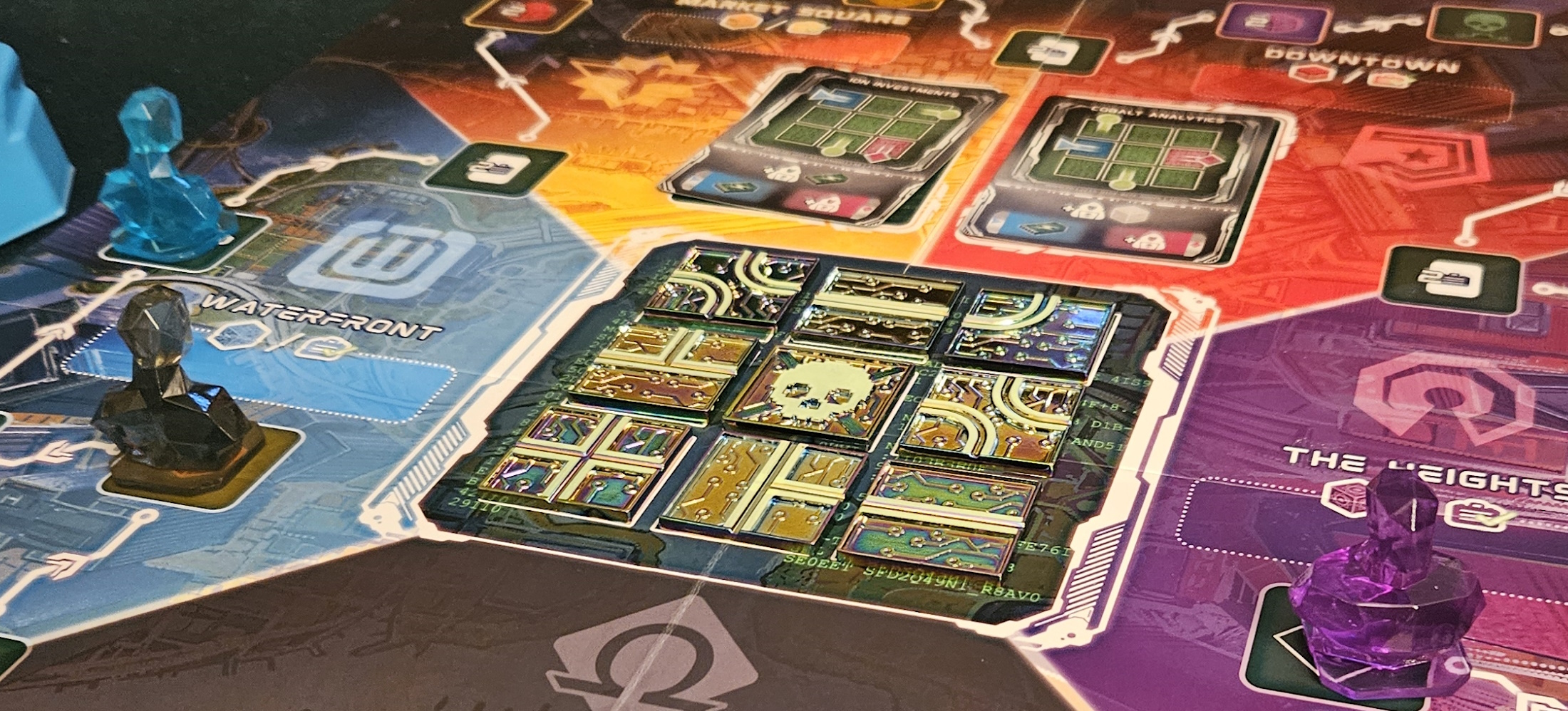
Hacking the planet. I mean the metro.
Every so often, you’ll want to hack the planet. No? How about a nine-tile grid? Metrorunner has one of those.
Landing on a hacking space interrupts the usual gameplay to play a plumbing minigame. Your objective is to connect two pins, displayed at random via the hacking deck. As you level up your reputation — one of those two tracks — you can also plug pipes into additional spaces for bonus stuff. Initiating a hack gets you two free moves, either to rotate a tile, swap two adjacent tiles, or slide an entire row or column. If you need more, you can spend cubes.
As little minigames go, it’s fine. Really. There’s a reassuring familiarity to the whole thing, probably because even people who haven’t played a board game have at least repaired a leaking sink or rerouted a sprinkler line. Figuring out how to configure a limited set of connections in order to bridge A to B while also plugging into X is something we’re hard-wired to appreciate.
What stinks about this process is that it intrudes into the game like a couch stuck in a hallway. Most turns take only a few seconds. Hacking consumes multiple minutes. There’s no such thing as planning; everybody works from the same grid, so any forethought will be wasted when anybody else conducts a hack. It gets so bad that landing on a hacking space prompts a round of groans. And it only gets worse. As you level up your character’s influence, you’re given additional pins to connect. Why shouldn’t you? This is an optimization game. Now everybody gets to wait around while you struggle to line up four pins without spending too many cubes.
I don’t know how others will approach the hacking, but in our group’s case it was so unbearable that we resorted to crowdsourcing solutions. As soon as somebody initiated a hack, Metrorunner’s competitive game took a beat. Now it became a cooperative endeavor, everybody laboring to find the most efficient connecting passage for those wires. At least we were doing something. Enough of this game is already spent sitting around for others to complete actions that won’t affect you.
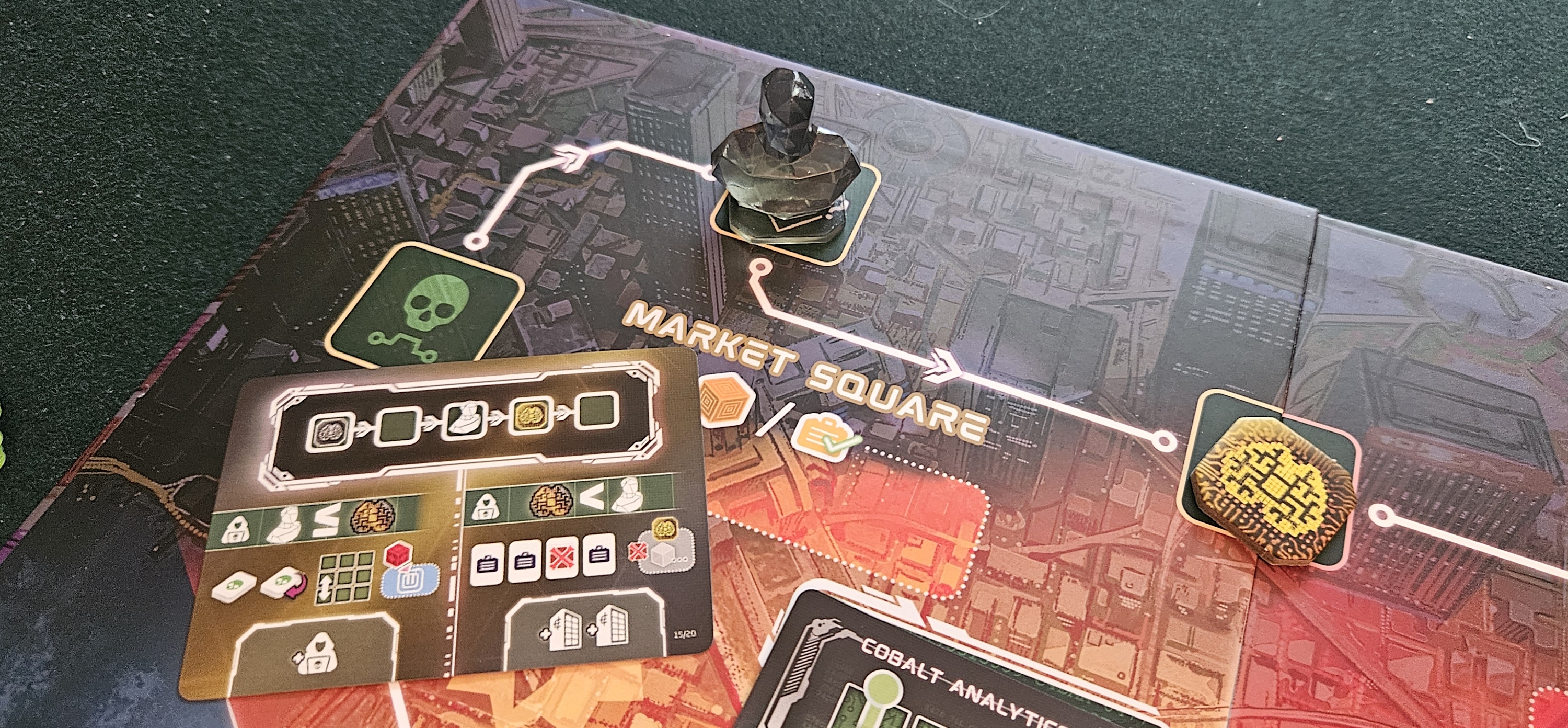
I’m a true solo now.
Look, I can appreciate a middling board game. It’s a hard market. There are a hundred very good games coming out every year. Every so often, it’s nice to sit down with a game that’s trying to be the best thing you’ll play tonight rather than the best thing you’ll play this decade.
But Metrorunner is not middling. It’s bad. It’s a one-way el-train that misses too many stops. It’s uninteresting, devoid of the essential friction that makes a game worth playing. It’s frivolous, going through the motions but producing none of the joy behind those motions. It insults the table by deciding to let one person play a different game while everybody else stares at them. The purpose of dystopian media is to draw our attention to society’s shortcomings, not to deepen that dystopia. Metrorunner doesn’t understand the difference.
(If what I’m doing at Space-Biff! is valuable to you in some way, please consider dropping by my Patreon campaign or Ko-fi.)
A complimentary copy was provided.
Posted on July 9, 2024, in Board Game and tagged Board Games, Metrorunner, Thunderworks Games. Bookmark the permalink. 13 Comments.

 SPACE-BIFF!
Thanks for an informative review again. And ouch, the game doesn’t sound that good. Like the most dystopian thing is to force someone to play it.
I’m not sure of course, but it sounds and looks like it was made with the help of AI. The hodge podge of game mechanics, idea and the actual art feels, cheap? Money grabby? Can’t really put my finger on it…
Oh dear, I hope not! I didn’t detect AI, but I also didn’t look very closely.
Publisher here. I can confirm AI was not used in any way to design or illustrate this game. Here is the list of illustrators we had the pleasure to work with:
Ignacio Bazan Lazcano
Ariel Anabitarte
Nicolas Zacaria
Matias Traberg
Thanks for confirming, Keith!
“like a couch stuck in a hallway”, something about this quote resonates with me, what a visceral comparison.
I can picture it now, haha.
Played this on the holiday weekend and we really enjoyed it. I thought the pipe puzzle was almost too easy if anything. No one took a long time to do any hacks at my table.
I’m happy to hear you’re enjoying it!
My group on the other hand found it to be one of the most turgid disappointing games we’ve ever played. Big pauses in the middle of the action for the hacking, and to boot the cube counting is terrible. Biff hit the nail on the head.
I’m sorry to hear that, SamYouAreNot. Sounds like our experiences were disappointingly close.
Brutale!
I have to say that this review left me shocked. I did not pick these critiques from reading the rulebook, but as I reside in the EU, I have not yet received my copy so I cannot say anything else except that I do hope that this falls in to the 5% category of the games that our opinions differ. This is now upcoming battle epic between one of my favorite boardgame publishers and my absolute favorite reviewer. Let’s see how I feel about it when the EU copies ship. For now, my excitement has taken a small hit…
There’s always a chance you’ll love it! Games are strange and wonderful in that they need no singular reason to work for some people and not work for others. All I can do is tell you why it didn’t work for me.