Country Directions

“Landmarks” isn’t the best title for Rodrigo Rego and Danilo Valente’s Landmarks, and not only because a heap of other board games go by the same moniker. (We are all of us indentured to SEO.) Rather, it’s because “Landmarks” sounds like one of those games where you’re visiting a bunch of state parks. Bo-ring. It deserves better.
Picture the solipsistic vocabulary terror of Vlaada Chvátil’s Codenames, the cooperative nature of its own spinoff Duet, and an adventure that sees players dodging traps, digging up treasure, and managing a dwindling water supply. That’s Landmarks. It’s sublime.
Apart from that title. Landmarks. Landmarks. Blech.

Someone had food on the mind.
Name aside, Landmarks owes a debt to Codenames and maybe lesser-known titles like Brian Leet and Kevin Worden’s Mystic Paths. Like those games, it revels in the unexpected flexibility of language, but also mires itself in language’s ambiguity, its vagueness, its imperfect boundaries. Both sides of that coin, flexibility and ambiguity alike, are ready-made systems for those who dare venture into the murky world of words.
That’s precisely what Rego and Valente have done here. The game’s central conceit is that everybody is lost on a treasure island and, oops, they’ve left the only map back at base camp. Good thing they also left their pathfinder behind. Great work, guys. Now there’s nothing left to do but work the problem. Operating with a faulty radio, the expedition is set to receive directions that will hopefully lead them off the island.
The beauty of the game’s wordplay is found in its associations. Each map card — which only the pathfinder can see, obviously — starts with three words clustered together. One at a time, the pathfinder writes a clue on a tile. One word. That’s all that can break through the static. Your lost party then places that tile somewhere on the map, adjacent to one or more of the tiles already placed there.
Over time, the meaning of these words is negotiated between the pathfinder and the lost party, a silent conversation that trickles out one word at a time. Let’s pretend our starting words are lime, watermelon, and tie. As the pathfinder, maybe I want you to step next into the space adjacent to lime and watermelon. So I write “seeds” as my clue and hand you the tile. Geoff nods enthusiastically and places the tile directly next to tie despite the insistence of his companions. When it turns out that he stepped directly onto a trap, they flip. Why? Why would he do that? Because he’s thinking about the ties used to bind the vines of a bean arch. Duh. Maybe “fruit” would have been a better clue.
Things get tricky as your clues reach outward. Now that seeds has been placed on our board, we need to think about the implications of that word for our future progress. What other words will stem from it? How will they interact with the words already on the board? What are the particulars of how this group seems to be communicating in the moment? Just because the pathfinder can’t speak doesn’t mean they aren’t engaged in a conversation.

Tracking progress.
It helps that Landmarks wraps its wordsmithing inside a compelling conundrum. It isn’t enough to move across the island. You also need to hit certain spaces and avoid others.
The most significant limiting factor is water. Your party’s canteens can only hold so much, translated into the number of tiles (and therefore clues) you can travel before you perish of dehydration. There are springs located across the island for refilling your stack of tiles. To survive more than a few turns, you’ll need to arrive at these spots — but also not stop so often that you use them up frivolously, only topping off your stack with two or three tiles instead of five or six.
Traps, meanwhile, deplete your stack. Incurring an injury has both an immediate effect, robbing you of a tile, and a delayed one, diminishing your cap when you refill at a spring later. There are also curses, nasty spots that prevent you from winning the game. Somewhere on the island is an amulet that will cure one curse, but that’s it. Anger too many ancient deities and you’re done for.
Broadly speaking, your objective is to reach the exit. There are also treasures, which… well, to be honest, I’m not wholly sure what they’re for. It’s here that Landmarks gets a bit wishy-washy. In theory, you’re trying to find the treasure before reaching the exit. But the game still declares it a victory if you escape the island, regardless of how much loot you’ve collected. The rules imply that gathering treasure makes for a better victory, but it isn’t stated outright. Nor is there much in the way of a formal scoring system. I would have preferred a more forthright directive here. “Collect at least three pieces of treasure or it’s a lesser win.” “Declare a difficulty level to determine how much treasure you need to find.” “If you return from that danged island without something to show for it, your mother will feign dementia to avoid speaking to you.” Something like that.
This isn’t the only place Landmarks doesn’t measure up. There’s also a competitive mode, a race between two separate parties to find a certain number of treasures. It’s here that Landmarks’ debt to Codenames bubbles to the surface. As in that game, both sides are trying to uncover certain tiles, some of which belong to their team and others that belong to their rivals. Finding a treasure that belongs to the opposing team still awards them the point, forcing your pathfinder to tiptoe your party around any offending spaces. Curses also make a return appearance. Here they operate like a softer version of the assassins in Codenames; once cursed, you’ll need to find an amulet. The twist is that you’ll lose outright if all your treasures are unearthed while you remain cursed — a nice opportunity for your rivals to reveal those spaces.
As game modes go, it’s serviceable enough. But it’s also a little too close to Codenames, swapping the resource management minigame for a more straightforward competition that doesn’t feel as finely differentiated from its inspirations.
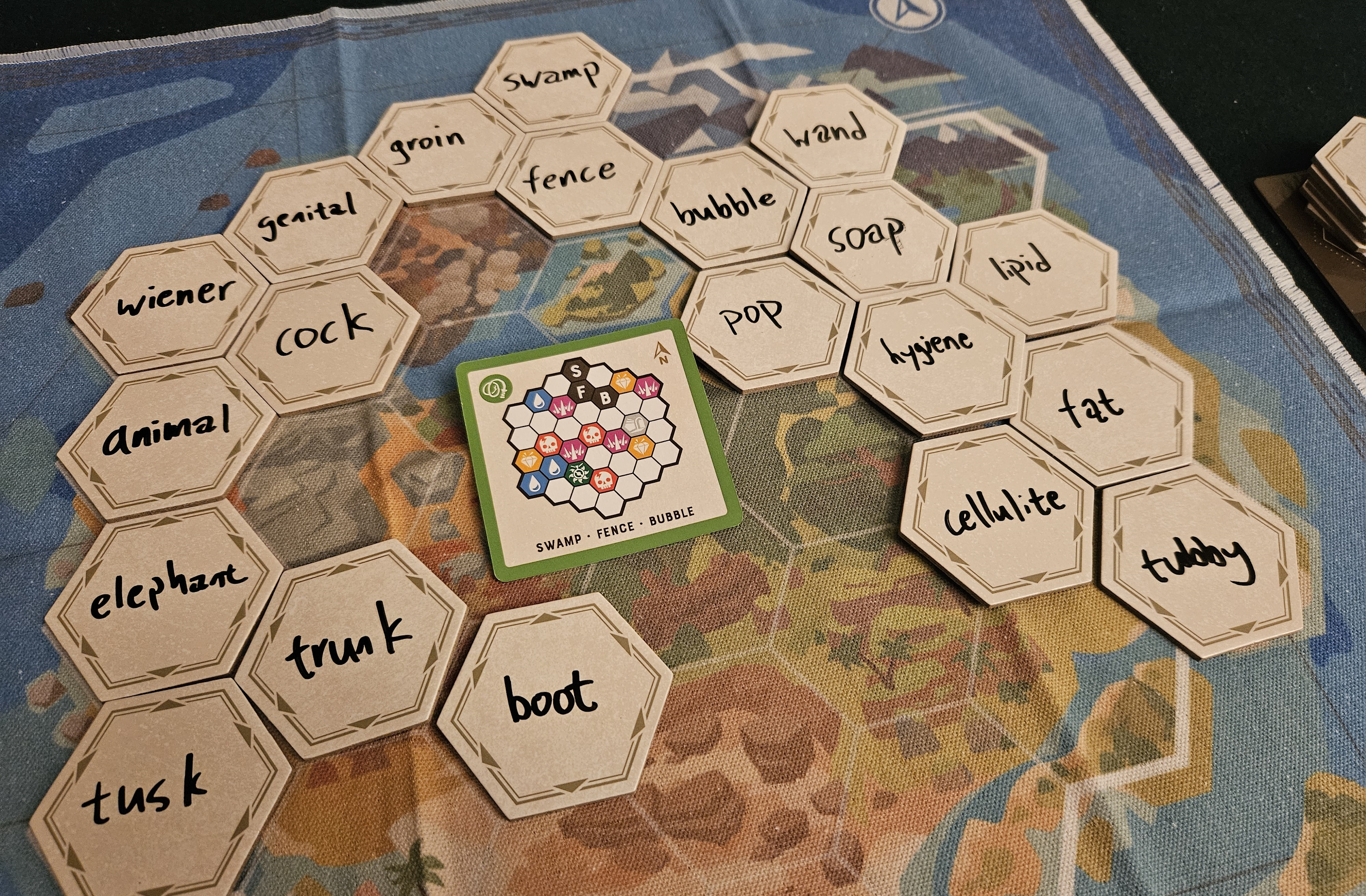
Landmarks… AFTER DARK.
Issues aside, Landmarks does its lineage proud. This is a smart word game, one that thrills at the way we use words to draw flimsy connections. Like Codenames, it thrives on natural usage rather than a broad lexicon, permitting everyone to join in on the journey. It shoots for broad appeal. And it deserves to find it — albeit maybe with a house-rule about those treasures.
(If what I’m doing at Space-Biff! is valuable to you in some way, please consider dropping by my Patreon campaign or Ko-fi.)
A complimentary copy was provided.
Posted on July 2, 2024, in Board Game and tagged Board Games, Floodgate Games, Landmarks. Bookmark the permalink. 2 Comments.

 SPACE-BIFF!
Just picked this up at PAX, and yeah we immediately added a Spirit Island-style House rule that before we start we declare how many treasures were going to acquire. Just a pre-declared a difficulty.
Good call!