Gonna Decimate Them Like You Did to Me

I’ve never read Robert Kirkman’s Invincible, and I’ve watched exactly one (1) episode of the animated show. In that time, my takeaway was that this was a more grounded, gritty, and realistic — yeah, we’re stretching that word to the breaking point — approach to superhero mythology. Kinda like every other modern take on superheroes.
What I’m saying is that I don’t have any nostalgia or reverence for the source material, no allegiance that would prevent me from telling you that Kevin Spak’s Invincible: The Hero-Building Game is a big ole stinker.
But in a twist worthy of a penultimate issue’s final panel, Invincible isn’t a stinker. Not at all.

Punch!
Invincible: The Hero-Building Game picks up pretty much where the first episode of Invincible leaves off. The Guardians of the Globe have been massacred by an unknown assailant (okay, not that unknown), leaving it up to four plucky teenagers to protect the planet from threats interdimensional, extraterrestrial, mutated, cloned, or otherwise.
In the long tradition of origin stories, you aren’t veteran villain-boppers; you’re kids with big powers that have yet to be harnessed and honed. So while everybody begins with a few basic moves, letting you punch baddies, move around the board, rescue imperiled civilians, and build your confidence, you’ll need to level up your skills before you can reliably tackle tougher threats. Thugs with nines? No prob. Cloned weightlifters with miniguns? Maybe bench a few extra pounds first.
Right away, the game sets itself apart by splitting each hero’s development across two axes. There are cards, a huge stonking range of them, each with a different skill to add to your moveset. These are divided into four colors, and further sub-divided into regular powers and ultra-moves that can only be paired with a corresponding card of the former type. There’s plenty of variety, but the gist of each color comes down to a few archetypes. Yellow powers are about bopping baddies on the nose, blue tends to focus on mobility and thwarting dastardly plans, orange is the category of utility, and your starting purple card is a signature move that always accompanies your hero.

Each scenario features a story beat from the series.
But it’s the second axis of your hero’s development that really sets this locomotive chugging. Powers only trigger once they’re filled with enough matching cubes. Drawn from a cloth bag, these cubes represent your hero’s stamina, raw talent, that sort of thing, and the contents are subject to development as you progress through a session. During training — basically an intermission in the middle of each round — you can spend confidence to buy powers. Your other option is to throw away a power card entirely to add a matching cube to your bag.
Over the course of a mission, then, your heroes go from plucky teens with big muscles and/or assorted mechanical and manipulative powers to the genuine article. There’s a fantastic sense of development to this process. Your starting powers are no slouch, and give each hero their own definable shape. Invincible is great at punching. Robot has an assortment of inventions that either aid in combat or aid other players with powerful single-use powers. Rex Splode (ew) tosses red cubes into anybody’s bag, giving them an edge that also happens to injure them. And Atom Eve has a flexible but unwieldy power that both rescues civilians, deals damage, and blocks damage. These are still just a starting point. By the fifth or six round, your heroes will be detonating the atmosphere to damage every baddie on the table, chucking villains into outer space to remove them from the board for a round, or simply punching punching punching until your enemies have stopped moving.
The best part of this process feels thematically important even if I don’t know the first thing about Invincible as a holy text. Scattered among your starting cubes are six black cubes. These function as wilds, helping to trigger any ability. That’s good! But they also represent your character exerting themself. Draw your fifth black cube and your character crashes. They’ve pulled their super-hammie. You tip your hero onto their side and pray one of your friends comes along to rescue you. If rescued, you can put those final cubes to good use before ending your turn. Otherwise you’ll have to roll the damage die, potentially KO’ing your hero. That’s bad!
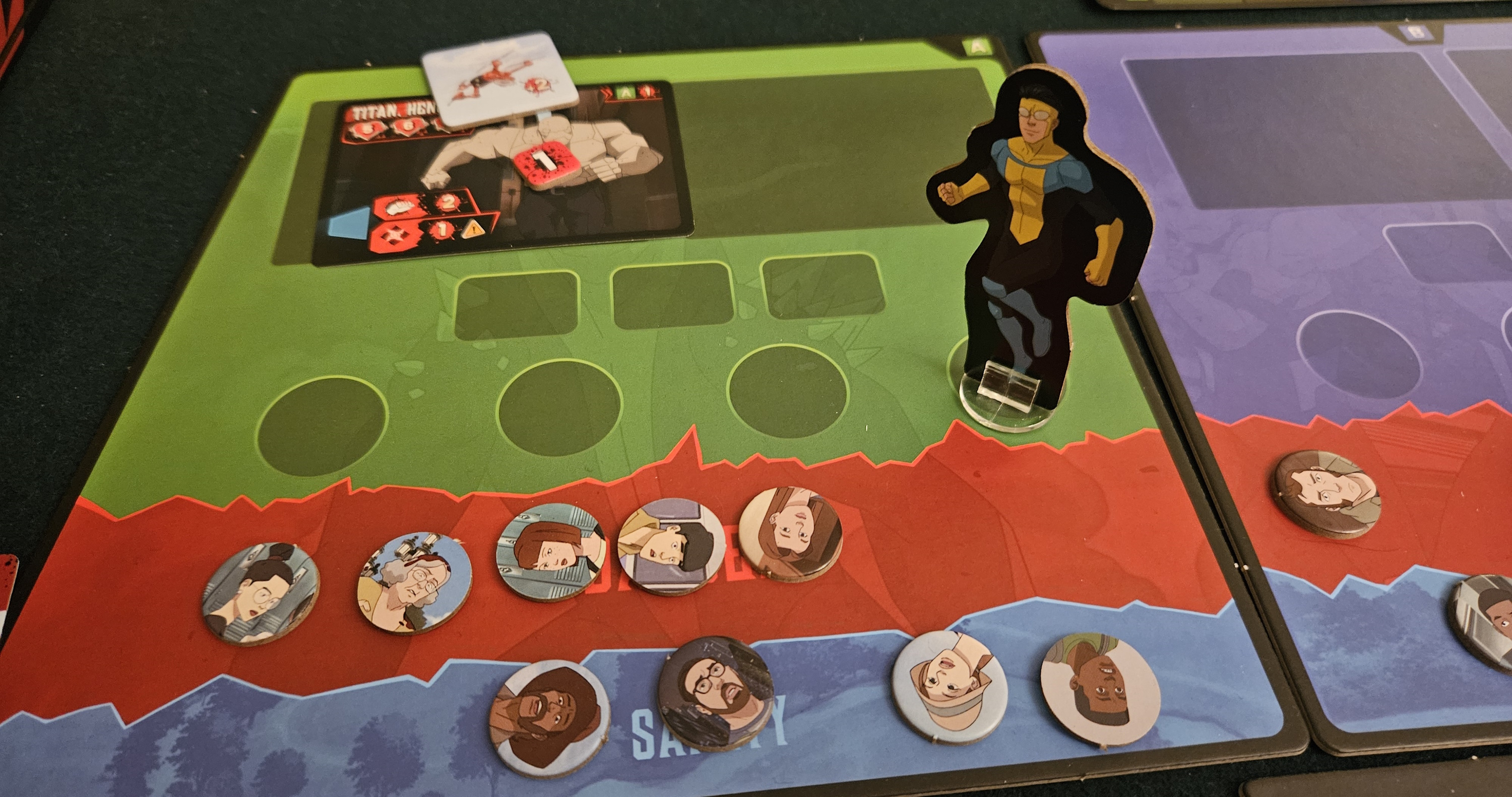
Hey. Just flyin’ round.
This escalates the hero phase into something truly gripping. Everybody goes at once, collaborating to defeat increasing enemy threats by drawing three cubes at a time and assigning them as they see fit. Nothing stops players from taking turns in any sequence. If you like, one hero could pull all their cubes before anybody else goes — a goofy idea, but it’s possible. This freewheeling movement between players establishes your crew as an actual superhero team, able to juggle enemies in the air, fly to one another’s aid, or pick up crashed buddies. It’s bouncy. It feels great.
At the same time, everybody approaches their own powers with a tentativeness that befits the fact that you’re playing as heroes in their early stages. How far can you push yourself? Sometimes too far. Other times, not far enough. It feels like Quacks of Quedlinburg as a cooperative superhero game to such a degree that I contemplated punning this review after Wolfgang Warsch’s bag-builder. Quarks of Quedlinburg. Yeah. You can see why I didn’t go that route.
In the game’s later scenarios and with the right modifiers, the pressure cranks up. I won’t spoil what Spak has done with the scenario design, but each of the game’s seven chapters poses its own challenges. Where one fight is a slugfest to put down your rivals before they beat you, others might revolve around saving civilians, disarming nefarious instruments, or defeating fleeing super-prisoners before they can reach an escape chopper. For such a smooth game, Invincible covers a lot of ground.

Upgrading your hero is a real delight.
It’s a hard game to express complaints about. Everything is buttery smooth, shifting from one beatdown to the next with few breaks in the action. Each step is so self-contained that even newcomers will likely find it an easy on-ramp into more complicated games. For example, gaining confidence, the game’s currency, is done naturally as you trigger other abilities. The first time I teach Invincible to new players, I don’t even bother to explain what they’re going to do with their hand of cards until we reach the first training phase. There simply isn’t any reason to front-load that information.
That said, it isn’t terribly challenging for anybody who’s played a board game before — Spak doesn’t seem to have stuck to the old conventional wisdom of cooperative games by only letting players win one in three tries — but there are ways to ramp up the challenge. The most obvious is printed right onto each scenario, additional baddies that spill onto the board before you’ve dealt with the last batch. There are also modifier cards that nudge the difficulty in either direction. If you’re struggling with a scenario, the appearance of an unlikely ally might help. If things are too easy, uh oh, it turns out you were on a date when the super-signal went up! Oh no! How will Rex Splode, um, rexsplode now?
That might also speak to the game’s limited appeal. Despite its smoothness, its cooperative nature and scenario-based structure puts a ceiling on the experience. After seven plays, I feel I’ve seen what it has to offer. There’s nothing stopping me from going through the levels again, and there’s even a light campaign mode where you can tally your performance after each chapter and compare your total against a score. Am I going to do that? Probably not. It’s just a scooch too light — and chancy! — to care whether I could have beaten a particular enemy before they slaughtered three fewer civilians.

Things get hectic playing two-handed.
So it’s light. Airy, even. That smoothness comes with a price. No, not that your loved ones will always be in danger. Rather, that the game doesn’t really have that many snags for catching either elbows or extended attention.
Still, Spak has created one of those rare tie-ins that manages to evoke a particular feeling without compromising gameplay. Invincible is about realizing your power — both its potential and the apprehension of not knowing your own strength. Even though I don’t intend to repeat its highs, my trip through those seven scenarios was a rewarding power fantasy.
(If what I’m doing at Space-Biff! is valuable to you in some way, please consider dropping by my Patreon campaign or Ko-fi.)
A complimentary copy was provided.
Posted on July 1, 2024, in Board Game and tagged Board Games, Dire Wolf, Invincible: The Hero-Building Game. Bookmark the permalink. 11 Comments.

 SPACE-BIFF!
Thugs with nines? An Odd Squad crossover episode!
I don’t know what that is…
Then you’re missing top absurdist educational children’s television. https://www.youtube.com/watch?v=7bWsSG1CGtg
Yes, when I watched that clip I did initially think they were saying “Vlaada, destroyer of cubes” and thought it was a Vlaada Chvatil reference, but apparently it’s Fladam?
That’s a weird name.
Did you win every scenario on the first go? It sounds like that from the write-up, but it is not explicitely stated.
We did. Sometimes by the hair of our teeth! And in the last scenario, we didn’t use “hardcore” mode (or whatever it’s called). But yeah, I found it pretty easy.
You might want to try another episode or two of the show. It’ll be less like that, IIRC.
Maybe! I don’t watch much TV, unfortunately.
In general, I’d say the show thematically has more in common with Watchmen or The Boys than most other superhero stories (I haven’t read the comics, but I believe the show is somewhat faithful).
A big part about it is exploring the power imbalances created by the existence of superheroes versus regular people, and how those superheroes, even when they’re well-meaning, don’t always make the world better. Sometimes because of character flaws, sometimes because they think their powers are an answer that can “solve” larger societal problems without realizing that some things take a long time and require careful planning for a reason.
It does get caught up in sideplots that muddy the waters – at times, it wants to be about superheroes rather than a deconstruction of the tropes and blindspots and cliches of the genres. While there are definitely the “it’s trying to be gritty!” moments that you sound tired of, it generally does it with more finesse / less for shock value than The Boys (which is pretty gratuitous).
It’s worth watching, but it’s not at the top of my show recommendations or anything.
As a side note as I read the actual review, Rex Splode’s character in the show is definitely worthy of the ew, not just the name. He’s pretty cocky, and he definitely feels like the kind of guy who would give himself that superhero name and think it was cool while everyone else cringed. I’m not 100% sure, but I think I vaguely recall a scene with other superheroes mocking him over the name choice.
Pingback: Float or Flounder | SPACE-BIFF!