Agon-izing
Yesterday we took a look at Ichor, the forthcoming Reiner Knizia abstract-adjacent game about warring gods and monsters. Today we’re investigating its companion piece, Iliad, a bustling melee that’s as much about picking your battles as it is about shoving pieces around a board. It’s also a novel title from Knizia rather than being a remaster of an earlier effort.

The early stages of battle.
In its very first moments, Iliad establishes itself as a self-contained conflict. Unlike Ichor, which opened with an infodump of unit abilities and positions, everything in Iliad has been funneled through careful bottlenecks. There’s plenty to parse, but it never becomes too overwhelming.
Let’s start with the board. When the game begins, the battlefield, another six-by-six grid, is rimmed with scoring tiles. These come in a few varieties, but they’re all easy to grasp. Some, those printed in soft hues, represent the favor of the gods. There are a few denominations of each, all with varying values, but they come down to a single constant: each of the game’s five gods has three tiles on offer. That’s it.
From there, a handful of other tiles round out the selection. Some tiles simply add points. Nice. There are two rings, which I’ll explain in a moment. Other than that, the scoring tiles are dominated by angry reds. These are negative points, worth somewhere between three and ten demerits to your score. Obviously, these are best avoided.
Easier said than done. As either Achilles or Hector, Iliad is about filling up rows and columns with your warriors. Given the nature of the grid, with its color-coordinated spaces, both players will eventually place three warriors per lane. The instant a lane is full, the game pauses to award the scoring tiles on that lane’s far ends. Numerals are counted up and the winner takes their pick of the two tiles on offer. The loser gets the other one.
Like many of Knizia’s best mechanisms over the years, it’s a solid core to build a game around. Every placement matters, with warriors contributing to the contest over both their lane and their column. But not every battle is equivalent. Some fights might represent a duel between the favor of two very similar gods. Maybe even the exact same god. Others might be a contest between two tiles that will reduce your score. Others still will be pivotal, the difference between a huge dip in points or precisely the god you’re hoping to appease.

As the board fills up, a few early scoring tiles are awarded.
That’s because Iliad doesn’t offer anything as straightforward as a race for points. Oh no. This isn’t to say points won’t matter. It’s entirely possible that they will. But a tally is the last resort. Almost a tiebreaker.
First comes winning the favor of the pantheon outright. When the game concludes, both players check their scoring pile. If only one side is holding favor tiles from all five gods, they win, simple as that. It’s only if both sides are favored — or neither are — then it goes to points. Even then, Knizia is up to his old tricks. Only the highest-value tile from each god is worth anything. Players, then, are encouraged to claim all three of a god’s tiles to prevent their rival from scoring, but penalized if that pursuit falls through.
And it isn’t always a simple thing to block someone from getting the tiles they need. For one, there are those two rings. Wedding bands. If either side claims both, they transform into a single wild tile, appealing to any god that player lacks.
Meanwhile, your warriors come with various abilities to help you secure any necessary contests. Some of these let you swap a tile from your scoring pile with one set aside at the start of the game. Now you’re not only winning tiles in battle, but choosing them from a sidebar market. That’s quite a bit of flexibility, all told. Not enough to guarantee access to all five gods, but enough to ensure your devotions have some leeway.
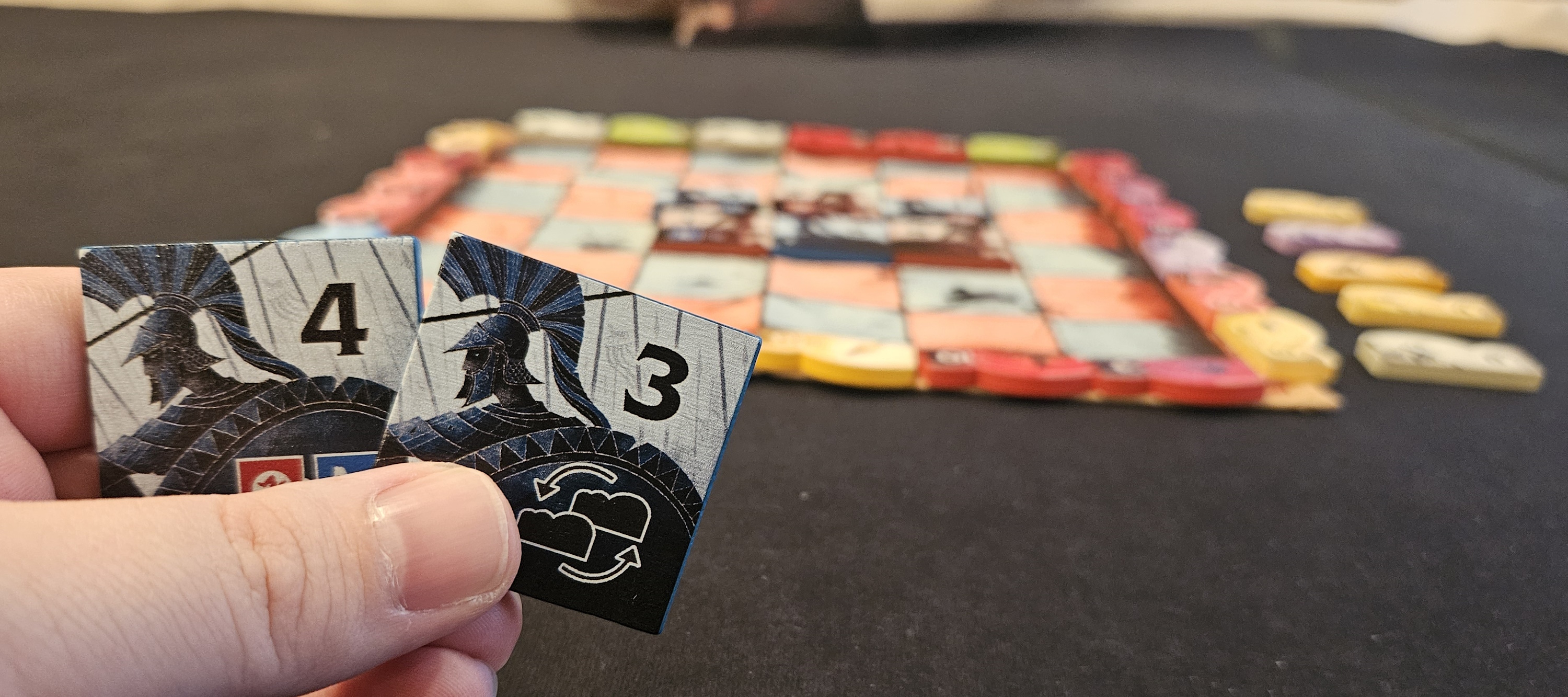
Your other warrior abilities throw what risks becoming an overly staid proceeding into glorious disarray. Some of them reposition other warriors, whether to weaken a crucial lane or bring one to a swift resolution. Your second-toughest warriors can flip themselves and a neighboring warrior face-down. That’s one heck of a sacrifice. But it’s one you’ll pay gladly not only because there are warriors who are innately stronger, but also thanks to the dolos, the final unit in your phalanx. Dolosse are a special brand of jerk who mirror the opposing warriors on either side, potentially becoming real bruisers that can dominate a lane. But this potency is contingent on careful adjacency. Cleverly, players are prompted to arrange them in central locations for maximum effect. But this makes them vulnerable to counterattack. Maybe an opposing warrior will shunt them to the edge of the battlefield, where their ability is minimized. Or maybe someone will flip them face-down. Regardless of the method, these are spring-loaded traps, sometimes powerful but often neutered.
Hmmm…
Iliad is full of little touches like that, the marks of a master who understands how to make everything matter without mattering so much that it throws the game’s delicate balance into disarray.
Take, for instance, your hand limit. Where Ichor threatened to overwhelm newcomers with its information density, Iliad only allows players to draw two tiles at any given time. You’re granted the slightest bit of wiggle room, about as much as a hoplite crammed into the middle of a spear wall. It’s a limitation that poses a risk of suffocation, especially when you draw a warrior who lets you swap scoring tiles before you’ve actually been awarded any. But there are other ways to think about it. You might, for instance, push a lane to resolve earlier than later so you can call first dibs on those juicy tiles off to the side. Or maybe it’s time to bite the bullet and find some other way to use your troops. Not every ability will trigger. Not every lane will go your way.
Indeed, that’s the centerpiece of the whole experience. Iliad is very much about picking your battles, and that’s where its tatters of thematic import can be found. There’s a word we sometimes use to describe difficult decisions in games, “agonizing,” which comes to us from the Greek. Its source word, “agon,” could be used to mean either an assembly or a contest, but both meanings were ultimately the same: a gathering for the playing of games and the holding of contests. On the whole, the ancient Greeks took their play more seriously than we do today. In the Iliad, Achilles mourns the death of Patroclus by holding funerary games; the myrmidons race chariots, throw discuses and javelins, and wrestle in the sand for prizes. As in many of our oldest stories, the play found in the Iliad was more than a diversion. It was holy.
In this representation of that text, mediated through a thousand tradents and hopping mediums until it gestures at the original through cultural familiarity alone, Knizia has crafted a series of decisions that offer some distant reflection of that seriousness. Every placement, every triggered ability, every determination of how to award the fruits of those embattled lanes — they all matter. It just so happens to be a mark in Knizia’s favor that they matter without mattering too much.
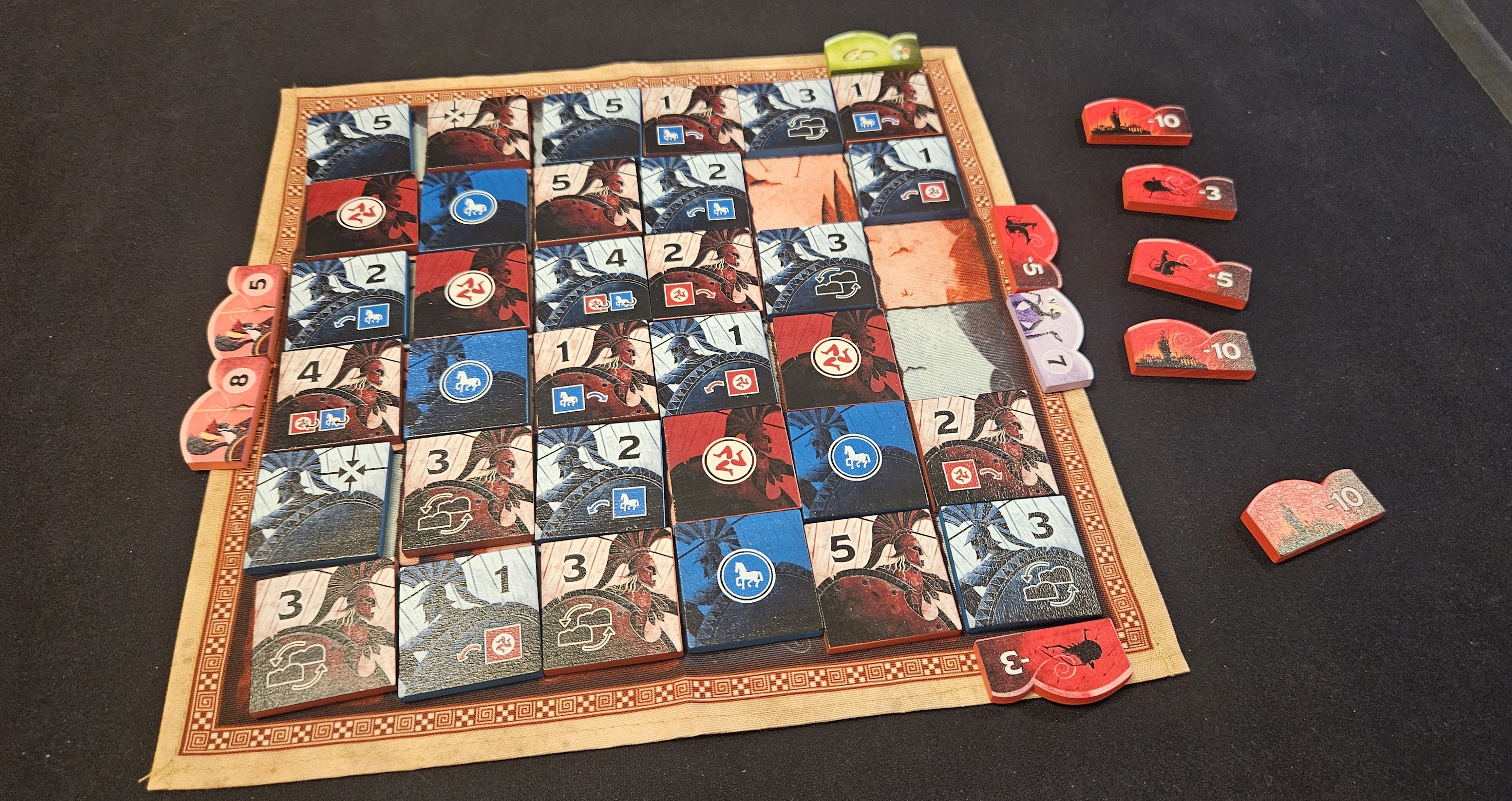
I adore how the full board resembles a Hollywood melee.
Like I wrote yesterday, I love Iliad. This is what I could call the perfect medium-weight Knizia. It’s a game that puts players through the agon, but also doesn’t make them feel like their intelligence is being judged when they don’t perform perfectly. If you’ll permit me the worst possible outro, it’s a Hellene of a good time.
Iliad is on Kickstarter today.
(If what I’m doing at Space-Biff! is valuable to you in some way, please consider dropping by my Patreon campaign or Ko-fi.)
A prototype copy was temporarily provided.
Posted on June 25, 2024, in Board Game and tagged Bitewing Games, Board Games, Iliad, Reiner Knizia. Bookmark the permalink. 5 Comments.

 SPACE-BIFF!
Thanks for doing this as-ever excellent writeup, Dan!
But….as your policy page says, I thought you don’t usually do previews for crowdfunding campaigns? Especially not when what you’ve got to work with is a prototype instead of a finished copy. How come you made an exception for Iliad and Ichor?
“Prototype” is pulling double duty right now.
There are “prototypes,” which are unfinished games made at home or printed by a local service, designed by somebody I don’t know, and often without working rules and in dire need of more development. That’s what 90% of the requests for preview coverage I receive entail. I generally don’t write about those. (But I do sometimes. As my policies page indicates, that’s a guideline rather than an ironclad rule.)
And then there are “prototypes,” games that are more or less complete, but not yet in production. I’m much more likely to write about those. The versions of Iliad and Ichor Bitewing sent me are almost identical to the copies they’ll be sending me when the game has been printed. I know that because I’ve worked with Nick quite a few times in the past and trust that he knows what he’s doing. The biggest alteration I’ve heard he’s making is that “Hercules” will be changed to “Heracles.” Not exactly a game-breaker.
This is also why I tend to write final reviews when games I’ve previewed eventually ship. Just yesterday, for example, I wrote a final review for Defenders of the Wild, which I previewed last year. In the unlikely event that Iliad and Ichor shipped in worse condition than the prototypes I based these articles on, you can believe I would make a stink about it in my final reviews.
Why write previews at all? Because I believe in the original intent of crowdfunding to create passion projects that might otherwise not exist. So I’m happy to write previews if I believe in the project. But I want to keep them to a minimum. Around one a month is my soft cap. I decline northward of a hundred prototype offers per year. In some cases, a designer’s pitch will be solid enough that I’ll accept a prototype, play it, and still find that it doesn’t suit the level of quality I want to highlight on my site. In those cases, I decline coverage and ship the prototype back to the designer. Just last week, I returned two such games.
In other words, this process is anything but flippant. I’m just some dude with a blog, but I take my recommendations seriously.
Wow, thanks for the very detailed reply! I thought this might be the reason.
Seems like, in the course of explaining it’s a preview, you might want to put in a sentence about why you think it was worth previewing.
And it may also be worth saying in your policies that you preview only about 10% of offered prototypes, to emphasize that the quality bar is that high.
BTW your reviews of Iliad and Ichor did in the end help tip me toward backing the Kickstarter. 🙂
Pingback: Godblood | SPACE-BIFF!
Pingback: Let Me Not Then Die Ingloriously | SPACE-BIFF!