Godblood
There’s a hallmark to a great Reiner Knizia game. When learning the thing, you say, “That’s it?” Five minutes into your first session, you go, “Oh, that’s it.” What initially seemed too simple is revealed as a bottomless puddle, a glassy mirror that belies the fathoms lurking below the surface.
Ichor is one of two Knizias forthcoming from Bitewing Games. It’s a reimagining of an earlier Knizia title, Clinch, which appeared in Spielbox Magazine in 1993 and was produced as the abstract game Tiku. In 2009 it received an upgrade in the form of Battle for Olympus. Ichor follows closely on the heels of that game, but with a series of adjustments and improvements that make it an absolute python on the battlefield. No, not the snake python. The dragon Python.
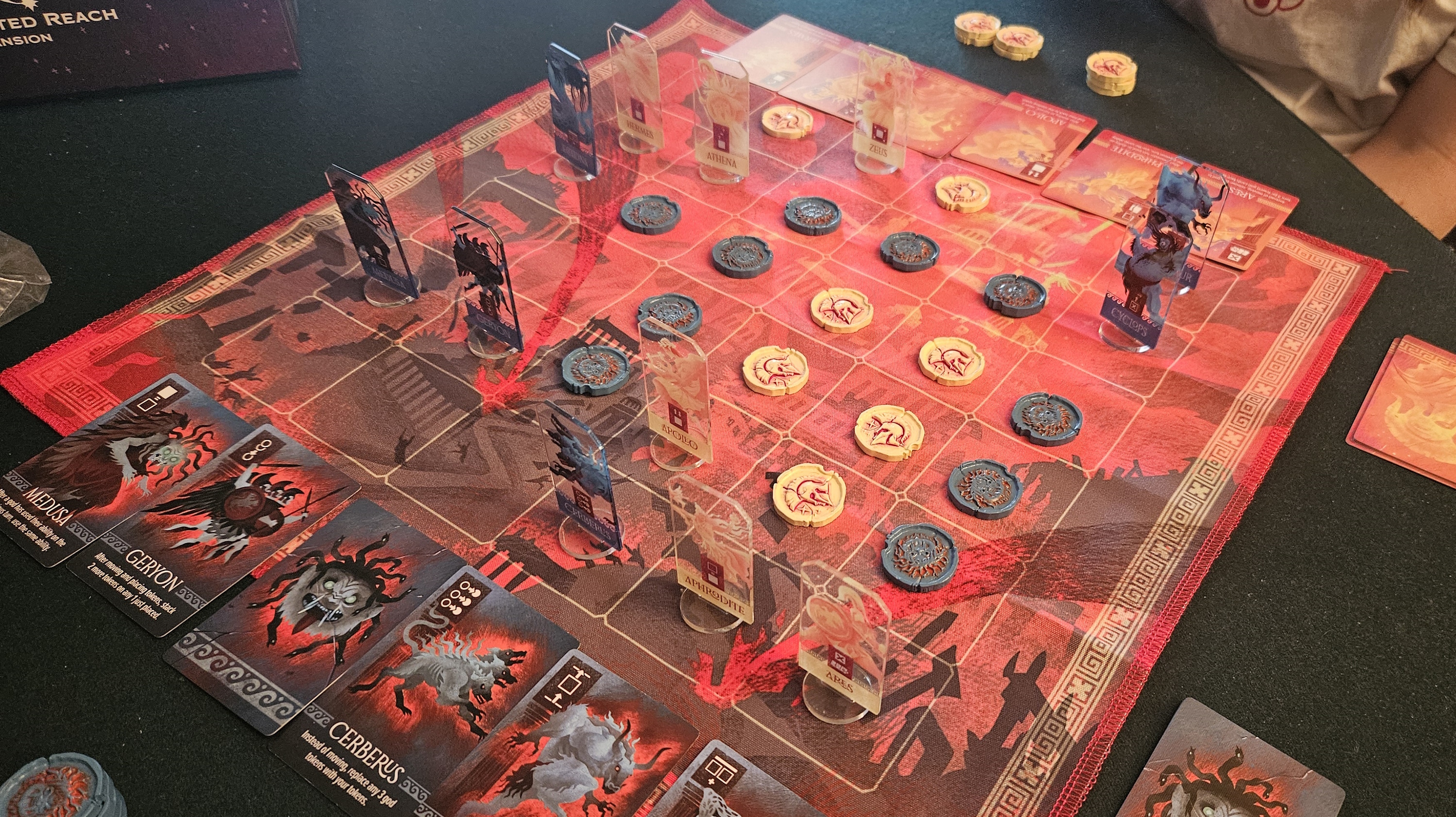
Storming Olympus.
We need to start with the rudiments, because even at its most basic there’s an assuredness to Ichor that manifests as a game you would swear you’ve played before. Like mancala or checkers, it feels like a game dredged from our primeval past, as though it should be played with cowrie shells on a grid drawn in the sand.
It works like this. There are two sides arrayed against each other on a six-by-six board. Each team’s pieces stand in a line on their second row — where the pawns would go in chess. Every piece’s move is identical: it can slide in any orthogonal direction as far as it likes until halted by the edge of the board or another piece. Unobstructed, a piece could glide from one side of the board to the other.
Here’s the big departure from checkers. Rather than capturing opposing pieces, moving a piece deposits counters along its path, one for each space it exits. Like the pieces themselves, these counters come in either your color or your opponent’s. You’re washing the board in your color one long slash at a time.
Naturally, your opponent is painting the same masterwork. Any time they move over one of your counters, they replace it with one of theirs. This is the game’s central conundrum. Both sides have the same sweeping maneuver at their fingertips. Both sides have fourteen counters. It’s a race to be the first to place them all on the board.
That alone is the basis of Clinch and Tiku. It’s sparse but undeniably clever. Within only a few opening moves, the board becomes a tangle of considered lanes, everyone’s position jammed not only by opposing pieces but also by the ongoing considerations of where new counters can be added or replaced. Moving along an empty row is tempting, letting you sow an entire furrow with your counters. Often, it’s more beneficial to maneuver tactically, subtracting a few opposing pieces to instead push your rival a little further from achieving their goal.
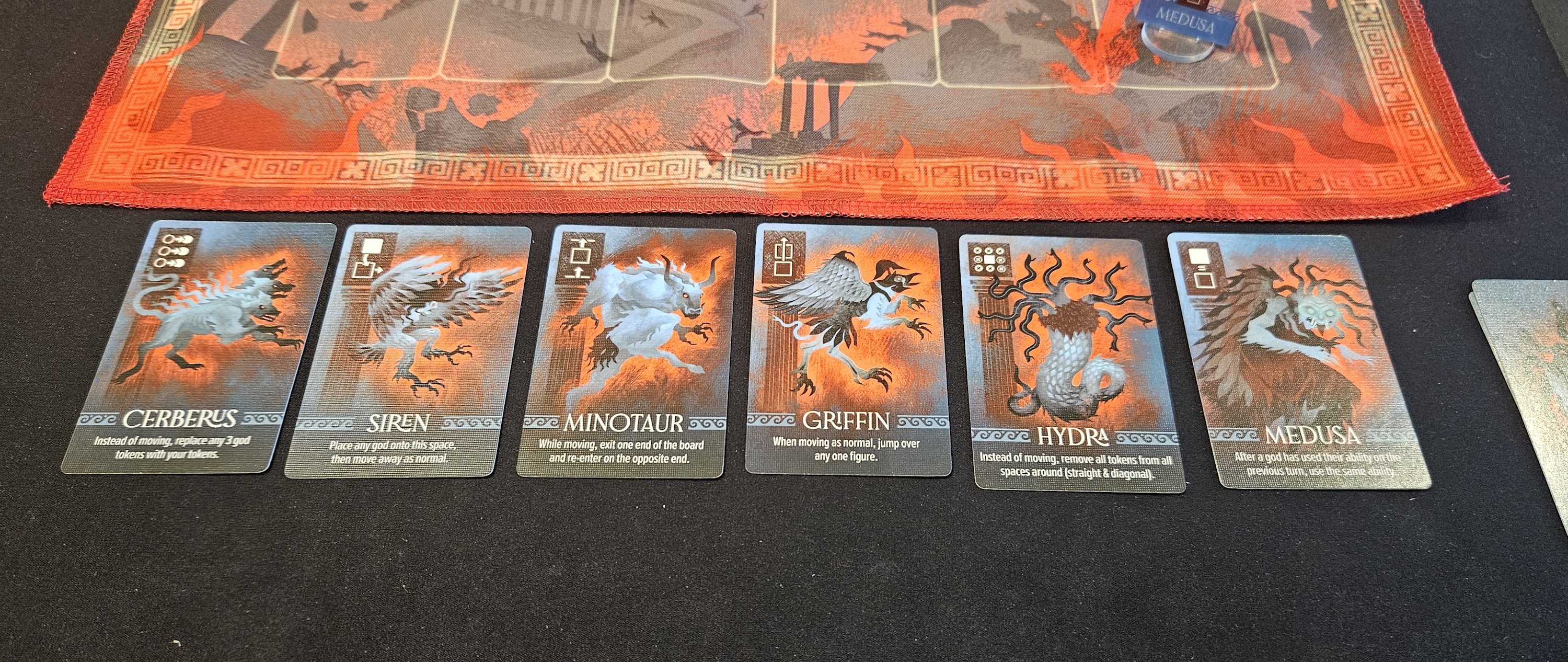
Each side fields a random assortment of gods or monsters.
What Battle for Olympus added — and which Ichor perfects — is a bunch of special powers for each side’s pieces. Rather than moving, you may activate one of these special abilities. To a one, these are all game-changers. The Hydra strips all tokens from every space around it. The Griffin leaps over a single figure as it moves, bypassing the enemy’s defenses. The Centaur slides diagonally. Artemis goes out in a blaze of glory, sacrificing herself to slay one of the monsters storming Olympus. Apollo dashes forward only to zip back to his starting space, defending his newly-seeded lane from retaliation. Heracles pushes an obstructing monster out of the way, gliding across the board in a dance of muscle and bone.
Of course, there is one major limitation to consider. Each of these abilities can only be used once. Upon being deployed, that god’s or monster’s ability card is flipped face-down. It will never appear again. Unless, that is, Medusa copies that ability on the next turn. Or Ares burns himself up to renew three of your powers.
Still. You get the idea. These bursts of power are singular. They alter the battlefield and then abate, leaving their user permanently diminished.
Which is a big deal given how often these powers function as potential game-enders. The Geryon, a monster with the power to stack two additional counters atop one it just placed, can potentially bring the game to a sudden conclusion even if it doesn’t move all that far. Hephaestus can pile a second layer of counters over those you’ve already placed, potentially doubling up an entire lane. The same goes for any number of other units. This transforms Ichor into a series of difficult choices. Each and every one of your divine creatures risks tipping the contest in your opponent’s favor by stripping themselves of some all-important ability three or ten turns down the road.
Along the way, Ichor becomes painfully thinky. At times, it’s almost too much. Every detail is laid bare. Your abilities are on full display. So are those of your opponent. Together, each turn risks unspooling into a tangle of hypothetical moves. Anyone who balks at long, speculative turns should stay away.
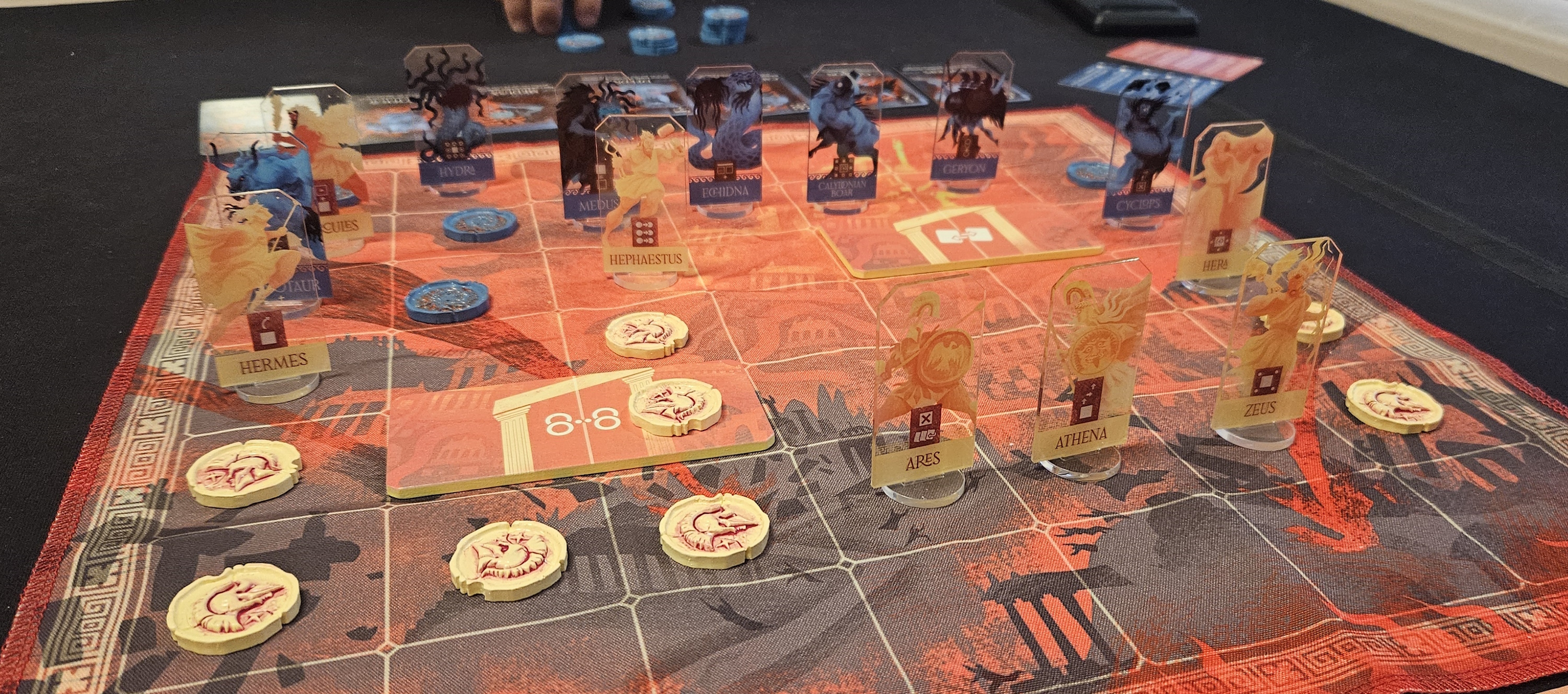
Gates are interesting, but may notch up the complexity too much.
Ichor rewards contemplation. There’s nothing quite like unleashing a unit’s power such that it catches not only your opponent by surprise, but also yourself. More than once, I’ve been left blinking down at the board, confounded that I didn’t see a particular move in advance. In those moments, Ichor inches closer to becoming a sport, something two warring superpowers would train their geniuses to play on neutral ground.
Like a sport, fairness is crucial to Ichor. A full session requires two matches, one as the monsters and one as the gods, with the sides flipped and mirrored. Your goal isn’t only to win, it’s to win with a bunch of counters still in your opponent’s hand. This establishes your score, a threshold your opponent now needs to overcome while occupying the same setup that favored you in the first match. This goes a long way toward offsetting any vagary of the randomized setup, any first- or second-player advantage, or any early unfamiliarity with the units. At its best, the second match now allows both players to preempt the moves that favored them the first time around. In one sense, you’re replaying the earlier contest, with the exact same roster your opponent fielded and with an intimate knowledge of their strengths and weak points.
That said, it can be exhausting. Ichor has a tendency to stick around for a while. This isn’t a long game, but two matches played back-to-back can feel like a lot to tackle. It’s the slightest flicker of how chess champions can slip into a stamina deficit in a tournament. More than once, I’ve stared down at the board’s mess of units and counters, my brain still fuzzed over from parsing through a dozen conflicting maneuvers, and said, “You know what? I think one match is enough for tonight.”
That’s only compounded by some of the game’s optional variants. There are four in all, and while I appreciate the addition of a few extra gods and monsters, and don’t mind playing on a slightly larger board with a higher counter pool, I care less for the victory units that unlock a new way to win. My problem with them isn’t so much that they permit new approaches — that’s fine — but that those approaches are so difficult that I’d frankly rather just field an ordinary unit and try to fill the board with counters. The same goes for the gates, little obstacles that prevent easy movement but can be moved through to trigger special advantages, such as stacking additional counters or transforming your monster into a new form. These don’t wreck the game, but they’re an unnecessary complicating factor, like insisting footballers also bypass sand traps on the pitch.
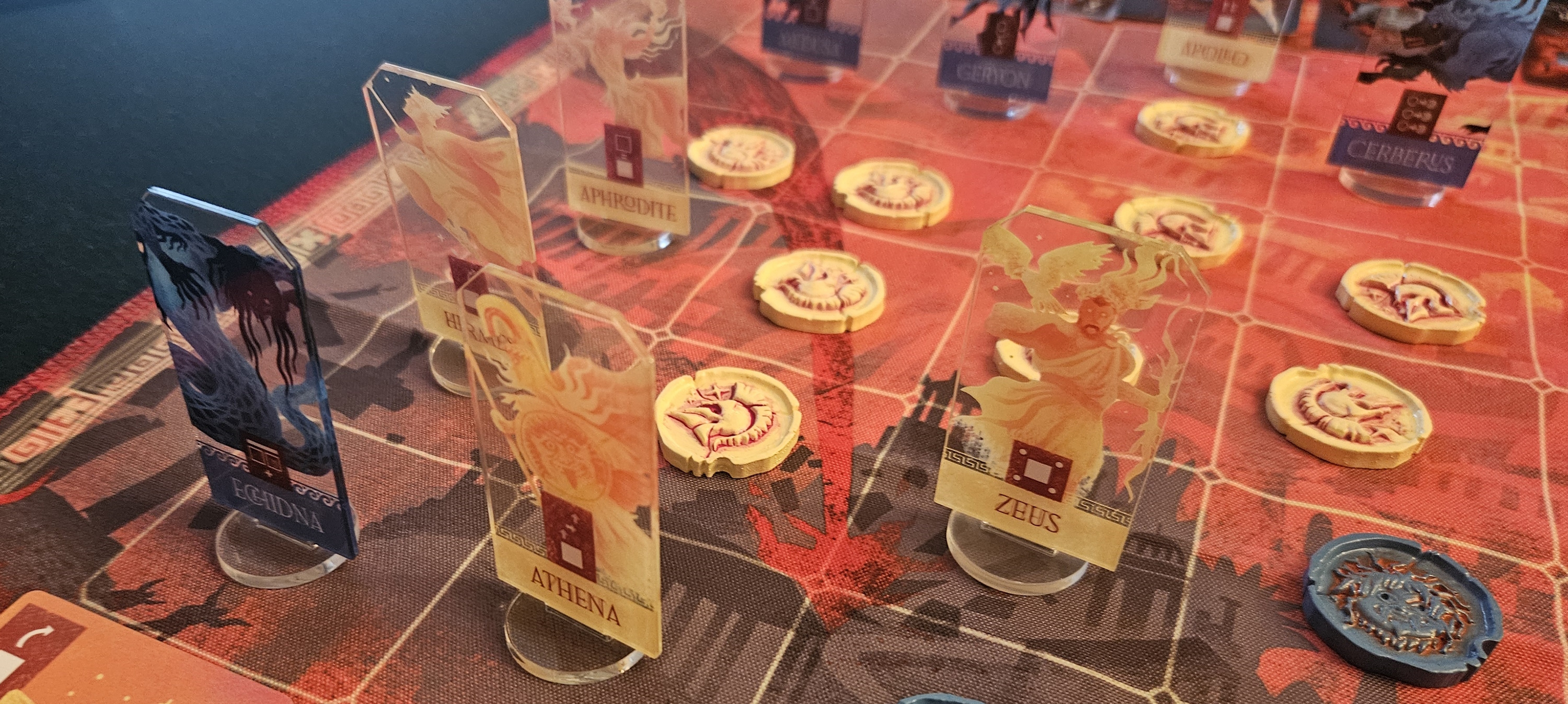
Cornering the Mother of Monsters.
To be clear, these are unnecessary because the core game is already as full as it needs to be. When it settles into a groove, Ichor is wonderfully competitive. Like a phalanx battle, it’s a shoving match, a contest of probing for weaknesses or weakening flanks.
Recent uses of the word have narrowed its meaning to something more squamous, but “ichor” was the vital fluid that coursed through the veins of the gods. Hence the word “petrichor,” the earth-essence that arises from soil drenched by rain. Reiner Knizia’s Ichor is indeed a divine thing, strenuous in its elevation, potentially out of reach for mere mortals such as myself, but also offering a gripping and fierce contest. I want to play it again right now.
Tomorrow, we’ll be looking at the second forthcoming Knizie game, Iliad. And here’s a taste for you: while I like Ichor a lot, I absolutely love Iliad.
Ichor will be on Kickstarter tomorrow.
(If what I’m doing at Space-Biff! is valuable to you in some way, please consider dropping by my Patreon campaign or Ko-fi.)
A prototype copy was temporarily provided.
Posted on June 24, 2024, in Board Game and tagged Bitewing Games, Board Games, Ichor, Reiner Knizia. Bookmark the permalink. 20 Comments.

 SPACE-BIFF!
Sounds wonderful. Need to keep an eye open for the Kickstarter. Thank you for a great review and a great read as always.
Have you tried out Bestiary of Sigillum? It came from nowhere and is now on it the most interesting games I’ve played this year. It’s an MOBA style area control game, where you need to whittle down your opponents castle by controlling locations on the map or destroying their units. There is no upgrades for the units and the game is deterministic strategy with all information open. It’s amazing especially as a two player duel. I think I will incorporate that rule about a complete gaming requiring two games with the same units, sides flipped and mirrored.
I haven’t even heard of Bestiary of Sigillum! It sure looks nifty. Maybe I’ll see if I can give it a try at some point. Thanks for the recommendation!
There was a failed and cancelled Kickstarter, but they decided to release the game as a Collector’s edition with everything included as they had planned for the KS. It should be available on European retailers for sure and on Amazon I think.
I join my voice to yours: Bestiary of Sigillum is, in my opinion, a very impressive two-player duel, and the best I’ve played since Riftforce.
I was drawn to it by the art style but the gameplay won me over. Sure, its generosity makes the drafting of a team seemingly extenuous, but there are ways around it and playing two or three games back-to-back (we usually consider the first match a training one) makes for an extremely entertaining evening.
FINE. I’ll order a copy.
😉
RIP my wallet. At least Bitewing’s games are pretty inexpensive
Yeah. Sorry. If you like Knizia and 2p titles, these are strong contenders. Otherwise, they might not be good fits.
”Ichor is one of two Knizias forthcoming from Bitewing Games. It’s a reimagining of an earlier Knizia title, Clinch, which appeared in Spielbox Magazine in 1993 and was produced as the abstract game Tiku. In 2009 it received an upgrade in the form of Battle for Olympus.”
That’s the most Renier Knizia thing I’ve ever read.
Thanks for the review! Would you say this game gave you a somewhat similar feel than Tash Kalar but with fully open information? I mean both games feature special abilities and a small board, so they might scratch the same itch (although I realize they are very different).
Not really? I think I understand what you’re saying (including the nod to them being so different!) but I didn’t get that sense.
Or maybe it’s just been too long since I played some Tash-Kalar.
Hope you give it a try. Based solely on this comment section, I ended up checking out the game and buying a copy. Still enjoying it!
I played it ages ago! I think I even reviewed it at the time. For a while it made regular appearances on my table. Very good game.
Thanks for doing this as-ever excellent writeup, Dan!
But….as your policy page says, I thought you don’t usually do previews for crowdfunding campaigns? Especially not when what you’ve got to work with is a prototype instead of a finished copy. How come you made an exception for Iliad and Ichor?
“Prototype” is pulling double duty right now.
There are “prototypes,” which are unfinished games made at home or printed by a local service, designed by somebody I don’t know, and often without working rules and in dire need of more development. That’s what 90% of the requests for preview coverage I receive entail. I generally don’t write about those. (But I do sometimes. As my policies page indicates, that’s a guideline rather than an ironclad rule.)
And then there are “prototypes,” games that are more or less complete, but not yet in production. I’m much more likely to write about those. The versions of Iliad and Ichor Bitewing sent me are almost identical to the copies they’ll be sending me when the game has been printed. I know that because I’ve worked with Nick quite a few times in the past and trust that he knows what he’s doing. The biggest alteration I’ve heard he’s making is that “Hercules” will be changed to “Heracles.” Not exactly a game-breaker.
This is also why I tend to write final reviews when games I’ve previewed eventually ship. Just yesterday, for example, I wrote a final review for Defenders of the Wild, which I previewed last year. In the unlikely event that Iliad and Ichor shipped in worse condition than the prototypes I based these articles on, you can believe I would make a stink about it in my final reviews.
Why write previews at all? Because I believe in the original intent of crowdfunding to create passion projects that might otherwise not exist. So I’m happy to write previews if I believe in the project. But I want to keep them to a minimum. Around one a month is my soft cap. I decline northward of a hundred prototype offers per year. In some cases, a designer’s pitch will be solid enough that I’ll accept a prototype, play it, and still find that it doesn’t suit the level of quality I want to highlight on my site. In those cases, I decline coverage and ship the prototype back to the designer. Just last week, I returned two such games.
In other words, this process is anything but flippant. I’m just some dude with a blog, but I take my recommendations seriously.
Again, thanks! I put a full reply in the Iliad comment thread.
“The same goes for the gates, little obstacles that prevent easy movement but can be moved through to trigger special advantages”
By obstacle, are you referring to the fact that a moving figure can’t stop on the 2 spaces that are part of a gate tile?
By my reading of the rules PDF currently up on the Kickstarter page, you can still move over those spaces, either vertically (like regular spaces, including dropping a token), or horizontally (also like regular spaces, except that it also triggers the gate’s power).
Yes, you can move over those spaces. But not being able to land on them is a huge limitation. A rival can park one of their pieces behind it; that prevents you from moving up to them. They’re much harder to deal with than they sound on paper.
Pingback: Agon-izing | SPACE-BIFF!
Pingback: 5 on Friday 28/06/24 – No Rerolls
Pingback: She’s a Grisly Monster, I Assure You | SPACE-BIFF!