Everything Minus the Zamboni

I had no idea what to expect going into the second edition of Trick Shot. Not only because I don’t know the first thing about hockey, but also because I was operating under the assumption that it was a dexterity game.
Here’s the good news: Trick Shot may not let me hurl around a puck by flicking it with a tiny hockey stick, but it doesn’t need to. Designed by Artyom Nichipurov, creator of the stellar Guards of Atlantis, this is even better than my assumptions led me to expect.

Find the puck.
Okay. Hockey. I’ve been to exactly two hockey games in my entire life. The first was during the 2002 Winter Olympics. In spite of what my parents promised, nobody threw a single punch. The players were graceful and professional. Mostly I caught up on reading Huckleberry Finn for my English class. The second was in rural Montana. The rink was smaller and dirtier. A trickle of piss ran out of the men’s washroom. The players whaled on one another at the slightest provocation. Someone chucked an empty water bottle onto the ice, which prompted a tussle with the rink staff.
It was glorious.
Perhaps the best compliment I can pay Trick Shot is that it snaps the latter portrait more than the first. There is some element of the former grace, to be sure. Players glide effortlessly across the ice, moving in frictionless straight lines and only redirecting their velocity with great effort. But this is closer to a brawl than figure skating. This is a rough sport, with fouls and fisticuffs and bodies slamming other bodies out of their path. The only thing missing is the missing teeth. And the ice resurfacer, come to think of it.
Your objective is as obvious as could be. You score points by thwacking the puck into the opposing goal. It’s everything else that’s hard. Trick Shot, you see, is a dice game. Every action requires a roll. Bashing into another player, obviously. Poking the puck away from a burlier player. Making a long-distance slap shot. But even the simpler actions require a roll. An unobstructed pass. Gliding from one point to another. Tapping the puck onto clear ice.

High drama.
It’s how these rolls are handled that makes the game so gripping. When your turn starts, you only roll a single die. The dice are reasonable. Only one face denotes failure. A second face allows your opponent to make a reaction move. The rest don’t interrupt your turn in any way. So the odds are in your favor. Tipping them even further, your team’s stamina allows a handful of rerolls.
So you make a move. You roll. If you flub that roll, you roll again. Everything is hunky-dory.
Except every subsequent action adds a die to your pool. Now you’re rolling two of the things. Still not bad. Failure is an outside chance. So you pass the puck between players. Now you’re rolling three dice. You blitz a player out into a viable position to receive the puck. Four dice. The pass fails. This would turn the action over to your opponent and maybe overshoot onto bare ice. You spend another portion of your team’s stamina for a reroll, succeeding at the pass but letting the other team make a reaction move. They shift their goalie to block your shot. Fine. Five dice. You slide a wingman into a wide angle. He has a clear shot but needs the puck. Six dice.
Around this point, a problem presents itself. You’ve spent two of your three rerolls. Should you end your turn now, recharging your stamina but letting your opponent go, or press your luck to pass and then shoot? Your crucial players have broken away from the opposition. Maybe they won’t be able to swipe the puck on their next turn. Even if they do, you’re in the superior position to retrieve it and make a shot. Then again, a whole lot can happen in only a few moves. Passing and shooting on six and seven dice is risky, and might result in a forced turnover. Then your opponent would get a turn and — this is the bad part — your stamina would remain depleted.
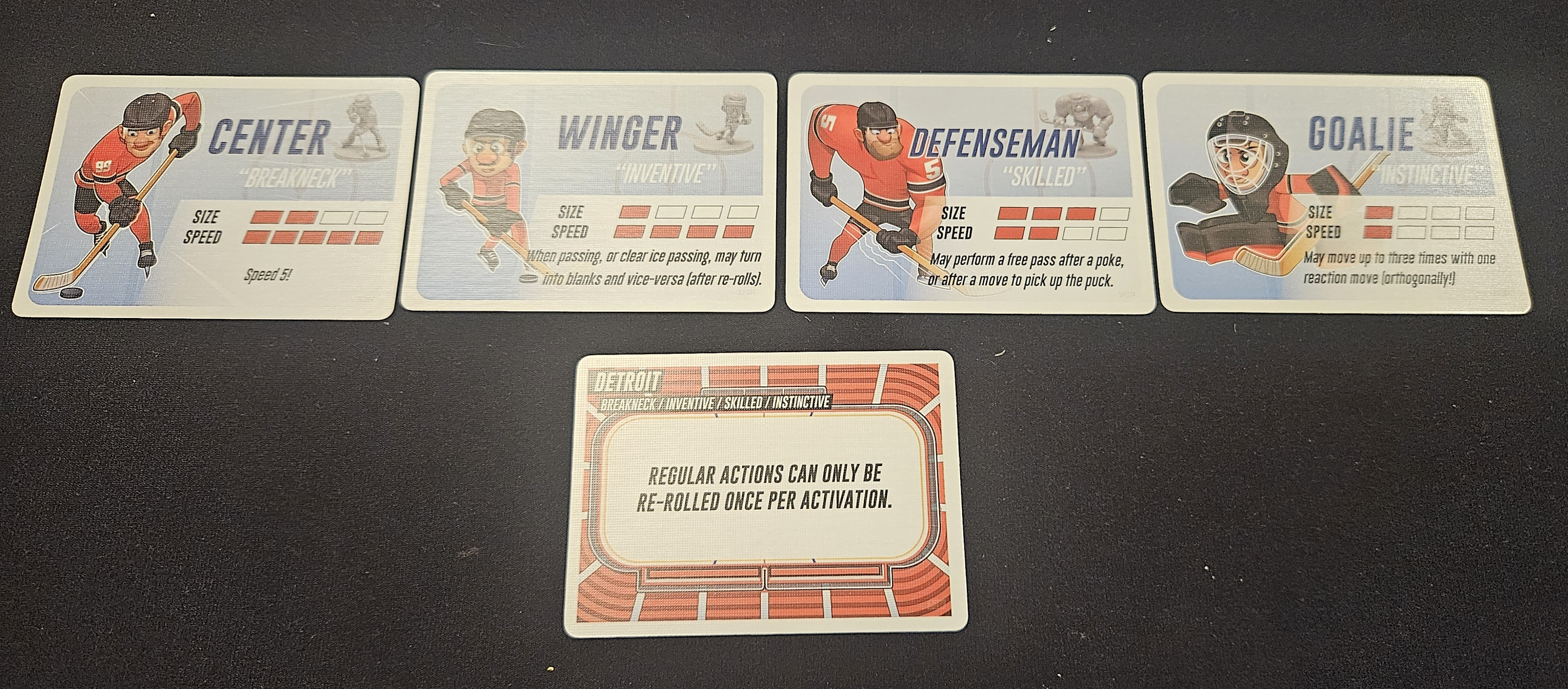
Each team has their own spread of abilities.
Trick Shot thrives on these questions. I can’t speak to whether it faithfully invokes the sport it’s based on, but as a dice game it’s sublime. Everything is kinetic, physical, in a way that methods of resolution simply couldn’t accomplish. The dice imbue every action with high drama, spoken via the possibility of failure. Even a simple move could result in somebody face-planting onto the ice. Other actions are labeled “difficult,” such as slamming somebody out of the way or making a slap shot. These don’t permit any rerolls at all, forcing players into a confrontation with both the game’s physical space and mathematical probability. Some actions may even result in a brawl between players, potentially tossing somebody into the penalty box.
There are hiccups along the way. In the game’s effort to recreate its parent sport, certain rules are somewhat fiddlier than they might have been. There are off-sides rules, of course, and as in the real world I’m not persuaded anybody fully understands them. You can pull your goalie to add a swifter player to the ice and (more usefully) recharge your stamina, but I haven’t yet seen this pulled off to much effect.
The bigger issue is the static nature of the rink itself, perhaps a limitation of the board game format more than anything. Because you’re limited to activating a single player at a time, this leads to natural situations where your activations bounce between two players, maybe three at the most, rather than employing your entire team. Most offensive pushes are limited, with most players remaining clustered near their starting positions rather than hustling to press or defend. Nor does there seem to be much use for the end boards behind the goal. There simply aren’t enough activations in a session to permit everyone to move around much.
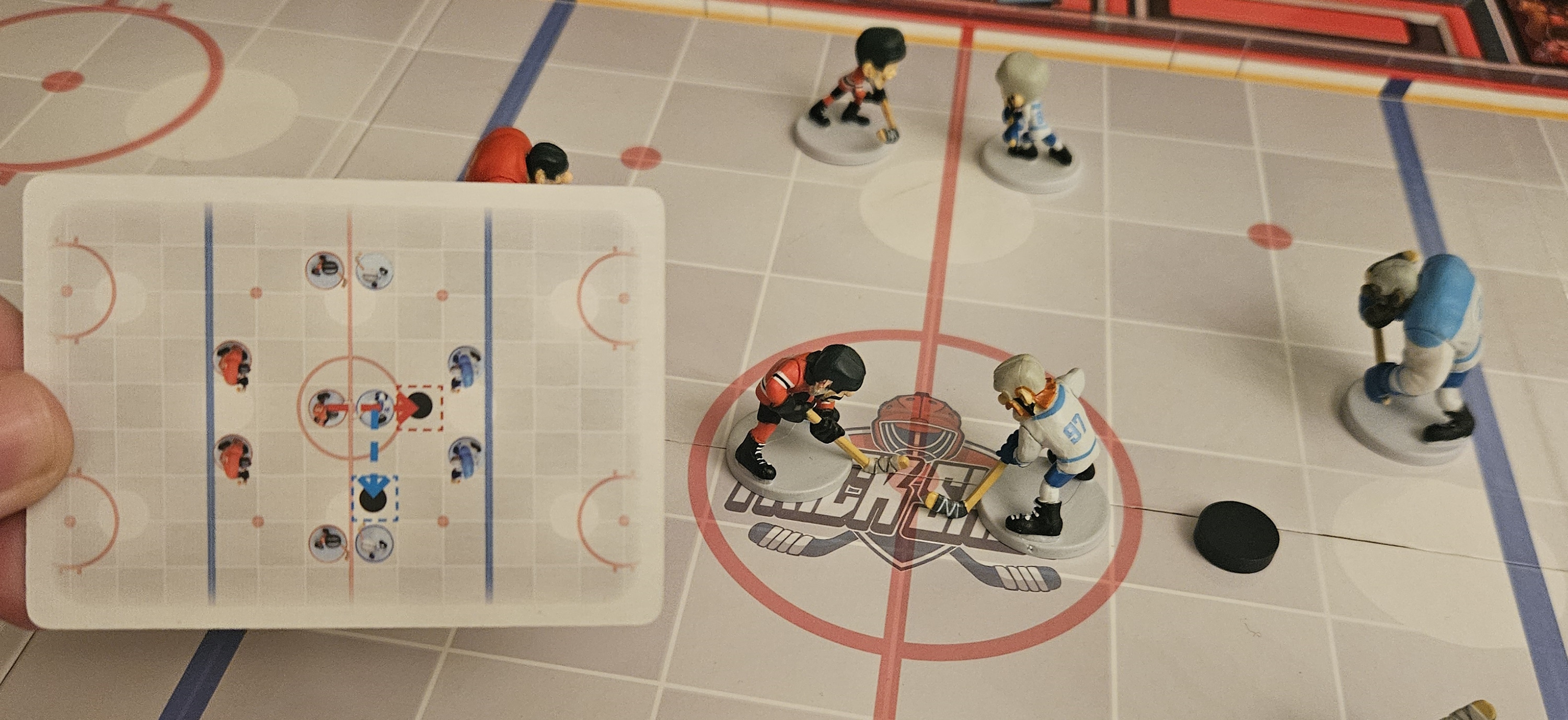
The second edition’s face-off cards add variety to the opening moves.
Although I haven’t played the first edition, Nichipurov’s second go at the system addresses this pokiness in at least one way. There are now optional cards that add some dynamism to each face-off. Rather than letting the roll award control of the puck to one center or the other, now it’s hurled free of the players and onto the ice. This mixes up the starting position, egging players into more interesting maneuvers right from the get-go.
On the whole, these reservations are just that — reservations. As a dice game, Trick Shot understands why dice are one of humanity’s oldest and most revisited components of play. I have yet to see a session of Trick Shot that hasn’t reached elevated emotions. It’s a game that generates elation, frustration, swear words both positive and accusatory. It’s a game of playing your angles, both spatially and mathematically, and then rolling with your punches when those angles don’t fall the way you’d prefer.
As odd as it may sound, the emotional heights of Trick Shot are reminiscent of those in Nichipurov’s Guards of Atlantis. These games couldn’t be more different. Guards of Atlantis is a team game best played with four or six people, with deterministic combat and a deep roster of complementing champions. By contrast, Trick Shot is best with only two, revels in its volatile rolls, and sets up in a jiff.
But they both tug at similar strings. These are games that succeed precisely because Nichipurov understands how to play on particular emotions. Big swings. Driving offensives and stubborn defenses. Careful positioning. Revelations that let friends shout at one another. Whether these emotions arise because your team has improbably collaborated to drive the enemy out of a defensive position or because the dice have allowed you to sweep across the blue line and make a last-minute shot, they’re present and accounted for in both titles.
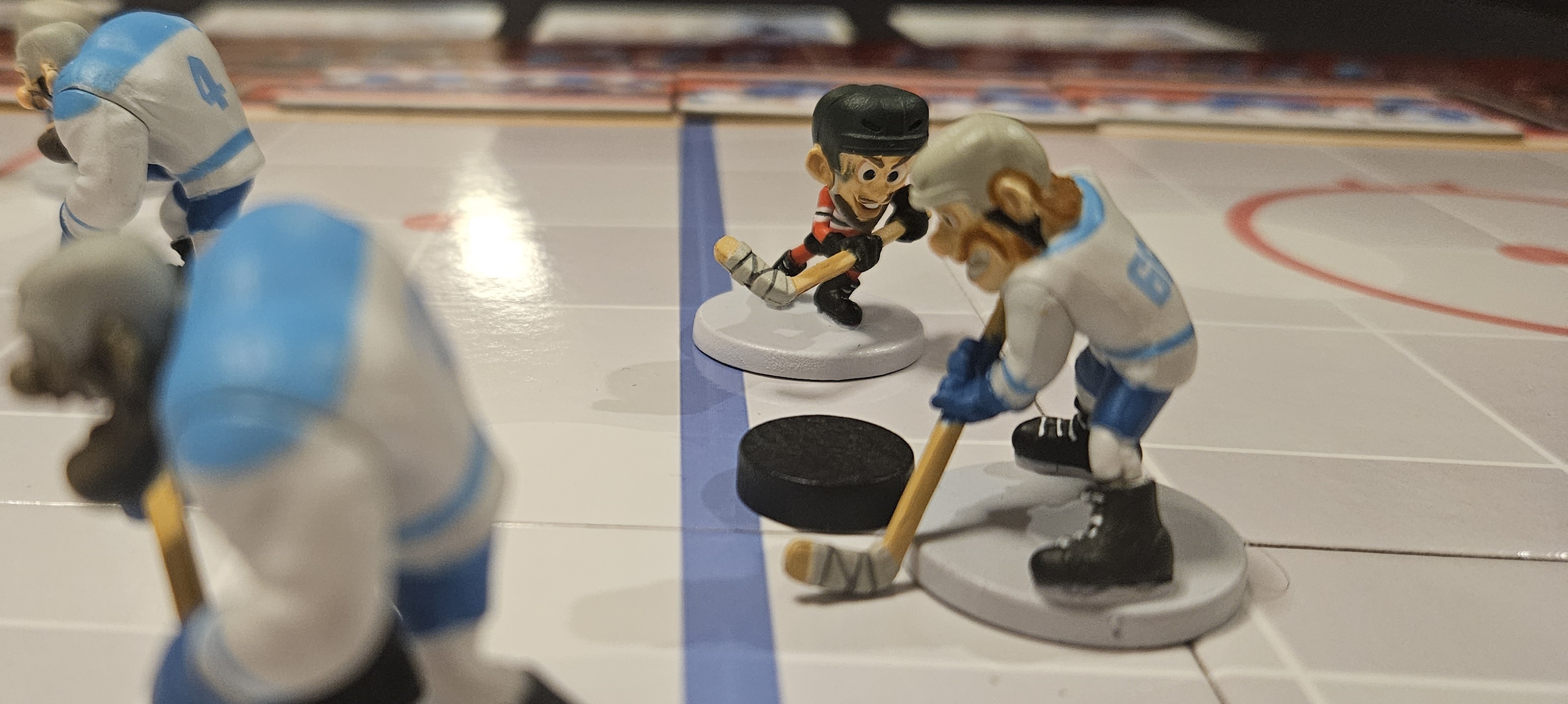
Not many games provide so many good action shots.
It’s possible that I’ll tire of Trick Shot in a way that hasn’t happened for Guards of Atlantis. By design, this is a smaller game, with less of a footprint and fewer considerations.
But that’s also what makes Trick Shot so immediate. Where Guards of Atlantis is a multiple-course meal, Trick Shot still provides takeaway from a fairly upscale restaurant. For now, I’m loving my time with it. There’s nothing quite like slipping into a groove and scoring a 4-0 blackout against your gaming bud. This is how you roll dice.
(If what I’m doing at Space-Biff! is valuable to you in some way, please consider dropping by my Patreon campaign or Ko-fi.)
A complimentary copy was provided.
Posted on March 5, 2024, in Board Game and tagged Board Games, Trick Shot, Wolff Designa. Bookmark the permalink. 16 Comments.

 SPACE-BIFF!
Glad you enjoyed it. I’ve been a rabid hockey fan for over 30 years and Trick Shot does and outstanding job of recreating the sport in a board game format. The best part it does it in an approachable and extremely fun way rather than a simulation with a bunch of charts trying to emulate everything the sport has to offer. Best sports game ever made in my personal opinion.
High praise!
“There’s nothing quite like slipping into a groove and scoring a 4-0 blackout against your gaming bud”. That’s what sold me to this title.
Does the game offer any continuity between games? It would be neat to play out a tournament or a season or something.
And is there a lot of variety in the hockey player stats? I can imagine it could be fun to build up a nice roster.
Sorry, nothing like that. The current incarnation (the second edition) covers a single match. It isn’t a team manager in any way. Different teams will have varying stats, but they tend to cluster: wingers are fast, centers are all-rounders, defenders are burly, etc. Moreover, rather than giving every player a set of stats, each position has stats. So my wingers will be different from your wingers, but not different from each other. This is a low-complexity game in that regard.
There are enough cards that you could assign each player a unique ability if you want to. I tried it, but like the designer said, it just became to burdensome and slowed the game down way too much. It works and plays a lot better with them assigned to the general positions.
One of the great things about Trick Shot is how easy it is to incorporate tweaks and house rules if you want to. As to the continuity between games, that’s something a lot of people would like so maybe that’s something we’ll see in an expansion, hopefully? I’m planning to make some things like a playoff bracket and release it at some point.
Thank you! 🙂
And thank you for designing a game that made me care more about hockey!
Dan, you need to experience a real NHL game at some point. Is Denver or Vegas the closest to you? Good news is that both of those teams are really good right now.
Las Vegas is closer by about two hours. I can get there in a rough afternoon, basically, whereas Denver would require the majority of a day. I’ve headed down there for the weekend once or twice, although it’s been a long time.
How dare you review a game that I cannot immediately buy!
Good news, though: there will be copies available later this month on the Wolff Designa website.
The pressing of luck and the risk of turnover remind me slightly of a game of Blood Bowl. That game nearly ruined some friendships over dice rolls.
Though I feel this game does have some things in common with Blood Bowl. It doesn’t elicit the rage and frustration that Blood Bowl does, at least to me, and I like Blood Bowl. Blood Bowl is all about risk mitigation where Trick Shot leans more towards pushing your luck, deciding when to take risks and managing your stamina. The feel in Trick Shot is that you’re in control. The feel in Blood Bowl is that the dice are in control.
Yeah, I’m trying to sort out my feelings between the two. I definitely prefer Trick Shot, although maybe that’s my allergy to painting miniatures speaking. But as dice games go, I don’t get angry in Trick Shot the way I get angry in Blood Bowl.
Pingback: Job in Sparta | SPACE-BIFF!