Wingnut Spanner

Brett Sobol and Seth Van Orden seem to have enjoyed Wingspan. Or maybe they didn’t, and that’s how Raising Robots came to resemble Wingspan with the action selection system from Race for the Galaxy. So it goes. Board games are more often about recombination and iteration than they are about innovation. Raising Robots iterates by adding as many icons as possible.
That’s unfair. It also innovates by making me worry about free will.
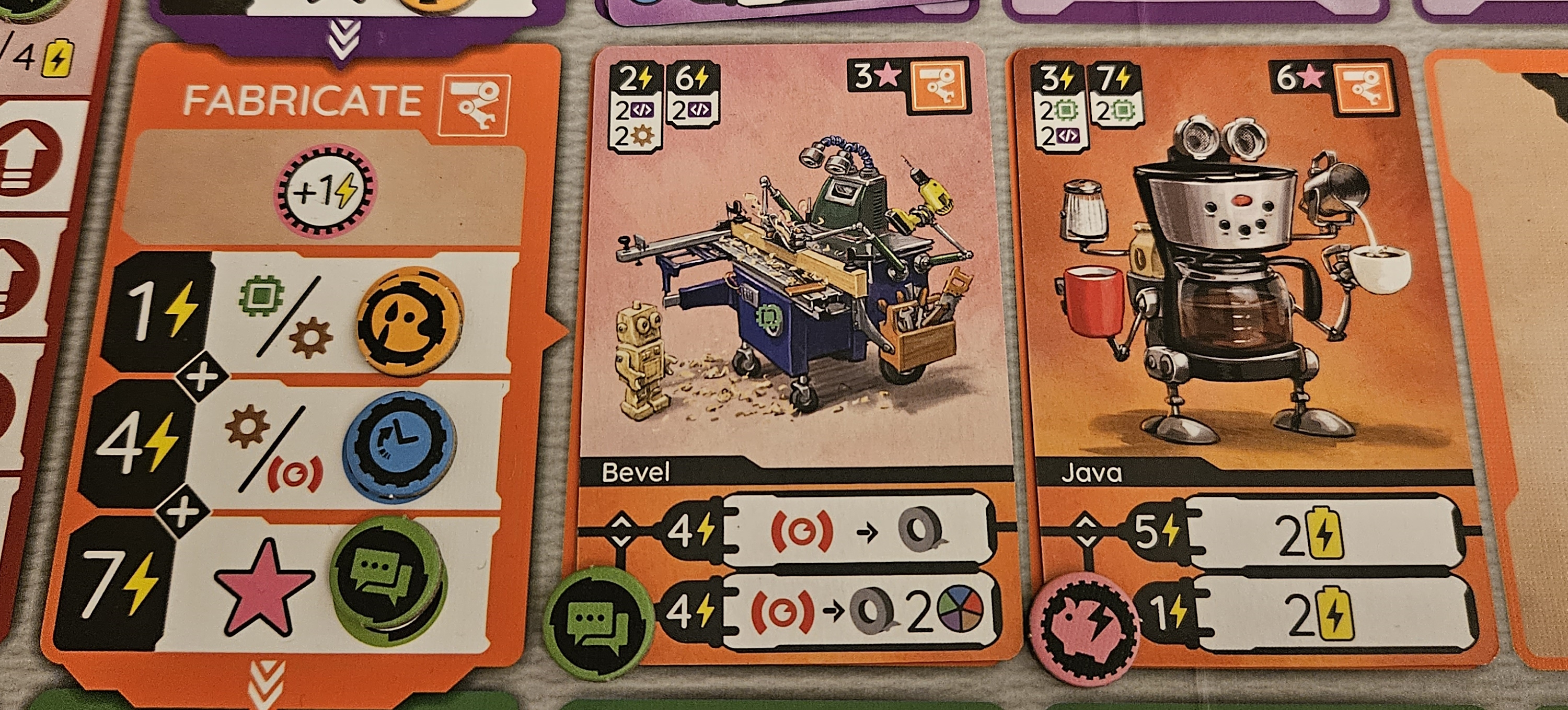
Icons! We’ve got ’em!
Casting players as a pack of youthful inventors, Raising Robots confirms what it says on the box. You are indeed raising robots.
These automatons are adorable expressions of their appointed tasks, cutesy designations and all. There’s Oz, pulling back the curtains to perform a puppet show; Cheers, with his foam #1 fan mitt and T-shirt cannon; the fisherbot Jonah. One wonders if this lord-bondsman dialectic is deliberate or only chilling by accident. Will Crisper ever be anything more than a refrigerator on wheels? Does Glaze have the capacity to tire of the potter’s wheel built into his stomach like a beer gut? One such creation, Selfie, is a robot that snaps selfies. Of itself. Can we hold Selfie accountable for its vanity, or is this an unfortunate hand-me-down from its human creator? Over the course of the Hebrew Bible, we observe the development of God from a fickle overlord who implants wicked suggestions into the minds of those he intends to destroy to a tamed deity who blames the bad stuff on the devil. Is the creator to blame for the limitations they embed in their creation?
Pardon my navel-gazing, but these are the paths I find myself walking while playing Raising Robots. This is partially my fault — I am me, after all — and partially because Raising Robots sometimes trudges. In this regard it improves upon Wingspan, which also suffered from leaden tendencies, by compressing the action into simultaneity. It consequently moves faster than its predecessor, especially at higher player counts, although the need to constantly pause and ask “Is everybody ready to move on?” provides an ample window for wondering how fantasists of general artificial intelligence can stomach the idea of crafting a hyper-capable being that is nonetheless tethered to our whims. If I were Ctrl+C, the robot printer from Raising Robots, I would smear toner across my master’s homework every chance I got.
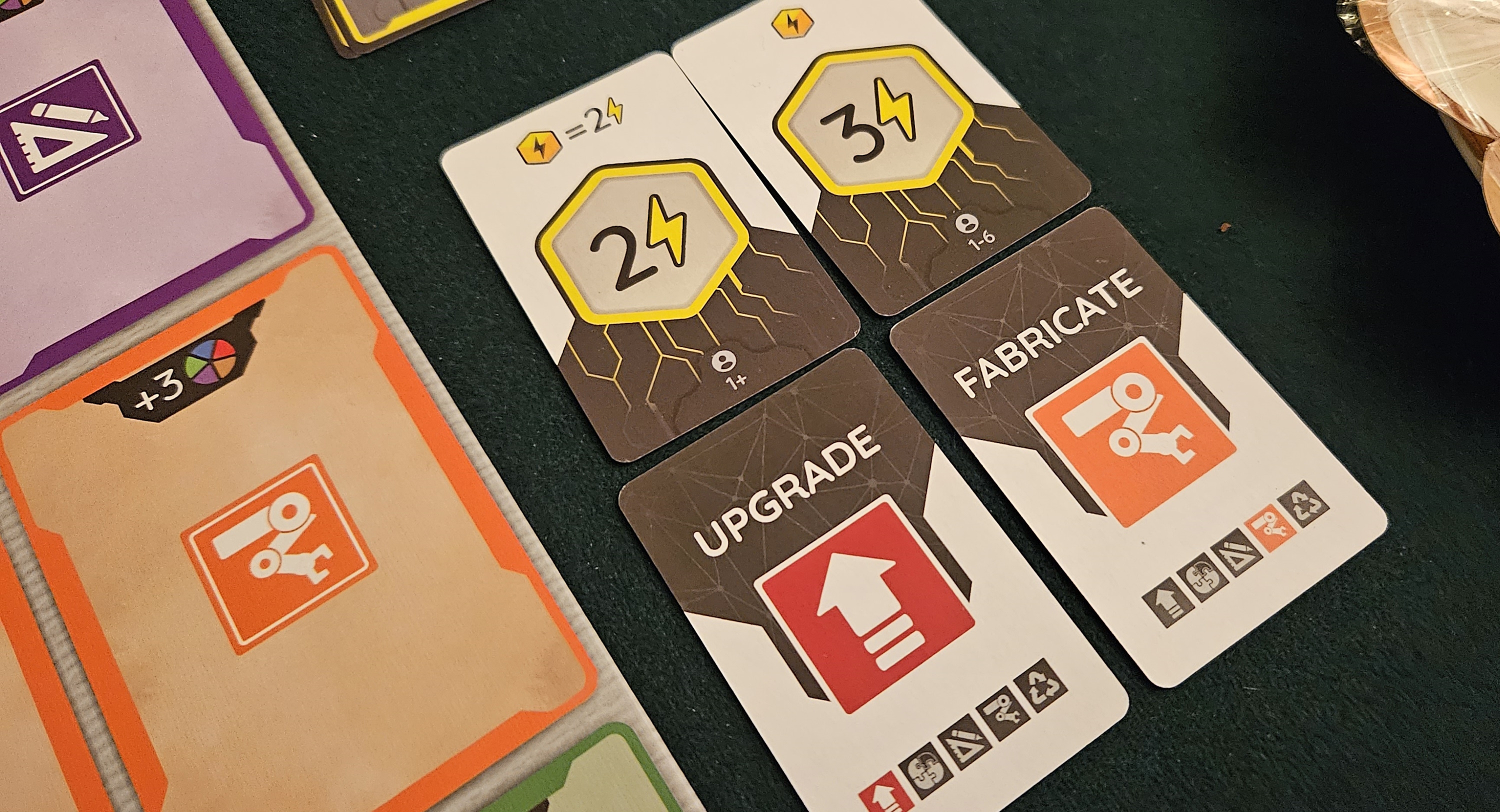
Selecting which actions I want to take this turn…
As Raising Robots picks up steam, the gaps for such meanderings are replaced by resource scarcity and action optimization. I mentioned Thomas Lehmann’s Race for the Galaxy, which makes every game that tries to climb its tower appear small by comparison. The application of Lehmann’s action-selection system here is straightforward enough on the surface. Players draw two cards showing some amount of energy, then pair those cards with the two actions they intend to take this turn. Most cards enable their action for you alone, while others also deposit energy cubes on a shared track to permit it for everybody.
The smartest impact of this system is that it forces ranked priorities. Raising Robots would be trivial if we could take all five actions in a turn, upgrading our board and assembling robots and activating those robots all at once. Instead, players will usually be able to take between two and three, maybe four, of these actions in a single go. Robots themselves are divided into three categories. Triggering one of these categories lets you utilize every robot assigned to it, resulting in a flurry of activity that becomes increasingly exciting with further additions. Where the early game feels incremental, later turns become complex machines in their own right.
That said, some of the designers’ intent goes awry. Certain cards only bestow a trickle of energy for their connected action. Without upgrades or batteries, that action will likely be small and unimpressive. To make up for this shortfall, those cards instead rely on the energy cubes deposited by other players, doubling their value. This can result in game-changing windfalls, if only you pay attention to what your fellow inventors are planning.
In some cases, this isn’t too tough an endeavor. If a rival player has five robots lined up, they are likely to activate that row for beaucoup profits. But that’s a late-game probability. Earlier on, when everybody needs to do everything, upgrading and assembling and activating robo-rows, guessing which action somebody will pick is an act of chance, and one made all the chancier by this game’s abundance of icons and far-off rows of cards. Raising Robots, you see, is a multiplayer solitaire game. Robot cards are drawn at random from a stack rather than drafted. Triggers rely on your board alone rather than requiring even the barest glance at your neighbors. You can go a whole ninety minutes without glancing up.

…and taking the actions collectively permitted by everybody.
And there’s nothing wrong with that. I often enjoy a session that lets me assemble my own engine without outside interference. Creating something in parallel with others can be its own reward, requiring no direct competition or friction to provide a good time.
That said, the action selection of Raising Robots provides the greatest benefit when I successfully guess what my opponents will do. It’s an awkward decision. The entire structure asks me to put my head down, only for the game to periodically lay a finger on my chin and tilt my gaze back up again. This is never not uncomfortable. The issue isn’t that the game ought to be wholly solitaire or wholly interactive; rather, it’s that the interaction is so very minor, a distraction that requires me to parse dozens of icons from a distance. I prosper when I guess what my fellow inventors intend to do, but that guesswork is an intrusion rather than the natural outcome of the game state.
This split personality doesn’t suit Raising Robots. It’s one more hiccup in the game’s simultaneous flow. Perhaps it would be more tolerable if everything else were more interesting, less built around resource tracks and hopefully dredging complementing cards out of the draw pile. In some regards Raising Robots improves on Wingspan, or at least lessens its tendency to withhold necessary resources. But its most important resource, the robots you’re tasked with raising, remain a matter of deep chance. The setup displays an understanding of this problem, having players select a number of cards up front: five robots from eight draws, an inventor identity from a pair of options, an end-game scoring card also from a pair. I’m always wary of this sort of thing, and Raising Robots leans into it. We’re placing the first flywheels of a great clockwork, only there’s no guarantee we’ll ever draw a hairspring of the proper size, a bearing-jewel of suitable cut.

Raising Robots does indeed include many robots.
This is a game that’s pleasant enough in the moment, but so shot through with interruptions that it’s like fingers snapping in front of my face. Raising Robots invokes stronger titles. Despite the colorful setting and decent scraping for resources, I’d rather play one of those instead.
(If what I’m doing at Space-Biff! is valuable to you in some way, please consider dropping by my Patreon campaign or Ko-fi.)
A complimentary copy was provided.
Posted on December 14, 2023, in Board Game and tagged Board Games, Nauvoo Games, Raising Robots. Bookmark the permalink. Leave a comment.

 SPACE-BIFF!
Leave a comment
Comments 0