The Banalities of Yesterday

Growing up Mormon, disdainful opinions about smoking were in plentiful supply. I recall a mother proudly recounting her answer to her daughter’s question about why people smoked. “Some people are on Satan’s side,” she declared.
She was half right. But the wicked were not the smokers — the victims, to use Amabel Holland’s parlance in Doubt Is Our Product. They were the profiteers who killed hundreds of millions for market share. Who peddled tobacco to children and obfuscated the deadliness of cigarettes. Who flooded the zone with bullshit so that ordinary people couldn’t make informed decisions. Who continue to do so, to the tune of eight million dead per year, one million of whom die from secondhand smoke. Textual critics have long held that hell and the devil were invented as a form of cognitive easing, a way to reassure ordinary people who couldn’t square why some of their peers, leaders, and oppressors were so predatory. Surely they were being influenced by a malevolent, otherworldly agent; surely they would receive a fiery judgement at the end of time.
If there’s anybody who makes hell and the devil seem necessary, it’s tobacco executives.

The Company fills its ledger with victims — and the public with doubt.
By now Holland is an old hand at inscribing a message into cardboard. The big examples loom large in her oeuvre: This Guilty Land and The Vote, subtler touches via Nicaea and Endurance, and plenty of others besides. Doubt Is Our Product returns Holland to polemics, but with an assuredness of both message and gameplay that marks this as perhaps her smoothest blend thus far.
And it is a blend. Necessarily a two-player game, Holland once again requires one player to helm the antagonist’s role. Far from endeavoring to tunnel the player into a tobacco trafficker’s headspace, the goal is more detached, showcasing the ongoing efforts of the Company in the broadest terms possible. To that end, the Company is represented as a sterile enterprise, full of all the color and life of rolling paper. Joe Camel’s penis snout is absent; one card instead offers “mascots.” The same goes for other marketing ploys. “Gimmicks,” not youthful slang. “Lifestyle branding,” not Marlboro points and baseball caps. There is none of the marketer’s glamour here.
The Company’s gameplay, meanwhile, speaks to an entrenched industry that’s begun to suffer under the weight of its own ubiquity. On the surface it’s a fairly boilerplate deck-building game, with cards purchased from a Dominion-style market and either discarded to resolve immediate effects or stacked in a temporary reserve for explosive turns later on. Beneath the rind, however, there’s a rotten core, an industrialist’s definition of success as expansion. The Company, you see, is required to play and purchase at least one card per turn lest it stumble in the overall market. To merely profit is to lose the game, a state of affairs that speaks to both the wolfish nature of capitalism generally and the Company’s urgency in selling cigarettes to fourteen-year-olds because they represent the forthcoming quarter century of profits.
Turns, then, are pacey even as they force the Company to juggle costs. Subtle horrors are unveiled at a devil’s pace. Loopholes sidestep bans. Credulous journalism casts aspersions on good research. Campaigns trumpeting “personal responsibility” turn non-smokers against the addicted. If those fail, outright corruption and intimidation poke holes in the opposition’s efforts.
It should be mentioned that the remoteness of the Company is very much intentional. There is no satisfaction to be found in these actions, only the hollowed-out realization that your television ads have hooked more children. There are those who object to playing as the bad guys of history, whether in Holland’s chewier mouthfuls or in titles like Taylor Shuss’s Stonewall Uprising and Tory Brown’s Votes for Women. We all boil at different degrees, and far be it from me to argue that somebody should play a role they find uncomfortable. But there is value in witnessing the discomfiting and the detestable rather than turning away. Holland’s portrayal of the Company is clear-eyed, distant enough that it never feels like one inhabits those suits, but close enough to smell the stink on them.
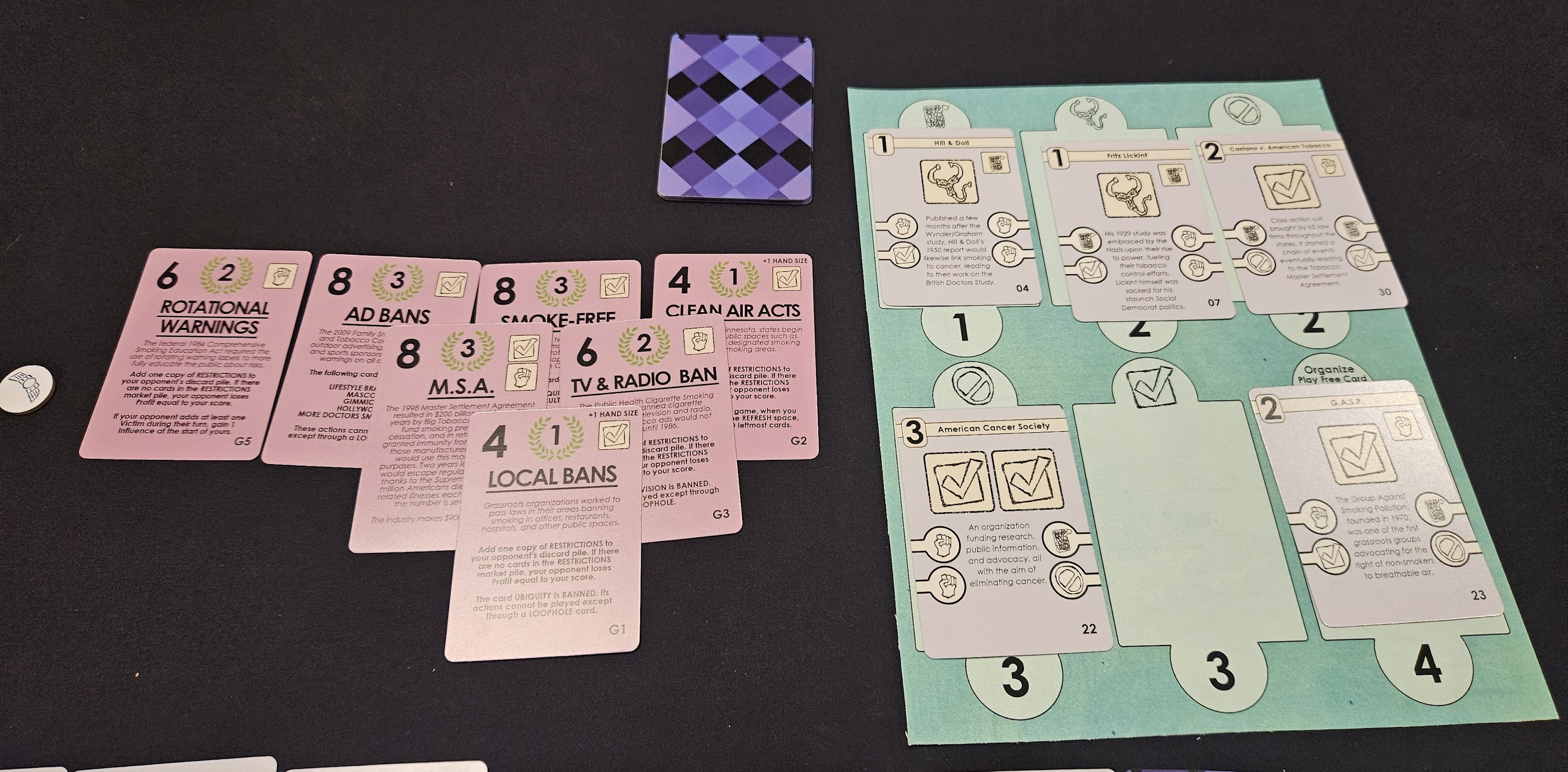
The Movement is gradual and piecemeal, but eventually comes together.
By contrast, the Movement, Holland’s designation for the loose coalition of doctors, researchers, lobbyists, legislators, bereaved, and everyday people who fought against the tobacco industry, offers relative warmth. Their cards and player mat have some color to them, for one thing. For another, they depict tangible steps rather than the genericisms of the Company.
These fall into two broad categories. The first are the Movement’s principal workhorses, cards that represent medical studies, activist groups, leaked information, school programs — any of the basic activities of the opponents of the tobacco industry. These trigger actions when purchased or played, and earn a steady income of influence, messaging, and agitation as they accumulate into a functioning tableau. Each resource has its own function, from spreading the word to breaking through the tidal wall of doubt that insulates the industry. When played in the proper sequence, it’s possible to cut through the bullshit and strip the Company of its victims.
But while these efforts are undoubtedly worthwhile, they offer only a partial solution. The Company always has something new in the pipeline, further victims to exploit. To turn the cultural tide away from ubiquitous smoking, the Movement must also accomplish goals depicting legislative landmarks that range from smoke-free areas and flight bans to restrictive taxation and warning labels. These cards are more difficult to obtain, requiring gradual investments and sturdy groundwork. They’re worthwhile objectives, however, adding restrictions to the Company’s deck and banning certain cards outright.
Of course, the Company is hardly helpless; it can use lobbyists and corruption to increase the price of the Movement’s cards or strike them from their tableau altogether. This jockeying is important despite only constituting a small portion of the design, generating a contrasting arc to both sides. As the Movement hits the Company with bans and penalties, the Company strikes back with price increases and additional doubt tokens. It imparts the sense of a culture in transition, ideas of medical awareness, masculinity, and public spaces undergoing a seismic shift from one set of priorities to another.
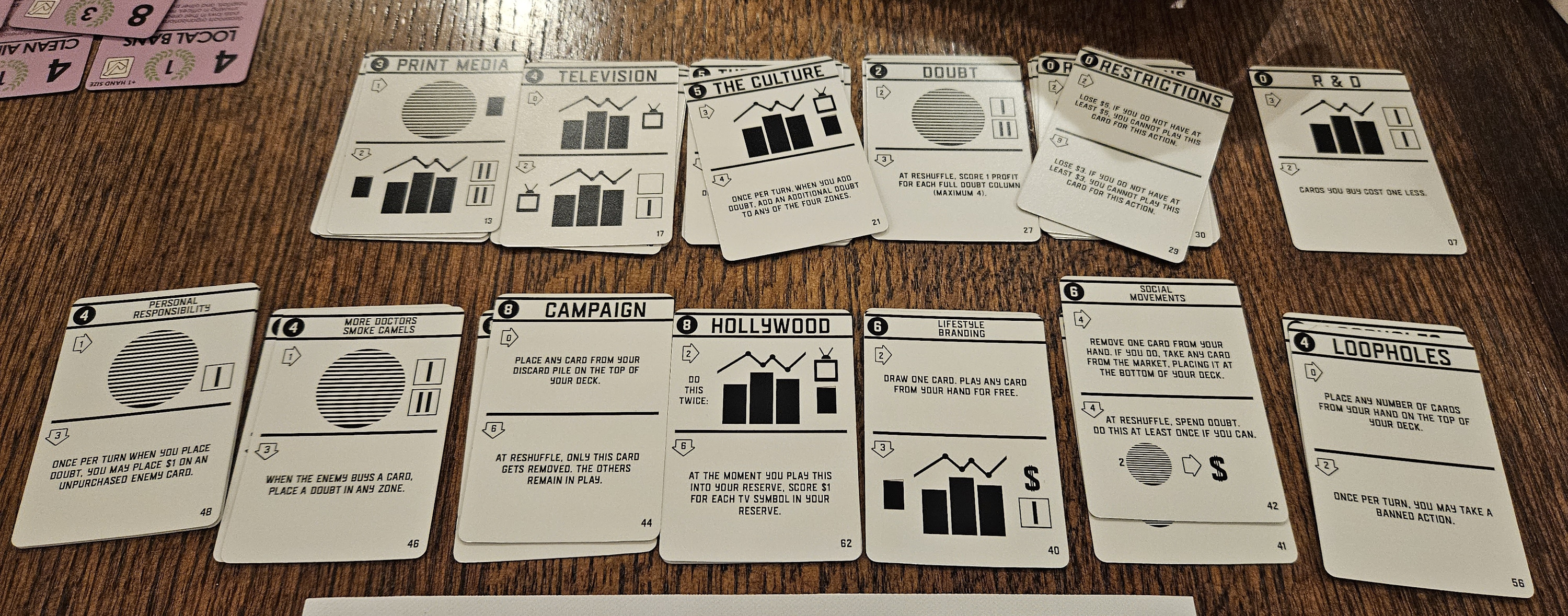
The Company’s cards are sobering and deliberately drab.
All the while, Doubt Is Our Product never strays too far from its core argument, a niggling realization that scoff as we might at the gullibility of a culture enthralled with sucking toxic smoke into their lungs, the efforts of the Company aren’t so far removed from those of our own grifters and profiteers. This is not a conflict in which both sides are engaged in commensurate good faith. The Movement’s cards are rooted in scientific studies, investigative reports, and expert testimonies. They strive for clarity and transparency.
On the other side, the Company’s cards might as well stand in for any number of modern phenomena. Is that Hollywood card about the image of a cowboy enjoying a smoke after a long day of being manly on a horse, or does it stand in for a spate of standup comedy specials mocking the queer community? Are those Company-bought white papers about the possibility that smoking promotes a robust constitution, or are they laser-focused on the short window of the year in which Antarctic sea ice forms rather than melting? Are those lobbyists paying congresspeople to defend smoking, or to erode democracy one lie at a time? Are those print articles spreading word about the latest method of toasting tobacco leaves, or “just asking questions” about vaccination? Is all that R&D going into formulating a more persuasive cigarette filter, or pretending that vaping doesn’t carry its own body of risks? This is not a game that’s interested in telling the tobacco man’s side of the story, nor in pretending that the banalities of yesterday are not also the banalities of today.
To some degree, this imbalance finds its way into the gameplay. While the Movement chugs along at a steady clip, the Company is labyrinthine and burdened by competing priorities: new cards versus a trim deck, products that kill their consumers, defensive efforts versus turning up the pressure on their detractors. Consequently, the Company’s turns are longer and its strategies harder to master.
I wouldn’t characterize this as a problem, and not only because balance is overrated. Rather, Doubt Is Our Product works precisely because it snags on fabric now and then. It flourishes in those moments when the Company adds a half-dozen victim tokens to their youth demographic, sending a chill down its players’ backsides, or when the Movement adopts the tone of a righteous march, stripping through layers of obfuscation and drawing away the Company’s customers. It’s not all sensation, thank goodness; both sides ask players to master their own particulars. But the Company’s tendency toward shadowy behavior bleeds into the game itself, resulting in decks that are knotty and difficult to unpick. Not unlike a conspiracy, perhaps. Unsurprisingly, the Movement’s arc mostly bends upward, while the Company’s profits tend to stall and fail in the endgame. Those who want an equal ratio of wins for both sides may not find what they’re looking for here.
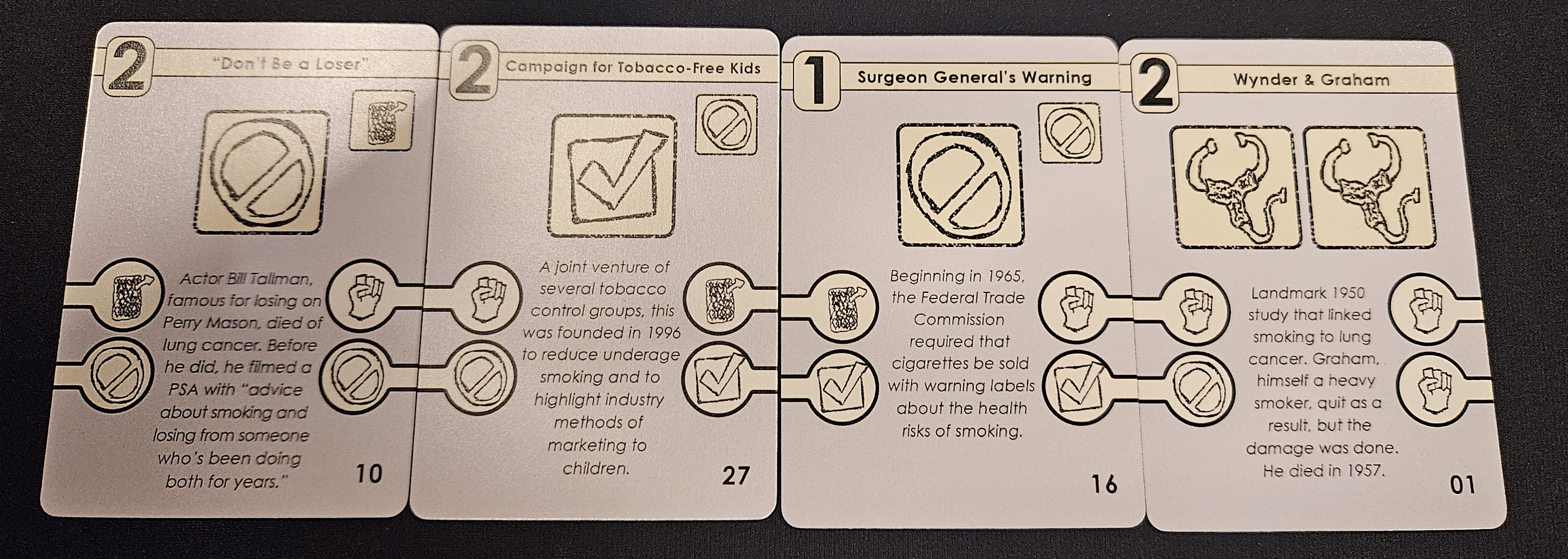
It’s a good start.
Indeed, it’s a difficult game to stomach in multiple senses. Its unwavering look at the devil’s own, its natural imbalances. Even its modern relevance can make a mouthful. This is very much a game for those with a cast-iron will, both for observing how game systems can portray corporate greed and social change, and for those who appreciate games that reach out and leave an imprint back on their players.
In those regards, Doubt Is Our Product is Holland in her finest form. Compared to some of her earliest agitprop, it is lucid and playable, not to mention crisp in its messaging. It left me chilly. I mean that as a compliment.
(If what I’m doing at Space-Biff! is valuable to you in some way, please consider dropping by my Patreon campaign or Ko-fi.)
A complimentary copy was provided.
Posted on November 24, 2023, in Board Game and tagged Amabel Holland, Board Games, Doubt Is Our Product, Hollandspiele. Bookmark the permalink. 9 Comments.

 SPACE-BIFF!
This is another game that absolutely fascinates me, it’s a shame Hollanspiele games are so hard to come by in Europe (I basically get all their games as print and play – but man that is a lot of work!).It is an excellent work of art which can take some disparate thing and make us relate to it in our lives today: The whole time reading your review, all I kept thinking was: “This could be a game about climate change.”Excellent review, and I hope I get a chance to pick this one up and play it sometime.
Fortunately, a game about climate change is coming soon! I’ll be writing about Daybreak shortly.
Once again your timing is spot on, Dan.
https://www.theguardian.com/world/2023/nov/27/new-zealand-scraps-world-first-smoking-generation-ban-to-fund-tax-cuts
I saw that when I woke up this morning, and man did I let out one long sigh. Talk about taking out a bad short-term loan.
But… she’s got a new
hattax cut!Pingback: Best Week 2023! War By Other Means! | SPACE-BIFF!
Pingback: Name Your Zombies | SPACE-BIFF!
Pingback: Space-Cast! #35. But Then She Spilled Tea | SPACE-BIFF!
Pingback: Leave It in the Pattern Buffer | SPACE-BIFF!