Fossil Industries

It would be a lie to say I love cube rails, but there is a handful I’ve enjoyed more or less, and it’s no coincidence that three of them were designed by Amabel Holland. Dinosaur Gauge, co-designed between Amabel and Mary Holland, is, I hate to break it to you, the least historical of the set. Despite some messiness, that might also mark it as my favorite of the bunch.

Navigating the infill of the Western Interior Seaway.
Dinosaur games seem to go in one of two directions. Either the clade’s inclusion means the game will be as fluffy and flaky as bakery pastry, or else it makes for an unusually stern experience. Dinosaur Gauge falls into the latter category. Far from being an airy entry point to cube rails, it’s a dense and knotty experience that imports the genre’s appreciation for false starts and dead ends. Be wary, all ye who enter here. When a stock valuation goes awry, this game claps its tiny T-Rex hands in delight.
Set around the Western Interior Seaway, the shallow inland sea that divided North America in twain many millions of years ago, Dinosaur Gauge is indeed about stocks and their relative share prices. Rather than only assessing the price of railways, however, there are four competing industries to compare, each with their own particulars.
The first of these, as it so happens, is a fossil industry — or in any case, an industry that will go the way of all fossils within the next few millennia. The Seaway that divides the map is dominated by three shipping companies. To link far-off cities — and you will want to, for therein lies the greatest profits — rail barons will need to contract with these shipping magnates, devoting cubes to their coffers. This, in turn, increases the share price of the shipping companies.
But there’s a wrinkle. Every turn begins with a single tile appearing somewhere in the Seaway, its destination chosen by the current player. These are transformative, depositing new obstacles like swamps, mountains, and an errant volcano, along with opportunities in the form of new cities, towns, and factories. These also inevitably bisect the old shipping lanes, becoming one more tool of corporate sabotage. As the game progresses, water shipping becomes more and more untenable as an industry. If there’s any one constant, it’s incontinence. Because the continent, it’s undergoing serious infill.
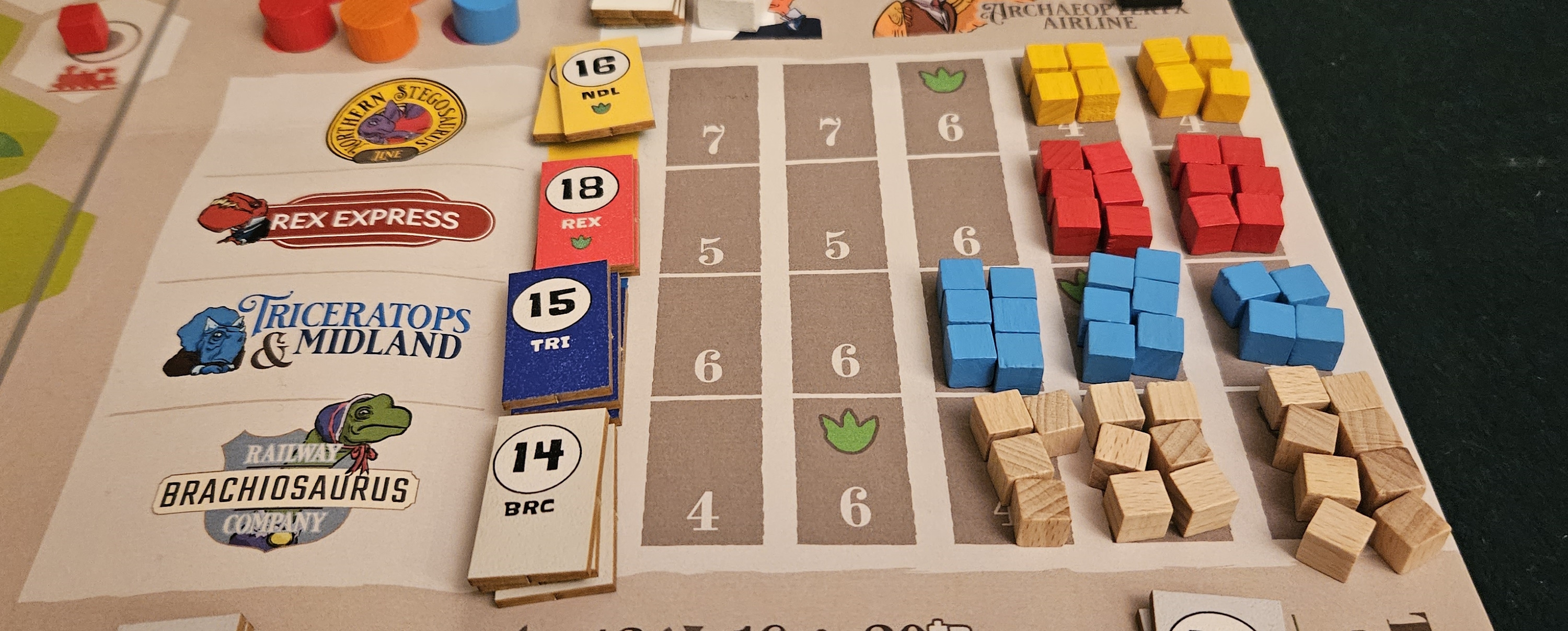
Stocks. Some of them, anyway.
While shipping via water is in decline, rail is on the rise. This is Dinosaur Gauge at its most traditional. Players may purchase stocks to gain access to rail cubes, then use those cubes to cross prairies, ford swamps, and tunnel through mountains, hopefully linking factories and cities, all while passing through as many towns as possible on the way. Factories complement this process, producing a tug-of-war for share value between two corporations. Elsewhere, air travel might be invented.
There’s undoubtedly a lot of cleverness at play. Each of these industries requires its own approach. Rail lines, for example, skyrocket in value and earn dividends for their stockholders when they deliver cargo. The “stomp market” where these values are tracked is cutthroat, with ascending companies “stomping” other companies down a space. Meanwhile, those factory corporations are locked in a war for market share, always jostling with one another for total value and bonus actions.
At the same time, there are a few gaps. Cube rails games — all stock valuation games, really — thrive on imbalance. These are gambling games at heart, tasking players with placing bets and then doing their darnedest to shepherd those bets and undermine those of their rivals. There wouldn’t be anything to assess if every valuation were equally viable. So the genre produces staples: companies that boom quickly but hit an early ceiling, long investments that pay out at a steady rate, the odd risky venture that may pay off in spades if only it can link up to its destinations in time.
But each of these bets needs some chance of paying out. In Dinosaur Gauge, entire industries are created unequal. Seaway shipping may be profitable to some degree, but it pales in comparison to investments in factories and railways. Similarly, air travel seems like a high-cost, high-risk investment that will almost never hit it big. I’ve seen an air travel company become profitable in one instance, and even then it was a molehill compared to even the flimsiest railway. That’s in part because of how airports (called “nests”) function. They’re added to cities to increase their value during a rail delivery, but only at great cost to the player building the structure. Which means that players are asked to invest twice — once for the stock and a second time for the nest — for a risky jump in stock value. By contrast, buying rail lines or factories means you’ll receive dividends, often right away, which can then be reinvested into further stocks. Snowball effects abound.
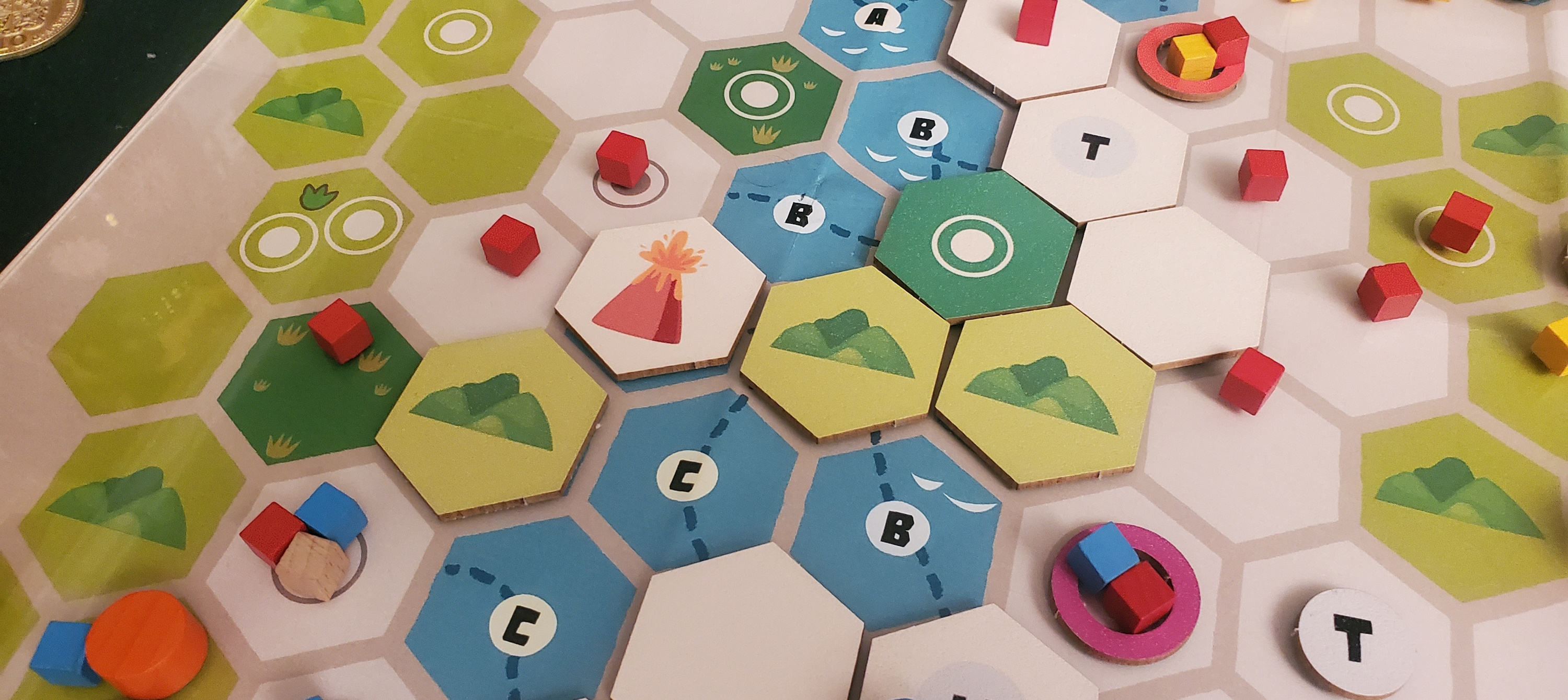
Sweet volcano, dino.
Is this deliberate? Is it a commentary on the desirability and carbon efficiency of rail? Perhaps a statement on the inability of pteranodons to carry anything larger than an average American’s checked luggage? Who knows. Taken together, these elements make Dinosaur Gauge unusually hostile to newcomers. In our last play, the magnate who thought they were clever by investing in air and sea travel was taught a stiff object lesson in prehistoric-stage capitalism.
At the same time, Dinosaur Gauge soars highest when played by stock-valuing veterans. In that light, the industries that are too fossilized or too cutting-edge become something closer to tiebreakers than staple bets. Like many cube rails games, it revels in its wooliness. Here that texture is found first through the stocks — and the way its different industries all function according to their own logic provides plenty to assess, even if certain balance sheets aren’t as attractive as others — and second through the gradual environmental change of the Seaway producing a fresh exploitable section of the map with each passing turn. As an illustration of how changing environments inform the behaviors of the populations who inhabit them, Dinosaur Gauge is unexpectedly evocative.
The result is a cube rails game that feels more dynamic than some of its counterparts. It’s a wild and strange sandbox, filled with dry clumps that don’t quite hold together and one or two half-buried lumps that smell suspicious, but also wet patches perfect for molding and little plastic toys that have somehow survived the winter without cracking. It’s one of those rare games that feels… not improved by its imperfections, as such, but certainly colored and shaped by them.
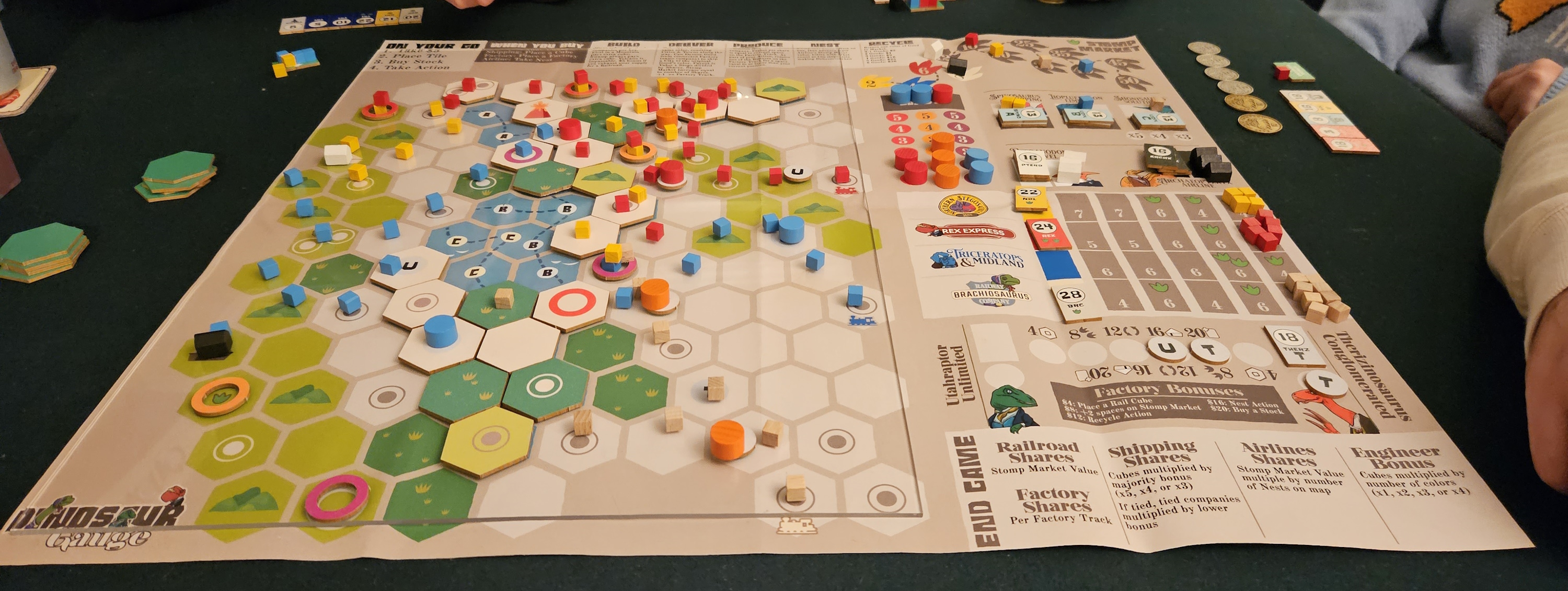
At last, paleontologists know the truth of the distant past.
In other words, Amabel Holland’s nth cube rails outing is a pleasant if woolly surprise, while Mary Holland’s first proper design demonstrates both her long knowledge of the genre and a willingness to innovate and alter. Dinosaur Gauge is a weird one — and that’s exactly why I like it.
(If what I’m doing at Space-Biff! is valuable to you in some way, please consider dropping by my Patreon campaign or Ko-fi.)
A complimentary copy was provided.
Posted on November 20, 2023, in Board Game and tagged Amabel Holland, Board Games, Dinosaur Gauge, Hollandspiele. Bookmark the permalink. 9 Comments.

 SPACE-BIFF!
Hey! You back! I was missing you.
Hope you were on holidays or something equally pleasurable.
Another jewell by this gal Holland, she knows how to make a game eh?
PD: As wordpress don’t let me edit my comment I ask here: is gal derogatory slang? If it is, sorry, cultural ignorance.
I don’t think so. Maybe depending on context. But I don’t think this is one of those contexts.
But who knows? Words are hard.
Nice review as always, but where did you come up with the term ‘clade’? 🙂
Isn’t it a biological term for “group”?
This is correct. “Dinosauria” is a clade.
I love the visual aspects of this, the pieces and colours. But I just can’t get into the stock aspect of this and 18xx games (and presumably, other cube rails games, though I’ve never played any. My one experience with an 18xx was… mediocre at best. If I saw this game on the table, I would so want to play it, but the moment you told me it’s about stocks, my hear would break. Sigh. I’m happy for the people who enjoy those, but I’d love a game like this *without* the stocks. Which is probably why I love Ticket To Ride and all it’s variants.
I hear you. My first couple of 18xx experiences were hairy as well. I do appreciate a good stock game, though.
Pingback: Cube Shuttles | SPACE-BIFF!