In Case You Didn’t Get Enough Zoom
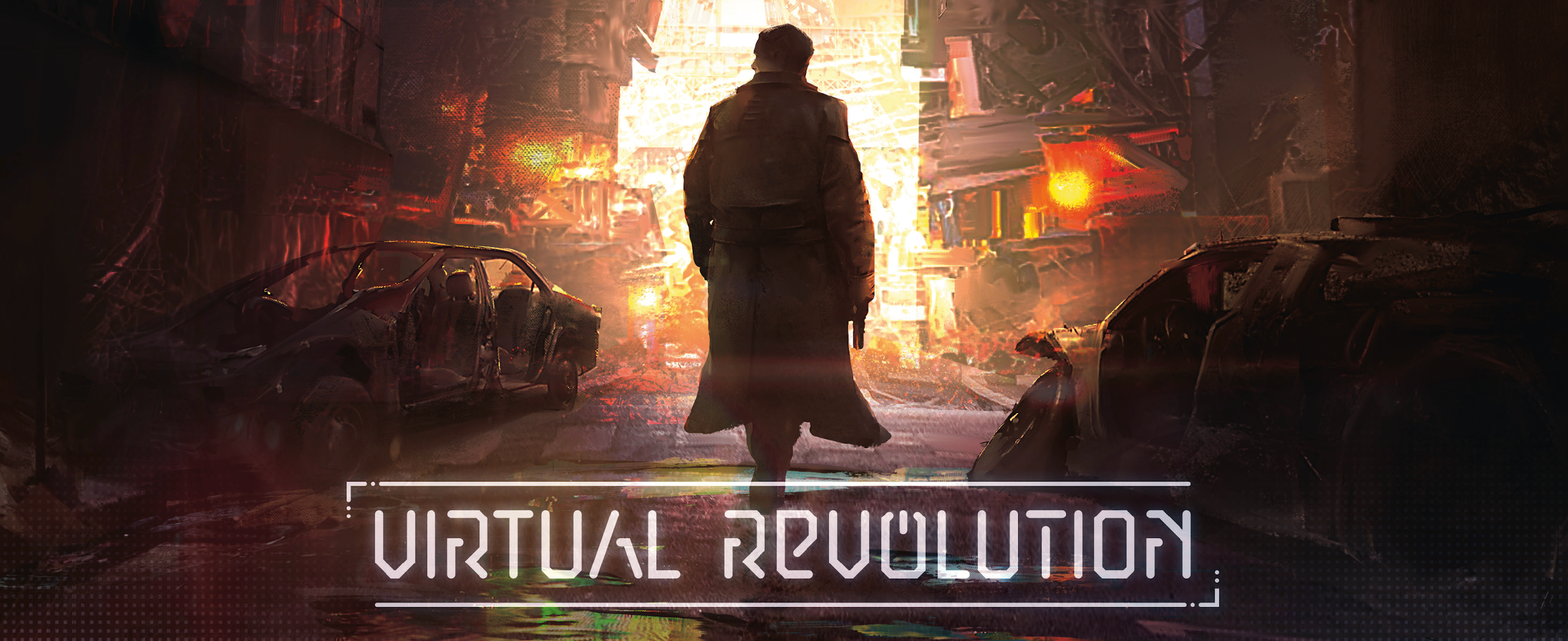
It’s the future. Plague and government neglect have caused humanity to retreat into the virtual world. No, I’m not talking about the COVID lockdowns of 2020. Fate dictates that we’re going to do it all over again in 2047 — although apparently this time the Metaverse won’t turn out to be such a deflated whoopee cushion.
Based on a film I haven’t seen but redolent of well-worn cyberpunk tropes, Virtual Revolution is the brainchild of Guy-Roger Duvert, who both wrote and directed the movie, penned a prequel novel, and has now designed the board game. I’m wary whenever an author adapts their fictive world to cardboard; a talent in one medium doesn’t often translate into another. Imagine my surprise, then, to discover that Virtual Revolution is a worthy non-virtual plaything.
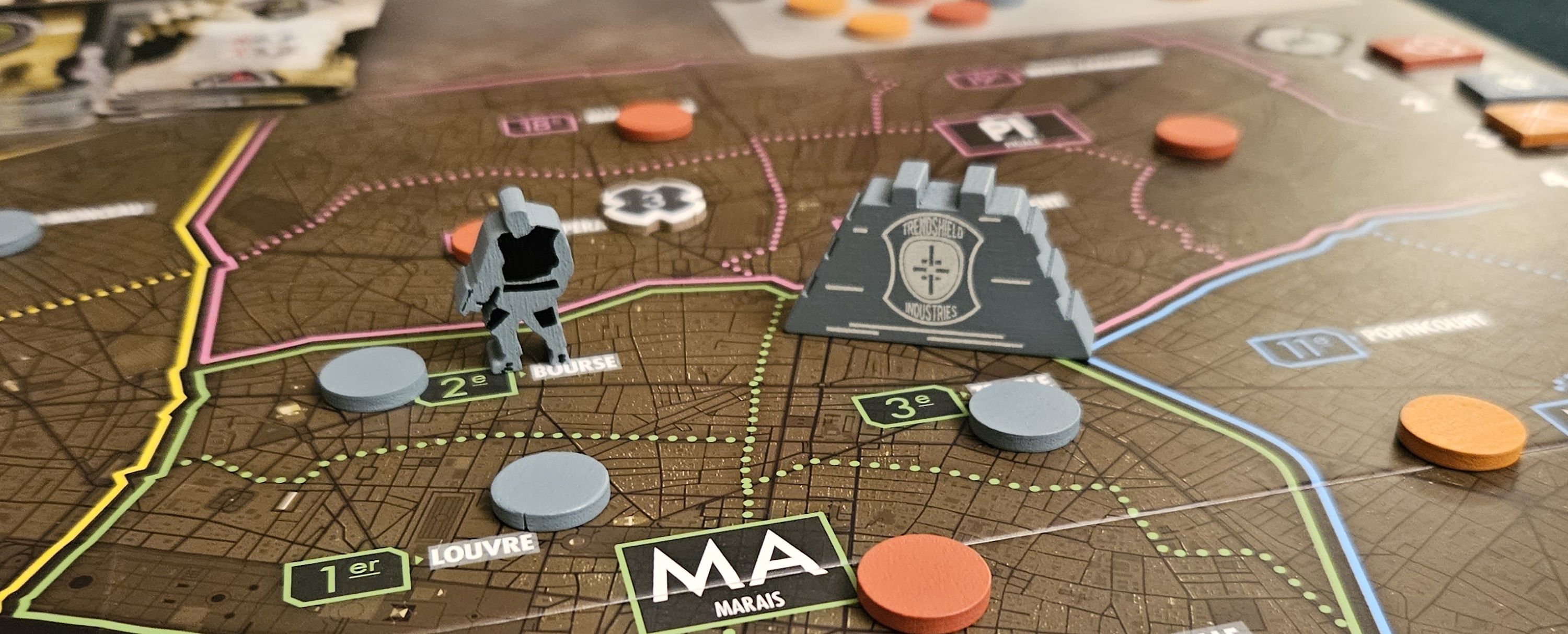
As close to a lone trench coat as you’ll get in this game.
Welcome to Neo Paris. Why its founders named it Neo Paris and not Nouveau Paris beats me. Probably for the same reason they changed arrondissements into boroughs.
Peccadilloes of the English version aside, Virtual Revolution immediately establishes itself as an unusually barren urban space. This is a far cry from the hustle and bustle of New Angeles, with its demanding citizenry and clashing interests. Or, well, pretty much any cyberpunk vision of the future. If the place didn’t seem so run-down, it might be nice to skip the lines. But never mind. Rather than meeting material needs, your sole domain is virtual. You are a megacorp that specializes in the design of verses, digital retreats for the future-shocked dwellers of this dystopia. These are more or less what you’d expect from corporate content, a mix of comfort-food pablum and colonial fantasy. Ubisoft has probably released its fortieth iteration of Assassin’s Creed.
But the ins and outs of verse design are not your ken. Your department is more concerned with wetware. As in, directing agents to seize control of boroughs like gangland thugs, erecting megalithic server farms for storing all that data, and doing everything in your power to evade the oversight of Interpol. You are very much the bad guy of this universe. Honestly, it’s a real hoot.
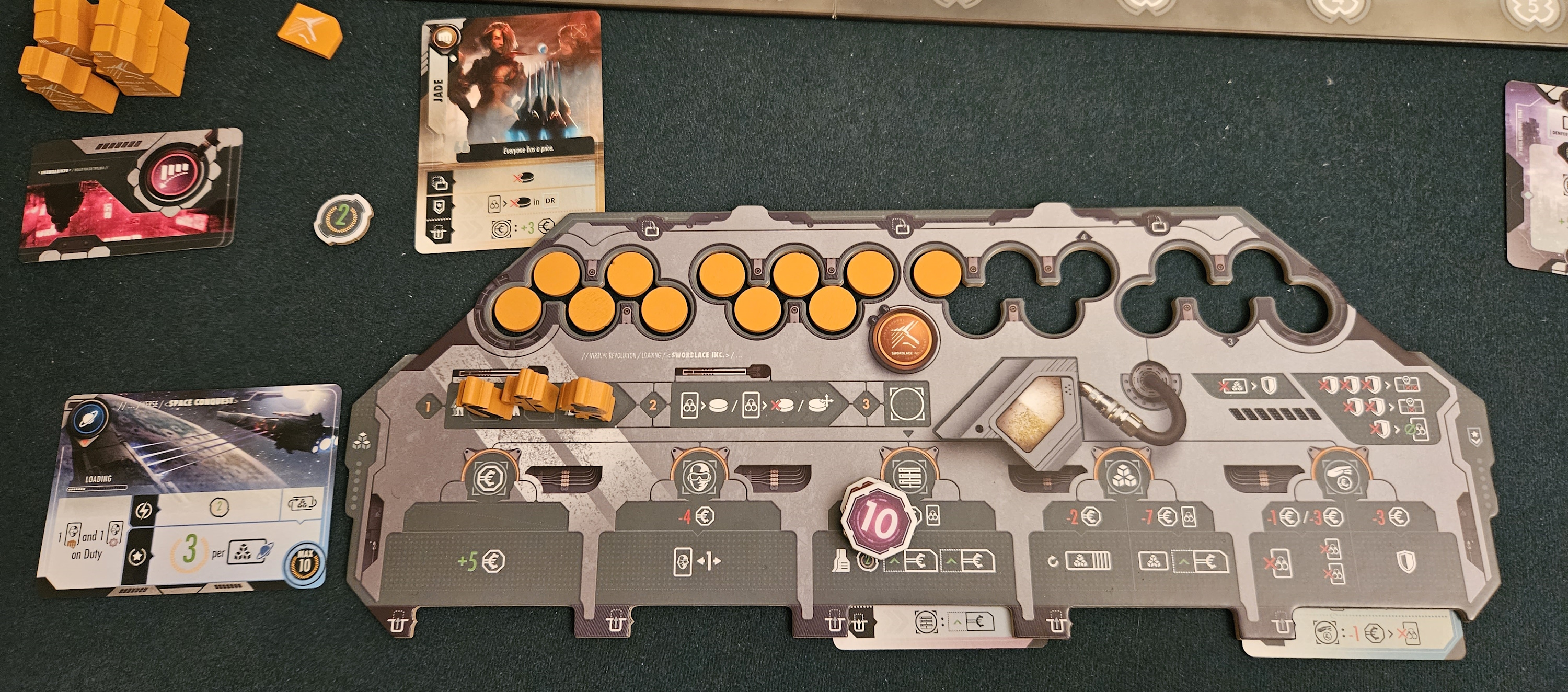
Hiring agents and booting up verses.
There are two overlapping degrees of complexity to consider. The first is the usual stuff you’ll undertake every turn. Each megacorp has three directors, who they will deploy over the course of three turns each. These first adjust their corp’s control over their borough, either adding influence discs or bumping off one belonging to a rival firm. From there, you choose one of a few actions. Most of them are costly, shelling out cash to hire agents, boot up verses, erect server farms, or invest in internal security measures. Another, called “work,” lets you bring home a few extra future-bucks.
This layer is simple enough. There’s some light area control, a bit of optimization, the modern Euro’s range of victory point categories to consider. It isn’t until you start adding the extras that Virtual Revolution comes into its own.
Because here’s the thing: this game gets busy. It isn’t the usual actions that do it, but rather all the free stuff that soon augments and eventually eclipses them. Agents are the biggest example. These are randomly seeded throughout Neo Paris at the start of each round, and can be recruited by sending a director into their general vicinity and paying a hiring bonus. This does a good job of breaking up the usual power blocs. If you’re looking for a specific agent, it’s entirely possible that you’ll need to muscle into rival territory to bag them.
Hiring agents early and often is a must because of the wide range of services they provide. Some are technical experts, adding extra shields to your pool of resources. These are useful for blocking Interpol investigations or counteracting Necromancer raids; more on those in a moment. Others are combat specialists who remove additional enemy discs, making it that much easier to control territory. The last type gives you money. Trust me, you will want as much money as you can get.
In addition to these free actions, agents can also be transformed into upgrades. These are usually paired with a cost — corruption — but provide an immediate bonus and supplement the boilerplate actions you take every turn. Suddenly it’s more efficient to build a server, for example, or you can recruit other agents from farther away. Maybe work becomes more beneficial. That sort of thing.
The point is, now you aren’t only optimizing the usual range of actions. You’re also tending a stable of agents. After a while you’ll also have verses, which need to meet certain requirements in order to come online and offer endgame scoring bonuses. And there are district bonuses, earned by seizing a few contiguous boroughs. Also, don’t forget to reclaim your removed influence discs from the holding box for a few extra credits or shields.
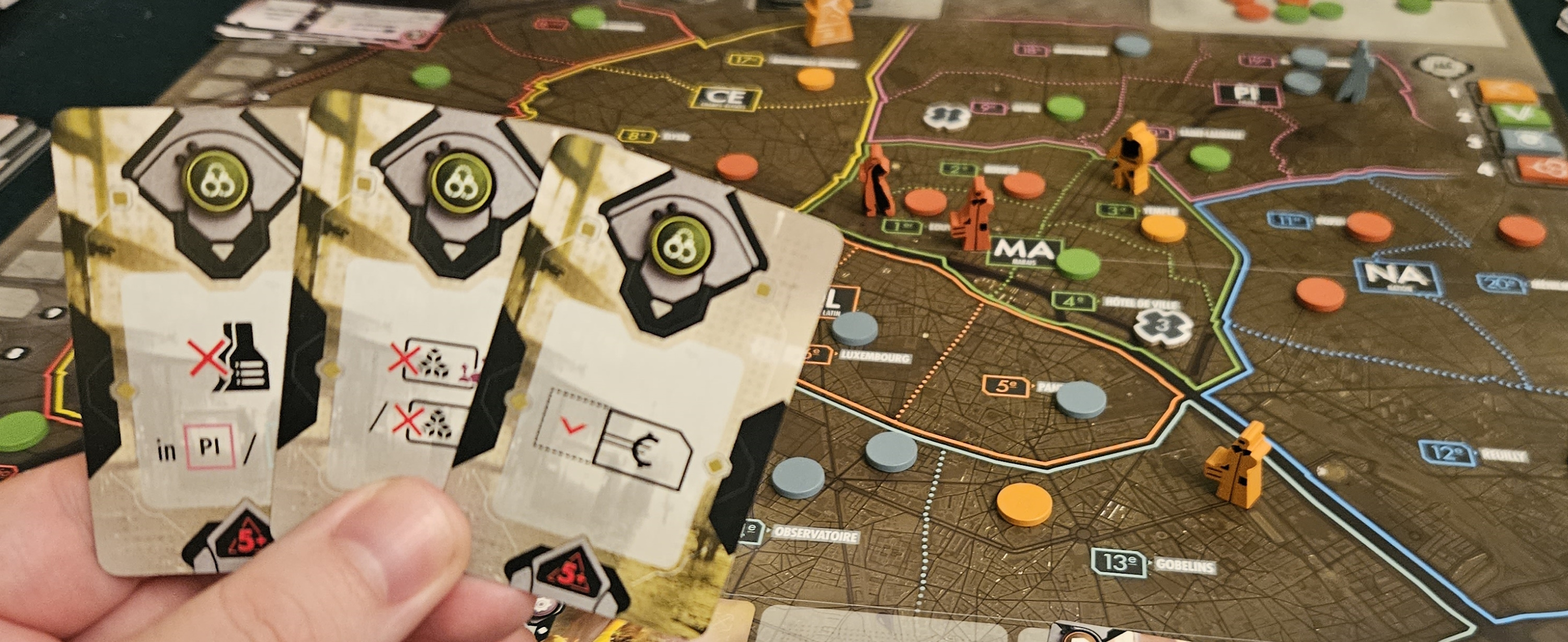
Corruption comes with the job, but prompts Interpol raids.
It gets a bit long-winded. That’s the main downside of Virtual Revolution. It doesn’t start that way. The first round, maybe the second, positively whiz by. Later on, with so many tools and options in the air at the same time, the game begins to feel more devious. Provided, of course, you can get past the game’s busy table presence. You could peek at a rival’s verses to determine how to undermine their goals. But when the icons and text are so very small and so very far away, one is more liable to approach their career as a megacorp executive like a hobby than a serious pursuit. We wouldn’t want anybody to strain their eyesight or anything.
But when it works, it manages to feel grungy and exciting, exactly the way cyberpunk ought to. Take Interpol and the Necromancers. These are the “good guys” and the “bad guys,” although it’s hard to tell which is which. Interpol periodically raids your offices, flipping all your corruption cards face-up and imposing a wide range of penalties. Maybe they shut down a verse that’s gotten too shady, or decrease your income, or torch a server that’s running too many torrents. You can block these efforts at policing via shields, but it’s even more impressive when you reveal seven cards and none of them apply to you in the first place. It’s all the satisfaction of watching the feds raid your office when you know the incriminating evidence is off-site.
The Necromancers work similarly, but they’re more equal opportunity. Every round concludes with a Necro attack, a spasm of terrorist violence against the digital incarceration of humanity. These can also be blocked with shields, but again it’s more satisfying to bend them to your favor. Being the weakest megacorp on paper — in terms of income, which does translate into points, but not as many as many other categories — means the Necro might be willing to work with you. This isn’t some big game-breaking deal, but it’s enough to allow a trailing corp to find a toehold.
Cram all of these ingredients into the same nutrient pod and you get a surprisingly textured meal. Oh, there are still a few chewy lumps in the slurry. Duvert seems to have ingested some of the conventional wisdom of modern game design a little too unquestioningly. There are heaps of scoring categories, for example, which makes the game feel airy rather than grounding it in a smaller handful of direct pursuits. The health of a real-world corporation may indeed be the matter of a well-rounded balance sheet, but we’re not here to conduct double-entry bookkeeping. This is about assassinating a rival corpo gang, bolstering our network security in advance of the counterattack, and blaming our worst excesses on the competition.
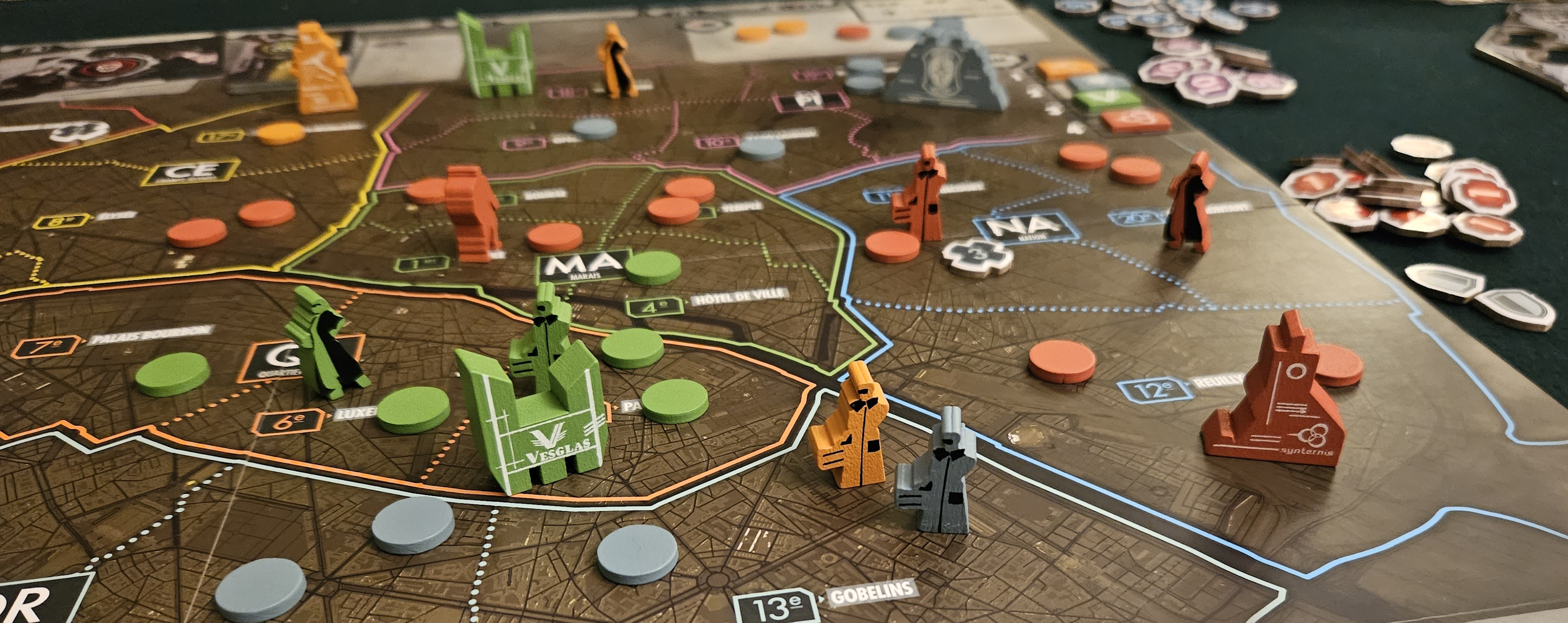
The new cathedrals.
This isn’t the most mind-blowing or innovative game I’ve played this year. Heck, is isn’t the most innovative game I’ve played this week. But it’s a pleasant surprise, reveling in genre tropes and a futuristic Paris on the verge of collapse, warred over by immoral agencies and terrible people. Sometimes, role-playing as the Tyrell Corporation is what I want out of a game night. That’s exactly what Virtual Revolution provides.
(If what I’m doing at Space-Biff! is valuable to you in some way, please consider dropping by my Patreon campaign or Ko-fi.)
A complimentary copy was provided.
Posted on October 18, 2023, in Board Game and tagged Board Games, Studio H, Virtual Revolution. Bookmark the permalink. 1 Comment.

 SPACE-BIFF!
Pingback: Best Week 2023! Making Memories! | SPACE-BIFF!