Knizidero
Zoo Vadis, Bitewing Games’ reprint and update of Reiner Knizia’s long out-of-print classic Quo Vadis?, has only been available to the public for a few weeks. But the good Doctor has never excelled at resting on his laurels. Already he has two more games on the way: Cascadero and Cascadito.
If those titles strike your ear as sounding somewhat similar, you aren’t experiencing auditory hallucinations. Knizia is well known for riffing on his own designs, sometimes producing games redolent of previous productions. Now, apparently, he’s expediting that process. Cascadero and Cascadito are deeply similar, and not in name alone. Today we’re looking at the “original” of the two.

Cube rails.
Knizia has designed so many tile-placing games that it would be easy to see shades of plenty of his other games in Cascadero. To list the handful that springs to mind, there’s Tigris & Euphrates, Yellow & Yangtze, Samurai, Babylonia, Whale Riders, Blue Lagoon, and surely others that Knizia purists will be sternly disappointed I neglected to mention.
But while it’s true that Cascadero works in an overlapping design space, it doesn’t invoke any of those entries too directly. If anything, it’s closer to a cube rails game. Sorta.
As with many of Knizia’s games, the fluff isn’t strictly necessary, providing a mnemonic flourish for onboarding the rules rather than producing anything like a narrative. Here the fiction suits the opening landscape, which is speckled with towns but otherwise vast in its emptiness. For decades, the story goes, this kingdom was at war with itself. Now the Cascadero has united the land. In his project to integrate the far-flung cities of his realm, he is sending messengers to bring word of their newfound national unity. You are one of his lieutenants, given charge of one of four industries — blue for mining, yellow for agriculture, pink for commerce, and orange for a crosshatched symbol that I can’t recall the significance of. There’s also white, education, a fifth industry that neither you nor your compatriots have direct control over.
Most of the time, a turn is as simple as placing a single envoy. These can be placed on any empty space on the map, first appearing as a lone rider on the horizon, then eventually spilling together like an overturned Pez shipment. Your aim is to place them next to towns. This will trigger scoring along one of five tracks, corresponding, you guessed it, with the five colors of industry.
This isn’t as easy as it sounds. Because the kingdom has been at war for so long, the towns are slow to trust. If a rider is placed on a town’s border alone, nothing happens. The people simply don’t believe the word of a single rider, no matter how handsome their apparel. Instead, the rider must be part of a group. That means two envoys at least. Moreover, the first rider to arrive at a town only moves your token up the matching track by a single space. Later envoys reinforce the Cascadero’s proclamation and thus score an additional pip. So there’s a simple but intriguing tension at play. You want to arrive at towns early enough to race up those tracks, but hitting the town with the second (or third or thereafter) group is more rewarding.
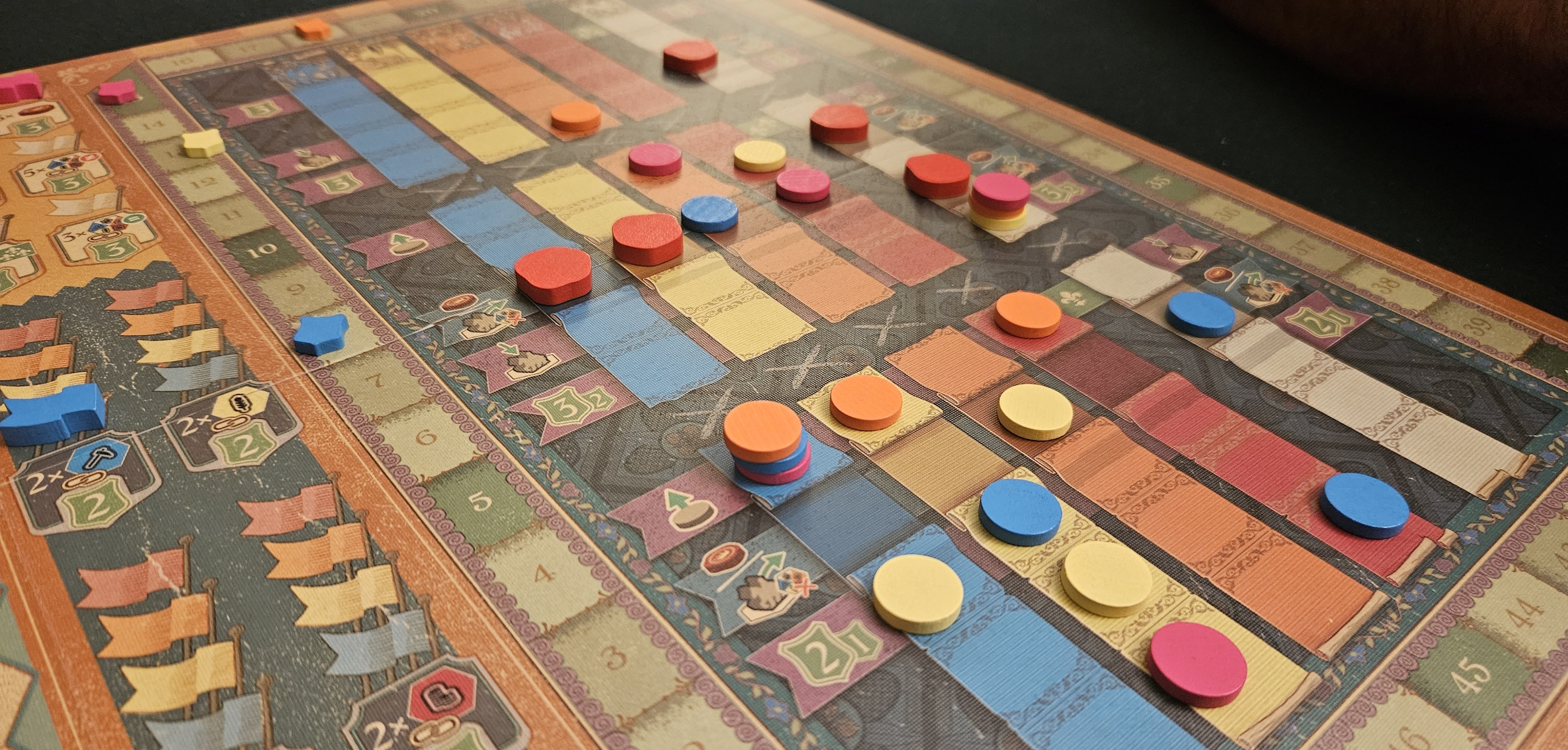
The tracks are all-important.
There are some peculiarities to this process. The first is that you’re free to approach the town from multiple angles, provided the envoys come from different groups. In theory, that means you can move up a track by entering a town from three contrasting directions. It’s also possible to move your envoys by hitting certain spaces on the tracks. This may retreat them from a city and allow a future rider to approach it afresh to score it yet again. But maybe we’re getting ahead of ourselves.
The tracks. As I mentioned, there are five, one per industry. These are crucial to every placement, but are host to just enough details that they can have an overawing effect in the first couple of sessions. Their bonuses range from straightforward victory points to more heady fare: an extra pip on another track, the aforementioned envoy movements, and additional placements on the map altogether. With clever forethought, a single turn can effectively transform into two or three as you bounce between bonuses. Let me give a long-winded but entirely plausible example. If I place an envoy next to a blue city and move along that track twice, it’s possible that I’ll be allowed to move up another track. So I bump myself up on the pink track, which secures an additional envoy placement. Then I place that rider next to a white city, rewarding myself with yet another placement. And so forth.
Moving up these tracks isn’t always painless. Certain spaces act as roadblocks and can only be leapfrogged by moving up two spaces at once. Others are “recessed” and only trigger if you land on them rather than passing through. These latter spaces are especially useful, doling out the Cascadero’s seals. These modify a single envoy placement, letting them trigger a city’s scoring even if they appear alone — perfect for snaking a high-scoring spot without having to first prep a group. That goes double when you can deploy them next to a city with one of the Cascadero’s heralds, since those score extra on the corresponding track.
There’s also a rather Knizian wrinkle to these tracks. Recall, they don’t exist in a vacuum. They not only match the cities on the map, but also the player colors. While you’re free to move up along any of them, the Cascadero has appointed you to handle a single industry. If you haven’t topped off your own track by the end of the game, you’re barred from scoring altogether. Naturally, this lends itself to its own wrinkles. Blocking tends to be subtle in Cascadero, often a waste of time compared to a scoring placement. But there are select moments when you can place an envoy that both furthers your goals and prevents a rival from edging into a scoring territory. In one brilliant session, someone prevented the blue regent from placing a vital envoy next to the high-value blue city. They were stopped two spaces short of the top of their track, and were consequently locked out of the running despite a comfortable fourteen point lead.

Farmers make placement more engaging.
That moment was as close to a riot as Cascadero has ever generated. This is a quiet game, on the whole. Thoughtful. Sometimes agonizing, especially when you’re on the verge of completing an achievement by linking certain cities or can’t quite figure out how to muscle your way up a track before a rival nabs those juicy first-come first-serve points. At times, the tracks are so dominant that they give the map an ancillary feel.
Until you try the advanced mode, that is. This flips the map onto its reverse side and adds farmer tokens. These are scattered in the wide spaces between cities, and offer tantalizing bonuses. Points, of course, but also extra placements, track pips, and — the really tempting one — the ability to move the Cascadero’s heralds.
I’ve only mentioned the heralds in passing. They’re the white trumpet dudes that stand on cities and increase their scoring, earning two or three points on a track instead of the usual one or two. In Cascadero, those are beaucoup gains. Unsurprisingly, much of the action tends to cluster around them, as befits the commercial hubs they represent.
But in the base game, this also leads to a certain flatness. The same clusters in each session, the same priorities as players race to capitalize on the beheralded city that matches their color. With the addition of farmers, this stale state of affairs is upended. With the right placements, now there’s nothing preventing you from reassigning one of those heralds to another city of your color. Or two more. Why not? Meanwhile, the more vicious among us will capitalize on the possibility of stripping someone of heralds in their cities at all, making it that much harder for them to top off their track and be eligible for scoring.
The base version of Cascadero is fine. Interesting, smart, all of that. Farmers jolt it to life. They add the necessary textures that put Cascadero within throwing distance of a modern classic like Babylonia. They pull some of the players’ attention away from the tracks. Not all of it. There’s no escaping their pull altogether. But it’s enough to carve out space for smart placements and surprising strategies. Blocking becomes more common. So do approaches that treat Cascadero more like a cube rails game, chasing linking bonuses rather than focusing so wholly on the tracks. It’s still a quiet game. But it’s quiet game with an apprehensive string section vibrating under the surface.

Balooooo!
Is Cascadero a modern classic? Who knows. I certainly don’t. Opinions on the Doctor’s corpus are wide-ranging and weirdly contentious. Believe me: I once mentioned that I much preferred Babylonia to Samurai in the wrong crowd.
But repeat plays have not only warmed me to it, but fired my affections to a steady heat. It doesn’t make itself as immediately known as some of its peers. It takes time. Time to master the implications of those tracks. Time to move onto the board’s advanced side and learn its particulars all over again.
That time is well spent. This is Knizia doing what he does best, asking players to demonstrate mastery over a system. And not only a system, but also mastery over something more ephemeral and more social, a player-driven uncertainty that makes every placement fraught. Cascadero is a beautiful and smart addition to the oeuvre of a master who refuses to quit.
Tomorrow, Cascadito.
(If what I’m doing at Space-Biff! is valuable to you in some way, please consider dropping by my Patreon campaign or Ko-fi.)
An early copy was temporarily provided.
Posted on October 4, 2023, in Board Game and tagged Bitewing Games, Board Games, Cascadero, Reiner Knizia. Bookmark the permalink. 22 Comments.

 SPACE-BIFF!
But are comparisons not an essential part of a critic’s toolbox when putting the current work in the context of the designer’s previous works or the greater history of the development of board game design as a whole?
Saying that, it kind of sounds like Through the Desert meets Ingenious! with more chrome.
They are, but they can also be too short of a shorthand. It’s frustrating to read a review that invokes too many comparisons, especially to things you, the reader, might not have experienced. There’s a needle that must be threaded.
Or perhaps an evolution of Spectaculum?
(Whale Riders is not a tile placement game at all)
Knizia crossed with cube rails sounds like a match made in heaven.
Dammit.
Interesting review! Speaking of Knizia’s tile-laying games, have you seen that Through the Desert is coming back this year from AllPlay? I recently suggested a long overdue of Knizia’s classic RA, I’ll be delighted if I get a chance to read about TtD too!
Ra is sitting on my to-review pile, so that’s coming shortly. And Through the Desert?! Good grab, AllPlay. I already have one of their games sitting on my table, ready to be learned. Too many games!
So many good Knizias! Huang (reprint of Y&Y) is about to ship!
It looks a lot like Through the Desert, I’m surprised there were no comparisons.
I’ve been avoiding crowdfunding pledges for quite a while now, but Cascadero looks to break that streak for me. I’ve been eyeing it for a while, it ticks everything I’m looking for – mechanics, aesthetics, theme – and I was hoping to get an extra assessment from the galactic biff himself. Suspicions confirmed – thanks!
Happy to help!
… I cant help it, but of all the info about the game, the one I want to know is how he came up with that name. Cause it sounds Spanish but it isnt, and “cascar” is anything from breaking an egg to dying, so…
I admit, is the less important part of the whole thing, as per usual with theme in his games, but I cant keep it out of my mind. And “Cascadito” is what, “little dead”?
Yes. Little dead. Let’s go with that.
(The name is goofy.)
It comes from “cascading effects”, never mind that we don’t use that phrase in Spanish. Their choice of suffix is anyone’s guess. Maybe the same Simpsons reference Dan saw? In the end, it matters little, because it wasn’t intended for us. What I want to know is if it works for an English-speaking audience. Do they immediately think of “cascading effects” with just a whiff of Spanish thrown in for flavour?
Huh, that never even occurred to me. “Cascade-ero.” In my head it was pronounced “cascAHdero,” so I didn’t draw that connection.
oh no
Which cube rails games does this game remind you of?
Do you have any thoughts on the two-player experience? We really like Blue Lagoon even with only two players, so hoping this is comparable. I was worried the map might be too open, but perhaps the farmers side is the way to go there
It’s a little more open than I’d like, but it works fine. Personally, I think it works best at either 3p or 4p.
You might have been in the wrong crowd, but you were right.
Babylonia > Samurai
For real. Just don’t say that around the Samurai bunch.
Pingback: Knizidito | SPACE-BIFF!