Ulos & Euphrates

Dawn of Ulos is seriously smart. Designed by Jason Lentz, and ostensibly set in the same universe as Roll Player and Cartographers, its intelligence is less a question of innovation than one of tactical inspiration. By drawing from classics such as Sid Sackson’s Acquire and Reiner Knizia’s Tigris & Euphrates, but still applying his own modern spin, Lentz has created one of the sharpest stock-profiling games I’ve ever had the pleasure of playing.
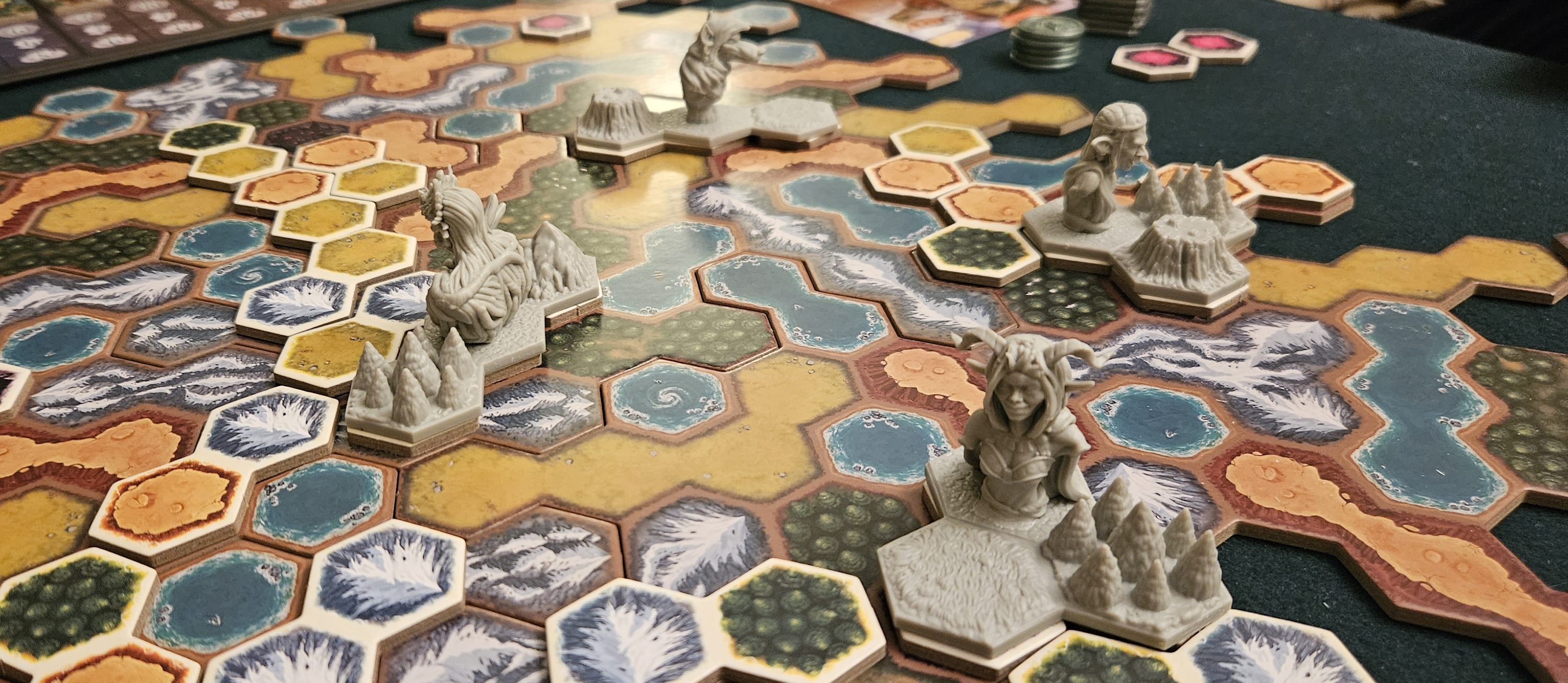
Empires of the Fertile Crescent. I mean Ulos.
It begins with a landscape. From a god’s-eye view, the land is an abundant welter of forests and fields, mountains and arid plateaus. This is the world In The Beginning. Fast-forward fifteen minutes and the beings that populate the place will have invented genocide.
But we haven’t reached that threshold quite yet. At the outset, Dawn of Ulos is all about placing tiles. Somewhat surprisingly, the tiles you place are tightly controlled. They come in pairs, always two hexes together, and can only be laid over the top of matching terrain.
When placed in the right arrangement, new life springs forth in the form of a base camp. Each base camp belongs to a single race. These are the species that you, as one of the competing deities of this realm, intend to toy with. Unlike the monolatrism that defined the regional gods of our own mythology, these deities are somewhat more equal opportunity. You are not, for instance, the Rat God or the Orc God or the Frogkin God. You are a neutral party who happens to be invested in the rise and fall of all these species together.
So you lay more tiles. Each faction has its own preferences. The Elves like open fields and dense forests. The Ogres like forests and mountains. Rats prefer fields and deserts. When a faction is matched to its preference by a cluster of placed tiles, its overall strength ticks upward. Little by little, the fledgling races of Ulos gain purchase, first as meager camps and then as local powers. Eventually, they’ll grow to be kingdoms and empires.

Each session is played with five (of ten) factions.
But who is a god without adversaries? The answer to this universe’s theological conundrum of pain is rather forthright: everybody suffers because the gods are remote figures who trade interest in their subjects like shares in a joint stock company. As theodicies go, that’s a stronger argument than plenty of the contortions we humans have slapped together.
In other words, your goal is to maximize your profits. When you pop a faction onto the table, you earn a free card from their stack. You can also purchase additional cards. The currency is “favor” or something, but it looks, functions, and tastes like money. Regardless of its provenance, you spend currency equal to a faction’s strength. Since strength rises based on how many of that faction’s preferred territories they control, it’s cheaper to get in on the ground floor.
In the game’s early stages, this is usually how it goes. Everybody creates a species. Then everybody buys some cards, maybe diversifying into multiple factions or doubling down if one of them seems like they’re going to take off like a firework. Over time, the value of your portfolio — sorry, the value of Ulos’s five factions, who are absolutely moral agents and not pawns in some sick cosmic game — gradually appreciates.
But it isn’t long before the world’s deities run into a cash flow problem. So instead of buying more cards, it’s time to use what you’re holding. Each faction has its own action. The Ratfolk expand quickly, adding extra tiles to the map in a single turn. The Sheki — tree people — rearrange existing tiles into new configurations, even breaking the normal placement rules. The Frogkin and Satyrs let you purchase cards from other factions for a discount. Some, like the Orcs and Dwarves, can pillage or remove tiles entirely, bullying the strength of nearby rivals. Whatever the particulars, you can spend a single card to take that faction’s action. You will lose the card in the process, but you’ll also earn some cash. As with everything else, the exact amount depends on how much territory that faction now commands.
Now we’re cooking. Buy a faction’s cards when they’re weak, beef them up, then spend them. It’s all so very Acquire. Simple, right?
Well. About that.
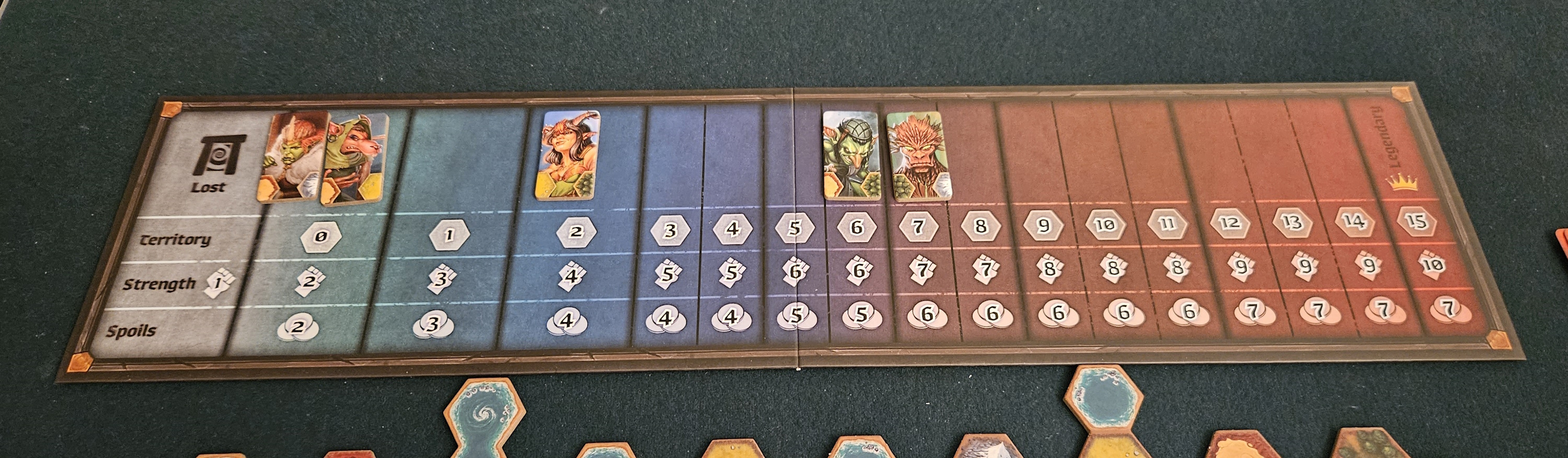
There’s a subtle but crucial curve to these power rankings.
The civilizations of Ulos are not destined to stay on the rise forever. They’re bound to jostle elbows. And when that happens, the game briefly reveals shades of Tigris & Euphrates. Specifically, the conflicts that occur when two of Knizia’s ancient kingdoms collide.
For those who, like me, struggle to keep Tigris & Euphrates’ wars straight, Lentz’s treatment of the process is significantly streamlined, although there’s only so much that can be pared away. This is Dawn of Ulos at its most phasey, and it’s important to keep the sequencing straight. The short version is that whenever a tile bridges two factions, it’s temporarily flipped face-down and both sides tally their strengths for an all-out war that will see one of them gobbling up their defeated foe’s now-vacated territory and the other disappearing into the annals of history. For a minute, anyway.
In Knizia’s masterpiece, everybody in the conflict is allowed to contribute tiles from their hand to sway the conflict. Here, players go through much the same process, albeit with a stockbroker’s spin. Every revealed card adds strength to its corresponding faction. Some, like the Elves and Flayers, have dedicated combat abilities that can be played into any fight, not only those that include their kind.
This can swing a fight in unexpected ways, especially when the entire table gets in on the action. The wrinkle is that half of the cards you dedicate to combat are divested, earning a quick infusion of cash but disappearing from your hand. This tends to amp up the swinginess, not to mention the mind games between gods. Because weaker factions are worth less, their owners tend to be freer throwing their cards into battle. Meanwhile, a cautious player who’s holding onto a half-dozen cards in an ascendant faction needs to thread the needle, spending enough so that they won’t lose their investment, but not so many that their stock in that faction doesn’t evaporate.
And the importance of these clashes cannot be overstated. They’re the hinges upon which Dawn of Ulos turns. In a single battle, a table-spanning empire might disappear, only for its territory to be instantly snapped up by the faction that destroyed it. The gods’ stock portfolios can prove similarly precipitous, dropping or skyrocketing in value. Measured play is possible, but it’s also prone to disruption.

Orcs and Frogkin come to blows.
The one stumbling block in Dawn of Ulos is the rift tiles. To invoke Tigris & Euphrates one final time, these are acquired much the way that game parcels out its gold tokens. Rifts begin on the map and function as the bedrock that the first few factions will be founded upon. Whenever a kingdom connects to one — whether by expansion or conquest — the current player claims the tile.
But where Knizia’s gold tiles were one resource among many, Lentz uses them to inject special powers into the game. Once per turn, you can spend a rift tile to trigger the ability on its underside. Most of these are benign enough, providing useful perks that don’t affect the course of the game too much.
Some, however, are a little too efficacious. To give one example, the Redistribute tile forces everybody to contribute a random card from their hand into a pool. These are then selected by the players at the table, going clockwise. In one session, this saw the two leading players get richer by nabbing (randomly!) a pair of high-value cards, while other players were treated to factions that had recently been destroyed. It was the least effective redistribution of wealth in nonhuman history.
For a game that’s otherwise so relentlessly player-driven, this is a misstep. The rest of the time, Dawn of Ulos is merciless. Not only in the sense that it treats players to wild swings of fortune, but also because those swings are the direct result of everyone’s actions rather than the whims of fate. When it shunts its consequences to a random shuffle of cards, it blunts the very sharpness that makes it so appealing.

Evaluating when to divest my stocks.
If you couldn’t tell, that’s an extremely minor complaint, one that’s solved by being choosy with which rift tiles get included in future sessions. I don’t often resort to house rules. It isn’t my job to fix somebody else’s game. But Dawn of Ulos is so dang good that I can’t help myself.
Because this is a vicious good time. It’s served best by a sturdy complement of three or four players, with two and five offering either too much or too little wiggle room. Similarly, it’s more group dependent than most titles; unless players are willing to bare their fangs, a session could prove very sedate indeed. But with the right crew it’s a surprise hit, a stock game that pulls new tricks with the format, a tile-layer that draws inspiration from the greats, and a contest that’s oh so perfectly nasty.
(If what I’m doing at Space-Biff! is valuable to you in some way, please consider dropping by my Patreon campaign or Ko-fi.)
A complimentary copy was provided.
Posted on October 2, 2023, in Board Game and tagged Board Games, Dawn of Ulos, Thunderworks Games. Bookmark the permalink. 13 Comments.

 SPACE-BIFF!
Cool, what an interesting twist on Tigris & Euphrates.
This is the only Roll Player-adjacent game that I didn’t back, but you do make it sound intriguing.
I’ll do one better: it’s one of my favorite games of the year!
This is now on my radar to track down. Big fan of stock-based area control/majority games. Imperial 2039 is likely my favorite but always happy to try more.
(whispers: I still haven’t tried Imperial)
It’s fantastic.
The flow of growing a nation to collect wealth and then having them get into a pointless war so they get obliterated so you don’t have to pay for that infrastructure is really interesting. With the rise and fall of nations and control of stock, there are a ton of shifting alliances that make for a great narrative arc as well.
I’ve definitely heard good things.
The only problem I have with Imperial is that I’m not really convinced with “who the player” represents. Closest similarity is to Pax Renaissance.
That being said, I do like Imperial 2030 quite a bit, and the wage of war to reduce tax bill is fun to do.
I have a first-world problem, then an unrelated question…
First, three friends are coming over tomorrow to play Root with my wife and I, two of whom are experienced and love the game, and one who hasn’t played but is excited to learn. But after re-reading this review, I really want to surprise them with Ulos instead! Alas, I think we should stick to Root, based on you saying Ulos doesn’t shine at 5p. Also, I don’t expect you to talk me, or anyone, out of playing Root hahs
Next, my question: It’s too bad you say Ulos has too much wiggle room at 2p, because my wife and I are THIS close to finishing Knizia’s My Island (only one chapter left, and yes, we’ve also played My City), and we want more Knizia-esque 2p tile laying! Any suggestions?
FYI, we’ve played (and loved) all of the Flatout games a million times, Of course I wouldn’t call them Knizia-esque, but it seems they’re the most commonly-recommended tile-laying games nowadays.
Heck, it’s not just about Knizia’s tile-laying, it’s about that sweet, sweet player interaction lol. The only Knizia game I’ve found with a semblance of that at is Quest for El Dorado.
Pingback: Best Week 2023! Puzzle Time! | SPACE-BIFF!
Pingback: Dungeon Accountant | SPACE-BIFF!
Pingback: Choo Choo Choom | SPACE-BIFF!