Fashion Is Danger
I had a revelation yesterday. After publishing my review of fashion game Couture, one reader asked if I had mentioned my ignorance of the topic as a form of hedging, perhaps to distance myself from something that might be considered “girly.” After all, one recalls how Prêt-à-Porter, the fashion industry game by Ignacy Trzewiczek and Piotr Haraszczak, was derided by some as unworthy of attention because it wasn’t “serious.” Serious, of course, meaning manly. Like war, trains, stock trading, and painstakingly accessorizing a paper doll cutout for a dungeon dive.
But when I think back, I’m not sure I’ve ever thought of fashion as dominated by women. To me, dressing women in outfits and having them glide down the runway for a crowd’s viewing pleasure always seemed rather male-oriented. Still, the question made me realize something. While fashion has never struck me as inherently feminine, I have always thought of it as frivolous. Much like Anne Hathaway’s character in The Devil Wears Prada scoffing over the false choice of two near-identical belts, fashion inhabited my mind as an expensive pursuit for people with more money than sense.
Until I played The Battle of Versailles.

Rule the runway.
Designed by Eloi Pujadas and Ferran Renalias, The Battle of Versailles is a recreation of the titular fashion show of November 1978. Pitched as a contest between French and American fashion designers, the show’s objective was to raise money for the restoration of the Palace of Versailles. It featured such high-profile designers that even this Kirkland Signature-clad ignoramus recognizes the names Yves Saint Laurent, Halston, and Anne Klein.
It’s also a card-driven game — a CDG, to use the acronym that marks any given title as Serious Business. CDGs, you see, are the province of wargames. There are multiple formats of CDG, but the broad concept is that cards represent historical events or figures, and can either trigger their stated effect or be spent for a generic action. Take Twilight Struggle as a starting point and you won’t go amiss.
From there, the format has flexed over the years. Where once it was limited to dense historical titles, it’s come to be used in all sorts of games. Just this year, we’ve seen it deployed to great effect in hefty games like People Power and Fire & Stone, but also more approachable fare like Land and Freedom, The Hunt, and Votes for Women. Even science fiction is on the table, à la Robotech: Revolution.
But The Battle of Versailles represents something different. Unlike those previous games, the stakes couldn’t be lower. Lives aren’t on the line. Political power isn’t reshaping itself. There will be no executions or reeducation camps once the dominant regime has been thrown down.
Yet that’s exactly what makes this such a fascinating game. Pujadas and Renalias explore their topic with exactly as much gravity as any other CDG. The result feels very much like a wargame. A lighter wargame, to be sure, but one that speaks to a clash of aesthetics and even values. It is, in its own way, as ideological a work as the other titles I listed, sans the implied gristle.
Designers, dresses, events, celebrities.
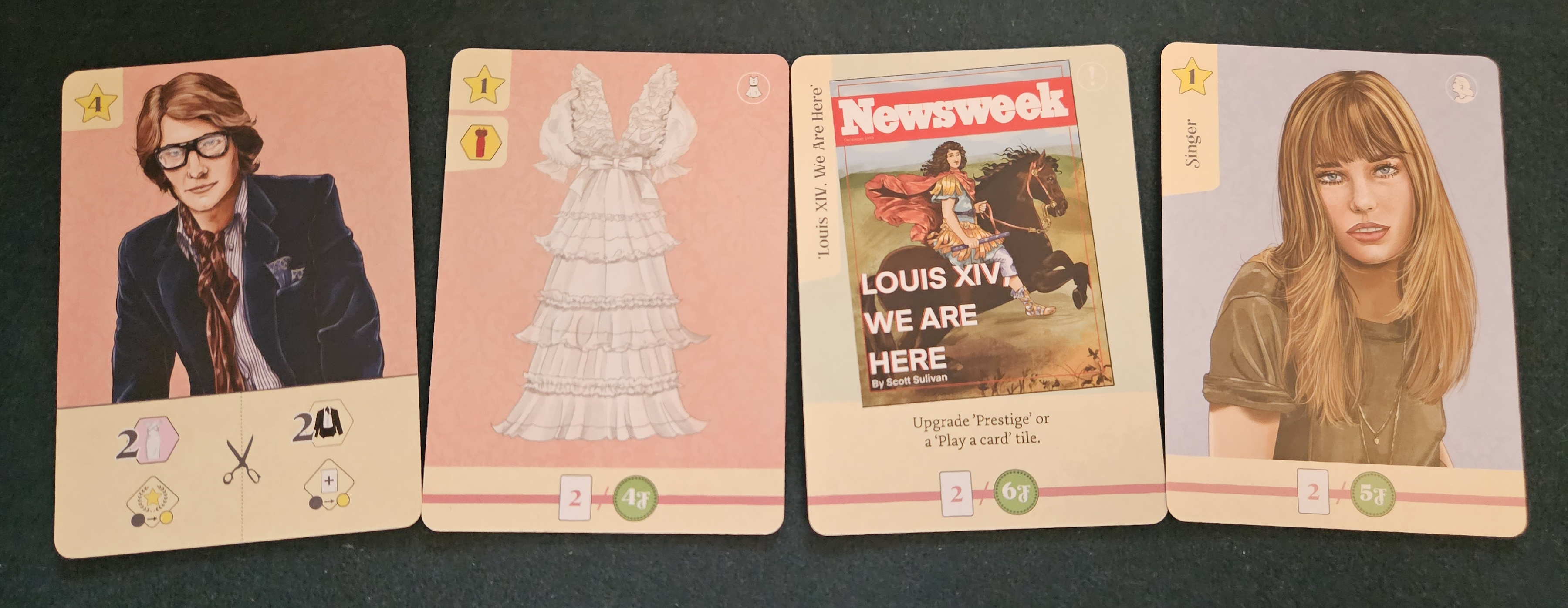
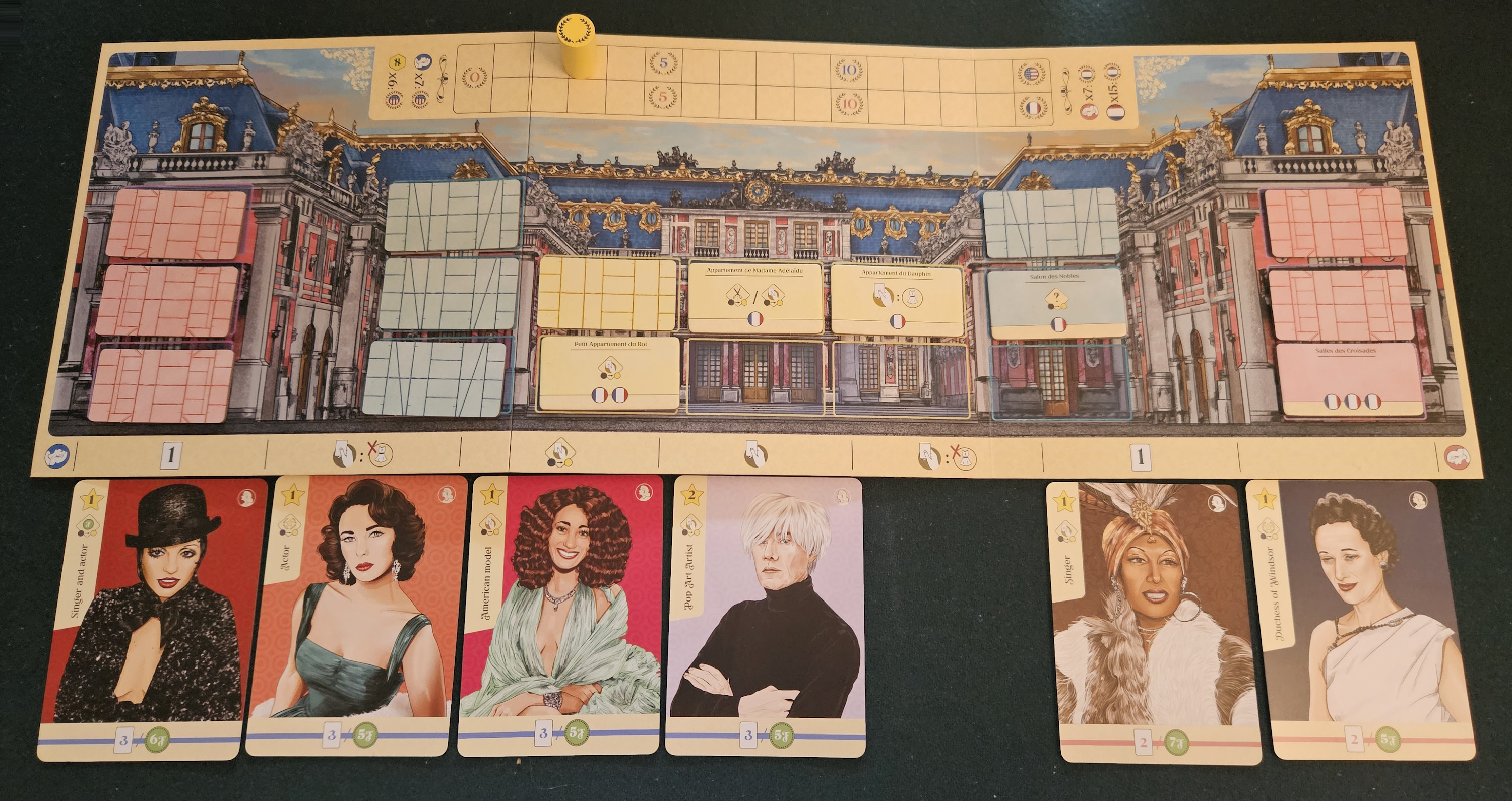
At its most basic, the card system replicates what works about the format. Both the French and the Americans have their own decks, from which they draw cards representing dresses, celebrities, and events. These are each played in their own way: dresses along the runway — more on that in a moment — where they contribute to the show’s competing aesthetics. Celebrities go to Versailles itself to hobnob and trigger special actions. Events do the usual thing and trigger some miscellaneous outcome. Any card can also be spent on a generic action, although the selection is strictly limited to either drawing more cards or contributing to the Palace’s renovation. It’s all very familiar, not to mention streamlined to a silky sheen.
Within that framework, however, there are terrific antics to be had. The historical show exhibited two clashing sensibilities. The Parisian maisons approached it as a matter of course, leaning into tradition with a two-and-a-half hour show and classic styles. The American designers approached it with all the verve of guerrilla partisans, limiting their time on the runway to a lean 37 minutes, but hiring Black models and showcasing radical new fashions.
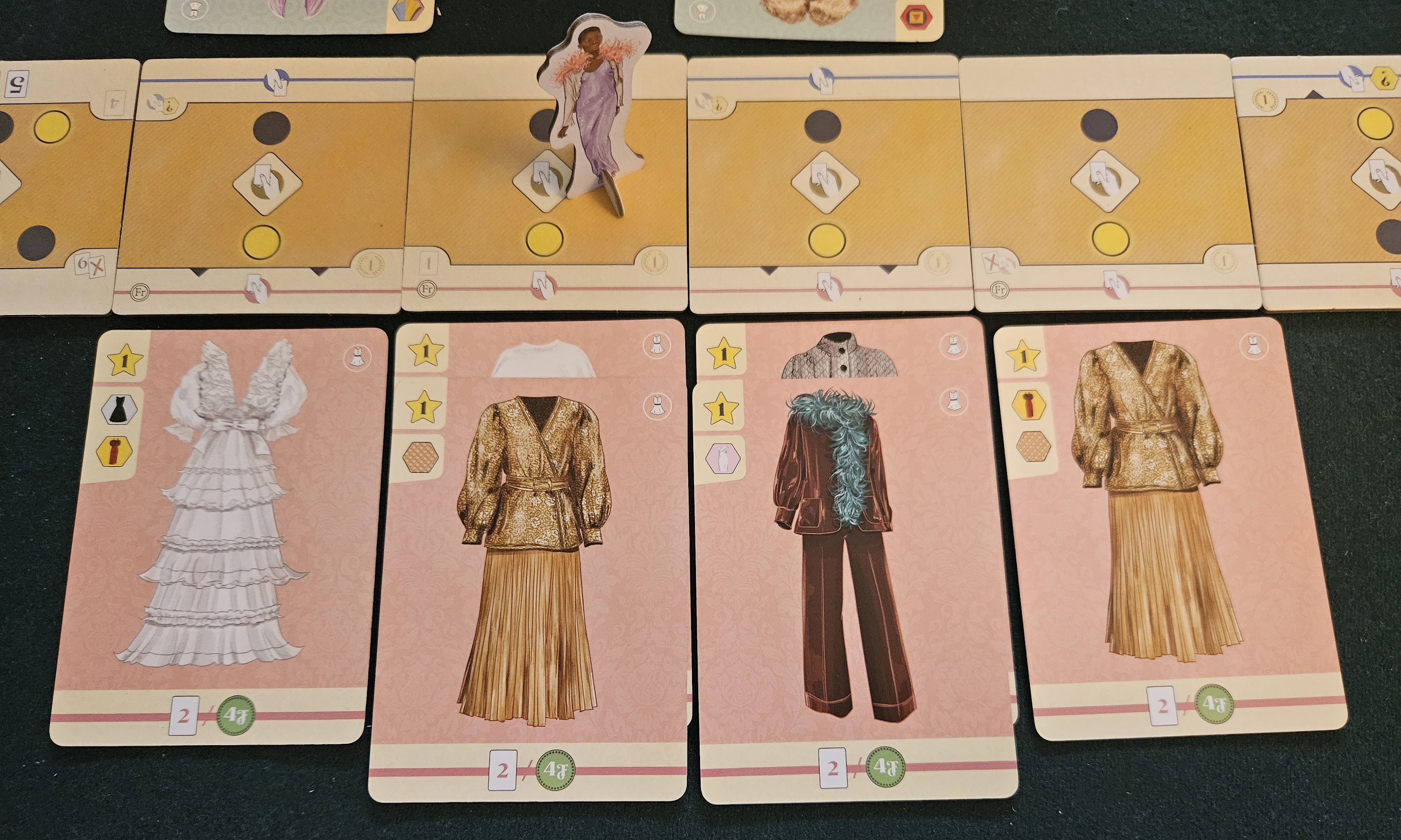
Everything is built around the runway, a series of tiles that walk players through the steps of each round, represented, naturally, by a model proceeding from one tile to the next. This also showcases the divergent approaches of the game’s two sides. The French player gets to take five actions per round, presenting an entire wardrobe before the show is complete and potentially overwhelming their opposition through sheer numerical superiority. With less time on their hands — in game terms, only three actions per round — the American team must dazzle with each and every play.
I’ve been there.
That’s not all. The runway itself is a fraught environment, prone to accident and disruption. Certain events allow players to swap sections, potentially skipping a tile entirely. Needless to say, this can prove devastating when somebody misses out on an action. Tiles can also be upgraded, swinging that portion of the runway into your favor and providing little bonuses, advantage in initiative, even extra cash or prestige when those phases roll around.
Every little bit matters, because both sides have their own objectives in mind. Both succeed if they amass enough prestige, but they also highlight contrasting ideas of what victory means. The French are more invested in having the Palace restored, so they tend to invest more of their cards into renovation projects. These award bonus tokens based on who bids highest, triggering additional upgrades or special actions, and if the French acquire enough flag icons it might result in an early victory.
But the Americans are never far behind. They can either win by showing off a diverse set of dresses or by bombing the show’s afterparties with so many celebrities that the judges are romanced into accepting American cultural hegemony. The former is the tougher option: dresses are arranged over the top of previous showings, adjusting the icons they display, and are prone to occasional manipulation. But the latter poses its own challenges, since the French have celebrities of their own. The real show concluded when Liza Minnelli, hot off her performance in Cabaret, led a parade of models down the runway to a roaring reception. The board game is prone to similar upsets, behaving like a race in multiple directions at once.
Putting on the best show possible.
It’s a rather mean game. One might call it catty, although maybe that makes too many assumptions about the setting. But its spiteful edge is also celebratory, reveling in an industry that thrives on uncertainty and speculation. Near the end of the catwalk are designer cards. These change every round, and offer bonuses if the proper styles are highlighted. It isn’t uncommon for these to drive the turn-by-turn action as players showcase a dress only to have their opponent bury it, or else remove it from consideration altogether. To call such turnabouts galling would do them a disservice. More than once, a designer has been entirely humiliated when their best efforts fell through.
Perhaps that’s why The Battle of Versailles works so well. Lives may not be on the line, but livelihoods? Reputations? The egos of its contestants? Wars have been fought over less.
Because the topic is played straight rather than handled with a wink and a nudge, the game slides gracefully into a larger conversation. Board games have long held a fascination for imperialism, perhaps even a fetish, with their focus on geography and growth and colonial action. Here is a game that’s about another form of imperialism, one in which the very clothes on one’s back, the names of the rich and famous one recognizes, the importance of a site like the Palace of Versailles, are up for grabs. Pujadas and Renalias treat their subject matter with the reverence it deserves. Such competitions may well appear frivolous — they may well be frivolous — but they’re also the quickening fount of culture and, by extension, cultural dominance. Textiles and clothing have often been the direct topic of imperial action, as much as tea and spices and oil and all the rest. Where other wargames portray such material resources as chits, The Battle of Versailles argues that they’re acts of imagination. This isn’t merely an exhibition to raise some scratch. It’s a struggle to shape what the public perceives as desirable.
That extends to every corner of the game. The designers display a keen eye for which parts of the show mattered most. The dresses and designers are only one portion of a greater whole. It’s also about which skin colors make a suitable palette for everyday fashion. It’s about whether professional women’s clothing can be more than feminized menswear. It’s about how proximity to celebrity can overwhelm the senses. It’s about national honor struggling in the face of a new wave of feeling. Old versus new. Tradition versus the shake-up. In the process of examining these competitions, it’s certainly as pertinent as any game about an overlooked field of battle.
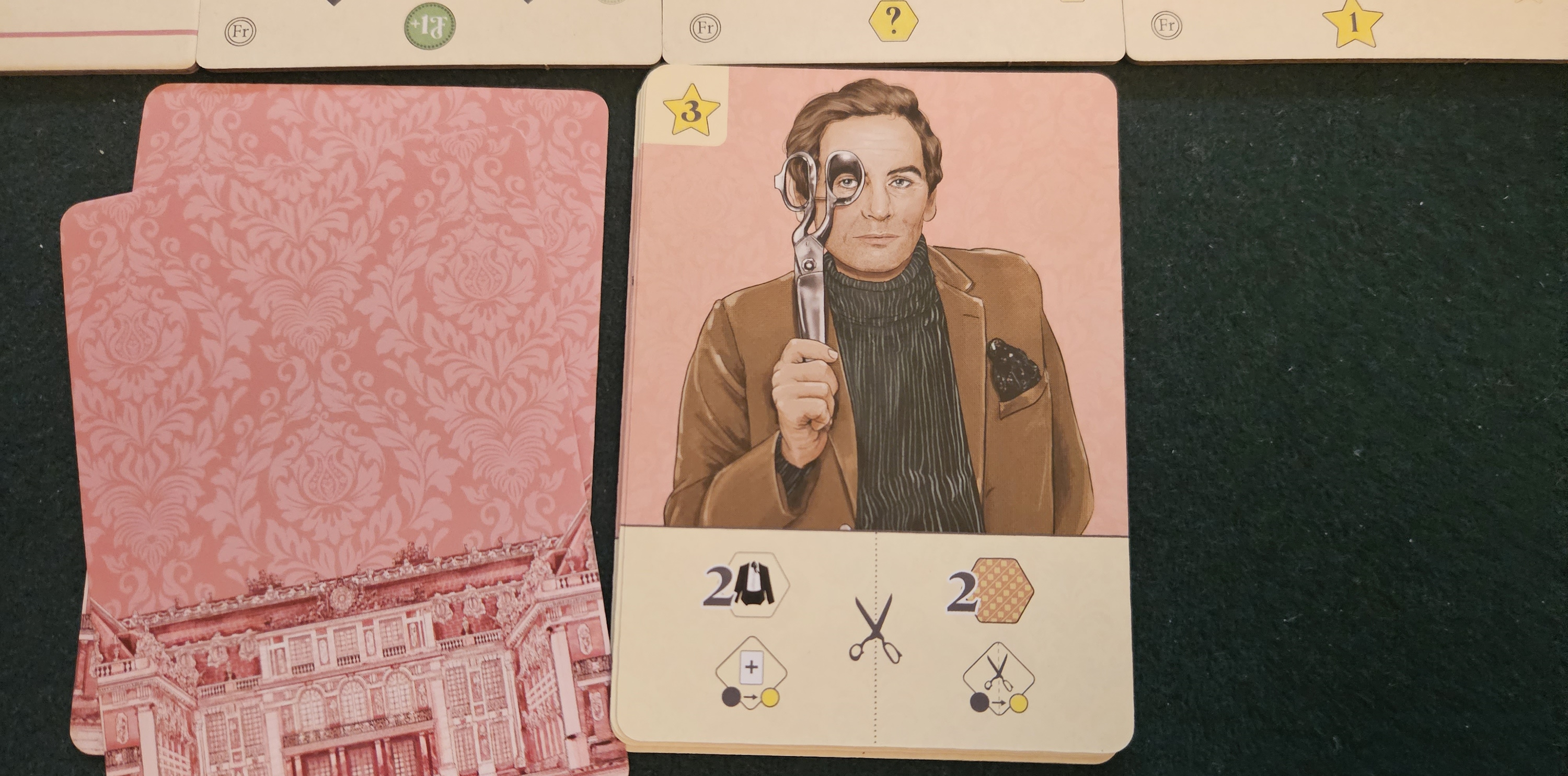
The designers work to show off their skills.
It’s also a rip-roaring good time. That cannot go unsaid. Sure, there are quibbles. I suspect the Americans are a little easier to play than the French, although I’ve won as both and lost as both. Certain concepts and icons are only absorbed after the requisite growing pains. And some of its protagonists seem as insufferable as George S. Patton.
But this is the good stuff. The Battle of Versailles takes the best of a well-worn genre and applies it to the most unexpected of settings, using the language and systems of wargames to tremendous effect. I’m not going to be popping flashbulbs at catwalks anytime soon, but this is a supernal example of how material culture can be treated as an object of serious study and play. The result is not only a fine game; it’s one of the finest “wargames” of the year.
(If what I’m doing at Space-Biff! is valuable to you in some way, please consider dropping by my Patreon campaign or Ko-fi.)
A complimentary copy was provided.
Posted on September 14, 2023, in Board Game and tagged Board Games, Salt & Pepper Games, The Battle of Versailles. Bookmark the permalink. 15 Comments.

 SPACE-BIFF!
I’m always on the look-out for games to play with my couture loving wife. How would you describe the integration of theme here? Is it something truly integral to the game, or “just pasted on?” We’ve been burned before.
Tight integration. Couture, which I reviewed yesterday, is flimsy. But this one is all about the setting, bone-deep.
Great writeup Dan. This game sounds absolutely mesmerising
Thanks! And yes, this one is considerable.
Wow, that sounds surprisingly interesting. I would have witten this off if not for your review.
I almost wrote it off myself.
Thank you for this review. We are really pleased with your depth analysis of the game.
Regards,
Ferran Renalias
Thank you for creating such a wonderful game!
Great review. One quick question, Dan. If my wife and I love Watergate, we will like this game. How would you compare them?. Gracias!.
They’re both card-driven, and in similar ways. Both on the simpler side, rules-wise, but with plenty to explore. This one is a little more expansive than Watergate (and I prefer it a bit), but they’re similar enough in terms of weight and heft that appreciation for one ought to translate to the other.
Pingback: Best Week 2023! War By Other Means! | SPACE-BIFF!
Pingback: Chuck Me in the Ocean | SPACE-BIFF!
Pingback: Conclave: The Board Game | SPACE-BIFF!
Pingback: Opera Is Danger | SPACE-BIFF!
Pingback: Monopoly Ruins a Great Train Robbery | SPACE-BIFF!