Charmed!
Taiki Shinzawa has designed no fewer than three of my favorite trick-takers: American Bookshop, 9 Lives, and Ghosts of Christmas. Now two more of his designs are getting wider distribution thanks to New Mill Industries. There’s Inflation!, formerly known as Zimbabwe Trick, and Charms, née Dois. Both titles very much want to punish you for making grave counting errors.

Inflation! is about… wait for it… inflation.
Let’s start with Inflation! Like 9 Lives and Ghosts of Christmas, Inflation! is all about bidding on how many tricks you’ll win. Nothing we haven’t done before.
But there’s a hiccup. Bet you didn’t see that coming. In lots of these contract bidding games, you can make a reasonably accurate guesstimate by assessing the usual strengths of your hand: high numbers, how many trump cards you’re holding, that sort of thing. Here, though, there are no suits, and hence no trumps. Instead, it’s all about the numbers — a whole lot of unevenly distributed numbers. Also numbers that have unusually persistent values. That’s because rather than playing a wholly new trick each round, your numbers pile up into the hundreds and thousands and eventually millions, splaying over the top of one another so that rather than a trick being decided by, say, 8 beating a 6, it’s decided by 4,729 beating 4,629.
You’re still required to follow. If somebody plays an 8 and you’re holding an 8, well, you’ll be placing that 8 on the table. Tiebreakers are important, and are often determined by glancing down-digit at a card you played multiple tricks earlier. In fact, it’s fairly common for an early flub to create a terrible spiral of failure.
Except, of course, you can count on those failures. Low cards are rare. Similarly, 10s, when covered by future digits, becomes zeroes. This lends the proceedings some interesting wiggle room. Inflation! isn’t about winning tricks. It’s about winning the right tricks. Suddenly, low numbers become persistent weak tiebreakers. They’re valuable the way high cards or trumps are valuable in other trick-takers. In this case, they’re reliable ways to lose instead of reliable ways to win. In the long run, that can provide a solid approach to betting. It’s also useful to understand how to leverage a single success into a chain of wins. By winning on a mid-digit card, you can creep upward from there, forcing other players to follow but winning on that earlier tiebreaker.
There’s a strategy here, and it feels great once it clicks, although like many of the genre’s exemplars that aha-erlebnis might require a few rounds before it truly lands. Even then it’s oddly enigmatic, asking players to exert tight control over sequences of cards. It’s possible I’m simply bad at it — I’m famously awful at trick-takers — but I do enjoy the consternation of trying to assess these ridiculous ballooning tricks in advance. Inflation! is still tougher to chew than some of Shinzawa’s other offerings, which says something when one of those titles is a game about hopping through time to confront specters of Christmas past, present, and future.
Charms, on the other hand…

Charms is charming.
…is pretty darn similar, despite feeling wholly different thanks to its card-matching core. Still, you can tell Shinzawa was working in a similar headspace. Or the other way around, since the original version of Charms came first.
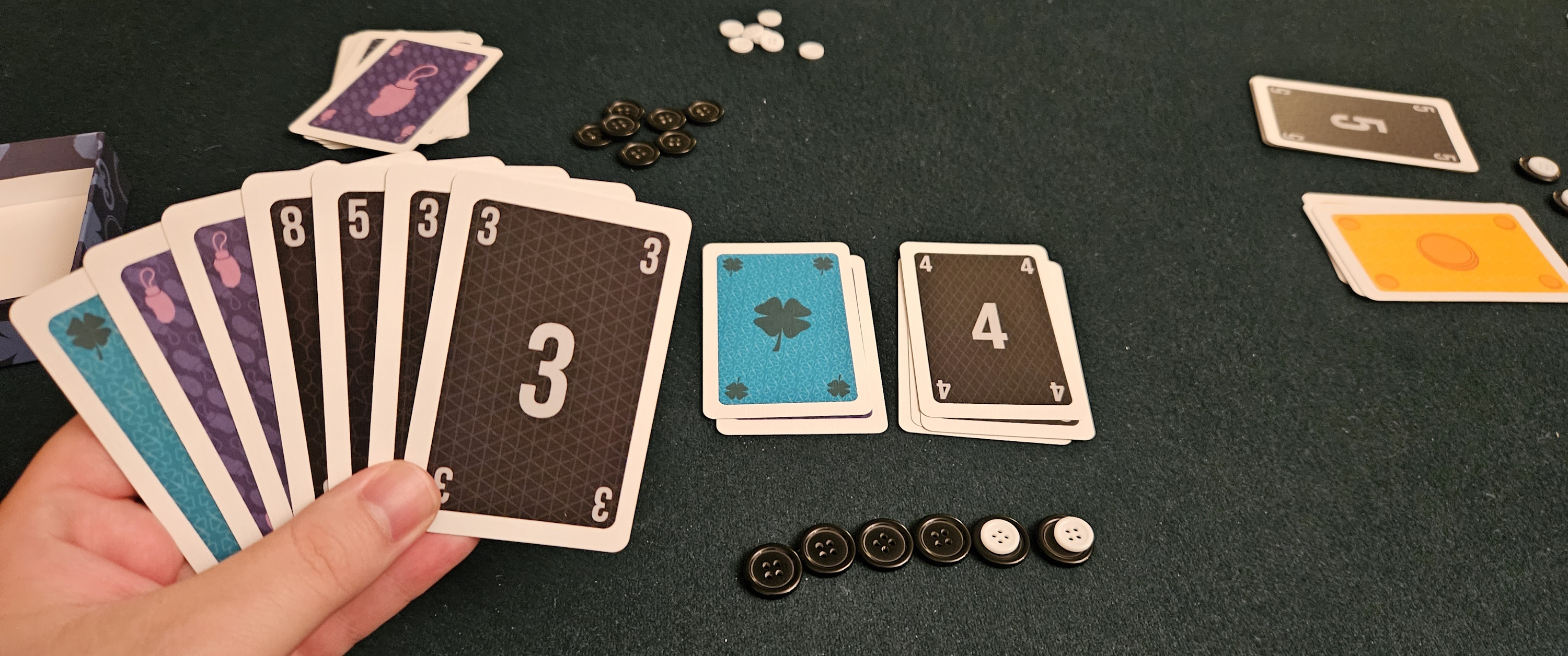
Like Inflation!, tricks in Charms stick around. Instead of accumulating into a twelve-digit mass, here they’re cobbled together via a combination of digit and suit. The deck composition is very nearly traditional; there are four copies each of eight digits, and eight copies each of four suits. By piling them together, players create shifting cards that once again have a high likelihood of needing to know a tiebreaker.
What sets it apart is that you’re only ever able to change either your number or your suit. As with Inflation!, this sometimes leads to chained wins that are fiercely difficult to break. And not only as an opponent, but also sometimes as a player who’s suddenly bringing home way too many wins and therefore overshooting their bid. To give one common example, if I win with a coin suit and an 8, I might flip the suit to the rabbit’s paw. Because suits are binding, everybody else at the table now has to swap suits as well, letting my paw-8 win once more. If I keep bouncing between suits, everyone else is thrust into a game of catch-up, handing me win after win — at least until somebody switches to the trump suit or I burn myself out.
Of course, there’s a very real possibility that I won’t want to win that many tricks. In fact, it’s an ordinary state of affairs in Charms to be on the lookout for ways to quit winning. That’s how easy it is to overshoot your bid target once you’ve started winning. Thanks to their combinatory nature, hands are unpredictable beasts. That’s one of many commonalities between Inflation! and Charms, both of which are subtly forceful despite their easy rules. I’ve argued elsewhere that contracts are one of the toughest mechanisms for newcomers to handle in trick-taking, and the same is true in both of these cases. These are deeply strategic games, demanding forward thinking and no small amount of up-front assessment, not to mention a stern sense of control over how to turn a win into a chain or break your own chain before it runs away. Despite their similarities, they manage to feel fresh and separate. Of the two, I prefer Charms. My wife has declared that she is roundly in the opposite camp.
No, see, this is a different image, because it’s a wider-angle shot.
In both cases, these are knotty but worthwhile trick-takers. Neither is what I would describe as beginner-level. Shinzawa’s 9 Lives is more forgiving, with its flexible bids, and I still prefer Ghosts of Christmas because time travel is a hoot. But both are good stepping stones for those looking to better master their bidding games. And, as is the case with the genre at large, there’s something soothing about the things. Despite the way they burn my gray matter, I can always count on these to leave me feeling both calmer than I began and slightly abuzz at how they use simple decks and similar concepts to generate such clever outcomes. All I play anymore is trick-takers. And that’s fine by me.
(If what I’m doing at Space-Biff! is valuable to you in some way, please consider dropping by my Patreon campaign or Ko-fi.)
Complimentary copies of both games were provided.
Posted on September 5, 2023, in Board Game and tagged Board Games, Charms, Inflation, New Mill Industries. Bookmark the permalink. 2 Comments.

 SPACE-BIFF!
Pingback: Hot Rook on Rook Action | SPACE-BIFF!
Pingback: Magenta One: Fives | SPACE-BIFF!