Sounds Swedish
I’m one of those nerds who insists that board games “get Star Trek right.” Just ask my reviews of Star Trek: Ascendancy, which offers a longue durée telling of the series’ civilizations, or even Star Trek: Super-Skill Pinball, with its emphasis on weird situations and problem-solving.
But it matters. Star Trek was the formative science fiction of my childhood. It was never as polished as Star Wars. Maybe more importantly, its collectible card game wasn’t nearly as interesting. But it was a series that celebrated doubt and skepticism rather than positing that its in-universe religion was the font of truth. In Star Wars, success was a question of believing hard enough. In Star Trek, it was a question of breaking down the problem into its constituent pieces and then working through them. For a kid grappling with existential questions in a culture that offered too many glib answers, Star Trek was a promise.
So when three sets of Star Trek: Away Missions appeared unbidden on my doorstep, I was skeptical. Hey, that’s the Star Trek way. Maybe I shouldn’t have been. Although Away Missions has plenty of problems, getting Star Trek right isn’t one of them.
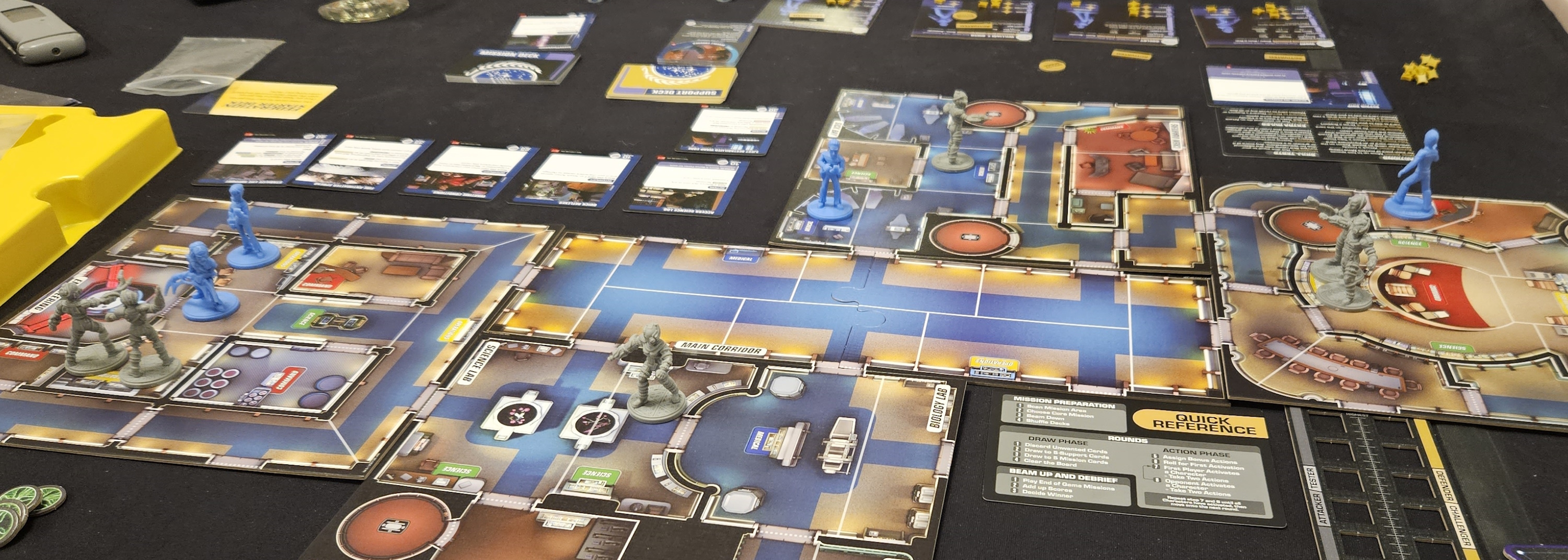
The Federation and Borg battle over an office complex.
The Battle of Wolf 359 looms large in Star Trek. It’s a moment of collective trauma for the United Federation of Planets, a staggering defeat for their fleet of exploration vessels and a moment that reminded Earth just how defenseless it could be. It was also a betrayal. Jean-Luc Picard, previously the captain of Starfleet’s flagship and spokesperson to countless new species, had been twisted by the Borg into Locutus, a mimicry of a diplomat.
Away Missions effectively takes place in that window between The Next Generation‘s third and fourth seasons. (Okay, technically the battle didn’t happen until “The Best of Both Worlds, Part II,” but stick with me.) The debris of the battle, thirty-nine starships and over eleven thousand lives, remain afloat in the wake of the passing Borg Cube. And now four factions descend on them like vultures. Each has their own goal. In the core set, a Federation away team led by Will Riker hopes to learn more about Borg vulnerabilities, while Borg drones and even Locutus himself seek to assimilate more Federation technology. And in the expansions, the Romulans and Klingons send teams to investigate the nature of this most recent threat.
What follows is largely faithful to the ethos of the series. The big question is combat. Too often, games about Star Trek focus on fighting rather than problem-solving — and in Trek, even the more combat-inclined races tend to look for any advantage they can get.
Right away, Away Missions makes a good first impression. Each faction sets itself apart by adhering to its own doctrines of battle. The Federation prefers to fire phasers on stun, and that’s if they stumble into a scrape in the first place. They’re more likely to avoid confrontation altogether, moving in force to mission-critical areas of the ship and extracting the necessary pieces of the puzzle. The Borg, on the other hand, behave largely like the drones they are. Early on, they’re barely a threat. It’s only with time that more of them beam in, either to assimilate individual portions of the ship or swarm the intruders. The Romulans are sneaky, setting traps and teleporting all over the place. And the Klingons… well, they’re more liable to raise their bat’leths and charge into battle.

The dice combat is replicated straight out of Spartacus. Nice!
Maybe it’s no surprise that my best sessions of Away Missions have always included the Klingons. There’s something about fumbling with a console while a space barbarian bears down on you that gets the blood pumping. The other matchups aren’t devoid of their own intrigues, but they don’t land with the same thwack. Pit the Federation against the Romulans, for instance, and there’s a good chance that neither side will ever directly engage the other. They might never even enter the same room.
That’s due to how Away Missions handles victory. Each side builds two decks, one filled with points-scoring mission cards and the other filled with tricks and tools and events. They’re slender decks, twenty cards apiece, easy enough to tinker with for ten minutes before launching a mission, but also dense enough that there are some false starts to avoid.
One such false start is relying too much on your opponent’s behavior. In one session, I figured I could kit out my Klingons for battle. Sure enough, they’re replete with tools for just such an occasion, all jagged cutting implements and blood oaths and stained honor. One of their missions required me to defeat a certain number of enemies. Easy enough. But it also required me to lose some of my own soldiers. That sounded easy, too. After all, I was going to be charging headlong into phaser fire!
Except my opponents didn’t bother firing back. Not very often, anyway. They were too busy fiddling with consoles and scooping up castoff Borg tech. The losses I inflicted on them were acceptable. They were in a hurry. A session of Away Missions lasts exactly three rounds. That’s not a bad slice of time, less than an hour at the table, but it’s over before you know it. In some cases, especially for the Klingons and Borg — both of whom ramp up with the passage of time — it might not be enough to actually accomplish your goals. That goes double for situations where you want an opponent to fire on you. A peace-loving space hippie opponent. Who sets their phasers to stun. And is more interested in pressing buttons than pulling triggers.
It might sound odd to complain that Away Missions is too peaceful. Didn’t I just note that Star Trek games too often emphasize combat over problem-solving? Well, yes. But one of the prime tensions of Star Trek is what happens when a conflict-avoidant group gets drawn into battle. The Fed might prefer to fight with their words, but they aren’t averse to deploying superweapons when no other option presents itself.
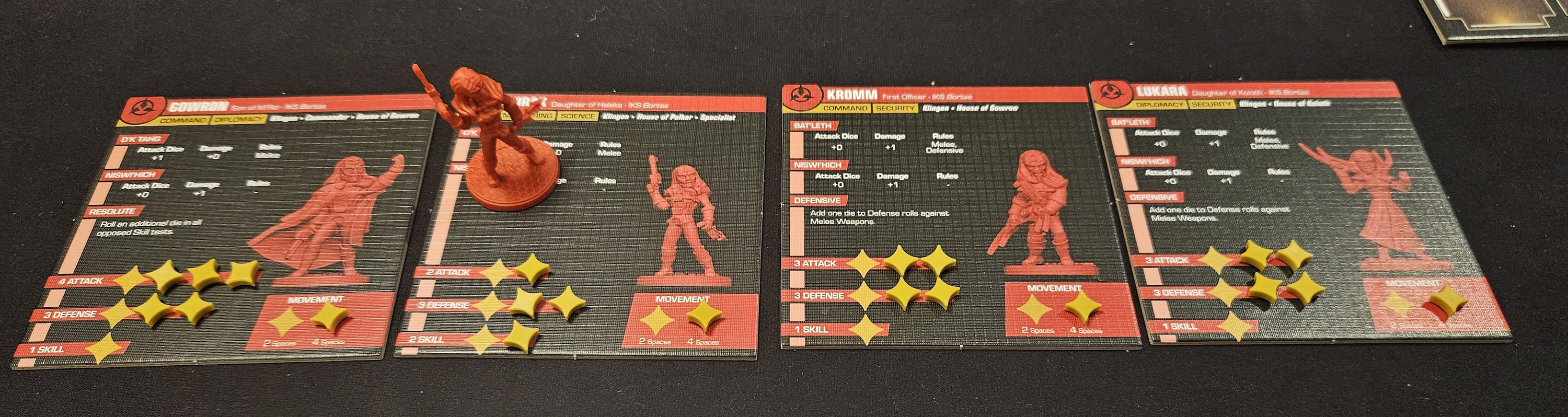
Play as your least favorite characters from the show!
In Away Missions, such eventualities are rare. This reduces some sessions to dice races. Both sides move into their respective rooms, reveal mission cards that require them to engage with a science or command console in the medical wing or on the bridge, and then roll to see if they’ve succeeded in earning some points. On rare occasions, a mission will require multiple inputs at once — say, by requiring two away team members in different parts of the ship — or take multiple rolls to succeed, or whatever. These are exceptions. More often, missions are straightforward. Go here, push this button.
This is partially a symptom of the way the game’s decks are structured. As it stands, your missions are entirely determined before the game even begins. There’s still an element of tactical problem-solving, since you only draw so many cards from each deck. But it’s still possible — even likely — that players will stack their decks with reliable missions rather than those that require input from their opponent. This robs the game of any opportunity to adapt on the fly, and results in a bunch of missions where both sides dance around each other rather than being forced to engage in direct conflict. The time crunch is simply too oppressive. You’ll only have so many turns, so many actions, so many cards, before the conflict concludes. So why bank those precious potential points on anything as uncertain as disrupting your opponent?
To offer some pointless theory-crafting, it might have been better to pitch the two decks as offensive and defensive rather than as missions and support. That way, each side could build decks around both styles of play and then work with whatever they happen to draw. This would create a new problem, since it would be possible to never draw your best point-earners. But that’s a problem already.
Of course, there are in-game solutions as well. That’s why the Klingons are so appealing. The same goes for the Borg to a lesser degree. Although they can assimilate their foes, they begin each match with such an emaciated roster that they’re unlikely to have enough wiggle room to steal away a good troop and then make much use of them. So why not put those drones to work reaching consoles and pressing buttons? And just like that, now we’re back to avoidant sessions with more dice races than inter-factional friction.

The Romulans go poking around in places they don’t belong.
I dunno. It says something positive about Away Missions that I like it enough to want to see its shortcomings rectified. To be sure, it produces memorable moments. Like when my Borg assimilated Worf. Or when the Romulans blew up a console in my face. Or when Data decided he’d had it up to here with this Borg shit and started tearing drones apart. To be clear, this latter occurrence was not an efficient use of Federation resources. It was just something cool they decided to do because they were already leading in points.
That’s Away Missions in a nutshell. Some of its best moments happen because ordinary play doesn’t cut it. It’s one of those games where you have to play along with its idiosyncrasies to get the best out of it. I’d rather it produce them as a matter of optimal play. So it goes. As much as it gets Star Trek right — and it gets a lot right — it fails to generate the stakes that made The Next Generation enthralling. Maybe that’s why this episode got stuck in the slush pile in between seasons.
(If what I’m doing at Space-Biff! is valuable to you in some way, please consider dropping by my Patreon campaign or Ko-fi.)
Complimentary copies of the core set and first two expansions were provided.
Posted on August 29, 2023, in Board Game and tagged Board Games, Gale Force Nine, Star Trek: Away Missions. Bookmark the permalink. 10 Comments.

 SPACE-BIFF!
I can name so, so many games that I like enough to want to see their shortcomings rectified. Darn shortcomings!
Me too. Most of the time, though, it’s easy enough to move onto something else!
I don’t think there will be ever a good game that “gets” Star Trek. What you describe as problem solving, is, if you transfer it to a board game, solving a puzzle. A puzzle is not the same as a board game and puzzles can only be solved once. You can abstract the puzzle solving rpg style to a die roll, but that makes for a not very interesting board game. So there remains the fight or a more strategic level like Star Trek Ascendancy..
I really don’t know where this idea came from that a puzzle can only be solved once, or only have one solution, but I’ve been hearing all sorts of people say as much. The big problem is that it isn’t true. In all my reading of emigmatology, I’ve never once seen either of those offered as necessary or sufficient definitions of puzzles.
But even if we were to grant that definition (which I very much do not)… so what? There are plenty of episodic board games that offer unique single-solution puzzles. Star Trek might fit a format like TIME Stories or Sherlock Holmes: Consulting Detective better than what Away Missions has to offer. It’s a question of creativity, not possibility.
Well, if there are puzzles with different solutions, I have yet to encounter them. But you are perfectly right, a solution like Sherlock Holmes: Consulting Detective would be feasible. Not something I like, because it is not replayable, but that is certainly a matter of taste.
I mean, there are tons of those around. There are “multiple setup” puzzles, where technically every single specific setup has a single solution, but there are a lot of possible setups, and easy enough way to generate them: Rubik’s cube, sudoku, picross. And then there are programming puzzles, things like Shenzhen I/O or SpaceChem, that have countless possible solutions for every puzzle, and where often challenge is not just finding a solution, bur trying to find a good solution specifically
Regarding your opening sentence, I see that you haven’t reviewed ‘Star Trek: Fleet Captains’. So, have you played it?
If not, then speaking as a long-time boardgamer and a Star Trek fan, I think you’d find that ST:FC gets Star Trek right! Whereas “Ascendancy’ is Star Trek presented on a grand, strategic scale, spanning decades and even centuries, ‘Fleet Captains’ presents Star Trek on a tighter, operational level.
Also, whereas ‘Ascendancy’ events immerse the players into the broader plot lines of the different Star Trek TV series, ‘Fleet Captains’ events bring to life individual episodes.
Is that the one based on Mage Knight? I played it once way back in the day. I also recall thinking that it captured Star Trek pretty well. Good pick!
Actually, no. The one that plays like ‘Mage Knight’ is ‘Star Trek Frontiers’. Actually, I’d say that ‘Frontiers’ presents Star Trek in the LEAST way out of the “big three” (The “big three” being ‘Fleet Captains’, ‘Ascendancy’, and ‘Frontiers’. Though now with the release of ‘Away Missions’, we might have to change that to the “big four”).
Anyway, for Star Trek Fleet Captains: https://boardgamegeek.com/boardgame/79127/star-trek-fleet-captains
It’s in stock at various times, and is usually on the 2nd-hand market. Game Nerdz is showing it as a pre-order which suggests that Whiz-Kids will be coming out with another reprint. Maybe. But still, I personally think this is the most thematic of all the Star Trek games ever published so far, including ‘Ascendancy’. And I think ‘Ascendancy’ is great.
Darn it! They look oddly similar to me. Guess it’s those clicky bases.