Rage Against the Artificial Machine
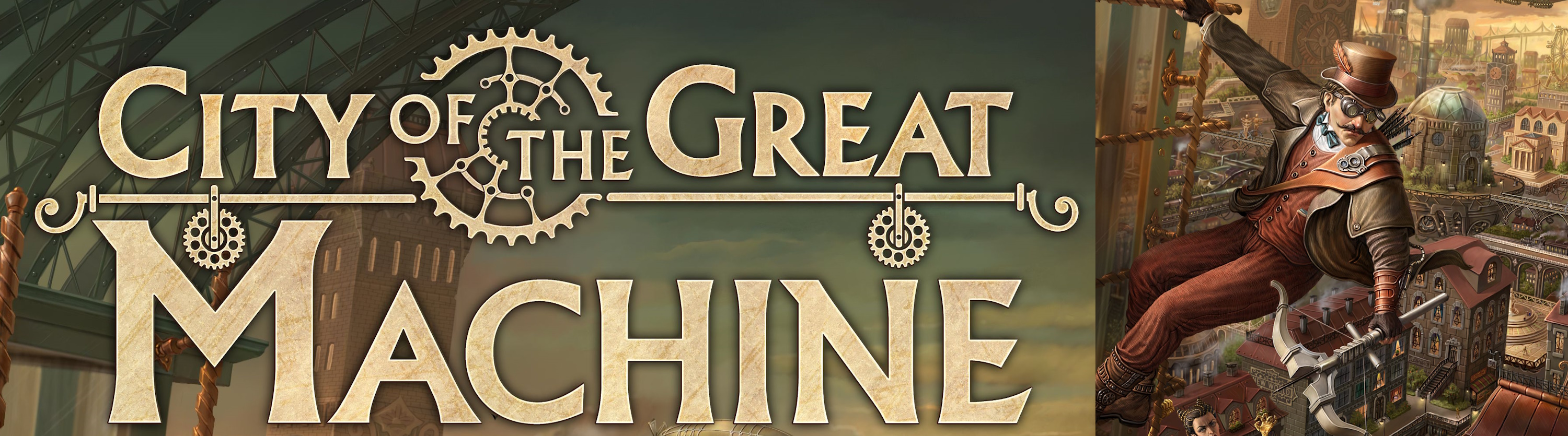
There are two cautionary tales in City of the Great Machine, the recent board game by German Tikhomirov. The first and more intentional of these tales is one we’ve read and watched and played many times. Decades ago, the citizens of this steampunk setting decided to automate the humdrum chores and maintenance tasks that were necessary for the operation of their floating city. Thanks to some serious feature creep, the great machine gradually took over more and more of the city’s labor. First it was factory work. Then sanitation. Next, security. Eventually, art. Tomorrow, perhaps, it will automate thinking altogether.
A resistance has formed. These brave men and women, armed only with stovepipe hats, corsets, and the occasional geared implement of war, intend to smash the great machine. Their one problem? Whenever they talk about the dang thing, everybody is too busy tinkering with its latest Midjourney ChatGPT steampunk app to pay attention.
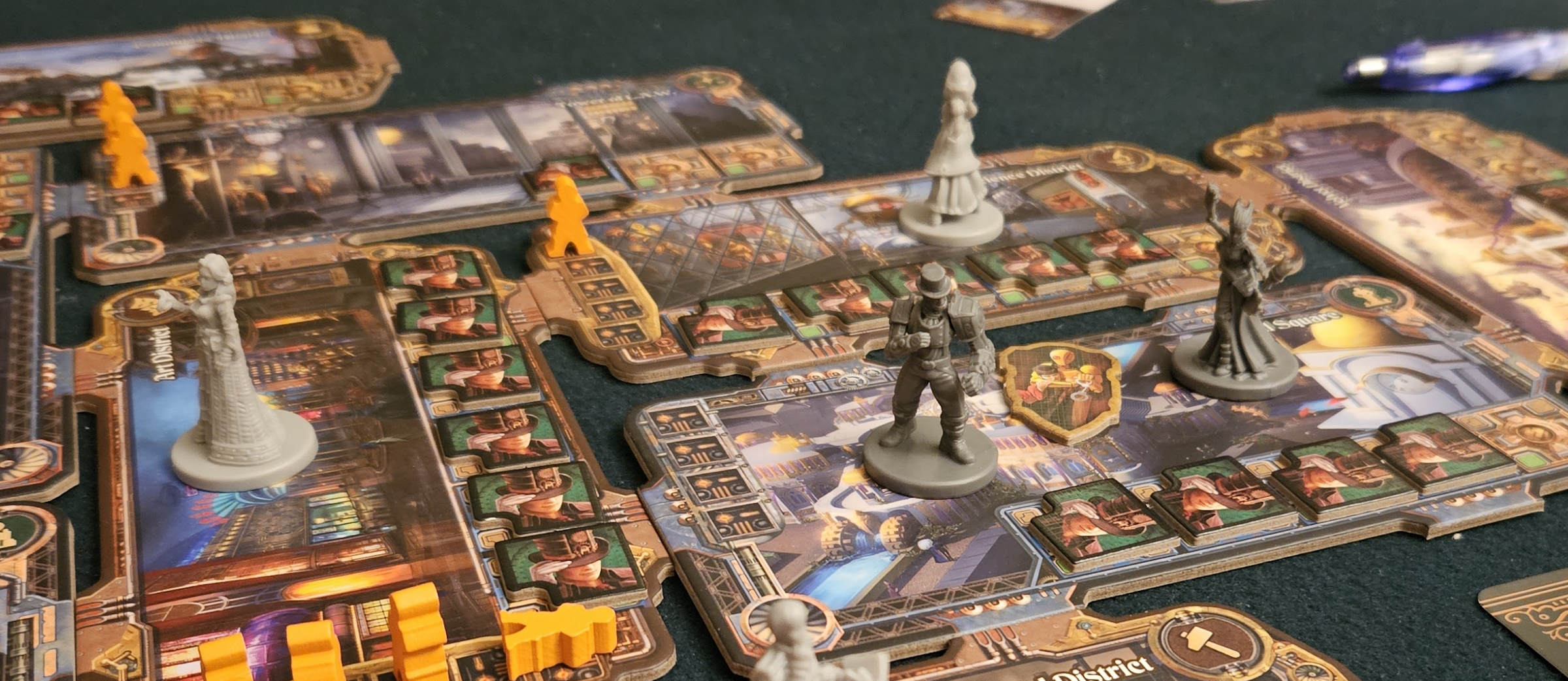
This week: hotties vs. ugly cyborgs.
That’s a hefty reality for a fantasy board game to tackle. When City of the Great Machine opens, nobody is willing to listen to your resistance cell. They can’t even conceive that there are problems with the system they’ve devised. Oh, the machine knows what you’re up to, and it’s happy to counter your efforts, but even its attentions are mostly invested elsewhere. The process of resistance is surprisingly similar to modern activism, all pounding pavement and trying to raise awareness. Granted, there are some additional frills — the city’s cyborg enforcers come to mind — but even those aren’t quite as much of a stretch as we might prefer.
In game terms, whipping the public into a frenzy takes a few steps. First, your resistance fighters need to travel to the districts where people live and holler about the injustices of the great machine. This increases the city’s unrest, gradually swaying its various classes to your side. The initial adherents to your cause are the city’s artists, probably because they’ve read enough speculative fiction to understand why a machine that eats literal human agency is majorly sus. Scientists are next; they’ve checked the data, and yes, the great machine lubricates itself with cerebral glucose. It takes more legwork to bring everyone else into the fold. Merchants, industrialists, and nobles all benefit from the stability the great machine’s oversight brings. Even when it’s on the cusp of total dominion, there are still those who will regard mechanical mustaches as a worthwhile trade for their free will. But little by little, it’s possible to bring most people onto the right side.
If only that’s all it took. Awareness may constitute the first battle, but it isn’t the last. It’s also necessary to organize. This is done by peeking at face-down citizen tokens to ascertain who will support the resistance in any given district. It’s then possible to shuffle them around, moving them to other districts if necessary. Along the way, the great machine might intervene. It can reposition guards to preemptively block your efforts, or even arrest citizens it deems deviant. With some luck, however, you can position a groundswell of popular support in the right location. There’s a confrontation at that point. If the district is filled with more citizens who are aware of the great machine’s abuses — we might call them “woke”; the game calls them “active” — than traitors and mechanical cops, the ensuing riot will bring you one step closer to freeing the city.
Along the way, there’s another component to keep in mind. Trust. Your in-game currency is aptly named, requiring your resistance members to be present and visible, drawing on popular support to spread the good word. Naturally, the great machine has plenty of tools for undermining the public’s willingness to listen to you. It isn’t uncommon to spend an extra turn building up trust, only for the great machine to swoop in and smear your good name, probably will an ill-timed arrest. The central irony is undeniable: as a member of the resistance, your public-facing persona must be impeccable. Meanwhile, your foe’s public relations team is staffed by cybernetic monstrosities who show off their killing limbs at every opportunity and wield all the empathetic appeal of a black hole.
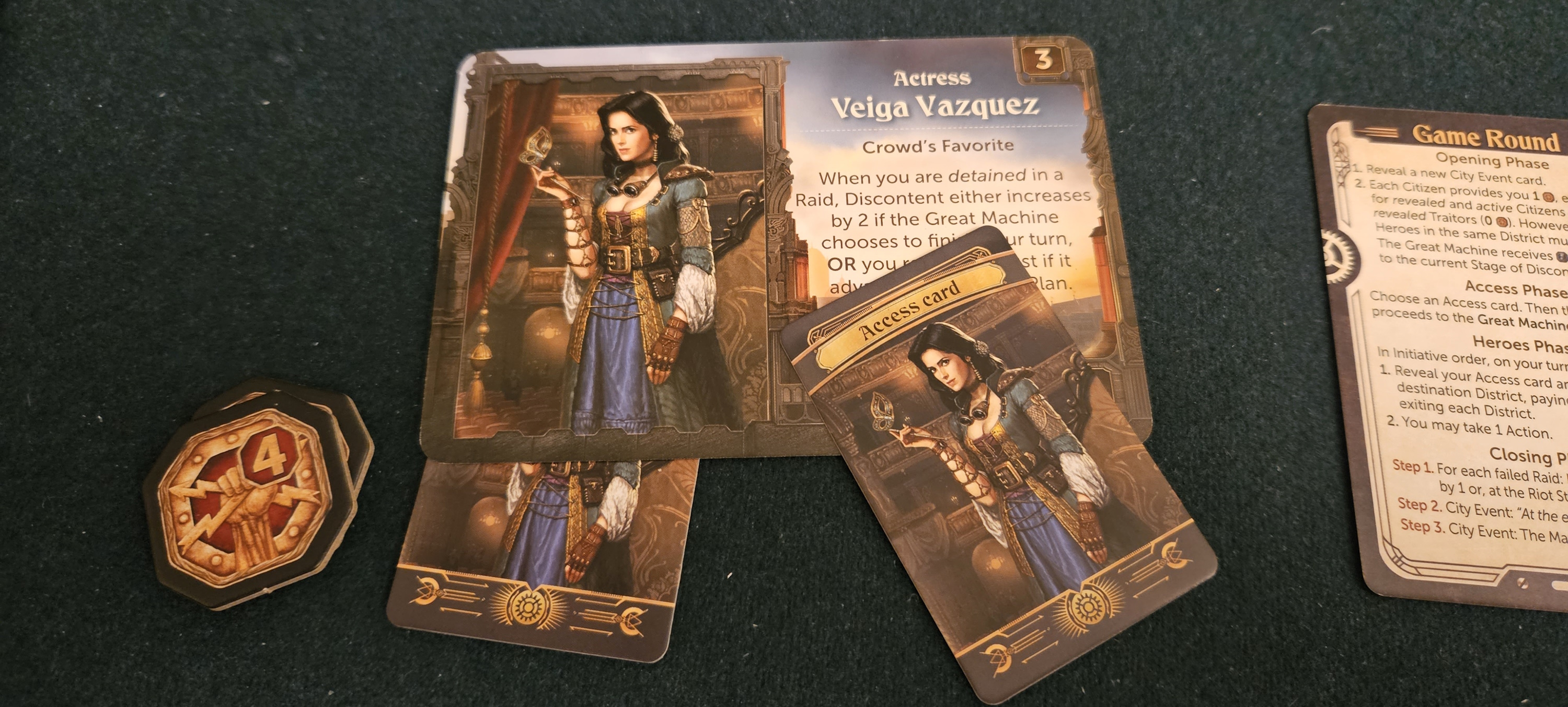
Using access cards to access districts.
While Tikhomirov’s portrayal of social organizing is surprisingly faithful, the crisis facing his steampunk city is timely, if well-trod. I used to chuckle at the astigmatism of fictional societies that promoted Skynets and Matrices and other mechanical overlords. Then major media networks here in the real world began deploying glorified autocomplete engines to produce articles and art, and a sufficient portion of the public decided that they didn’t mind being shoveled full of formless gloop to make such endeavors profitable.
City of the Great Machine delves into that conflict, albeit with more terminal stakes than a bazillion A.I.-written and SEO-optimized websites that say nothing useful. Playing as the resistance, one catches some of that Luddite fire. The entire system is built around a game of cat and mouse not unlike the one found in Ghislain Masson’s Not Alone, in which explorers stranded on an alien world are pursued from one location to another by a hungry lifeform. Here that structure is replicated more or less intact. First you pick which city district you intend to visit, then the great machine takes its actions and possibly predicts your destination. When your turn proper comes around, it’s possible you’ll bumble into a trap, being stripped of trust or watching as the great machine forwards its goals through your blunder.
The big difference is that City of the Great Machine adds more context to its locations. Where the destinations in Not Alone existed in isolated bubbles, the ongoing realities of a persistent map give this city some much-needed texture. Perhaps you need to reach the Tower of Law to free a high-profile prisoner, but it was recently removed to a hard-to-reach corner. Or you were planning a riot in the Commerce District, except the great machine saw your efforts and decided to swarm the place with newly refurbished automatons. The inverse can be true, too, with the great machine helpfully vacating the Central Square at the precise moment you hoped to canvass the locals for a big bump to unrest. Either way, the point stands. The city in City of the Great Machine feels like an actual place. Despite some necessary abstractions, it feels alive and in motion. Players may soon develop preferred haunts, or get locked out of a crucial district, or decide they want to smash robocops in the Art District for no other reason than because robots can’t do art, dammit. That’s a human activity.
This, then, is the first of Tikhomirov’s cautionary tales. It’s a story we’ve heard plenty of times before, about a system that traded security and profits for freedom and expression, and the plucky misfits determined to bring that system to its knees. And it works. It feels good. You can freely revel in dodging the police and smashing the state, absent any of the real-world implications of such a phrase.
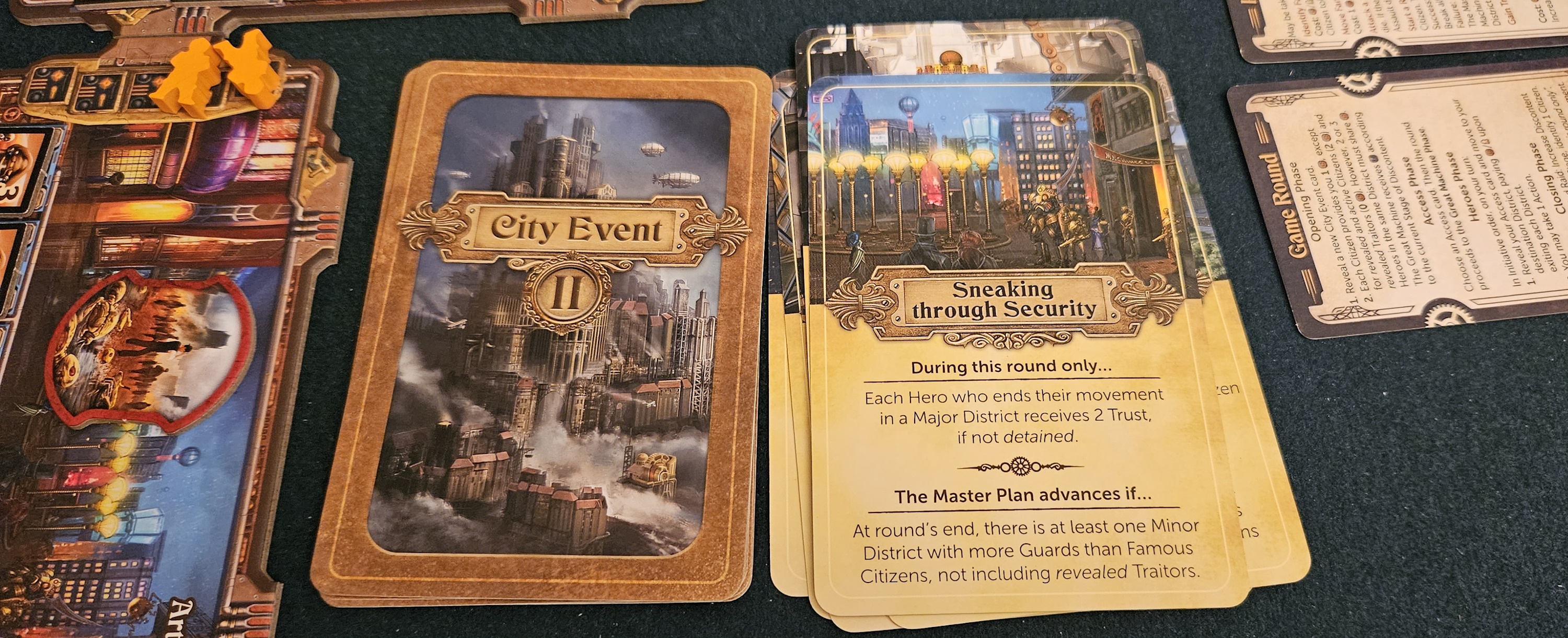
Events direct much of the gameplay, for better and for worse.
And then there’s the great machine’s side of the story.
This is a one-versus-all game, one of those rare treats we don’t see all that often, probably because they’re fiendishly difficult to design. While up to three players take control of the resistance, one person is asked to control the great machine. There isn’t any wishy-washy both-sidesism here; the game’s postscript for a machine victory freely admits to its lobotomizing of the entire human population. As the great machine, you are The Machine, the dystopian enterprise that delights in crushing the human will.
Sadly, it’s a total bore.
For a machine that controls a floating city, you sure have limited options at your disposal. Your principal appendages are three cyborg enforcers, which travel around to fix broken guards, take special actions, or conduct raids to capture resistance members. When the game begins, these are so costly to move that you can easily blow most of your robo-allowance (called “bonds”) trundling them out of the starting district. Additional bonds become available as the resistance increases the city’s unrest, but these are still precious enough that you won’t be able to make sweeping changes.
On the one hand, there was a definite need to make City of the Great Machine a balanced contest, and it’s easy to see how the titular baddie could stifle any spark of resistance had it been given too much latitude. On the other, the great machine is so stilted that it struggles to put up much of a fight. It has two methods for advancing its master plan, and neither of them are reliable. The first is to capture those pesky kids. But the resistance spends its entire time trying not to be caught, and a clever cell isn’t likely to appear in the obvious places. The other option is to use that round’s event. These cards provide both an adjustment to the rules and a way for the great machine to further its plans. As before, though, these swing wildly in their objectives, sometimes asking the great machine to release prisoners or to gather its collaborators in a single district. Furthermore, these objectives usually offer the resistance a contingency, like liberating prisoners before the great machine can make a show of magnanimity by releasing them.
This produces nail-biting narratives for the resistance. Every round puts them off-balance by presenting another treacherous plot that they must defuse or face the consequences. If only they knew that the great machine was also being blindsided. For an automated system that casts its all-seeing eye over the city, this machine suffers from debilitating shortsightedness. Rather than hatching the plots of a thinking mind, you’re more of a middle manager being fed these incomprehensible directives from a text generator. The game’s fiction claims you’re the great machine, but in fact you’re the editor at a sports website trying to wrangle all these A.I.-written articles into good enough shape to both fool the public and appease your venture-capital boss who threatened to shutter the whole place if you don’t keep up.

Float away, o city of the clouds.
It’s a devil’s bargain. While three people are having a great time dodging the mechanical police and riling up agitators, their counterpart functions as a glorified game master. Not even that — because this isn’t a role-playing game, there’s very little room for expression. So the great machine player goes through the motions, responding to stimuli without wholly connecting to what those inputs mean in the real world. Not unlike a Chinese Room, come to think of it. But I very much doubt it was Tikhomirov’s goal to help one player sympathize with the great machine by stripping the semantic meaning out of their syntactic actions.
More’s the pity. City of the Great Machine is a game full of big ideas. Social movements, righteous resistance, the terror of automation; these are all worthwhile concepts, and Tikhomirov gamifies them admirably. At its best, it feels like a title from the Fantasy Flight Games of old, all swingy event cards and bombastic player interactions and more than its fair share of wobbliness. I’ve had a great time with it — but only as the resistance. Call it a cautionary tale, but I prefer my games to be enjoyable for everyone at the table.
(If what I’m doing at Space-Biff! is valuable to you in some way, please consider dropping by my Patreon campaign or Ko-fi.)
Posted on August 28, 2023, in Board Game and tagged Board Games, City of the Great Machine, CrowD Games. Bookmark the permalink. 17 Comments.

 SPACE-BIFF!
Oh, I’m sad to read this. I have it, and I’m eagerly awaiting to get it to the table at a convention next month… but of course, as I’m the teacher, I’ll be the Machine.
Hope I find it less boring than you did, but … well, we will see. But if it is then the problem will be that almost all the time I’ll be the Machine
There’s always a chance it will land better for you, Jesús! In fact, I hope it does. If so, please let us know!
Thanks for the review Dan, great as always (especially the alt text!)
Jesus, the chap in our gaming group who owns CotGM usually plays the Machine and has a great time, as he’s trying to figure out what the other players are plotting. I think it’s a game where what happens above the table is as significant/interesting as what happens on it. Hope it works out for you!
Thanks for the review. But doesn’t the game have a co-op mode where the Great Machine is automated? Do you think playing this way would alleviate some of your concerns?
My attempt with the cooperative mode didn’t quite work for me, I think because the game benefits from having a thinking mind in control of the Great Machine.
In other words, it feeds on suffering.
Did you have similar feelings or misgivings about playing the monster in Not Alone?
Hard to recall, but I don’t think so.
Enjoyable read. I really like this game, but the biggest negative I’ve found is that highs for one team generally mean lows for the other side. I’ve had really fun plays as the machine making all the right guesses, but then I can see my partner just getting more frustrated at the game when all their resistance moves wiff.
Oh, that’s an interesting way of putting it. Yeah, I agree. For whatever reason, all of my plays of this game have left somebody deeply annoyed with the system.
Russian publisher, Russian designer, automatic skip for me
What does a guy who happens to be a board game designer have to do with the government of the country he is from? Are we going to play games from now on depending on where a game designer was born? Is this a new witch hunt? By the way, where are you from?
Well for one, if he lives in russia he gets paid and therefore pay taxes there (IF he indeed moved to US that’s fine, but the publisher is still based in russia). And yes, if someone was born in russia I’m automatically wary of them, I’ve seen enough people I considered friends, including in the board game community, turn out to be nationalistic maniacs. Being born in a country doesn’t make you a bad person, but growing up surrounded by nationalist and imperialist narratives easily can
I’m from Ukraine btw
By the way, the game designer is from Russia but lives in the United States.
Looks like it might be fun in coop mode.
Dang, that was a turnaround worthy of SUSD! A shame to hear, the game was sounding fascinating from the first half, but part of what makes hidden movement games good is the way that they present a compelling puzzle for the side of power that’s trying to pin down fugitives. This feels like it could have been a great opportunity to explore ideas like a massively powerful juggernaut that struggles to wield power in delicate, agile ways, for example.
Does get my brain buzzing around ideas for how one might design such a mechanism, though. Some sort of twist on programming, for instance, or a mechanism akin to the Eyrie in Root…….
I think one of the areas that AI will excel at (or, rather, excels at) is making non-art. Commercial imagery. Like the stuff of comic books or that which is used in most FFG games (like their version of Condottiere). The stuff that people get paid so little for it makes gig work enticing. This also happens to be what a lot of people already consider art… so we are off to a rough start.
Pingback: Non Eventu | SPACE-BIFF!