This Trick-Taking Life: The Future

My wife introduced me to modern board games. Oh, not totally — I’d played The Settlers of Catan to exhaustion, and eventually I discovered Philippe Kevaerts’ Small World on my own. But meeting Somerset introduced me to an entire world of tabletop games, one that was wide and wonderful and only in its infancy. The trick-takers, though, those I didn’t get. Wasn’t it just, we all put a card down and someone gets all the cards?
This is the last part of this letter to my younger self. We’ve already discussed the history and appeal of the genre, from its inherent simplicity to the innovation of the triumph suit to the important hurdle of contract bidding. Today, there’s only one last piece of history to explore. It’s the year 2021, and a handful of trick-taking games are about to change the format forever.

The Root of trick-taking. (TRICKTAKERs)
The entire genre might well fit in a single title. Hiroken’s TRICKTAKERs has been described a the Root of trick-taking, and not only because it features anthropomorphic forest creatures. Under normal circumstances, I’m wary of such an epithet. Hard as it is to imagine today, asymmetry existed prior to Cole Wehrle.
In this case, I’ll give the label a pass. TRICKTAKERs offers a tour of the trick-taking genre in roughly half an hour. Like the game it’s accused of emulating, it varies wildly depending on one’s chosen role. In its most basic form, there are five: the King, Gambler, Resistance, Hermit, and Berserker. Where a less ambitious title might give them slightly varied abilities, Hiroken invests each character with the full weight of an entire subsection of the genre. The King and Berserker, for example, revolve around trump cards, with the former always holding a personal duplicate of the rarest card in the deck and the latter managing the highest ranked cards in every suit. The Gambler is all about bidding, placing an open contract and then striving to fulfill it. The Hermit and the Resistance both transform playing low cards into an art form.
But what makes the game’s comparison to Root more apt than not is its careful tempering of these roles against one another. The Berserker seems all-powerful, able to win every single trick if he so chooses, but his personal goal is to win zero tricks. The same goes for everyone else, their goals either embodying or defying their archetypes. The Gambler wins outright if he bids and takes exactly four tricks, a signal that forces everyone at the table to come gunning. The Resistance wins if she inverts the rank of the cards and then somehow wins with a black card, this game’s triumph suit. And the King earns double points in the last round, but remains a solid pick earlier if only because he allows the previous King to draft first.
Yes, draft. Unlike Root, TRICKTAKERs doesn’t tether players to a single character for the duration. Instead, each round sees players grabbing new roles based on the cards in their hand. If you’re reasonably sure you can win exactly two tricks, the Gambler becomes a solid choice. If you’re holding a bunch of retreat cards, the Resistance is your gal. And if you’re afraid of the Berserker, why not become the monster yourself?
It’s difficult to play well, especially before the limitations and strengths of its roles become clear. But that’s hardly the point. TRICKTAKERs represented a new step in trick-taking not only because it embraced the whole history of the genre in a single title, but also because it stepped beyond the confines of the genre. This wasn’t only a trick-taking game. It was as much a drafting game, one in which your meta-decisions between rounds was a determiner of your overall success.

Sail away, sail away. (Sail. Obviously.)
This was hardly the first hybrid trick-taker. From its very beginnings, this is a genre that’s been unafraid to mingle with its neighbors. What is contract bidding, if not a way to introduce the thrill of gambling?
But TRICKTAKERs was emblematic of an awakening, and 2021 was the year for it. Where Hiroken conceptualized the genre as a drafting free-for-all, Akiyama Koryo and Korzu Yusei transformed it into a nail-biting movement puzzle. Hameln Cave, later imported as Sail (review), is a cooperative game about navigating a ship past obstacles in order to escape a trap-laden cavern. Despite only operating with two players at the helm, the trick-taking was put front and center, with each trick’s winner pulling the beleaguered vessel in their direction, tacking toward safety at diagonal angles. The game even uses off-suits to its advantage. If both players deploy a mermaid card at the same moment — a difficult feat, since there’s only one mermaid card per suit — the ship is launched straight forward rather than being wrenched back and forth. It’s a game that intimately understands how to use the limitations of the genre to produce moments worthy of a triumphant holler. Or a scream of despair when the attempt goes awry. (It usually does.)
The same year, Fukutarou designed Tooth & Claw: Animals with Civilization, transforming trick-taking into a set-piece battle. With cards in hand, both sides select and then field military formations, complete with strategic gaps and strong points. These lines and columns of furry warriors are then pitted against one another as a series of tricks, with displaced cards being replaced by those defending the rear. It isn’t the smoothest experience, but it’s yet one more example of the ways the genre is constantly being flexed and remolded.
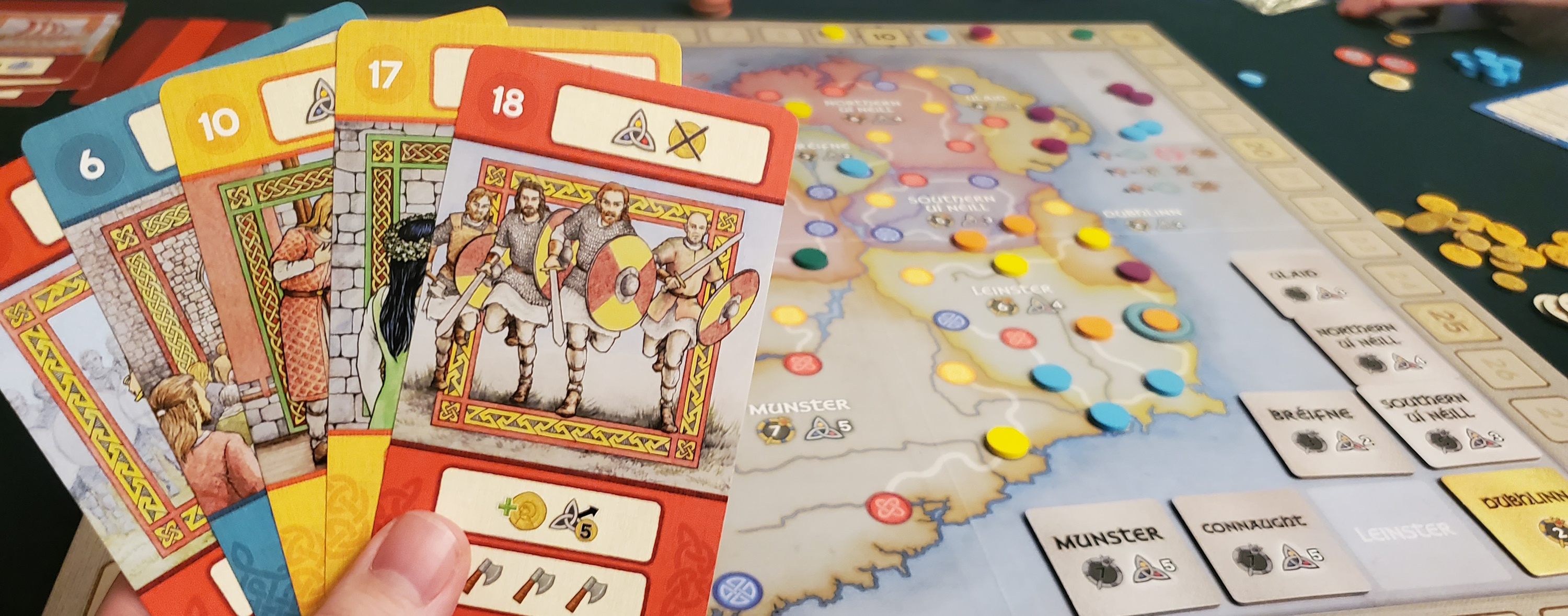
Brian Boru! Brian Boru! (Brian Boru)
Meanwhile, other designers were pushing this transformation until the original genre was but one part of a novel whole. Peer Sylvester’s Brian Boru (review), also released in 2021, featured trick-taking as its core mechanism, but many were quick to note that it didn’t feel like the trick-taking they knew and loved. True, Sylvester ditched some of the genre’s conventions: players could follow with any suit, for one thing. But this also signaled that trick-taking had permeated the hobby’s ludic consciousness to such a degree that it could be used as an underlying system rather than as the entire focus in its own right. Trick-taking had gone mainstream.
And Brian Boru showcased new innovations of its own, rooted though they were in well-trod concepts. As clan leaders in medieval Ireland, players vie to unite disparate towns and regions under their banner despite Viking invasions and the meddling of their political rivals. Tricks are nontraditional; rather than being won outright, they permit an array of actions. Winning a trick allows the game’s most powerful action of all, the conquest of a town. But this action is an expensive one, forfeiting points if the player lacks the coin to pay up. Much of the time, it’s better to lose a trick, earning a weaker but more flexible action. The emphasis is on the map itself and the relative sway players hold over its various regions, not to mention the church, royal marriages, and the Vikings.
That’s only the beginning. Although bearing only superficial similarities, this notion of “tricks on a map” has other claimants, including Cole Wehrle’s forthcoming Arcs and Wray Ferrell and Brad Johnson’s The Barracks Emperors (review). And others are in the works, although it’s beyond the scope of this letter to remark on them.
As of this moment, however, my favorite hybrid of trick-taking and some other perpendicular genre is Shamans (review). Designed by Cédrick Chaboussit, this is another revelation from 2021, a blend of the aforementioned genre and social deduction. Here, players either work to preserve creation or unravel it. Like TRICKTAKERs, its roles are infirm, changing over the course of multiple hands, often pitting players against their so-called teammates. What sets it apart is the way it stands astride both worlds at once, both wholly trick-taker and wholly social deduction, without slipping up in either arena. That it transposes the language of one genre into the actions of the other, and vice versa, is a big part of its charm, taking two concepts that might seem over-represented individually and merging them into an unparalleled experience.

Tooting my own horn. (The Barracks Emperors)
Where does that leave us? On the cusp of something beautiful, I expect. It’s impossible to say whether trick-taking’s moment in the limelight will continue or flicker out prematurely, but already the rejuvenation of this primeval genre has resulted in some of the finest tabletop games we’ve ever witnessed. I went most of my life not grasping the appeal of the trick-taking game. Now I can safely say it’s one of my favorite ways to play. Hopefully other designers will follow suit.
(If what I’m doing at Space-Biff! is valuable to you in some way, please consider dropping by my Patreon campaign or Ko-fi.)
Posted on July 21, 2023, in Board Game and tagged Board Games, This Trick-Taking Life. Bookmark the permalink. 14 Comments.

 SPACE-BIFF!
Rrrrrrrrrrrrgg!
Give into your hate… that way lies love. Of trick-taking.
😂
Man, I love your reviews but a lot of these, especially the trick takers I’ve been interested in, are really hard to acquire. It’s honestly a bit depressing haha. There are a few games here and there where I’ll disagree with your final verdicts but overall this blog is hands down the best content for finding the ones that really interest me. Thanks for all your hard work
Yeah, sorry about that. The Japanese designs are especially difficult to import. Yesterday’s review of Schadenfreude, for example, was partially to encourage it to get a wider printing. Fortunately, some of these are pretty easy to get: Shamans, Barracks Emperors, Brian Boru. I’m pretty sure TRICKTAKERs is getting a US printing soon, too.
Thank you for the kind words!
It has been announced that Tricktakers will be getting a US release this year on BGG
https://boardgamegeek.com/thread/3021640/its-official-portland-game-collective-will-be-rele
Nice! Thanks for the info, Tim.
My trick take, is that these articles are rounds, paragraphs hands, and puns trump, and Dan has finished the game victorious with the ultimate flourish.
A wonderful set of articles. Thoroughly enjoyed. Thank you.
Thanks for the kind words, Jeppic.
A delight to read, as always. I was very found of your series on Root but this one (and the various trick-taking reviews) feel like reading the diary of an explorator, uncovering uncharted territory weeks after weeks.
It’s pretty amazing how flexible the genre is and how it can be used as a part of a design as well as pushed to be the whole thing itself. By the way, I bought Shamans the other day and cannot wait to try it out!
Thanks for the kind words, Chips. I hope Shamans treats you well!
We had a blast with a 3-players game of Shamans last night (and I suspect it gets better with 4 or 5). The game unfolds with each new trick and you see the options widening as the tension rises until everything collapses at the end of a round, leaving a blank slate ready for a new cycle of mischief and treachery. A joy to play and contemplate!
Glad to hear you enjoyed it, Chips!
Pingback: This Trick-Taking Life: The Contracts | SPACE-BIFF!