With Friends Like These…
All I play anymore is trick-taking games.
As a genre, they’ve ensnared me with their neurotoxins and begun the process of digestion. Not unlike a sea anemone, come to think of it. That’s the topic of Daniel Newman’s Enemy Anemone, which one suspects was created solely because it’s so fun to pronounce. Fortunately, that’s not all it has going for it. Not unlike yesterday’s Aurum, it has some devious surprises in store.
Putting my sea life to good use.
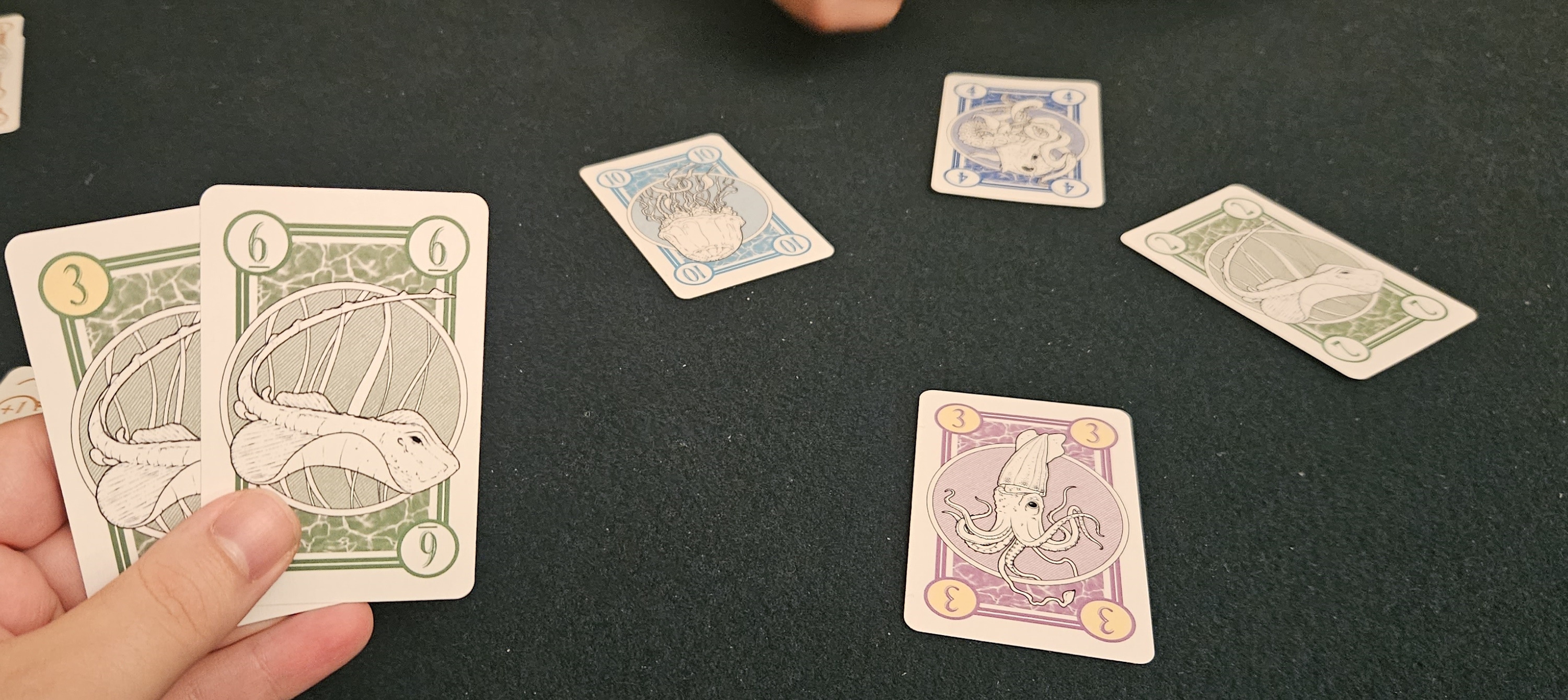
The comparisons between Enemy Anemone and Aurum are more than skin-deep. Like Shreesh Bhat’s trick-taker about the transmutation of base metals into gold, Newman is tinkering with a lesser-seen subgenre by forcing players to not follow any suit already played. With six suits in total, hands are a thrown-together hodgepodge of squids, jellyfish, stingrays, octopuses, and other aquatic creatures. It’s pretty rare to see every suit represented in a single hand, and individual tricks are splashed with color as multiple suits are slapped down.
Also like Aurum, Enemy Anemone revels in the tension of trying to either win a trick or lose it as badly as possible. In the first case, every claimed card is worth a point — and, in the case of highlighted middling cards — 3s, 5s, and 8s — they’re worth two. Every trick comes across as a contested pot, with some of lesser value, others greater, keeping everybody’s attention on what exactly everyone is playing.
But it’s just as valuable to lose big. That’s because the lowest card earns an anemone. The titular polyps can attach to any other creature to add one to their value — and can even stack together. Now, rather than maxing out at 10, it’s possible to see values that hit 11, 12, 13, and beyond. These transform flailing players into serious threats, able to boost nearly any card into a winner.
I mentioned the way tricks resemble pots, and the comparison is an apt one. Every trick-taker shares DNA with poker to some degree, the “comparing” genre being an offshoot of those original trick-takers that gave birth to the French-suited deck in the first place. Here that shared parentage is on full display. Tricks aren’t merely binary wins or losses; every play at once ups the ante and wagers to claim the pot. The anemones, meanwhile, generate a possibility space not unlike the reveal of a full house. Everyone oohs and aahs at such an appearance, pressures following players into wagering their own anemones, and, of course, revels in the moment that a high card is defeated by a royal flush. Or rather another high card, since that’s what Enemy Anemone musters given its delightfully sparse language of play. The anemones add texture to simple numbered cards. They’re landmines suspended beneath the surface of the water, always threatening to upend what would otherwise be a plain-jane trick-taker.

Oh no! That anemone is my enemy!
In a sense, that makes them similar to Aurum’s gold suit, although they’re easier to deploy. Where Aurum tends toward the complex, with its contract bidding, team-play, and carefully valuated gold cards, Enemy Anemone is breezy. This is trick-taking as a conceptual fish-bone, bare and slender enough to lodge in your throat. This isn’t to say that one is superior to the other, although I do prefer Newman’s design. They swim in similar waters, and as ever it’s an impressive study just to examine them side by side, to see the way a few minor changes can produce such radically different experiences.
The beauty of Enemy Anemone is found in its sleekness. This is what we mean when we call a game “elegant.” There is nothing spare about this design, nothing that requires additional explanation or justification. It produces textured hands, desirable or humdrum tricks that are worth bidding anemones on or ignoring, and does so with such ease that it almost becomes camouflage, a means by which the game could be overlooked for its simplicity. That its tongue-twister title is so pleasant to utter is only a bonus.
(If what I’m doing at Space-Biff! is valuable to you in some way, please consider dropping by my Patreon campaign or Ko-fi.)
A complimentary copy was provided.
Posted on July 18, 2023, in Board Game and tagged Board Games, Enemy Anemone, New Mill Industries. Bookmark the permalink. 2 Comments.

 SPACE-BIFF!
Dan! Thank you so much for the lovely review! The game is currently in pre-order on New Mill’s website through the end of July, and there will be limited copies available after. If interested, visit http://www.newmillindustries.com/store.
Pingback: First Place Goes to Second Place | SPACE-BIFF!