The Goose Will Have Blood

I can’t speak to whether The Gods Will Have Blood, the latest game by Dan Bullock, is a faithful adaptation of Anatole France’s Les Dieux ont soif, but it evokes sensations that only rarely creep into our hobby from literature. Perhaps it would be better to call it an abridgement. At only twenty minutes in length (if that), it packs terrible questions into a pressure cooker that threatens to pop with every flipped card and drawn cube.
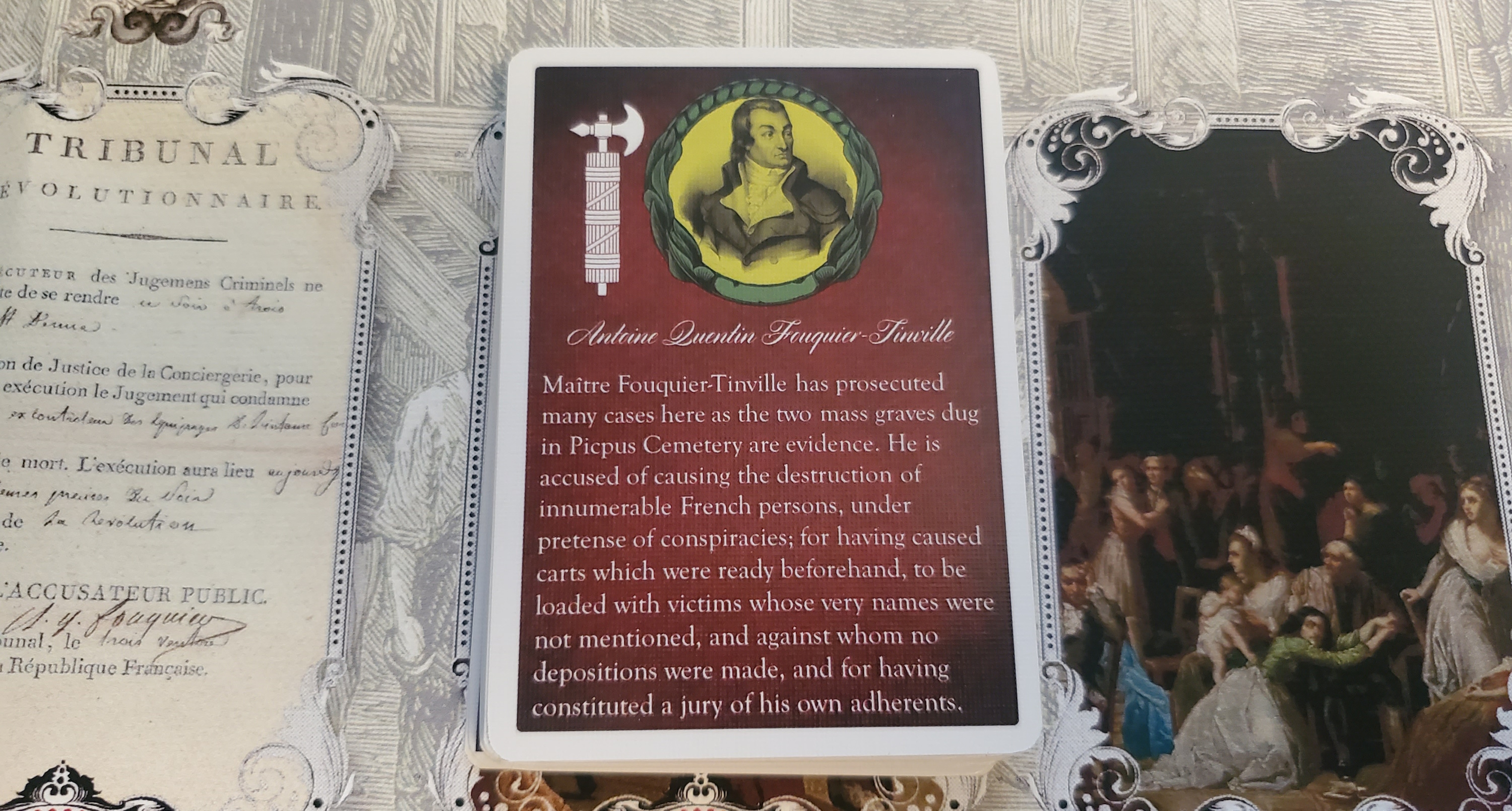
Confronting the accused.
Like the principal character of France’s novel, Bullock puts you front and center as Évariste Gamelin, an ambitious and idealistic young painter recently appointed a magistrate of revolutionary France. Given that it’s set during the most vicious months of the Revolution, such a position is one of grave responsibility, requiring Gamelin to oversee the show trials of accused royalists and counterrevolutionaries. One can imagine a person carrying out such a duty with due caution and solemnity. One can imagine. Instead, our protagonist is soon caught up in a whirlwind of his own making. Rivals are brought before the court. Friends are brought. Lovers. Already there are previous judges facing the guillotine. Gamelin may well be next.
What follows warbles between psychological terror and terror of the traditional sort. This is the sort of game that’s rather easy to lose, but is possibly more terrible when won. It raises the question that was old even when Juvenal asked it in the second century, and responds with something between a forlorn sigh and a twitch.
It’s also a perfectly encapsulated little thing. The gameplay reads like a riff on Lucas Pope’s 2013 title Papers, Please, which raised similar questions about the latitude we afford to authority in the name of safety. Most turns begin with a card. No, not merely a card; the accused. You’re given only a snippet of detail about them. Étienne Clavière is a former finance minister who served the tyrant king. Rosalie Filleul is an artist who has sold pieces of the royal hunting lodge’s furniture to a secondhand dealer. Antoine Barnave is a political rival and correspondent of Marie Antoinette. These were real people, for the most part.
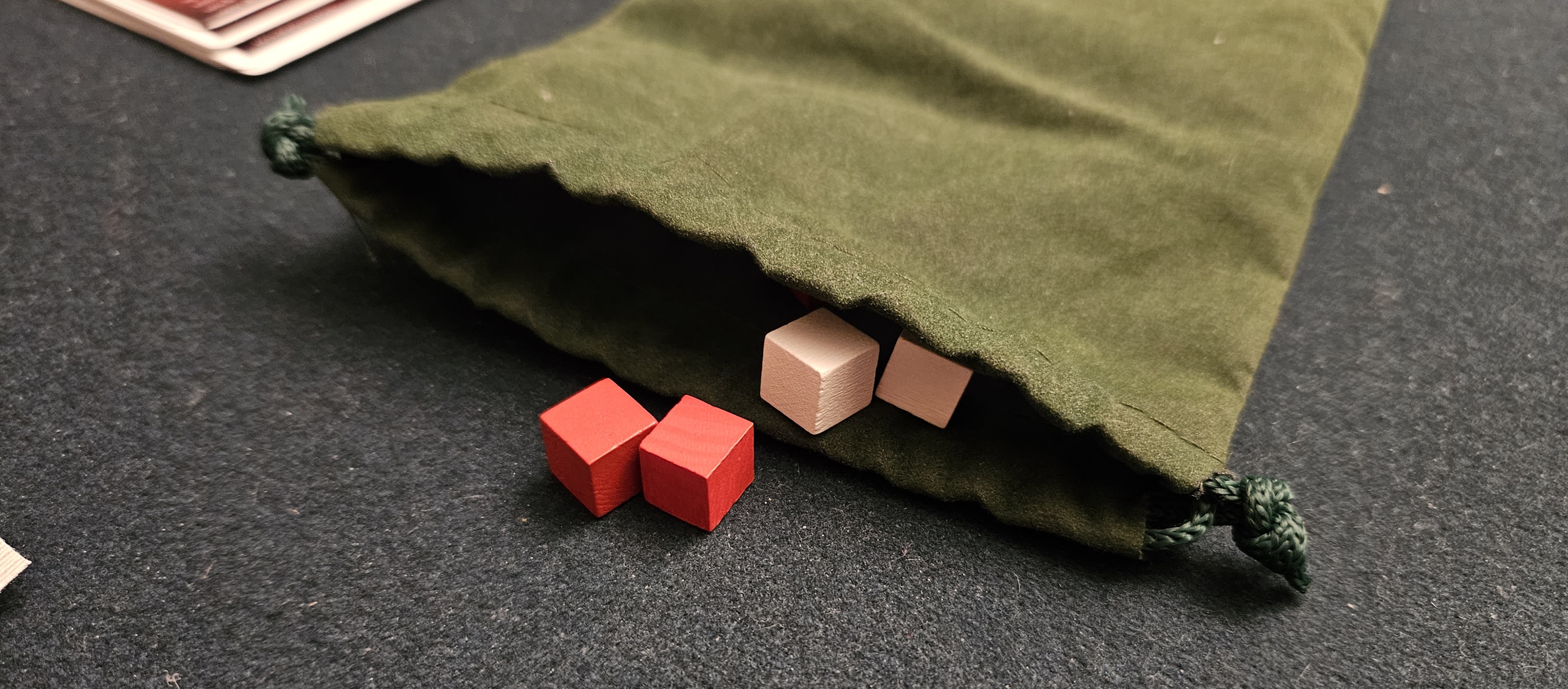
Issuing a verdict.
But their lives aren’t entirely in your hands. In Bullock’s most interesting application, as well as The Gods Will Have Blood’s most overtly gamey aspect, your influence over life and death isn’t total. Instead, your verdict must be confirmed by the court. This is represented by a bag stuffed with red and white cubes. When you declare that one of the accused is guilty or innocent, you draw from the bag, two cubes at most, to determine whether your ruling bears out. Either way, the accused card is now flipped to its reverse side, where the consequences of either sentence are laid out.
As befits the game’s brevity, the list of effects are sparse. There are two tracks to consider. Your own personal reputation is one of them, and must be pristine when the game concludes or the guillotine’s fourteen-foot drop will catch up to you. The legitimacy of the court also counts, although in reverse; if it ever bottoms out, that’s it for you. At times, the reputation of one will affect the other, little bottlenecks where the court is so ill-considered that your reputation suffers with it, or vice versa. It’s as simple as can be.
The more relevant consideration is the contents of your bag. These change over time, usually as the result of a guilty verdict. The game considers a bloody momentum in which one beheading makes the next one that much easier to carry out. With every execution, further red cubes are added to the bag. Bloody your hands too often and the killings become nearly impossible to halt, even when a friend or lover is brought to the stand. That in turn might witness the erosion of your soul itself, the permanent disappearance of those precious white cubes speaking to a heart that no longer twinges with mercy. This is a game where your head is only one of the items on the scale, and perhaps it’s the lesser of them.
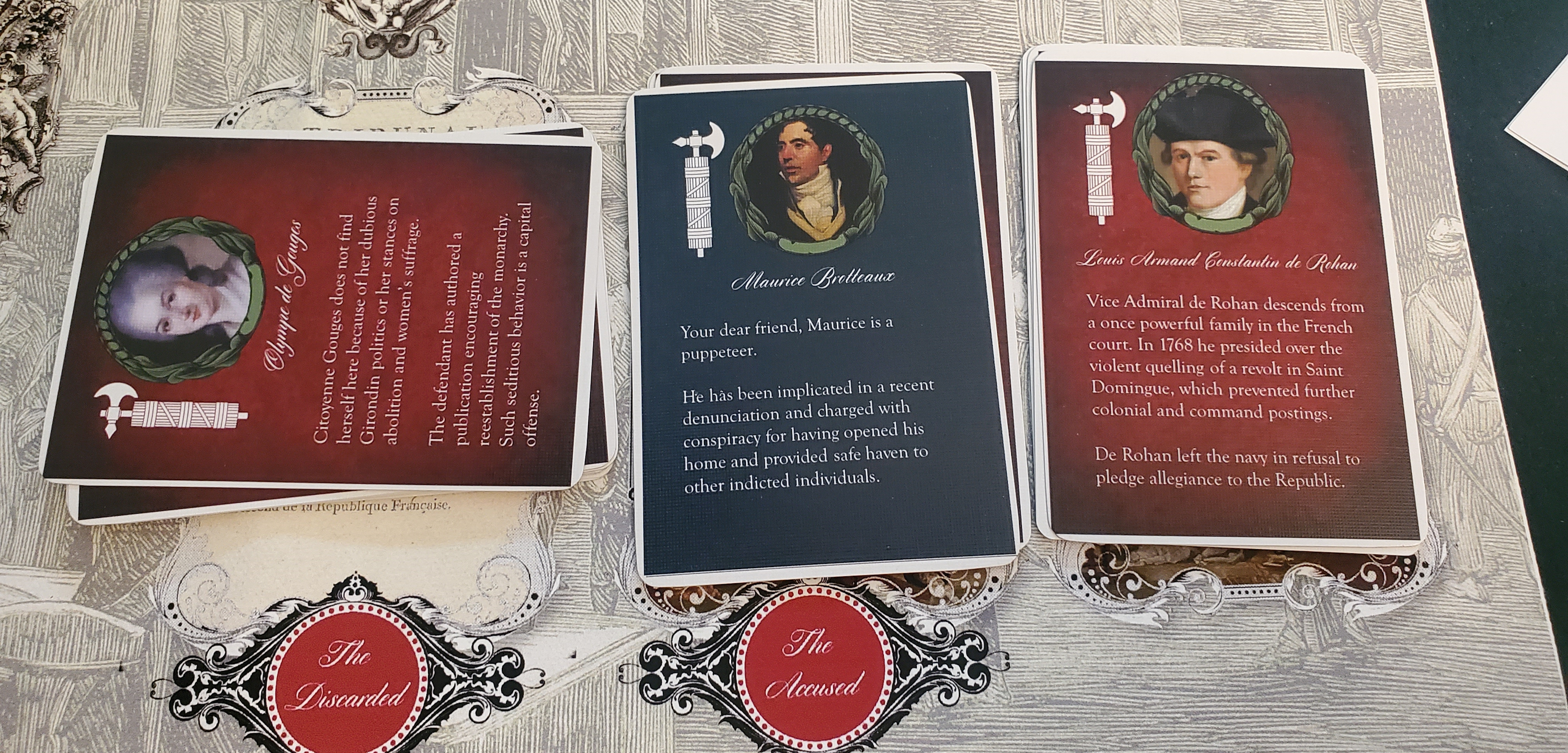
Trying two accused at once.
At some point, The Gods Will Have Blood reaches a boiling point. Where exactly the pot spills over is a matter of each individual play. For me, that moment usually arrives when the court’s thirst for vengeance leads to two defendants being tried at the same time. As developments go, it makes a mockery of the already-reduced dignity of show trials. There’s something terrible about deciding the fate of two paired victims, one perhaps guilty but the other definitely innocent, and having no idea whether you’ll be able to rein in the court’s impulses — or whether, indeed, you should. I’ve “won” the game, but only at terrible cost. If anything, the closest I ever came to emotional satisfaction was when I lost my head but saved my friends.
There’s an inevitable question about all of this, one that’s especially inescapable under the circumstances: what’s the value of all this grim business? It’s a question that’s been asked plenty of times not only about games, but also about films and novels and opera and probably cave paintings if we go back far enough. The Gods Will Have Blood is not a cheery experience. Those averse to games that aren’t light and social need not apply. And not only because this is a solitaire outing.
The value of such a game, of course, lies in the critique itself. In history, we sometimes joke that one of the great similarities between capitalists and revolutionaries is that they’ll both bend your ear about the evils of revolution. With the slightest squint, The Gods Will Have Blood could be considered reactionary. Certainly, it’s apprehensive about the ways republican zeal can result in terrific bloodletting, and it presents a human core that makes those excesses all the more immediate.
Yet it remains tethered to the perspective of its protagonist. Here is a man whose convictions have led him to awful places, and may lead him to places even more awful still. He is not worthy of admiration. Pity, though? Perhaps. Bullock has asked us to walk a mile in pitiable shoes before, ayatollahs and supreme leaders and coked-out rock stars alike. What’s remarkable about his work isn’t only that he asks us to inhabit unsavory roles, but that he forces us to reckon with them on a personal level. The same is true here. Évariste Gamelin is a successful foil for the player because his actions are similarly despicable and oh so very human. Playing this game, one is forced to wade through both the allure and the cowardice of hiding in the crowd — even when one has, ostensibly, been placed at the crowd’s head.

A jaunty Reign of Terror.
There’s something almost biological about how the game deploys that emotion. The wisdom of herds. The horror of unwilling sacrifice. The blood that encrusts itself under one’s nails. In drawing from the most difficult of source material, Bullock has crafted something truly appalling. I think it might be a masterpiece. A very small masterpiece that is, at times, more self-reflective than most will find comfortable.
(If what I’m doing at Space-Biff! is valuable to you in some way, please consider dropping by my Patreon campaign or Ko-fi.)
A complimentary copy was provided.
Posted on July 12, 2023, in Board Game and tagged Board Games, Daniel Bullock, Lock Horns Games, The Gods Will Have Blood. Bookmark the permalink. 9 Comments.

 SPACE-BIFF!
I had never heard of this game until this review popped up on my feed. As a Frevolution obsessive it’s clearly a must have, I will jump on the campaign as soon I’m allowed to.
I thought the campaign was supposed to launch today, but apparently it will be next week. Eyes peeled!
Oooo… the gamefound campaign launches in an hour!
What a concept! Thanks for the review.
Sure thing!
Very much the same concept as “We. The Revolution” PC game, where you play a judge at the height of the Terror and hatch political intrigues to save your own head. Being it PC game it is a little more involved, as you have to examine the evidence presented to you, and write the judgment etc. https://www.youtube.com/watch?v=tLEfdfdZmjU Very nicely done – am certainly backing this!! Thanks Dan for sending these rare finds our way.
Happy to help!
Pingback: Best Week 2023! Making Memories! | SPACE-BIFF!
Pingback: Carceral Draftsman | SPACE-BIFF!