Sustainable Archipelago

In 2017, an island vanished. Parali I, one of thirty-six islands in the Lakshadweep archipelago off the western coast of India, disappeared thanks to rising sea levels and coastal erosion. It was a small island, uninhabited, a quiet calamity. But it’s a calamity that will be repeated. Four more of the archipelago’s islands are expected to disappear in coming years. Experts anticipate that it won’t be long before more populous islands and coastal communities are affected.
Sidhant Chand’s Lakshadweep is about the titular archipelago. Its tone is optimistic. Rather than dropping islands beneath the waves, it’s about developing sustainable industries that will allow the local population to prosper without demolishing the natural world around them.
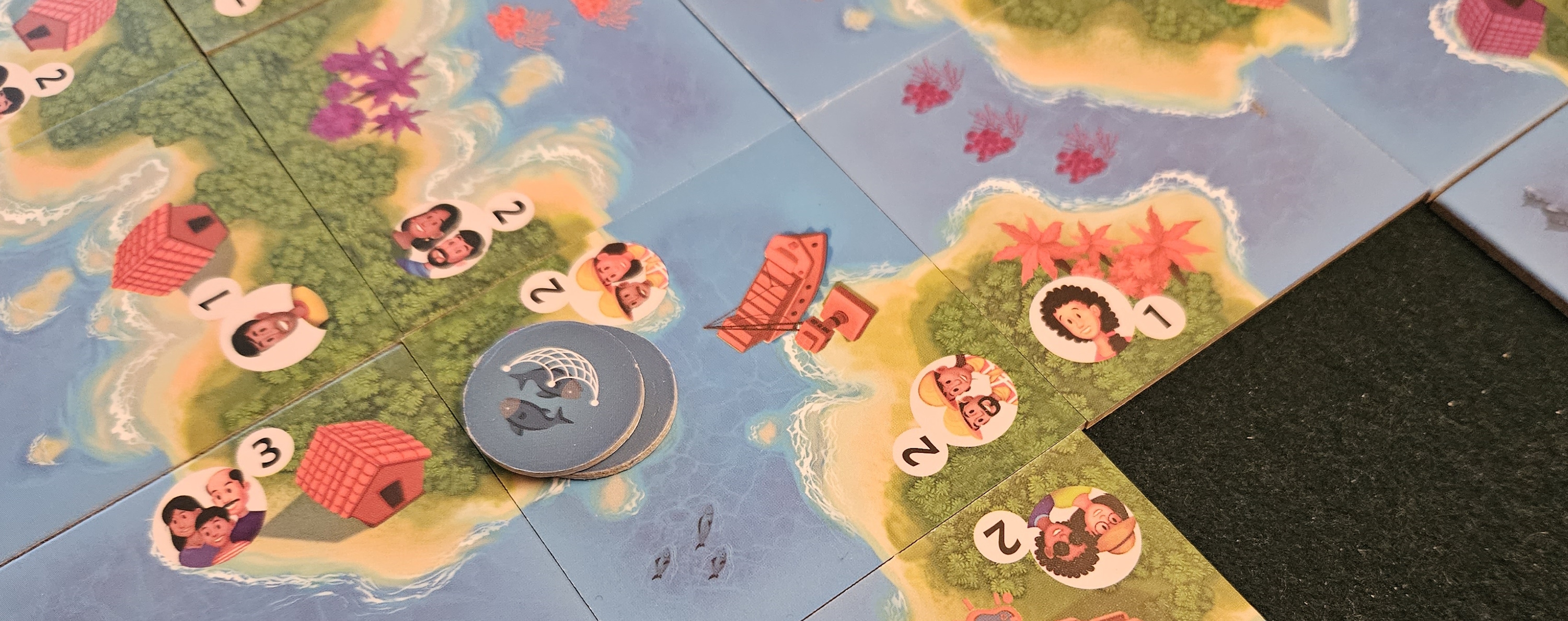
Fisheries, shipyards, houses — just a handful of Lakshadweep’s features.
It would be easy to read too deeply into Lakshadweep. Take, for example, its status as a two-player game. Or, more than that, a competitive game. Is that a statement? Is Chand making the argument, as plenty of others have before, that it will be competition and business as usual that saves us from the climate crisis? That nobody will need to adjust their expectations or degree of comfort? That efficiency is the natural end-state of enlightened rivalry and not the cause of the problem we see before us?
Or is two-player the most common player count, and competitive the dominant play mode, both by an overwhelming margin?
I expect the latter is the case. For all its posturing, Lakshadweep is such a very traditional game. Far from being a ding against the game, however, this works in its favor. Lakshadweep has no barrier to entry to speak of, instead letting players get right down to the business of drafting and laying tiles, assessing victory margins, and enjoying the sights that result from their efforts.
And to the credit of both Chand and the game’s emphasis on sustainability, “balance” is very much the watchword that defines the experience. The tile-laying is largely unadorned, especially compared to weedier offerings like Land vs Sea or Beacon Patrol. The principal constraint is that land and sea edges must align — a simple request when the landmasses in question may make corners or straight lines, but never oxbows or twists or straits or any other peccadilloes of geography that would be difficult to puzzle together. Islands in Lakshadweep take one of two forms: perfect squares or elongated blocky corndogs. As much as I enjoy painstakingly finding the right tile to bridge a mismatched gap, here the simplicity of the archipelago’s arrangement keeps the focus where it belongs, on the features that fill the islands rather than the overall profile of the islands.
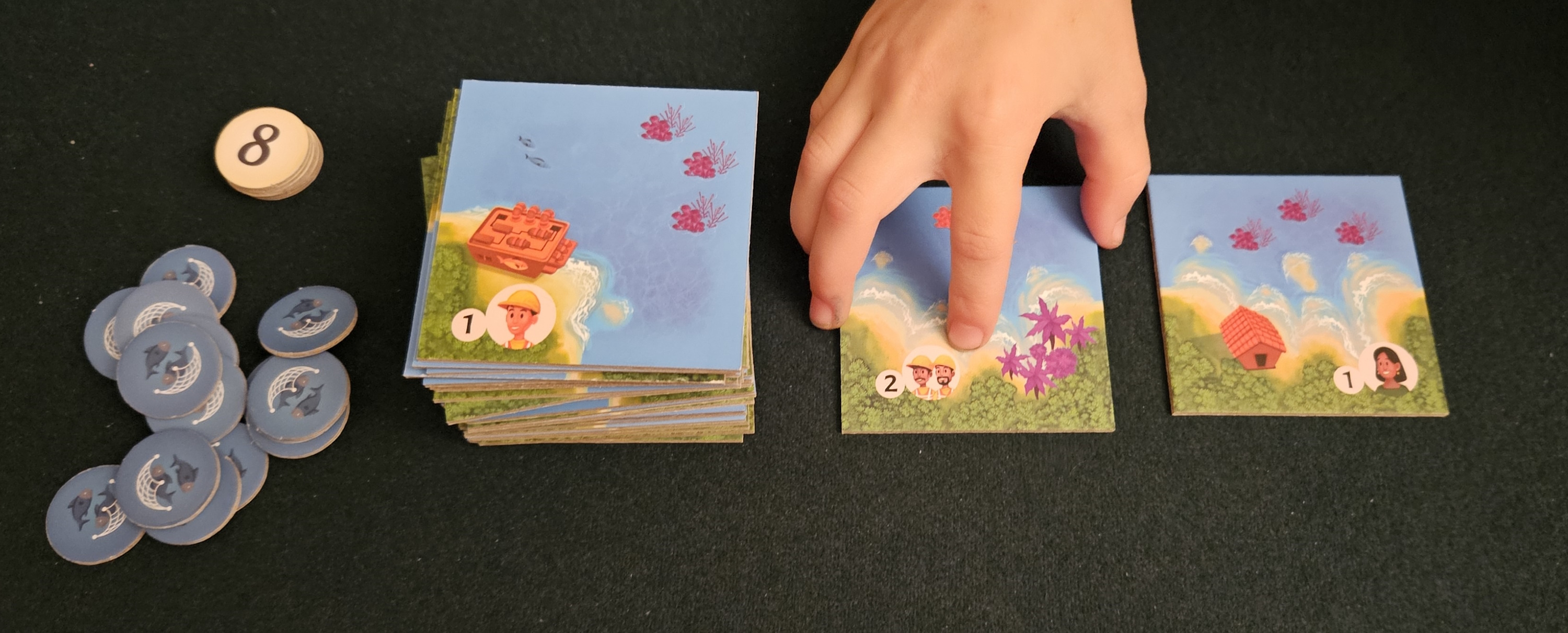
Tile selection is crucial.
Those features are where Lakshadweep shines, both in terms of gameplay and as a rumination on sustainability.
The gameplay revolves around a single concept: every tile shows two features, one for the orange player and the other for the purple player. The tile’s reverse shows the exact same features with inverted colors. There are three tiles available at any given moment. The two “older” tiles in the market may be freely rotated and flipped, while the newest offering can only be rotated, thus preventing access to its color-inverted side until later. It’s a clever use of a river-style market, simple to parse but still adorned with the occasional tricky choice.
Of course, there can be no discussion of Lakshadweep without examining the features themselves. There’s a decent handful to choose from, each with its own scoring metric, and because every placement awards something to both you and your opponent, it’s useful to keep track of both players’ intentions. Certain icons offer little contests, such as trying to have the most houses on an island or own the most reefs at the end of the game. Since tourism is one of the archipelago’s dominant money-makers, hotels offer a whole lot of points according to how many people inhabit its island. But they’re also prone to sabotage, such as when an opponent deliberately finishes an island before its hotel can accumulate enough guests to make it worthwhile. The same goes for shipyards, which score big for islands with many unique features. By plopping duplicate icons into the vicinity of an opposing shipyard, you can keep their score under control.
There are also little statements to be found throughout Lakshadweep’s scoring. Fisheries, for example, can be worth a whole lot, drawing face-down tokens that are only revealed once the game is finished. The points on these tokens hit a wide range of values, so you’ll want to pick up as many as possible. Place fisheries too close together, though, and over-fished seas will earn only one token rather than two. On the other hand, forests are worth a flat quantity of points, making them immune to rival meddling. That’s an attractive proposition when your opponent can literally shape islands to spite your new hotel.
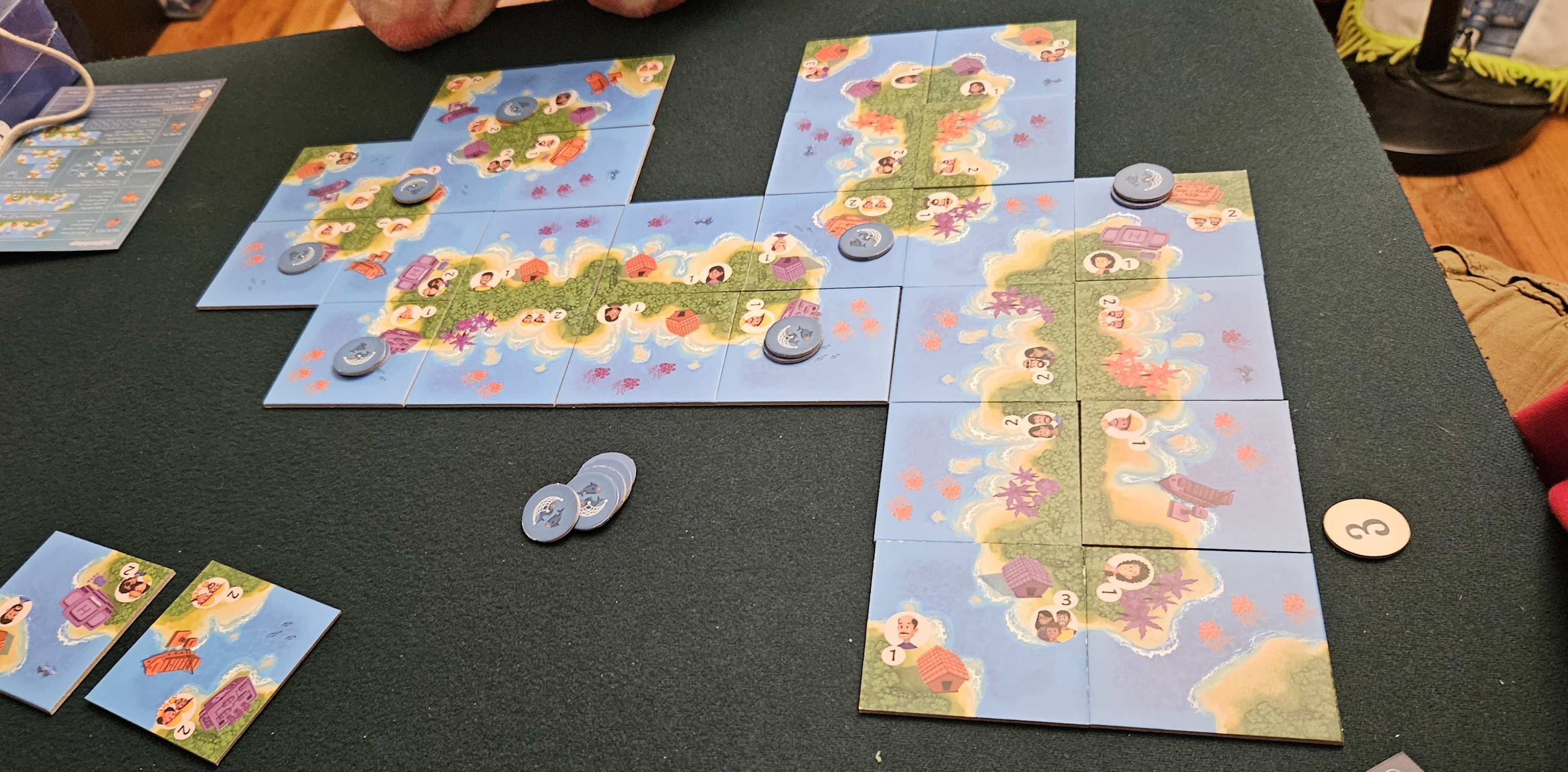
The archipelago develops into little corndogs.
But the ultimate value of forests only appears in the advanced game, where they’re one of two ways to earn bonus tokens. These emphasize the game’s focus on mitigating climate change. Now you can construct green structures, prop up sustainable tourism and fishing, and enact conservation measures for forests and reefs.
Both modes work. That should be made clear. But it’s the advanced game that makes Lakshadweep come alive. This is a game about considering an environment holistically, the health of its seas and lands and people together. In a game that rightfully directs its gaze at its features rather than at the contours of each tile, the addition of a few extra icons snaps it into focus. Where previously reefs were a secondary concern, now they’re a valuable source of points in their own right. Forests are transformed from a sure bet into the metamorphosis of an entire island, an entire chain of islands. Rather than playing reactively, always adjusting to what appears in the market, long-term planning becomes possible. You can enrich a poor island, or diversify an island that only has one or two features, or mitigate the damage of a poor placement. For the first time, Lakshadweep feels like a game about fixing something rather than merely crafting a shared space.
And it works like a charm. The result is a delightful score-chaser, bite-sized and easy to learn but with plenty of trills and ah-ha moments. It’s nice to play a little eco-optimism now and then.
(If what I’m doing at Space-Biff! is valuable to you in some way, please consider dropping by my Patreon campaign or Ko-fi.)
A complimentary copy was provided.
Posted on July 6, 2023, in Board Game and tagged Board Games, Lakshadweep, Luma World. Bookmark the permalink. 8 Comments.

 SPACE-BIFF!
Very happy to read this review, especially for its discussion of the game’s eco-optimism. I much enjoyed Sidhant Chand’s tea-making game Chai Garam and I think he’s a vitalizing force in game design.
Oh! That’s great to know. I saw that he had a few others designs, but I have yet to try any of them.
Means a lot, mate! Thank you
Dan, this was such a nice review. I’m glad you liked the game and appreciated the messaging behind the game 🙂 special mention to my publishers Luma World to make this possible 🙂
Thank you for designing it, Sidhant!
Thank you for this wonderful review, Dan! Glad you liked the game 🙂
Sidhant is such a talent and we’re honoured to have worked with him!
Pingback: Adolescent Archipelago | SPACE-BIFF!
Pingback: Brass: New Delhi | SPACE-BIFF!