Carcassonne-by-the-Sea

It would be easy to label Beacon Patrol, the tile-layer designed and illustrated by Torben Ratzlaff, as a toothless Carcassonne-by-the-Sea. Like Klaus-Jürgen Wrede’s masterpiece, it’s preoccupied with the matching of corners and edges, the apprehension of gaps yet to be filled, and landmasses that come together at jutting intersections. Despite those similarities, Beacon Patrol is unhurried, a wholly cooperative or solitaire game that proceeds at leisurely pace and doesn’t conclude so much as it goes to sleep.
That’s exactly what it’s meant to do. It may lack bite, but the better descriptor would be to say it never breaks skin.
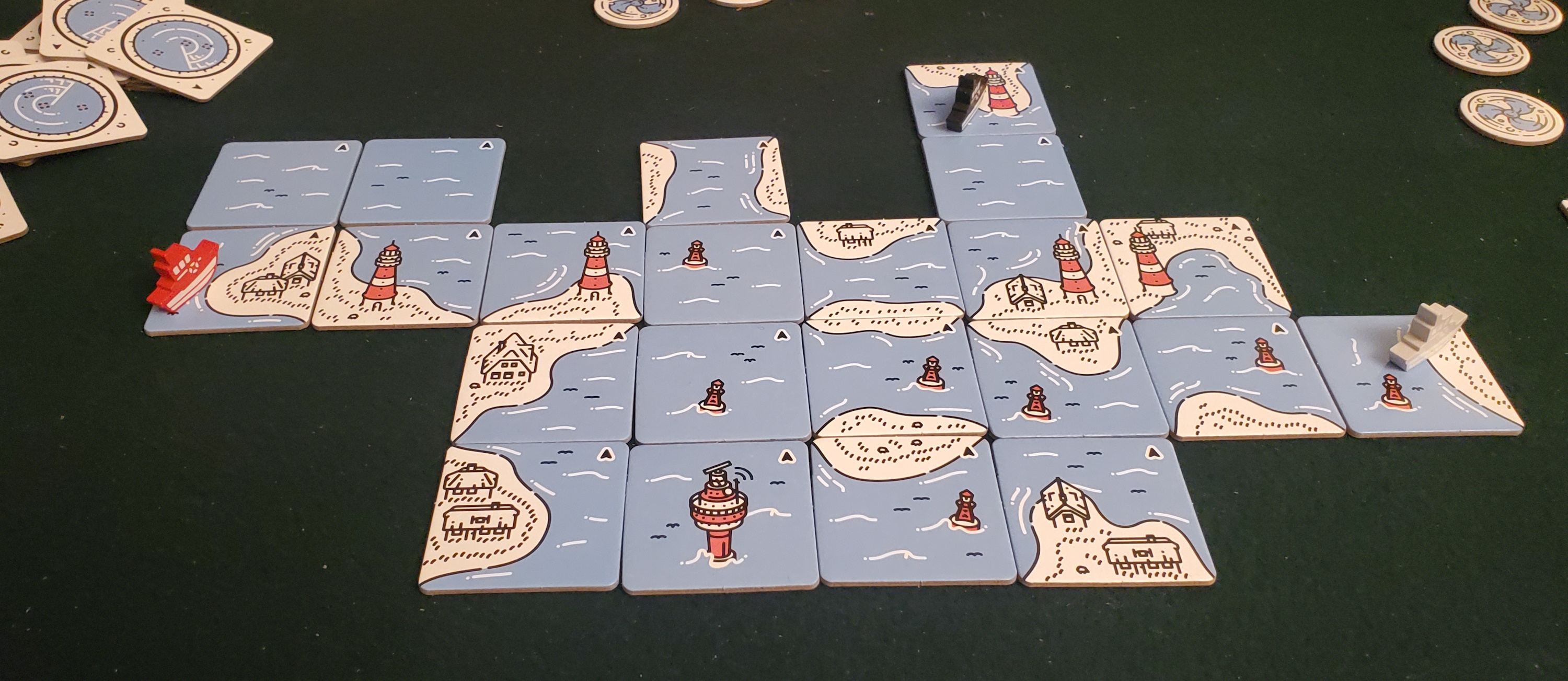
Welcome to Carcassonne-by-the-Sea.
One glance at Beacon Patrol’s seascape is enough to explain how it works, or at least get the gist. You’re a captain in the Coast Guard mapping the small islands of the North Sea. Is that a thing? Do islands go missing? Who cares. Ratzlaff’s illustrations are bare but evocative, chilly and turbulent, but not too choppy to dispel the sensation of a brisk morning chill threading through a cracked window, felt only through the safety of a down comforter. Presumably all these buoys and lighthouses have been erected here for the safety of passing vessels, but today is a cold bright one, the waters lapping rather than heaving, perfect for motoring around in a boat to observe the sights.
It’s the palette that does it. To my untrained eye there are only four colors, all of them wintry. Even its warmest tone, the orange splashes that are the game’s markers of safety and therefore scoring, are drawn in a chilly hue. Anything more might have oversaturated the landscape. This is not a vivid game so much as an expressive one. It’s about the texture of a coastline, the way islands appear like organic creatures seen beneath a microscope. It’s about exploring those contours and maybe getting caught on them. At the same time, it’s a game without any real snags or snarls.
Okay, enough of that. It goes like this. Turns are the same whether played with friends on on your own. You have a ship with three propeller counters. You also draw three tiles. From a starting tile you go exploring. Most of the time this is as simple as placing a tile and moving onto it automatically. To move without placing a tile requires that you spend one of your propellers, or else a map tile if you’re in a bind.
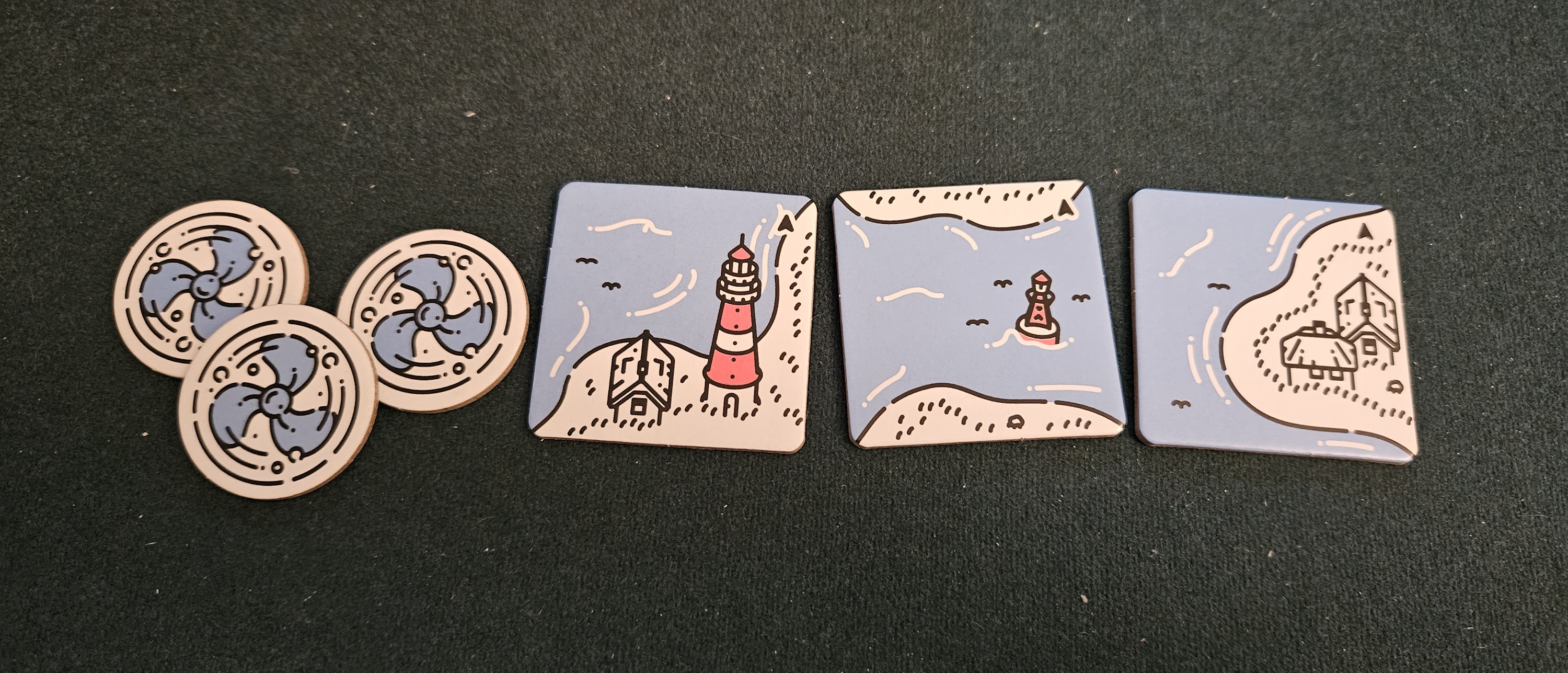
Working with limited options.
Bit by bit, the map expands. At times you’ll explore yourself into a corner, usually by placing a wall of coastline in your way. Getting around these obstacles can be tricky, sometimes requiring multiple moves and lucky draws. This latter element, the draw, is central to the game, but it never fully loses its sting. There is no market of tiles to select from, only the three you’ve drawn into your hand. Stick with Beacon Patrol long enough and you’ll witness a bum draw that leaves you few options. That’s by design. When playing with companions, there’s the lifeline of a once-per-turn swap, a way to bounce a tricky tile between players or exchange a handy section of open sea. More often, you’ll wrestle against the ocean. Moving around an unfilled corner becomes a puzzle in its own right, a quest for the proper section of map that will let you sidle around the edge of an island.
Of course, you could leave gaps. But this is a concession you won’t make lightly. That’s because tiles only score if they’re built in on all four sides, so gaps in an otherwise charted region are also dead spaces in terms of scoring. The scoring itself is as straightforward as can be. Tiles score one point if they’re featureless, two for a buoy, three for a lighthouse. Of course, the tradeoff is that lighthouses only appear on land, forcing you to box them in with further coastlines. The advanced rules add two more features that are all but essential: piers, which score for every house on the connected island, and wind turbines that earn extra points for every adjacent stretch of open sea.
As repeated plays bestow a stronger sense of foresight and strategy, you become less an explorer and more a creator. You begin to remember that there are only so many tiles that depict bays, only so many straits with islands to the north and south, or that you’ve seen so many juts of land from the west that you can’t rely on drawing many more.
The same goes for your sense of navigation. Every lost tile is a tragedy, but sometimes it’s a tragedy worth enduring for the sake of an extra boost, inching your boat closer to an unfinished span rather than floating in the corner. Sometimes ego plays a role. There’s a relatively hard cap to the size of an island, considering how you can’t march inland. But on occasions an island will become a challenge of its own, a task to circumnavigate. Indeed, Beacon Patrol is much like an off-trail hike in that regard. Your goals are concrete, but they never stop being self-directed. Just as a hiker might summit a difficult saddle or hill just to avoid saying it defeated them, certain areas of the map beg to be completed, for no other reason than because they gave you the trouble.
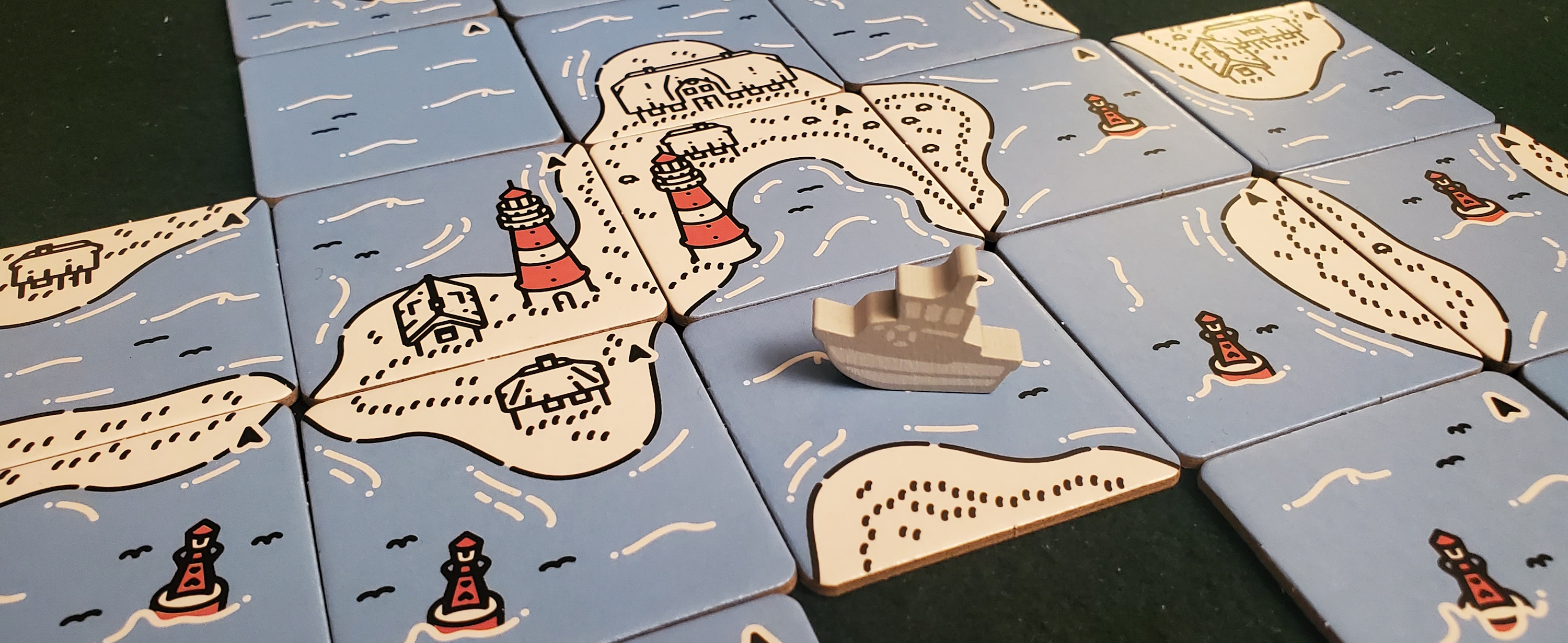
Completing larger islands can be difficult or even impossible.
Every so often, we stumble across a game that’s about the process of play more than about the outcome of play. Beacon Patrol nods at the latter while incarnating the former. Carcassonne offered this sort of tile-laying as a means of connecting and controlling discrete areas. Beacon Patrol wraps its tile together with a tally of points, but its point of play isn’t to arrive at a high score. The scoring criteria are a set of guidelines more than a hard statement, meant to shape the archipelago rather than bend it to a specific purpose. Instead, it’s about the process. The picking up and examining of tiles. The laying of them down. The moments when a shape must be examined from another angle in order to complete it. It’s childlike that in that sense, fascinated with action over purpose.
Sure, to some degree it’s also soporific. Even with the advanced rules, this game about interlocking tiles offers none of the usual overlapping scoring mechanisms. There are no tiles that ask you to judge what else lies in their column or row. There are no townies versus tourists to carefully segregate. The closest the game gets, the aforementioned piers, make a splash to some degree, encouraging larger islands with many residents. But like everything else in Beacon Patrol, they’re such naturalistic inclusions (and drawn so randomly) that they’re less of an overlapping feature than one that nestles comfortably into an island’s elbow.
If anything, it’s a study in why those features have come to feel overused. Compared to other tile-laying games, Beacon Patrol feels like a return to our roots, less burdened by two decades of received wisdom in how these things should score, how they should handle. It’s more interested in how we should feel when we make something that looks good. My nine-year-old was hypnotized laying those tiles. She stared and stared, losing herself in that sea’s imagined motion. When I asked if she was all right, she smiled and realized she knew exactly where to place the tile she was holding in her fingers.
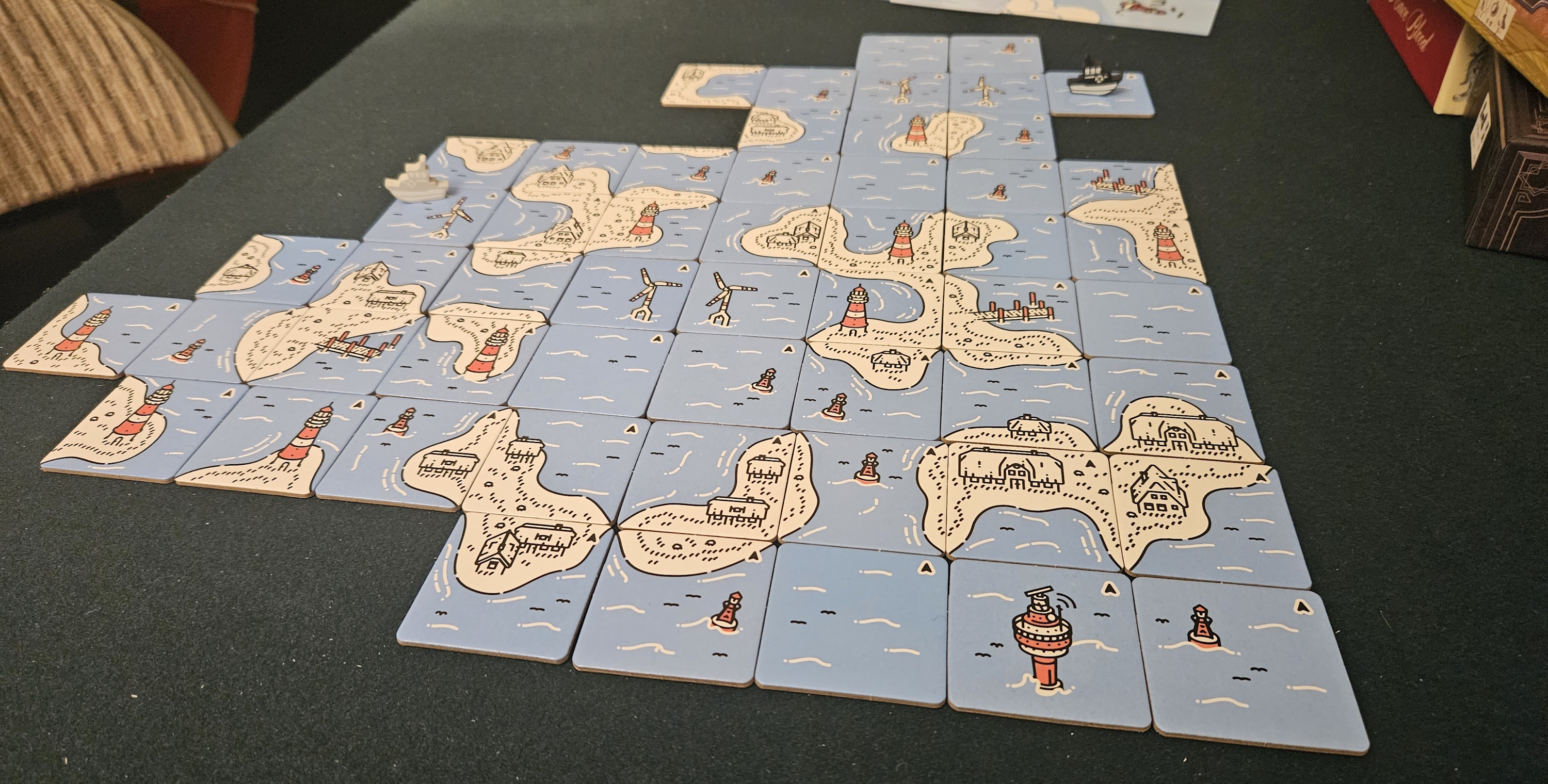
Completed maps are lookers.
Beacon Patrol is atavistic both in setting and function. Despite the presence of civilization in every corner, the necessity of charting its corners marks it as a place of forgetfulness, the very act of recollection as raw as the formation of a first memory. The same goes for its handling and play. This is tile-laying at its most primal. There are scoring goals and modern considerations, even limited resources in the form of those exhaustible propellers. Yet it returns us to the delight of putting things in order simply because they need to be matched. It recalls playing with building blocks, or fitting a puzzle together, except of course there is no singular solution to the quandary it places before us. Only the pleasure of the process matters.
The result is a mesmerizing game that will undoubtedly be judged by its absences, stark as they are. To do so, however, would be a mistake. In its own way, I’m reminded of the landscape woodblock prints of Japanese ukiyo-e, with their emphasis on place and motion. The maps produced by Beacon Patrol are images without a focal point. They are meant to be explored. Beacon Patrol doesn’t require a dozen scoring criteria, or competition, or anything else. To mark the boundaries of its islands, to wander through bright waters, to stare in wandering hypnosis — that is enough.
(If what I’m doing at Space-Biff! is valuable to you in some way, please consider dropping by my Patreon campaign or Ko-fi.)
A complimentary copy was provided.
Posted on June 13, 2023, in Board Game and tagged Alone Time, Beacon Patrol, Board Games, Pandasaurus Games. Bookmark the permalink. 9 Comments.

 SPACE-BIFF!
“You’re a captain in the Coast Guard mapping the small islands of the North Sea. Is that a thing? Do islands go missing? ”
Not entirely sure about the North Sea, but to the East roughly where the Gulf of Bothnia meets the Baltic between Finland and Sweden, the Åland Archipelago consists of a lot of islands. Like north of 17k islands. And the number and size of islands are growing at a rate of 4-10 mm per year, thanks to “post-glacial rebound.” As I understand it, Finland and Sweden and Åland all do fairly constant surveys of these waterways and redo navigation charts accordingly.
Contrast that with all the islands going under globally from rising sea-levels. So, yeah, geologic time acting out in near real time. Gotta go survey!
Fascinating! Thanks for the info.
Since Carc is still a fave of mine, this tile laying game appeals to me. The simple premise of play seems to focus on a sense of hugge rather than huge strategy. Sounds good to me. Alas, your review title remindeds of the Genesis song Home by the Sea so thanks for putting that earworm into my head today.
I’m glad I pre-ordered this. It sounds exactly like my preferred kind of unexceptional, ‘meditative’ solo game to play in front of the telly.
I’m curious, Dan, if you’ve played ‘Finished!’ by Friedemann Friese? Most people seem to find it offensively boring. The reason why I wondered what you would have to say about it, is it’s a bizarre little curio. It’s not even “fun” and yet I still think it’s a masterpiece, and strangely addictive. It’s like folding laundry, something one does for the sake of its own doing. I don’t play it to enjoy myself per se, but to “finish” the task, because what else are tasks for? I’m convinced there is some layer of genius to it and I keep wondering if you would agree.
I have not played Finished!, but I’d be willing to at some point. I love a good “is it boring or what?” challenge.
Pingback: Bloodsucking Techbros | SPACE-BIFF!
Pingback: Sustainable Archipelago | SPACE-BIFF!
Pingback: Best Week 2023! Family Stuff! | SPACE-BIFF!
Pingback: Adolescent Archipelago | SPACE-BIFF!