When Fire Met Stone
From Troy to Stalingrad, there’s nothing quite as gripping as the stakes and drama of a good siege. Sieges seem like the perfect setting for a board game, with their limited parameters and clear-cut victory conditions. Yet we don’t often see them given their due. In many cases, board game sieges are little more than countdown timers while armies elsewhere rush to reinforce besieged allies or outmaneuver their foes.
In stark contrast with other efforts, Fire & Stone: Siege of Vienna is possibly the best siege game I’ve played. We’ve seen the work of Robert DeLeskie before, first with The Wars of Marcus Aurelius and later Stilicho: Last of the Romans. But where those were sweeping epics, covering decades of zoomed-out politics, Fire & Stone covers two months of intense fighting between the Ottoman and Holy Roman Empires.
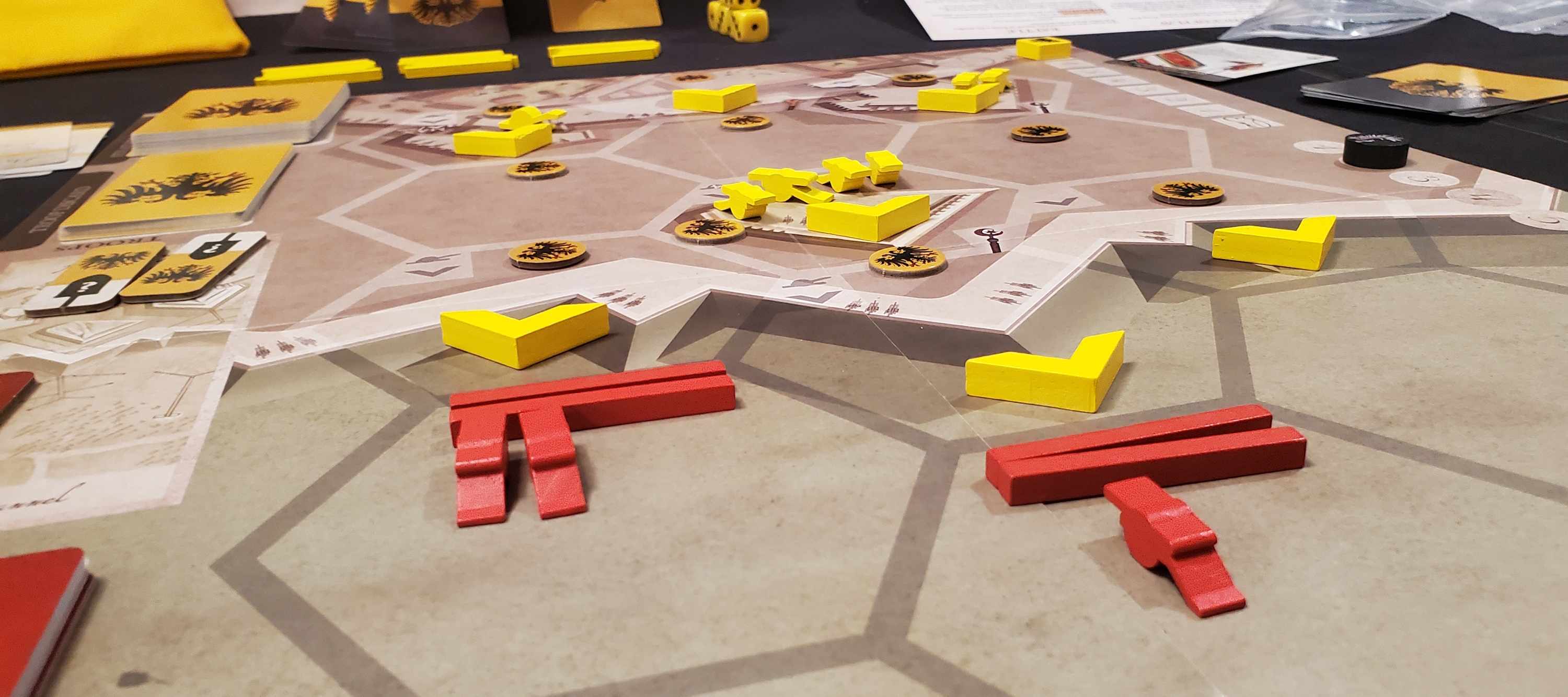
Approaching the walls of Vienna.
The 1683 Battle for Vienna was a peculiar fight, with one foot in the modern era of trench warfare and moveable artillery, but the other still grounded in the medieval, fought with bows and arrows, spears and swords, and average engagement ranges of only a few meters. The best compliment I can pay Fire & Stone is that DeLeskie nails the feeling that we’re on the cusp between one era of warfare and another. Both the Ottomans and the Viennese rely on fortifications, but they’re growing obsolete thanks to better cannons and sappers. At the same time, ranged weaponry is still prone to failure. Charges explode prematurely, soldiers sally into enemy territory to spike cannons, and rain — well, nobody’s yet figured out how to mitigate wet gunpowder.
For the most part, the effect is gripping. Just as the siege of Vienna functioned as an extended chess match between engineers, Fire & Stone plays out as a series of escalating bids and counter-bids. The Ottomans dig their zigzagging trenches; the city’s defenders emerge under cover of darkness for some close-quarters retaliation. Sappers tunnel under the walls; counter-diggers scramble into pitch-black combat. Disease spreads. Fire spreads. Mud spreads. Large groups of soldiers are exhausted, then killed. Both sides can feel the days closing in on them.

Battles are likely to inflict casualties.
According to recent tradition, Fire & Stone is directed via the same card system that’s come to dominate this sort of wargame. Both sides have their own deck to work from, and spend hands of cards on either historical events or more generic actions. The system is translated intact from other titles with few alterations, but why mess with what works? Especially since the strength of this system is that it lets designers emphasize both general events and exceptions alike. As in other card-driven wargames, DeLeskie sieves history for singular occurrences that would otherwise go unnoticed if they required their own rules. This allows the game to include both the usual business of siege-making — digging, attacking, firing off cannons — alongside those that are more particular, whether because they’re driven by circumstance or because they’re downright bizarre. For example, along with the premature detonations and intercepted couriers that are the usual godsends and crises of battle, DeLeskie includes a literal battle of the bands, when on July 31st both Ottoman and Viennese musicians attempted to drown out their foe’s tunes while battle raged below.
While events provide texture, it’s the overall arc of the siege that’s the most important. In that regard, Fire & Stone strikes a balance between ongoing projects and sudden gouts of violence. Both sides must carefully maintain their defenses lest they see the other side push them back. There’s a crucial asymmetry at play. While Vienna’s cannons are more effective, striking attackers from anywhere on the map, they’re also fixed in place, letting the Ottomans gradually wear down their firepower as sections of the fort are overrun. On the other side, Ottoman firepower is limited to medium artillery that must be hauled within spitting distance of their targets, making it possible for sallies to wreck crucial pieces. Speaking of which, every sally and assault must be carefully measured. The Viennese have limited defenders and need to rely on their defenses and guns to survive, while the Ottomans are more numerous, able to sacrifice great quantities of troops for every gained inch, without ever escaping the apprehension that too many losses will see their morale collapse. It’s an anxious sort of game, every played card posing a new setback.

Know your cannonballs.
It’s also a game that doesn’t wholly trust its own systems to produce the desired outcomes. Take, for example, cannon fire. Both sides regularly bombard the other, whether thanks to one of Vienna’s periodic barrages or during battles especially. These battles are the hinges upon which the rest of the game turns, climactic moments that are both the outcome of broader events and minor decisions in their own right. Both sides choose their lineup of troops, dictate which will be exhausted by defensive emplacements, and decide whether to play one of their limited battle cards. The rest is up to the dice. When cannons fire, dice are flung from their mouths in place of shot. Casualties are determined by 6s, but always only to a point. Usually, the limit is two per side. The casualties themselves are also assigned at random. While it’s possible to deploy weaker troops to absorb losses, there’s no guarantee your veterans won’t take the hits instead.
The result is appropriately brutal. Siege warfare is, after all, a terrible business. One route to victory is simple exhaustion. If a side runs out of troops entirely, they’re forced to concede the fight.
It’s also evidently artificial. Not that troops are lost at random, nor that the game’s cannons are so unreliable. Rather, that the outcome of all these actions and battles are capped. Undoubtedly there’s a subtle balance being struck. If a single salvo could eradicate the Ottoman army, a single lucky roll could render the game unplayable. Still, Fire & Stone doesn’t quite escape the sensation that it’s being carefully shepherded away from big errors or pivotal collapses. It contains big moments, to be sure, but never cataclysmic moments, never moments that are decisive on their own. At its remotest, it’s almost like playing a synopsis of a game rather than the game itself. The broad strokes are there, but the individual scenes, the moments of greatest anticipation and release, have been rounded out. The very abstraction that makes it such a tight contest also gives it a distant air.
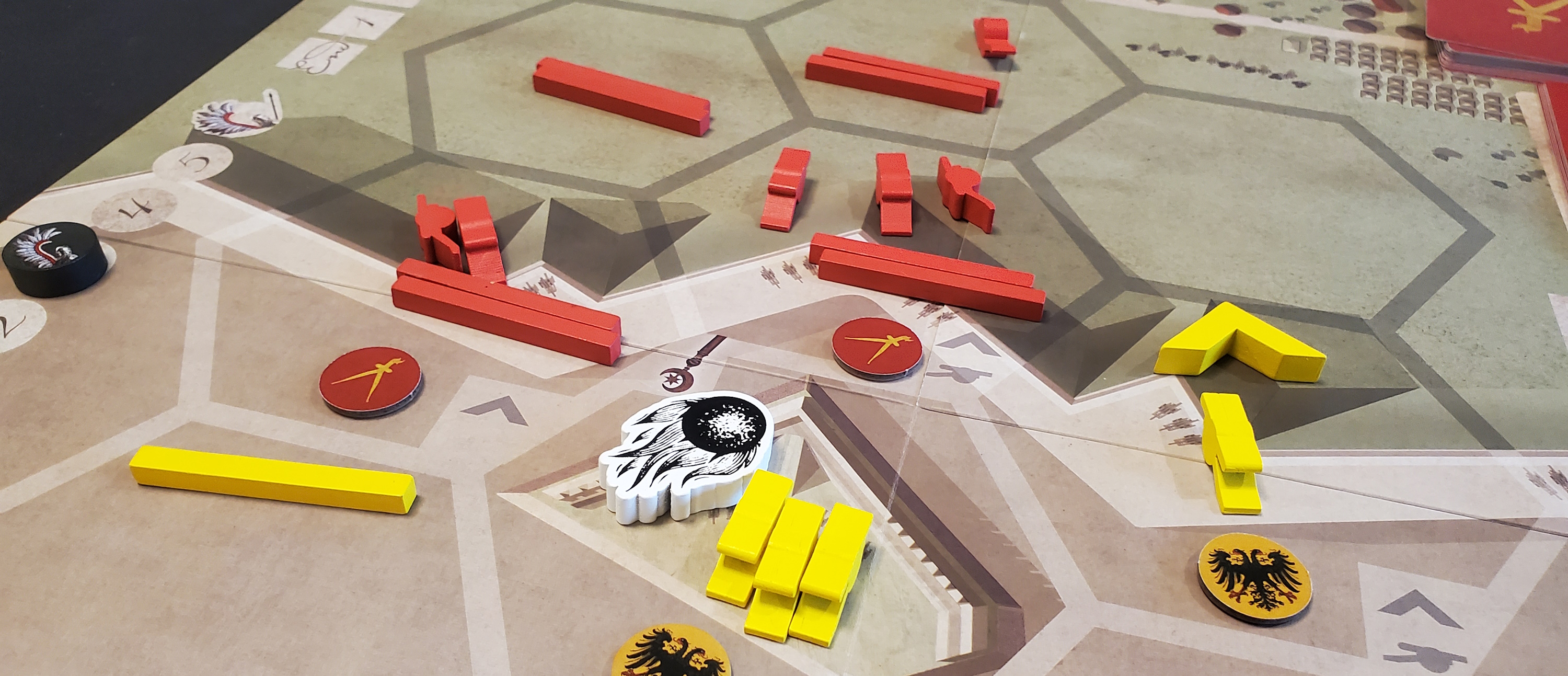
Another engagement.
This should probably be taken as fainter damnation than it sounds. A siege is a contest of attrition, so it behooves a siege game to be a duel of needles, even if it misses the occasional jab to an artery. Fire & Stone is an impressive game, both as a duel and as a depiction of history. Nicely, DeLeskie not only frames the siege itself, but also goes to pains to explain its context — including why the East vs. West framing of the Battle of Vienna is for dupes.
In short, of DeLeskie’s titles this is easily the smoothest, and thanks to Capstone’s production it’s certainly the most lavish. It isn’t wholly grounded, opting for abstraction over emotion, but it captures the technical aspects of siege warfare, revealing a contest of wills, engineering, and momentum that’s too often overlooked. More sieges in this vein, please.
(If what I’m doing at Space-Biff! is valuable to you in some way, please consider dropping by my Patreon campaign or Ko-fi.)
A complimentary copy was provided.
Posted on June 8, 2023, in Board Game and tagged Board Games, Capstone Games, Fire & Stone. Bookmark the permalink. 13 Comments.

 SPACE-BIFF!
Thanks for the review, this game really intrigues me.
I picked this one up based on your review, and I was not disappointed. A very tense game with lots of interesting decisions. Considering the limited board space and small action list, there’s a surprising amount of flexibility and options in the game. As the Ottomans, do you ponderously burrow your way under the wall or just throw your vast army at the defenses? As the Austrians, do you plan for a counter-attack, hold your ground at all costs or give ground to try to wear down the Ottomans? It’s such a deep game for such a simple design.
Glad to hear you enjoyed it, Christian!
How would you rate the game for replayability, Dan? My fear with a streamlined seige game being that it ends up feeling a little rote…
There’s some variability there. Each side has two decks to work from, and you won’t see all the cards in a single play. This isn’t the same as replayability, of course, but it does give the game a little more to explore.
Understood, and thanks for the clarification.
When the Winged Hussars arrived!
Yes! Although unfortunately the game ends with the relief army’s arrival. You don’t get to see them in action in any way.
For a siege game in a similar vein I’d suggest “Freedom!” by Vangelis Bagiartakis. The first edition was a bit rushed, but the aesthetic is gorgeous and it has a wonderful sense of pressure. The besieging Ottomans constructing ever more deadly artillery emplacements, suffering withering fire from the city walls and creeping round the islands in the city’s lagoon; meanwhile the beleaguered Greeks desperately fight to repair the walls and marshal support from nearby cities to give them supplies.
Not perfect – the importance of the cannon volleys at the beginning of each round can make or break a turn for both sides, and the Greeks have fewer options to be proactive while defending – but something I’d say more people should be aware of (I have a lot of time for Phalanx as a designer and publisher)
It looks like I’ll be trying Freedom! sooner than later — no sooner had I published this review than the folks at PHALANX threw their hat in the ring. We’ll see which siege game emerges with the title.
….”It contains big moments, to be sure, but never cataclysmic moments, never moments that are decisive on their own. At its remotest, it’s almost like playing a synopsis of a game rather than the game itself. The broad strokes are there, but the individual scenes, the moments of greatest anticipation and release, have been rounded out. The very abstraction that makes it such a tight contest also gives it a distant air”….
Sorry, when I translate it into Spanish I find the paragraph very romantic and I can’t understand what you mean.
Is the game abstract? I mean, is it not very immersive or thematic when playing it?
Is it dry and flat? I mean, not very emotional, not very memorable, does it have no epic moments?
Correct. It’s more abstract that it needed to be. It isn’t very emotional or memorable.
Pingback: Fashion Is Danger | SPACE-BIFF!