The First Shall Be First
There’s an account in the Gospel of Mark that stands out, not only as an expression of Jesus’s idealism, but also as an indictment of the Christian project at large. Jesus walks in on his disciples arguing over which of them is foremost among the entourage. His answer is succinct: Whoever wants to be first must instead be last. The symbol of greatness to Jesus is the servant, the child, the helpless. I have yet to find a church that takes Jesus at his word.
Pardon the religious talk. It’s impossible to discuss Ierusalem: Anno Domini without slipping into the territory. Designed by Carmen García Jiménez, this is the most devotionally charged board game I’ve played in recent memory, and that’s counting titles like The Acts of the Evangelists, Nicaea, and The Mission. The rulebook is glossed with statements from the Gospels. Resources include stones, loaves, fishes, and the Holy Spirit. Final scoring is an outpouring of points based on your proximity to the big man himself.
Speaking as a lifelong student of early Christianity — and surely not projecting any of my own hangups and traumas — it’s a very weird game indeed.

Jesus is a friend of mine.
Years ago, a well-intentioned pastor told me that one proof of Jesus’s divinity was the impossibility of imagining him as shorter than yourself. As an actual short person, I’m not so sure. I imagine everybody as taller than me, and that doesn’t mean I fall to my knees every time I picture the towering visage of Peter Dinklage. Regardless, Ierusalem opens with an image of Jesus that’s not only satisfactorily tall, but is closer in stature to the Nephilim. He occupies, by my estimation, the same floor space as eight ordinary people. Behold the King of the Jews, sitting at the center of a large table in the upper room where the Last Supper will take place. It’s your goal to sit as near to him as possible.
It’s a proposal that reads almost like satire, but Ierusalem is entirely earnest. Everything you do revolves around seating arrangements. You’re a community of Jesus’s followers, newly arrived in Jerusalem to celebrate Passover. This is where Ierusalem piques my interest. Which communities do you represent? Is this game interested in exploring the contrasting expectations and aspirations of its various groups? There’s so much ground to cover. An Essene community, preoccupied with questions of authority and asceticism, might score differently from Hasmonean restorationists, who in turn would have very different feelings about this self-proclaimed king than a band of Herodian loyalists or Pharisee observants. This is an opportunity to explore the seedbed of first-century Judaea.
Ierusalem isn’t interested. In fact, there’s nothing to distinguish these communities — not only from one another, but also from the realities of their surrounding time and place. At times, it veers into the distasteful. It’s telling, for example, that there’s a Sanhedrin track for counting down the turns until the assembly of the temple decides to crucify Jesus; meanwhile, the Romans are wholly absent. That’s the extent of Judaism’s cameo in this tale, as schemers waiting in the wings to slay the Son of God. Its sense of identity is so remote that one might forget that every single character it depicts is Jewish.
Rather than calling it supercessionist or antisemitic, kinder terms might include naïve or allegorical. This is the Last Supper story taken at face value, subjected to neither curiosity nor serious research. To be fair, it never even strays in that direction. This is a boilerplate Eurogame, full of boilerplate Eurogame actions and boilerplate Eurogame scoring criteria. Your followers — meeples, what else? — journey from your player board to the outskirts of Jerusalem, gather resources from nearby nodes, exchange them at the local market, do some light inventory juggling, and then conduct careful accounting to buy entry to the upper room, visit apostles, and avoid that Judas fella at all costs. It’s all the fun of tax collecting, except the game is empty-headed about the particulars of Roman occupation.

For a game about the Last Supper, you sure make a lot of visits to the market.
There’s really no overstating how bland most of these actions are. Turns revolve around playing a card and taking the actions listed thereon. Most of these are hardy staples of the genre. A card bearing the icon of the lake will let you collect fish according to how many followers you’ve deployed there. The same goes for the desert and mountain and their corresponding stones and loaves. Other actions are more interesting, letting you listen to parables or grant favors to your fellow communities, but even these are underdeveloped. The parables, it turns out, are worth points, and not especially many of them. Favors are worth points and also an occasional extra fish. At one point, the favor track goes wild by letting you unlock one extra space in your inventory. That’s right, one space. So much for charity being its own reward. In Ierusalem, charity’s a rip.
The lion’s share of your points come from the game’s most interesting conceit, the Last Supper itself. Every so often, you’ll be allowed to send a follower to the feast, buying their way into the upper room with those hard-earned resources. The greater your contribution, the better your seat.
The twist is that the value of these seats develops as the game progresses. By collecting sequences of icons on your played cards, you can visit apostles to earn bonuses and send them to the supper. The bonuses themselves are impressive. Some apostles invite you to the feast for free, while others score early, let two followers swap seats, or, in the case of Judas, give you a few of the silver coins he happens to be holding.
The apostles, once seated, also dictate scoring. They’re worth differing amounts of victory points, so that Peter, for example, is worth more than poor doubting Thomas, who at least isn’t subtracting points the way Judas does. This transforms the upper room into a mishmash of intermingled scoring incentives. Just because another player has plopped an apostle’s bum into a particular chair doesn’t stop you from sitting at his feet, or indeed from swapping chairs or shuffling closer to Jesus himself. This is Ierusalem at its best, a core system that unites (most of) the game’s actions and brings everyone into direct conflict with one another.
And it’s such a human idea that these people are jostling to be first in line. It flies in the face of Jesus’s teachings, but that makes it all the more charming. Despite the game’s claptrap portrayal of history, it contains a kernel of reality that makes its excesses easier to swallow. Jesus says, “Whoever wants to be first must be last,” and we clamor to sit closest to him instead of bussing dishes or giving up our seat to a widow. It speaks to the fallibility that resides in all of us.
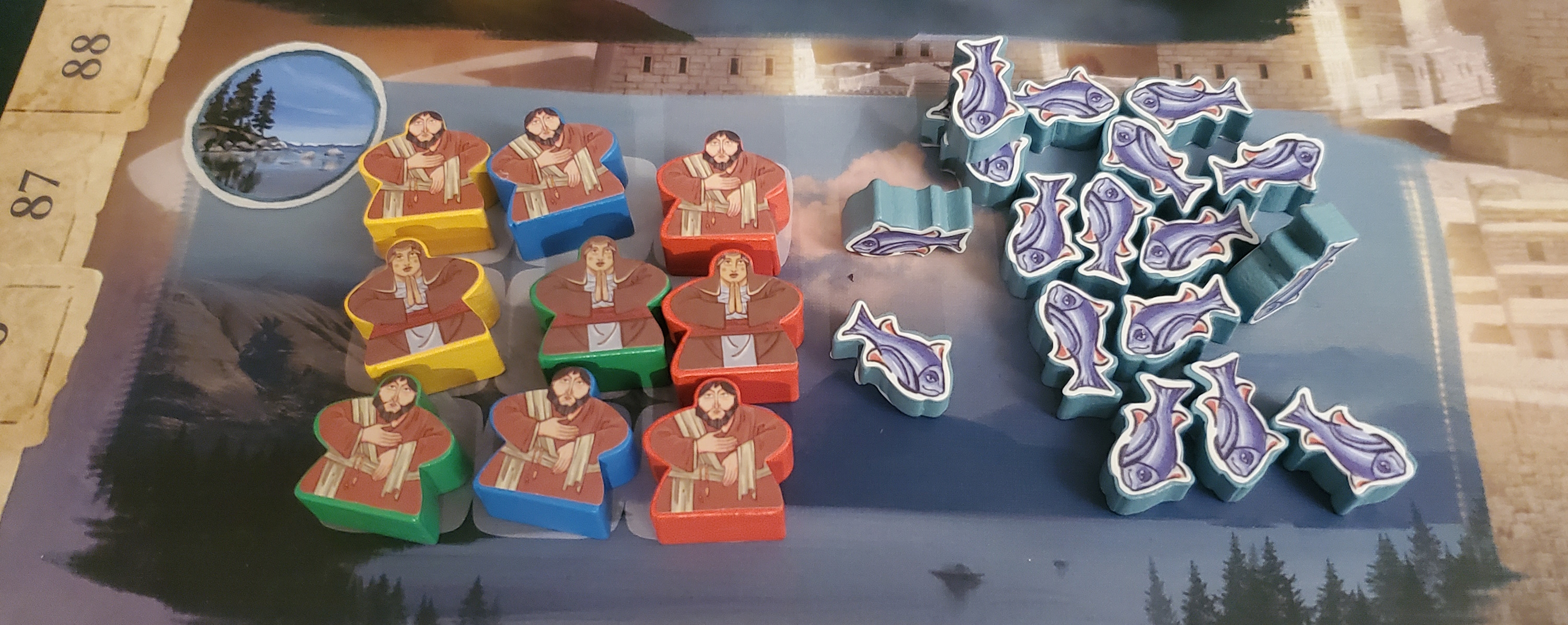
Fishers of fish.
It also reveals how impoverished the rest of Ierusalem is. The enthusiasm and graciousness of the game’s central contest makes it clear that it was intended as a positive experience, one that both celebrates and chides its human subjects. That part is golden.
If only its trappings didn’t make it feel so cynical. By wrapping this event in the framework of a boilerplate Eurogame, the message is unlikely to be delivered. Worse, it’s likely to be subverted. The parables and favors are a sideshow, disconnected from the Last Supper and worth little compared to stacking the upper room with as many followers as possible. It’s easy to envision a version of this game in which they had a greater impact — rewarding the community that went to the pain of understanding the teachings of Jesus rather than simply crowding the man. But because Eurogames must include scoring categories, Ierusalem pitches its parables and favors along those lines, to meager effect.
The same is true elsewhere. For a game about the birth of a new religion, its endless resource exchanges feels grubby and pedestrian. When you get right down to it, its religious observances are formalist, more about going through the motions than the function of those motions. Proximity to Jesus’s body is elevated above the developing meaning of that body, while commercial exchanges are ritualized far beyond any observances of the Passover. I don’t necessarily attach divinity to Jesus, but it still feels borderline impious to depict him as charging an entry toll to his final supper. Jesus said that the first would be last and the last would be first; Ierusalem says that the first shall be first, and too bad for the losers.

The seating arrangements are the best part of the game.
To be clear, this may be a symptom of the game’s format more than anything. By format, I don’t mean simply that Ieruslaem is a board game. Rather, I mean that it’s a Eurogame, obsessed with scoring categories and iconographies and resource conversions. There are more imaginative means of depicting religion and devotion, and a handful of designers are leading the charge to deepen the medium’s capacity for expression. Sadly, Ierusalem is trapped in a rut. It’s a game that yearns to graze fingers with the divine, only to imitate the hidebound approaches of other titles. I appreciate the effort. I wish I could have appreciated the meal.
(If what I’m doing at Space-Biff! is valuable to you in some way, please consider dropping by my Patreon campaign or Ko-fi.)
A complimentary copy was provided.
Posted on May 30, 2023, in Board Game and tagged Board Games, Devir, Ierusalem: Anno Domini. Bookmark the permalink. 18 Comments.

 SPACE-BIFF!
Gonna file this one in the memory banks under “examples of ludo-narrative dissonance”
Yeah.
very entertaining, thank you!
the masses with Brian’s sandal were permanently showing up before my inner eye.
I had a similar reaction to Ierusalem when I saw news about it. I wondered if it is was purposefully cynical, but after reading the designer’s dairy I realised it was sincerely meant, just utterly missing the mark in what Christianity should/could be, or rather, how that might be depicted well in a game. I have no interest in getting this, despite (or because of) being a devout Catholic. Of the other games mentioned, I’ve played Acts of the Evangelists, which is a very good game with a well-integrated Christian theme, but it doesn’t speak of Christian life itself. Now that would be something! I have a design of my own in the works, but will I ever finish it? And will it be good?
I don’t envy the designer. There’s really no way to get Christianity “right,” since there are so many Christianities, not to mention dueling perspectives on the historicity of the whole thing. One of the shared characteristics of those other three Christian-topic games is that they elide the person of Jesus altogether. He’s firmly off-camera. Maybe that helps?
I think there can be ways to make games that authentically touch on aspects of what Christianity strives to be. Yes, there are many different approaches to Christ and many different aspects of living or trying to live in faith, but I don’t think a game has to encompass everything. So I definitely think it’s doable in theory, if tremendously tricky in practice. I wouldn’t say Jesus is altogether elided in Acts – he is the focal point of all of the gospel stories you are collecting and recording, so definitely part of the game. But I agree that working him more directly or actively into a game is a tall task.
This game is puzzling to me. Either you are a religious person, and this is a ridiculous concept, maybe even a disrespectful one, and goes completely against the values of the religion. OR, you ar enot a religious person, in which case, why pick this theme at all if you’re making a EURO game of all things? It’s not often you find a project that is absolutely confusing why it exists to begin with.
From a certain perspective, it’s a bold choice! And I do admire the effort. But yeah, the only other review I glanced at was largely effusive because the author was Christian, and then also bemoaned the game’s obsession over victory points.
Well, not really, I mean, considering the author has a degree in Theology, I guess at least some religious persons are going to find it not offensive or even nice.
For all I have read, she tried hard to portrait the game as non-proselytizing, open to be played by anybody of any religion or none, etc. Of course there is the small detail of the pretension that the game is historical and lets you explore the “events”, which is somehow not considered a religious position in the design, but well…
I think that is part of the reason for the blandness. Hey, I love games, I love this theme, I want to do them together, but I dont want to come out as having a message to say because that would be polarizing and difficult. So the “message” is “explore the events, that are 100% true and historical, but as you like to see them”. You are “following” this guy because who knows, maybe you are a believer, maybe you are just checking the hot new thing in town.
For sure, I would have liked something with more of a clear message… or not, maybe I would not have liked the message, but it would have been a more interesting thing, but well, again, for what I’ve read, Devir was not really going to publish it for being a religious game and thinking they didnt want to kick that nest of hornets, but Millán (the designer of Bitoku, Sabika, Bamboo…) convinced them. And I guess a great deal of the convincing went into “see, it is harmless”.
From the Ecclesiastic Reviewer:
Whereas other games that try to provide a moral argument in a historical setting, such as John Company, falter by making amoral behavior pleasurable and forcing players to wrestle with uncomfortable truths, this game sticks the landing of its moral argument by leaving the player with no other interpretation than that the pursuit of being first is ultimately an unrewarding and pointless endeavor.
Expertly using the trappings of the Eurogame the designer exposes both the banalities inherent to our daily pursuits but also the boardgame genre as a whole.
Vanities of vanities, says the designer, what do players gain from placing a worker on the fish market tile? A turn goes, and a turn comes, but the desire to purchase yet another boardgame remains forever.
Is this a thing?!
In my imagination 🙂
(I was hoping I had laid it on thick enough to not require a sarcasm tag, but in fairness the internet is a pretty wild place)
I didn’t know if there was some other reviewer stepping in on my space! Well done.
Sounds like the beginnings of an amazing review! Actually, sarcastic/parody reviews waxing lyrical about some complete misinterpretation of a game could be a really fun series to follow and read, if anyone could be bothered and inspired to write them.
I was just thinking something similar, ha.
Nice review. I was wondering though if the game is modeling how people wanted to get close to Jesus as the various events happened, as opposed to actually modeling his teaching about the last being first. And it does end with the crucifixion, so while you end up getting close to Jesus, partly by taking in his teachings as victory points along the way, you end up realizing that the point of all your striving is quite drastically different that what you had originally envisioned for an outcome. So one might say that the “winner” also gets a highly profound raising of consciousness.
Pingback: Strategic Prayer | SPACE-BIFF!