Blog Archives
When the Bell Breaks
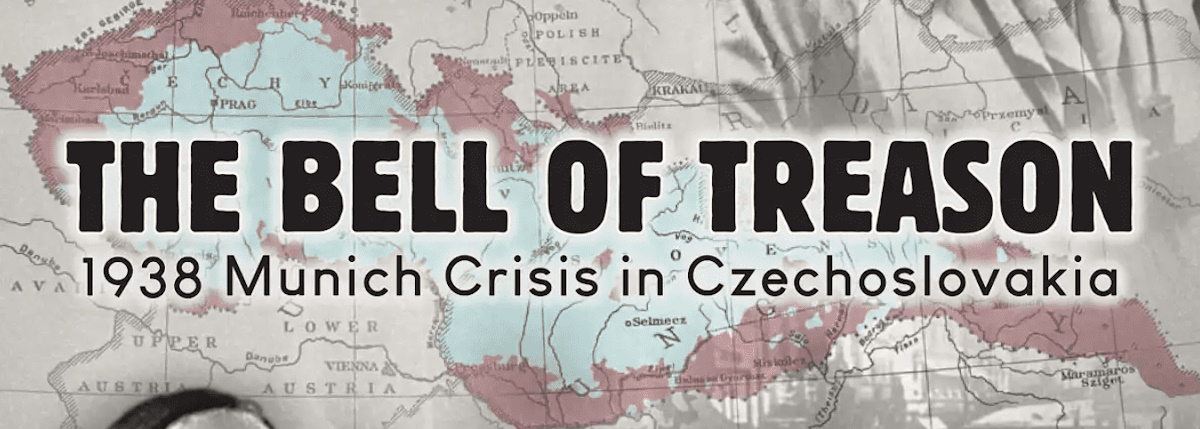
It wouldn’t be fair to call the Munich Crisis “small.” Certainly it wasn’t small to the almost fifteen million inhabitants of Czechoslovakia. But time and history, especially the history of World War II, have a way of making the betrayal of an entire nation seem tiny. In 1938, Czechoslovakia was twenty years young, guaranteed safety and autonomy by France, and remained the sole functioning democracy in Central Europe. Within a few short months, it became the latest target of Germany’s rolling territorial acquisitions and, after the Sudetenland was traded away to appease Hitler, was carved up between neighbors. The peace purchased with the First Czechoslovak Republic’s dissolution held less than a year.
This is the topic of Petr Mojžíš’s The Bell of Treason, an improbable but evocative title, not to mention a despondent one in an era of renewed imperial aggression against states that have been promised security by feckless global powers. Riffing on Mark Herman’s system from Fort Sumter and Frédéric Serval’s developments from Red Flag Over Paris, it’s also comparatively diminutive for a wargame, with short rules, a compact profile, and a sharp eye for the crisis’s framing. All the better to make its players feel like minnows among sharks.
Resistance in France

“Timely” isn’t my favorite descriptor. It’s such a trite word, like we’re trying to persuade somebody to take our hobby seriously. I tend to feel that board games are timely because somebody bothered to create them right now, in this time and place, and the sooner we assume that contemporary objects have contemporary meanings, the better and more durable they become.
Unfortunately for all of us, concentration camps are back in fashion and due process has been downgraded to an inconvenience. These are the years that make art like In the Shadows not only timely but necessary, if only as a reminder that people have, elsewhere and in other times, resisted movements every bit as stupid and cruel as those rolling off their overfed haunches today. Dan Bullock and Joe Schmidt have an eye for such examinations, and In the Shadows is no exception. As models go, the history they display here is both a reminder and a corrective. If only we didn’t need them so badly.
Pink Mars
Volko Ruhnke’s COIN System sure has come a long way since Andean Abyss. It’s sobering to realize that it’s been twelve years since we stalked the mountains of Colombia for drug cartels and Communist insurgents. The system has always prioritized certain assumptions about adversarial state-building, but now, in its twelfth volume, with multiple spin-offs and grandchildren padding its family tree — not the least of which is Cole Wehrle’s Root — the main series has taken a hard left turn into the speculative. We’re a long way from those history classrooms and CIA factbooks now, grandpa.
Red Dust Rebellion is the first game by Jarrod Carmichael, although we took an early look at his forthcoming Shadow Moon Syndicates a couple months back. For the most part, this project is a surprisingly cozy fit for the COIN Series. Set two hundred years in the future, give or take, the usual geopolitical boundaries have been redrawn thanks to the game’s remote setting, the red planet itself. What’s that phrase about how history doesn’t repeat itself, but often rhymes? Yeah. That. Even thought it takes place 140 million miles away, Red Dust Rebellion is so familiar that it might as well be a roadmap.
Infinite Gest
One of my professors believed that every generation needed to retell the story of Julius Caesar. In her mind, the story functioned as a sort of cultural tonic. Tyrant or hero, victim or opportunist — Caesar was a lens through which generations current and future might better witness themselves.
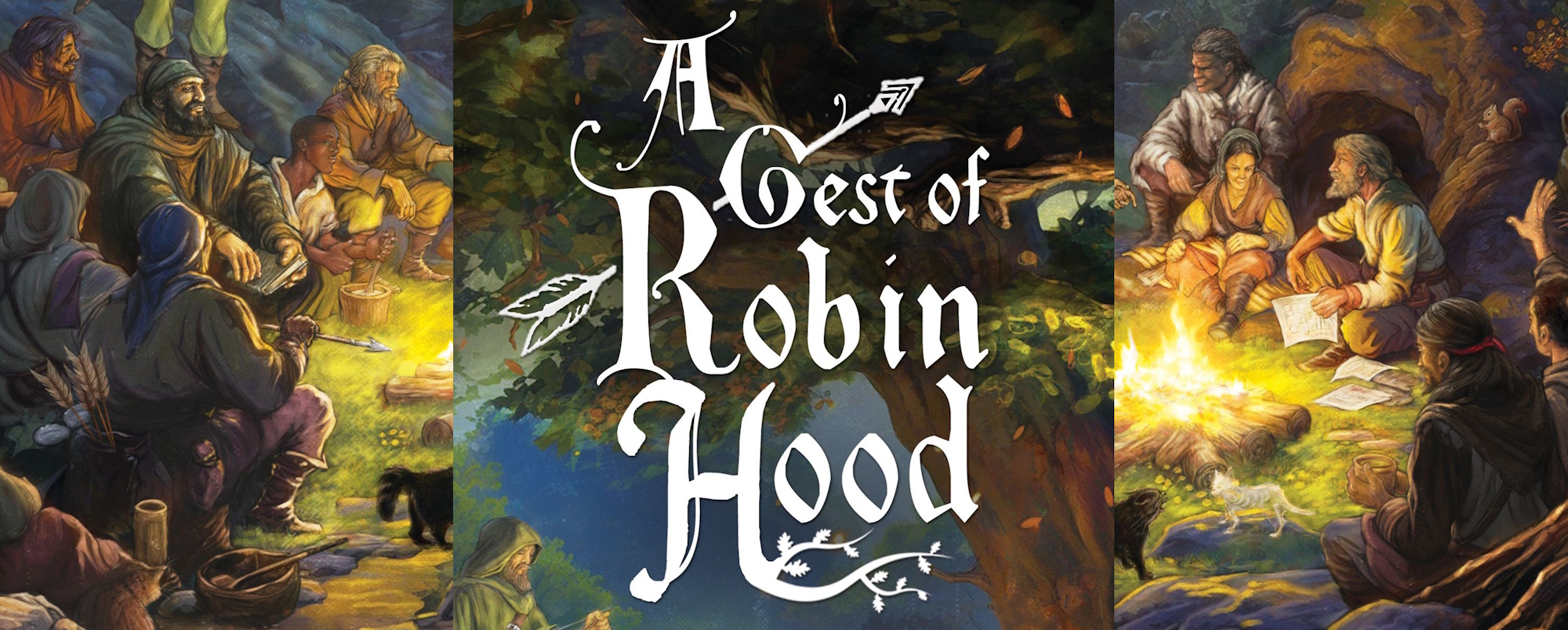
In playing Fred Serval’s A Gest of Robin Rood, the second installment in the Irregular Conflicts Series, itself a spinoff of the long-running COIN Series, the same could be said of everybody’s favorite forest fox. Is he a vagabond, robbing the rich for no other reason than because their wealth is there for the taking? Is he a lower-class hero, uplifting the poor? Has he been coopted by the gentlefolk, elevated to a lordling deprived of his privileges? Is he a crusader? A jokester? A kingsman? Does he venerate the Virgin Mary or has Maid Marian been invented to take her place? Eventually he’ll move into his gritty teenage years and relitigate the Battle of Normandy. Shhh. He gets embarrassed when we talk about that.
From Grave to Cradle

If I keep saying the same thing it risks becoming a running joke, but even compared to People Power and The British Way, Vijayanagara offers an easy entry point to the formidable COIN Series. Designed by a quartet of designers — Cory Graham, Mathieu Johnson, Aman Matthews, and Saverio Spagnolie — this is the first in GMT Games’ Irregular Conflicts Series. The pitch is that this is not your ordinary COIN, with all the procedure and chrome the title implies. These are experiments, salvaging the system’s baseline concepts and taking them in a new direction.
I’m not so sure about that. Vijayanagara is about as COIN as they come. That doesn’t stop it from being a perfect gateway drug for an unsuspecting playmate. This one goes down smooth.
Winds of Change, Part Four: Cyprus

This is how The British Way ends: not with a bang but a whimper. Of the four scenarios in Stephen Rangazas’s vivisection of 20th-century British colonialism, Cyprus is the briefest and least rules-heavy inclusion, a suitable outcome for a conflict that was comparatively minor when contrasted with the counterinsurgencies of Palestine, Malaya, and Kenya. Exhausted by colonial occupations across the globe, the British Empire was spread too thinly to enact a full response. Instead, it elected to utilize the lessons of occupations past to sway international opinion and brutalize the insurgents into surrender.
As we will see, the outcome proved unsatisfactory to everybody.
The Plum Island Park Stroll

One of the finest solitaire games of all time is Dawn of the Zeds, Hermann Luttmann’s masterful riff on the States of Siege model. Not that it should be taken lightly. It presents a vicious struggle for survival that might end in calamity faster than the game can actually be set up. It doesn’t help that further editions and expansions cluttered the table with so many optional modules that even veterans of the zed wars might pause before breaking it out. At least this veteran has.
So it was with no small measure of excitement that I approached The Plum Island Horror, a spiritual successor to Dawn of the Zeds, and a perfectly schlocky reimagining of the small town under siege by reanimated horrors.
Winds of Change, Part Three: Kenya

It’s all too easy to think about colonialism as something that occurred centuries ago, resolved in the dim twilight of history and bearing little import on current interests. But as we examined in our last two entries on Stephen Rangazas’s The British Way, both the Palestinian and Malayan “emergencies,” as they were euphemistically known, are relatively fresh historical atrocities whose reverberations can still be felt today.
The same goes for British imperial behavior in Kenya. Indeed, the imperial incursions into Kenya were a 20th century phenomenon. Missionaries and British corporate interests began settling East Africa in the late 19th century, but the incorporation of the Colony and Protectorate of Kenya only occurred in 1920. Over the next three decades, British abuses reached a fever pitch. It was no surprise when an undermanned and underequipped group of rebels named the Mau Mau began to terrorize the countryside.
Winds of Change, Part Two: Malaya

In the West, it’s all too easy to blind oneself to the long-term consequences of colonialism. As we examined last time, the reverberations of British Imperial promises in the Middle East continue to be felt a full century after they were made. Today we’re looking at a conflict — euphemistically called an “emergency” — that was far bloodier and more pressing to the Crown than the logistical colony of Mandatory Palestine: the communist uprising and subsequent imperial deployment on the Malay Peninsula.
The Malayan Emergency is the second of four insurgencies included in Stephen Rangazas’s The British Way, and it’s by far the most robust of the multipack. Were players to pursue these scenarios in order of complexity, this would likely constitute the final installment. Unfortunately, history doesn’t gently ramp up its level of complexity for our ease of play. Cinch up that rucksack, because this one is going to require some explanation.
Winds of Change, Part One: Palestine

If you’re invested in historical board games, you’ve probably heard about Phil Eklund’s infamous essay defending British colonialism. Personally, the backlash against that essay was a pleasant surprise. Perhaps I had become numb to imperial apologetic. To me, the essay was merely the latest impressionable perspective in a century that had been meticulously prepared for selective memory. The notion that the British Empire was a gentle overlord has been a constant drumbeat across its tenure, from its earliest adventures in the New World to its participation in my generation’s quagmires in the Near East and Central Asia. Where other empires were vicious taskmasters, so the story goes, the British were invested in winning the hearts and minds of their colonial subjects.
That’s precisely the topic behind The British Way by Stephen Rangazas. This is the first official spinoff of Volkho Ruhnke’s now-formidable COIN Series. Rather than tackling a single conflict, The British Way functions as a folio series in a single box, covering four wars from 1945 to 1960. It has quickly become my favorite expression of the system. Which is why I intend to cover each of its conflicts separately. Today we’re looking at the first battle of the era: the Jewish insurgency against British rule in Mandatory Palestine.

 SPACE-BIFF!