Blog Archives
Knizia Gets Hooked on Netflix

I don’t have much free time for TV these days. Except for Tiger King. I’m sitting on a dozen solid Netflix recommendations from trusted sources who’ve never led me astray, and I blitzed through that garbage in under a week.
Victor Melo’s Streaming gets it. More importantly, this is one of the finest auction games I’ve played in a good long while. I’d even go as far as to call it Knizian.
Massless Rod, Massive Bob

Real-time games are tricky, both to design and play. It’s an inherent conundrum. Most of our hobby lets us take things slow, examine the playing field from a sky-high vantage, and make decisions based on data rather than reflex. For a real-time game to work, it’s necessary to shift the player’s headspace into overdrive without cooking it altogether. Along the way, there are hurdles aplenty to consider.
Pendulum almost clears them. But the thing about hurdles is that almost clearing them still leaves you chewing rubber. Let’s talk about how it misses that final crucial inch.
Sand in Yer Crack

John Clowdus has always trafficked in games with a homemade feel, and not only when he’s stretching shrunken boxes to make the cards fit. In some ways it’s Small Box’s foundational ethos. Here’s a guy making the type of games he likes, in print runs so small it’s possible to step over them, and he’s having the time of his life doing it.
Sandstone takes this ethos to a new level. Apart from the cards, Clowdus took as direct a hand in the production as possible. The drawstring bags and box are hand-stamped. The pieces are hand-poured. There’s a signed card detailing the care that went into each copy and explaining why there might be some imperfections. The interior of the box declares which of this “small batch” you hold in your hands. Mine is first printing, number 100 of 100. A nice round number.
And then there’s Sandstone itself. It feels like a home-brew as well, in ways that are both endearing and somewhat rough.
Alt-Delete

Ctrl sure knows how to strut its stuff. Never mind that its stuff is an ill-fitting peg leg, peg arms, and a peg head that keeps falling out and looks so identical to its other peg-parts that nobody can remember which depression it’s supposed to peg into.
One Thousand Years of Solitude

When I heard that Tim Hutchings’ Thousand Year Old Vampire was a solo RPG, my response was pretty much, “Buddy, if I wanted to pretend to be somebody else when I’m all alone, that isn’t a game. That’s my life. Now cease disturbing my slumber.”
The first chink in my armor was the book itself. If it weren’t so pristine, this thing could have passed for a tome stacked under a hundred years’ worth of library sediment. The title and byline appear as though they’ve been shoddily glued into place, the description on the back secured with masking tape that’s peeling at the edges. The cover’s golden debossing calls to mind pottery mended by kintsugi, but more veined, more branching, like rivulets of blood straining for shared warmth. With great restraint, in only a few spots, the spine exhibits dents and tears. And within, an academic’s trove of article clippings and telltale stains and artwork of a dozen styles, none of it detracting from the actual utility of explaining how you, the reader, will spend the next few hours sharing the story of a vampire in bloom and decay, love and ruin, tragedy and beauty.
As for partaking of a solo role-playing game, pay no attention to my earlier reaction. Thousand Year Old Vampire is devastatingly therapeutic.
Four Complaints about Crokinole
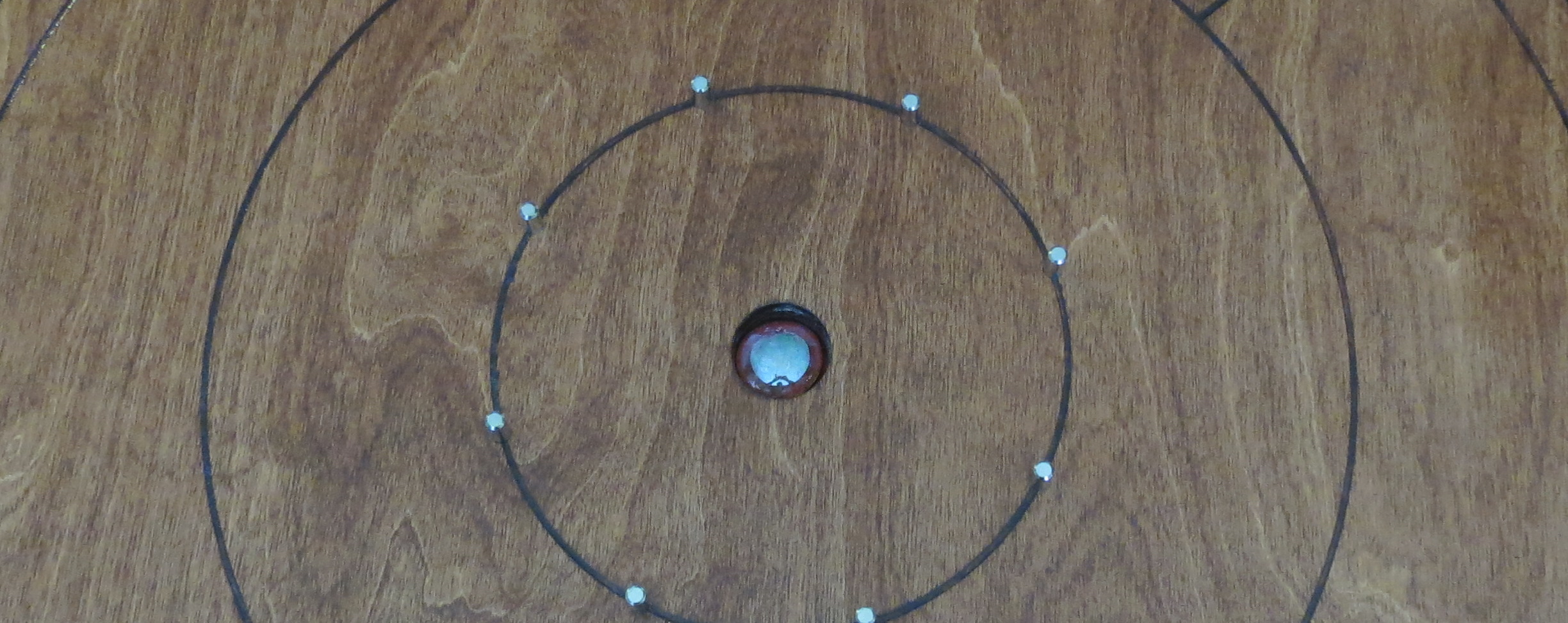
I recently purchased a Crokinole board. It’s ruining my life. Let me tell you how.
Back to the Universal Studios Licensed Property

I like Back to the Future. You like Back to the Future. Everybody likes Back to the Future.
So let’s set that aside for a moment and ask the bigger question: does Prospero Hall’s take on Back to the Future hold together as a functional game about Elliot Alderson’s most beloved film or a mere slideshow of its best scenes and catchphrases?
How Tall Is Your Spire?

I’m always curious to see how board games handle issues of scale. Is a desolate geographical region compressed, perhaps necessarily, in order to fit onto a map? Is a powerful monster larger than its weaker kin? Do oceans feel vast, or are they minor transitions between continents? Do stock markets plummet or gently slope?
And then there’s Gil Hova’s High Rise. Set on an island that could give Manhattan a run for its money, every addition makes its presence known. A size-six structure is twice as tall as a size-three structure. When somebody muscles into a district, the skyline is altered. When one of the taller edifices is constructed, it stands over the rest, unironically erect. Phallic comparisons? Isn’t that gauche? Not when it comes to corrupt billion-dollar enterprises stamping their mark on human endeavor. Scale is the point.
Oh, and it bears mentioning if but once: High Rise manages this without a single plastic miniature.
Viking Dice
History is shot through with unintentional ironies. In response to political meddling in church affairs, English monasteries tended to be isolated on cliffs and islands, all the better for devoting time to God and avoiding the bickering of minor kings. In board game terms, they were located on the edge of the map. This solution worked — right up until June 793, when ships of Northmen made landfall and sacked the lightly-defended abbey on Lindisfarne before anybody from the mainland could respond. So much for keeping your back to the wall.
Alain Pradet and Damien Fleury’s Lindisfarne has nothing to do with that particular raid or its aftermath. It’s a dice game. A particularly clear-headed dice game that highlights both how to do dice properly and how to fail to generate much lasting interest.
Grant Rodiek Presents: Fart

What a difference a change of paint makes. Well, a change of paint plus a number of quality-of-life improvements, careful mechanical adjustments, and a near-total user interface overhaul.
Grant Rodiek’s SPQF was a treat, a Disney’s Robin Hood approach to deck-building and empire-building. Despite some jagged edges, it made a name for itself as one of the best games of 2018. But that’s old news. After some development with the folks at Leder Games, SPQF has been nipped, tucked, and fine-tuned into Fort. Quite the metamorphosis — and an improvement in nearly every regard.

 SPACE-BIFF!