Blog Archives
The Eleventh Cardboard

Mistborn: House War is a bit of an odd duck. Based on Brandon Sanderson’s much-loved series, it sees you taking command of Vin, Kelsier, and the rest of those scrappy rebels as they seek to topple the rapacious Final Empire.
Except, oops, it isn’t about that at all. Instead, House War’s protagonists are the first book’s sub-baddies, the Great Houses who squabble, gossip, and often lend that “rapacious” an uncomfortable edge. And they’d very much like to kill off the heroes of the books.
Tic Tac On-the-Go

OK Play isn’t the usual sort of thing I write about, but… um…
All right, look, I don’t have an excuse. Deep down, all we’re doing in this hobby is playing with toys, and OK Play looked like it would be fun to play with. Not necessarily by following its rules, but just by clicking it around. It’s sixty little squares of plastic attached to four prongs that are connected to a carabiner. And yeah, it’s a lot of fun to goof around with. I basically use it like a stress ball or fidget spinner. Clickety clack clickety clack. 10/10.
Do Androids Dream of Electric Algebra?

Sentient is a bit of a weird one. By plugging robots into your mainframe — and doing your best to keep things orderly when their growing awareness starts to kick back — you hope to position your company at the forefront of the sentient revolution. It sounds like the first act of a robot uprising story, not a game designed around basic algebraic operations.
It doesn’t help that the game’s setting is about as substantial as chalk dust. As a thought experiment, my gaming group redesigned the whole thing on the spot to be about trying to persuade our pal Geoff to do us a favor, wherein his mental states — things like “playing Angry Birds right now” and “has another question about the rules” — might begin to affect our collective mood. It worked just fine.
But that’s where Sentient sets itself apart, because in spite of its insubstantial fluff and algebra-based gameplay — or perhaps thanks to it — it’s a surprisingly excellent filler.
A Few Acres of Stardust

Martin Wallace birthed a new subgenre with A Few Acres of Snow. Here was deck-building but tied to a map, every single location represented by a card. Seizing territory not only meant extra points and opportunities, but also more regions to administer, and your deck and hand could gradually choke on bureaucratic smoke that distracted from the conflict at hand. It was deviously clever. Also incomplete.
Wallace’s Mythotopia sought to fix up the concept, broadening it from two to four players and sanding down some of the system’s rougher edges while giving others their due. It made for a good time, as far as I’m concerned, though still an experience where a single pulled thread might unravel the whole thing.
Now Wallace is back with A Handful of Stars, the last in his trilogy of deck-building-on-a-map games. And as we’ve come to expect, there are some excellent ideas on display here — and a few that could have used some extra work.
Hotline Jacksonville
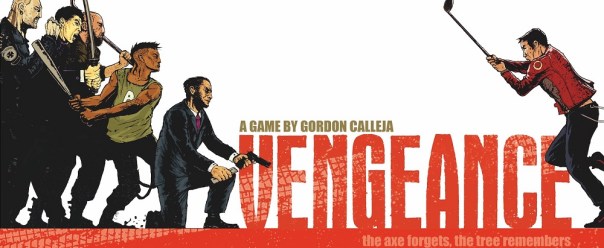
Every so often, along comes a game sporting a sense of style and rocking a ‘tude, making itself known with a crash and a holler. Much like a toddler who’s climbed onto the counter and tossed a dish onto the floor.
Vengeance forces you to sit up and take note, is what I’m saying. Emulating the likes of Payback, Kill Bill, and the snazzy digital Hotline Miami, it’s the sort of game that sends you bum-rushing into a room packed full of no-gooders, swinging and shooting until they’re dead and you’re barely limping, then hitting repeat until some nebulous concept of revenge has been fulfilled.
It also happens to resemble one of those corpses your protagonist will undoubtedly leave sprawled behind them. But we’ll get to that.
Ascendancy: The Next Generation

Star Trek: Ascendancy was not only among my favorite games of 2016, but also one of its most unique for how defiantly (yeah, that’s a reference) it clung to the vision of Star Trek. It was sprawling and dangerous, complete with a burgeoning playtime and the possibility of player elimination. But it was also as sleek and streamlined as a Starfleet vessel, every single turn — nay, pretty much every move — cast as an episode of the original series, with planets and cultures and deadly space phenomenons popping onto the table. It was rife with political intrigue, border tensions, shaky alliances, and a futurist’s appreciation for technology.
Well, buckle up — or don’t, because real Starfleet ships don’t have seat belts — because now that its first two expansions are out, Ascendancy is better than ever.
Codenames Iterated

Last week I talked about a Vlaada Chvátil game called That’s a Question!, arguing that it was pleasant enough, particularly in family or get-to-know-you settings, but didn’t exactly rock my socks off. In part because it didn’t feel like much of an innovation from one of our hobby’s most renowned innovators.
Well, today I’m going to tell you about Codenames Duet, which right there in its title announces itself as a new take on the living classic Codenames. But here’s the thing — in addition to being a testament to why our hobby thrives on iterative design, it just might be one of my favorite Chvátil games.
The Interrogation Game

Here’s a question for you. Which would you miss more if it ceased to exist: Vlaada Chvátil designing light party-style games or Vlaada Chvátil designing overly complicated games?
If you’re anything like me, there’s no contest between Codenames and Space Alert, though I’d still miss the former if it disappeared from the face of the Earth all the same. If you guessed that would be my answer, you get a point. If not, the guy who asked me the question gets a point.
There you go. I just summed up Chvátil’s latest, That’s a Question!
Secrets Secrets Are No Fun

With its pedigree, you’d think Secrets would stand out as one of the finest creations ever put to cardboard. Bruno Faidutti stands at one end, with hits like Citadels, Mission: Red Planet, and Mascarade in his pocket, while Eric Lang inhabits the other. And if you don’t know who Eric Lang is, might I recommend Blood Rage or Chaos in the Old World? A social deduction by those two seems like a no-brainer.
But as it would turn out, no brains isn’t the right way to go for a social deduction game. At least not unless you’re content making a merely okay one.
Rumble in the Literal Jungle

Zoo Ball isn’t my favorite dexterity game — that honor remains with Catacombs — but when it comes to my favorite fast, easy, and super silly dexterity game with only like three rules? Then, sure, Zoo Ball is the clear frontrunner.

 SPACE-BIFF!