Blog Archives
How Was the Gameplay, Mrs. Lincoln?

I know it’s far removed from today, but the assassination of Abraham Lincoln makes me sad in a way that most historical events do not. Thanks to my father’s interest in the topic, the Civil War was my first real foray into both history and wargames, and the Gettysburg Address was the first speech I ever memorized. Not original for an American schoolkid, I know, but still.
There is some small upside: playing Wes Crawford and Ryan Heilman’s The Pursuit of John Wilkes Booth, I had that extra motivation to nail the bastard. Some part of me approaches the subject reluctantly. It’s a game about the early history of American policing more than anything, staffed with military detectives and Pinkerton agents and Secretary of War Edwin Stanton pulling strings to put more federal cavalry under my command. Like the Civil War that had ended only five days before the traitor’s bullet found its mark, this is America’s Old Testament period, its belly fired with vengeance and fury. I know the problems. I have my hangups. And yet there is nothing I want more than to catch the assassin before he crosses some remote frontier.
Manifest Sudoku
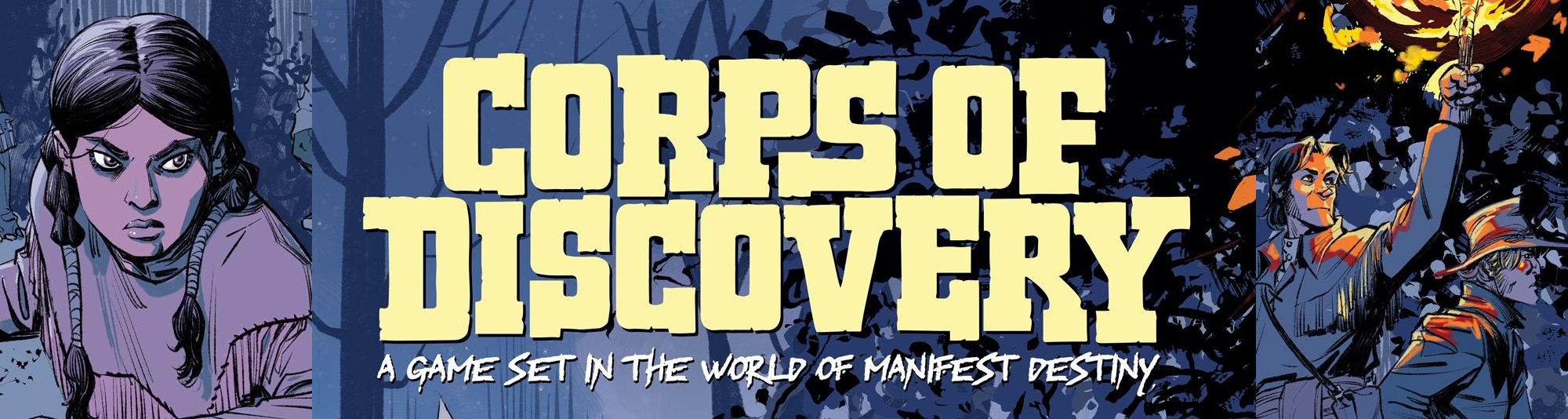
Manifest Destiny, the sprawling, brutal comic by Chris Dingess, is a tough read. Pitched as an alt-history version of the Lewis and Clark Expedition, one where minotaurs and head-snatching pterodactyls pose as much of a threat to the survival of its battered Corps of Discovery as starvation or the weather, it’s both a rollicking adventure and a mouth-covering gasp at the westward roll of genocide. And if those elements don’t sound like they blend as smoothly as chocolate and peanut butter, you’d be right on the money.
But I’m not here to review the comic. Corps of Discovery: A Game Set in the World of Manifest Destiny is the third title from Off the Page Games, Jay Cormier and Sen-Foong Lim’s follow-up to both Mind MGMT and Harrow County. As a game — and in terms of quality — it hobnobs more with the former than the latter, presenting one of the best exploration puzzles I’ve ever witnessed. As an adaptation of the comic, unfortunately, it leaves the tale only half-told.
Gastrotheism

There’s an old anthropological theory that religions naturally develop from polytheistic to monotheistic. Like many anthropological models, this one is outdated and hated by pretty much everybody. Religious folks dislike the theory because it implies their religion evolved over time; everybody else notes that there are plenty of modern polytheists, not to mention religions that defy the monotheist/polytheist rubric altogether. Anthropology: uniting theists and doubters since 1647!
Despite producing some rather bad science, the notion of a pantheon gradually winnowing itself down from a whole extended family to a singular daddy-god is the topic of Monotheism, a deck-in-hand card game designed by Frank Brown Cloud and illustrated by Jennie Plasterer. It’s delightfully unhinged.
Skyblivionrockmarsh

Way back in 2011, Todd Howard let it slip that Skyrim would have “unlimited dragons,” dragging surprised reactions from the internet. Don’t believe me? Here’s pre-People Make Games, pre-Shut Up & Sit Down Quintin Smith’s press release on the matter. It’s pleasingly sarcastic. Because, you know, “unlimited nouns” has always been the Elder Scrolls’ whole thing. This is the fantasy series that made volume its defining metric. Depth? Nah. Enjoyment? Get outta here. Kelvins? Only if you’re talking about Lord Kelvyn, the Redguard Knight of the True Horn. No, really. Like I said, unlimited nouns.
Which brings us to The Elder Scrolls: Betrayal of the Second Era, Chip Theory’s adaptation of not only Skyrim, not only Oblivion, not only Morrowind, not only those other ones nobody talks about anymore, but the whole dang universe with its boundless recreations, provided your recreational interests are limited to hoofing across fantasy landscapes and murdering fantasy gobbos. It comes with a bazillion components, weighs so much that it should have a team lift warning on the box, and costs as much as twenty-five burritos from my favorite local burrito place.
You heard that right. Despite my policy on the matter, this thing is so pricey that I think it warrants some discussion. First, though, I want to walk you through the shape of an average TES:BOTSE campaign.
Boss Cells

I don’t envy the creative team tasked with adapting Dead Cells to cardboard. The video game is all twitch reflexes and light-speed assaults — a state I’ve heard called “submission,” more about submerging oneself within a game’s flow than about responding to any specific stimulus — which isn’t exactly the most conducive mode for taking turns or planning ahead. How does a designer transpose a video game that’s about subordinating one’s consciousness to sheer reactivity into a medium that generally works the other way around?
For the most part, the answer is that Dead Cells: The Board Game doesn’t bother.
Don’t get me wrong, there’s a living spring of talent behind this adaptation, a wundersquad that consists of Antoine Bauza (7 Wonders, Ghost Stories, Oltréé), Corentin Lebrat (Faraway, Draftosaurus), Ludovic Maublanc (Cyclades, Ca$n ‘n Gun$), and Théo Rivière (Sea Salt & Paper, The LOOP). For this collaboration, the squad approaches the original design like a fold-up snowflake, snipping around the edges of the video game for the stuff that’s easily ported to the game table and leaving the rest scattered on the carpet.
Don’t Know If It’s Day or Night

A lot has changed with Bernard Grzybowski’s Purple Haze since I examined it three years ago. As wargames go, the final product is more assured and polished, as one would expect, but also less burdened by the prototype try-hard attitude. I might even go so far as to call it one of the finest narrative wargames ever produced.
To explain why, you need to meet my squad.
A Mindful Rain

It’s been said many times before, but A Gentle Rain is not Kevin Wilson’s typical fare. Highly abstract, both in setting and objective, and showcasing a willingness to sidestep victory conditions altogether — a willingness that Wilson doesn’t wholly indulge in, although he gets close — this has all the makings of a pet project. For all that, it’s beautifully crafted and clearly wants to communicate something, even if that something is fuzzier around the edges than most board games manage.
I didn’t get it. The first time I played it, that is.
Resistance in France

“Timely” isn’t my favorite descriptor. It’s such a trite word, like we’re trying to persuade somebody to take our hobby seriously. I tend to feel that board games are timely because somebody bothered to create them right now, in this time and place, and the sooner we assume that contemporary objects have contemporary meanings, the better and more durable they become.
Unfortunately for all of us, concentration camps are back in fashion and due process has been downgraded to an inconvenience. These are the years that make art like In the Shadows not only timely but necessary, if only as a reminder that people have, elsewhere and in other times, resisted movements every bit as stupid and cruel as those rolling off their overfed haunches today. Dan Bullock and Joe Schmidt have an eye for such examinations, and In the Shadows is no exception. As models go, the history they display here is both a reminder and a corrective. If only we didn’t need them so badly.
In the Margins

At a mechanical level, In the Ashes, the gamebook by Pablo Aguilera, is a major accomplishment. Full of novel solutions to problems that have dogged the format since somebody first decided to put a game inside a book, I was repeatedly struck by Aguilera’s creativity. Nearly every encounter did something new, exciting, or innovative. Sometimes all three at once.
But before you order the thing, let’s rein in our expectations. In the Ashes is also a hot mess. At least in the format I played it, anyway.
Imperium: Kobayashi Maru

More than most fictional settings, Star Trek lends itself to what-ifs. Mirror universes, alternate dimensions, and time travel play a big role in making the final frontier ever more expansive, but we don’t even need to breach the time-space continuum to find uncomfortable alliances and enemies-turned-friends. In its messiness, Star Trek has always been playful. Ever wondered what would happen if a dilithium leak briefly tricked an intoxicated Commander Sisko into courting Lursa Duras? Me neither! But there’s a non-zero chance that someone in the writer’s room drafted an entire Deep Space Nine episode about that very scenario.
Star Trek: Captain’s Chair swims in those possibilities. Designed by Nigel Buckle and Dávid Turczi, and built around the deck-building system they unveiled in Imperium: Classics, Legends, and Horizons, this isn’t the first board game to bottle the spirit of Star Trek, but it is perhaps the one that most exemplifies its endless possibilities.

 SPACE-BIFF!