Most Select of Board Games
The temple complex of Ipet-isut, “the most select of places,” today known as Karnak, is unique among Egyptian sites for the sheer duration of its construction. Nearly thirty pharaohs, from the Middle Kingdom to the Greek Ptolemies, added to the complex’s collection of statues, arches, obelisks, columns, hieroglyphs… pretty much anything we associate with “very old building.”
Now Karnak has one more addition: a board game by design collective Jasper Beatrix. Yep, the same folks whose designs I’ve been admiring all year. And like Karnak itself, this one necessitates some excavation.
Space-Cast! #48. Compiling

Computers! They’re always doing pesky things like falling in love. For today’s episode, we’re joined by Michael Yang to discuss Compile, his hit lane-battler that sees two rival programs compete to expand their nascent sentience. Along the way we discuss the game’s inception during the pandemic, the joys of nailing that first pitch, and the heartbreak of having your publisher dissolved by venture capital.
Listen here or download here. Timestamps can be found after the jump.
Apex Card Shark

Sometimes I joke that every board game about evolution is really about intelligent design. We are, after all, streamlining these creatures for maximum survival, carving out niches with great forethought and consideration. This is not meant as a substantive critique. Board games give us control over all sorts of things that normally fall outside the realm of human agency. Anyway, if these games accidentally argue that a thinking mind must direct the evolution of species, then it’s a polytheistic bash of many gods competing to secure the most calories for their preferred fuzzies.
And then there’s Nature. Eleven years after Evolution, nine after Evolution: Climate, and five after the spinoff Oceans, Dominic Crapuchettes has taken the system that cemented his reputation as a serious designer and honed it into an apex predator. This is the sleekest representation of evolution ever put to cardboard. But there’s a bigger question lingering behind those grandiose claims. Namely: is it worth it?
Chicago Gets It Up

Imagine checking into a hotel in 1861. Not just any hotel, but a six-story brick building. Over the course of your stay, the front stairs have grown noticeably steeper each time you return. When you check out five days later, the windows that once sat at eye level are now several feet above your head.
This isn’t a ghost story. It’s an actual anecdote from the raising of Chicago, when engineers used thousands of screwjacks to lift the city’s brick structures six feet above their previous elevation. In some cases, as with the Tremont House Hotel, the laborers worked in covered trenches, permitting business to be conducted as usual. This brought the city above the water line, permitted the construction of a sewer system, and hopefully prevented another outbreak of cholera from killing one in twenty inhabitants. Chicago was saved. At least until the next decade, when a cow would kick over a lantern in Mrs. O’Leary’s barn.
Manifest Sudoku
Manifest Destiny, the sprawling, brutal comic by Chris Dingess, is a tough read. Pitched as an alt-history version of the Lewis and Clark Expedition, one where minotaurs and head-snatching pterodactyls pose as much of a threat to the survival of its battered Corps of Discovery as starvation or the weather, it’s both a rollicking adventure and a mouth-covering gasp at the westward roll of genocide. And if those elements don’t sound like they blend as smoothly as chocolate and peanut butter, you’d be right on the money.
But I’m not here to review the comic. Corps of Discovery: A Game Set in the World of Manifest Destiny is the third title from Off the Page Games, Jay Cormier and Sen-Foong Lim’s follow-up to both Mind MGMT and Harrow County. As a game — and in terms of quality — it hobnobs more with the former than the latter, presenting one of the best exploration puzzles I’ve ever witnessed. As an adaptation of the comic, unfortunately, it leaves the tale only half-told.
Gastrotheism

There’s an old anthropological theory that religions naturally develop from polytheistic to monotheistic. Like many anthropological models, this one is outdated and hated by pretty much everybody. Religious folks dislike the theory because it implies their religion evolved over time; everybody else notes that there are plenty of modern polytheists, not to mention religions that defy the monotheist/polytheist rubric altogether. Anthropology: uniting theists and doubters since 1647!
Despite producing some rather bad science, the notion of a pantheon gradually winnowing itself down from a whole extended family to a singular daddy-god is the topic of Monotheism, a deck-in-hand card game designed by Frank Brown Cloud and illustrated by Jennie Plasterer. It’s delightfully unhinged.
The Year of Living Boringly

Ever wanted to make a year seem as long and tedious as possible? Boy, have I got the game for you! Meet 365 Adventures: Cthulhu 1926: 2026, a title filled with too many damn numbers. Designed by Lee Ju-Hwa, this is the sequel to this year’s 365 Adventures: The Dungeon. Some have called the idea of letting you play a microgame every day “innovative.” That’s a heck of a thing to say when daily peel-off crossword and sudoku calendars have existed since Ancient Roman times. But, sure, let’s go with it. 365 Adventures is innovative for anyone who wants to make their year seem as long and tedious as possible.
Oops. I already wrote that. My bad. Forced repetition is more of this game’s shtick.
Cvlt of the New

If you’d ever like to add some awkwardness to a social gathering, ask the table what they feel the difference is between a religion and a cult. The soundbites are guaranteed to be insufferable. And to answer your forthcoming question, I avoid dinner parties at all costs. I’m too much fun.
These days, I’ll confess to some wariness when it comes to trick-takers. It’s a lovely, storied genre, and I can play them with my in-laws, but too many of the things put only the slightest spin on the formula. I’ve reached the point where I can’t even keep these myriad trick-takers straight. Wait, was this the one where you want to take your chosen suit or avoid it? Are there fourteen ranks or only ten? And what’s the deal with these blank cards? It’s a jumble.
But then along comes a title like CVLT. It’s pronounced “cult,” by the way. That’s how we earn Alex Garland’s love. Anyway, CVLT was designed by Ashley Hauenschild and Taylor Fontaine, and it’s one of the most distinctive non-hybrid trick-takers I’ve played in recent memory. At the very least, I won’t be confusing it with any of its peers.
I’ll Rest When I’m Blinked Out of Existence
The gods have betrayed us. At the tolling of a distant bell, the world they once safeguarded now sloughs like burned skin. As even the stars lid their brilliance one by one, we enact one final act of defiance, setting out into the wasteland break ourselves against them. We will perish. The only remaining question is how.
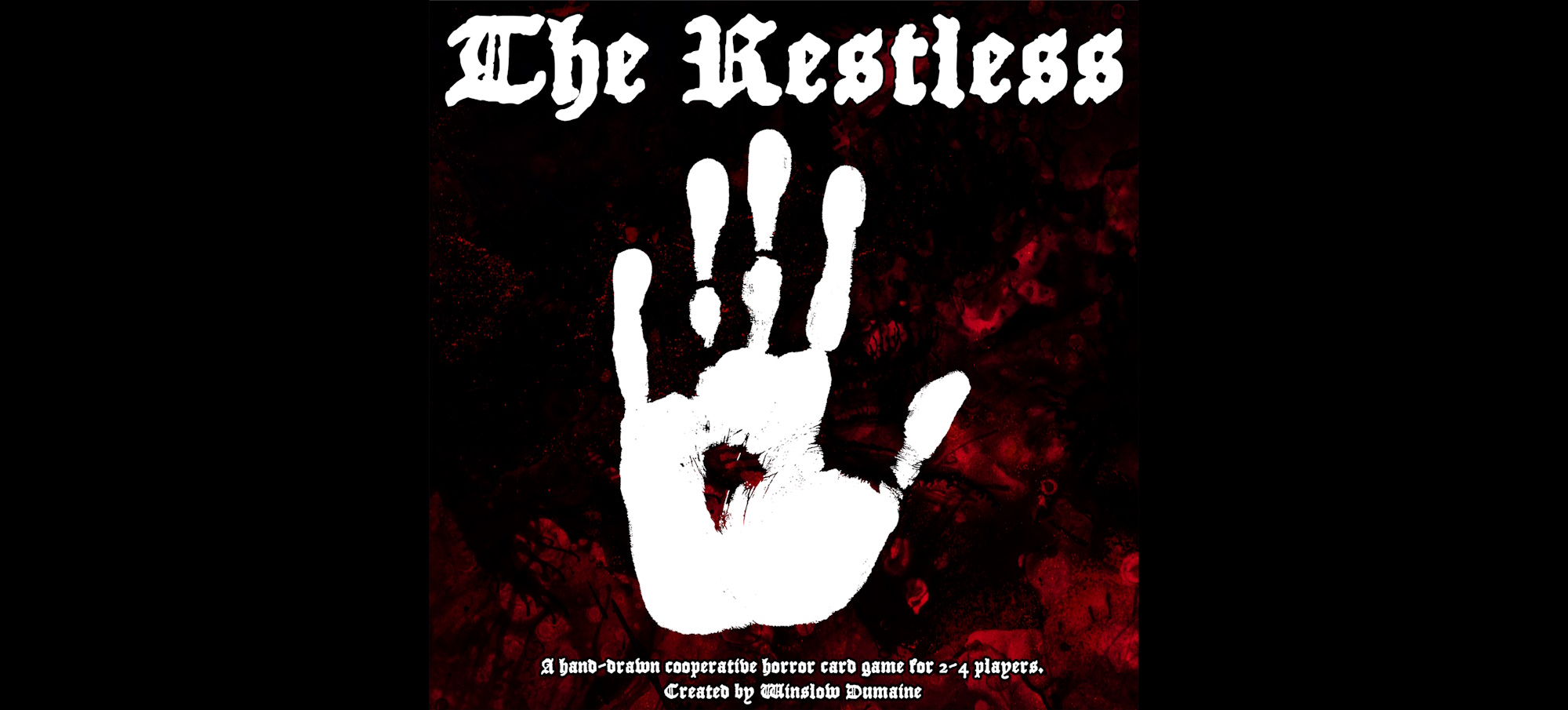
That’s the premise behind The Restless, Winslow Dumaine’s forthcoming… well, look, this thing defies easy description. Is The Restless an adventure game? A dice-chucker? A phallus-filled nightmare?
Yes. All those and more. When I teasingly recommended it to three victims as a chill game about unexpected friendships, I wasn’t even lying. It’s just that Dumaine’s hand-drawn illustrations have such the consistency of chilled intestinal jelly that it’s easy to miss the buddy tale for all the guts. This one is hairy, abrasive, and, against all odds, meditative. Among the dismembered torsos and countless rolls of a d20, there is a monkey’s yawp that hovers between defiance and acceptance. We are all corpses in waiting. But maybe, just maybe, that’s all right.
Frank in the Woodland

In Frank West and James Tomblin’s latest title, fully clothed animals travel between forest clearings and initiate battle in order to restore their chosen power structures to the woodland. Hmm… where have I heard this before? Ah, I remember — it’s Defenders of the Wild!
I kid, I kid. To be fair, Emberleaf bears only the most superficial of resemblances to Root. I wouldn’t dare invoke Foucault to describe its depiction of biopower or sexuality, for one thing. On a somewhat less onanistic spectrum, Emberleaf is an optimizer’s board game, jam-packed with sequences of actions that spool into other actions, resources that must be spent in precisely the right order, and conflicting objectives that each award their own variable numbers of victory points. It’s an intriguing, persnickety, and sometimes gummy title, either a deeply flawed masterpiece or a mess with pretensions. I’m still trying to determine which.

 SPACE-BIFF!