Author Archives: Dan Thurot
Eila and Something Disconcerting

I’ve never taken a firm stance on age ratings, in part because I’m not sure what they’re trying to impart. Most of the time, I take them as an evaluation of a game’s complexity, and a wishy-washy evaluation at that. A rating of 12+ won’t prove much of a deterrent to my nine-year-old because she plays more board games than her peers. That’s only the first limitation. I also can’t be certain that the designer invested much thought into it. Before I had children of my own, I couldn’t have told you the cognitive difference between ten and twelve years. And it isn’t as though the other numbers on a box bear much resemblance to reality. How often has a game’s estimated playtime proven to be hopelessly optimistic? These days, the only digits that really catch my eye are player counts.
I didn’t play Eila and Something Shiny with my daughter. Jeffrey CCH’s narrative experiment is a solitaire game, and for once I took that suggestion to heart rather than offering to loop in my kid. What a relief. Given the game’s friendly exterior, she might have accepted.
I Cherish Peace with All My Heart
I have a soft spot for Sami Laakso’s Daimyria, the shared setting for Dale of Merchants, Lands of Galzyr, and Peacemakers. It’s the specificity that does it. Other games about anthropomorphic animals feature, I dunno, turtles. Daimyria doesn’t settle for such broadness. Instead, it’s populated with fennec foxes and short-beaked echidnas and giant pangolins. Each species is an entire identity unto itself. Medieval courtiers in fursuits need not apply.
The forthcoming Peacemakers: Horrors of War is a reimagining of Laakso’s Dawn of Peacemakers. The early version of the game only includes two scenarios, but those were enough to get me excited for more.
These Animals Need an Estate Tax
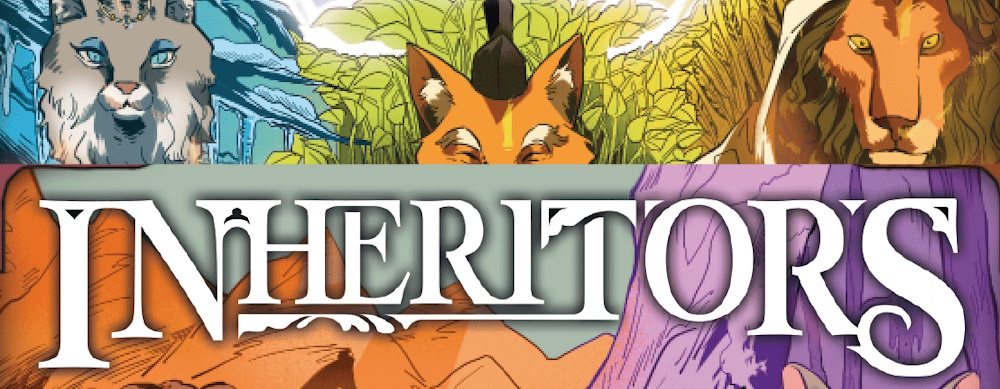
The king is dead. Long live the king’s many successors, claimants, and pretenders. Designed by Hong Kong-based creators Jeffrey CCH and Kenneth YWN, Inheritors is the latest in a long string of titles that demonstrate why hereditary monarchy is a terrible way to run a burrito cart, let alone a country. Maybe it should come as a surprise, then, that this transition is so smooth.
Olé Olé Oltréé

Oltréé shows its genealogy in its cheekbones. Now working with co-designer John Grümph, this is Antoine Bauza’s third take on the besieged fortress, completing an arc that began with Ghost Stories and continued with Last Bastion. Like those titles, Oltréé is about weighing odds and uprooting danger, working cooperatively to turn the tide. Unlike them, the siege has been more or less broken before your arrival on the scene. Those anticipating a stiff challenge need not apply.
Prickle Root

Since it’s the law that every slightly asymmetrical game must be compared to Cole Wehrle’s Root, let’s get this out of the way right now: Cactus Town, designed by Raúl Luque Torner, is an eensy-weensy bit like Root. Three or four players — five with expansions — are each given a unique role and then set loose to sneak, shoot, and can-can dance through the Old West. It’s cute. But it could have done with more than good looks.
Legacies of Stalingrad
Ever since the form was birthed by Rob Daviau’s Risk Legacy, there’s been a central irony to legacy games — simply put, that their best parts are the things you do when you aren’t playing. Opening envelopes. Marking the board. Tearing up cards. Seeing how this physical artifact will transform before your eyes.
The same is true of Undaunted: Stalingrad, the fourth and most ambitious release in Trevor Benjamin and David Thompson’s much-celebrated Undaunted series, although to a thankfully lesser degree than in other exemplars of the form. This is a gentler legacy title, components-wise; nothing is destroyed over the course of its dozen-or-so session campaign, which can be safely reset upon its conclusion. More importantly, however, it sets itself apart by leaning into the physical terrors of war. By the conclusion of that fateful siege, both its titular city and the bodies of its combatants will have been ravaged by combat. This is a legacy game not only in the sense that it transforms between plays, but also in the way it forces one to confront the scars of war. It transforms, but is also transformative.
Antiquity in Your Pocket

So we were talking about wallet games. Yesterday we took a look at River Wild, a microgame by Steven Aramini that didn’t quite live up to the (compact) heights of his previous efforts Circle the Wagons and Sprawlopolis. As I wrote way back then, it’s exciting to see how a genre can be pressed into its purest form by the strict limitation of having to fit onto eighteen cards. The only hitch is that the resulting microgame ought to be, you know, good.
Ancient Realm, also by Aramini, is good. Maybe better than good. Maybe even better than Sprawlopolis.
River Riled

When it comes to his work with Button Shy, purveyor of 18-card wallet games, Steven Aramini has a mode. Between Circle the Wagons and Sprawlopolis — not to mention spinoffs Agropolis and Naturopolis — his output has been a fixture of microgames for years. His latest diminutive title is River Wild, about selectively channeling a river through a fantasy kingdom to preserve its wildlife. It is exceptionally pink and purple. That might be the one kind thing I can say for it.
Know Your Woods

The beauty of stacking games is that they’re at their most best when they’re failing. Yes, I’m talking about things falling down. Whether we’re talking about a classic like Jenga or the best stacking game, Rita Modl’s Men at Work, they thrive in that middle space between striving to succeed and the relief of giving up.
Moku Tower, designed by Louis Hsu and Ivan Kan, presents a frenzied take on the genre. It also presumes I know a lot more about dendrology than I ever will.
When I Roll Into the Wild Tiled West

It’s safe to say I’m a fledgling Paul Dennen connoisseur. After Clank! Catacombs and the utterly perfect Dune: Imperium, Dennen could design one of those gawrsh-awful “alcohol and vulgarity” party games I’m emailed about every other week, and I’d be game for a few hands.
Wild Tiled West is not about alcohol and vulgarity. Maybe it should have been.

 SPACE-BIFF!