Wagering Everything on Bronto

Are wacky races the new zombies of board games? Probably not, but it strikes me as wild that I’ve played four distinct wacky race games within the span of a single year, yet nobody within my circle agrees on which one is the forerunner. Dino Racer, the third of those four, was designed by Marceline Leiman, who gave us the lovely High Tide and Nebular Colors (née Heavenly Bodies). This time, the racers aren’t hot dog mascots or magical athletes. I think you can guess what they are.
(They’re dinosaurs.)
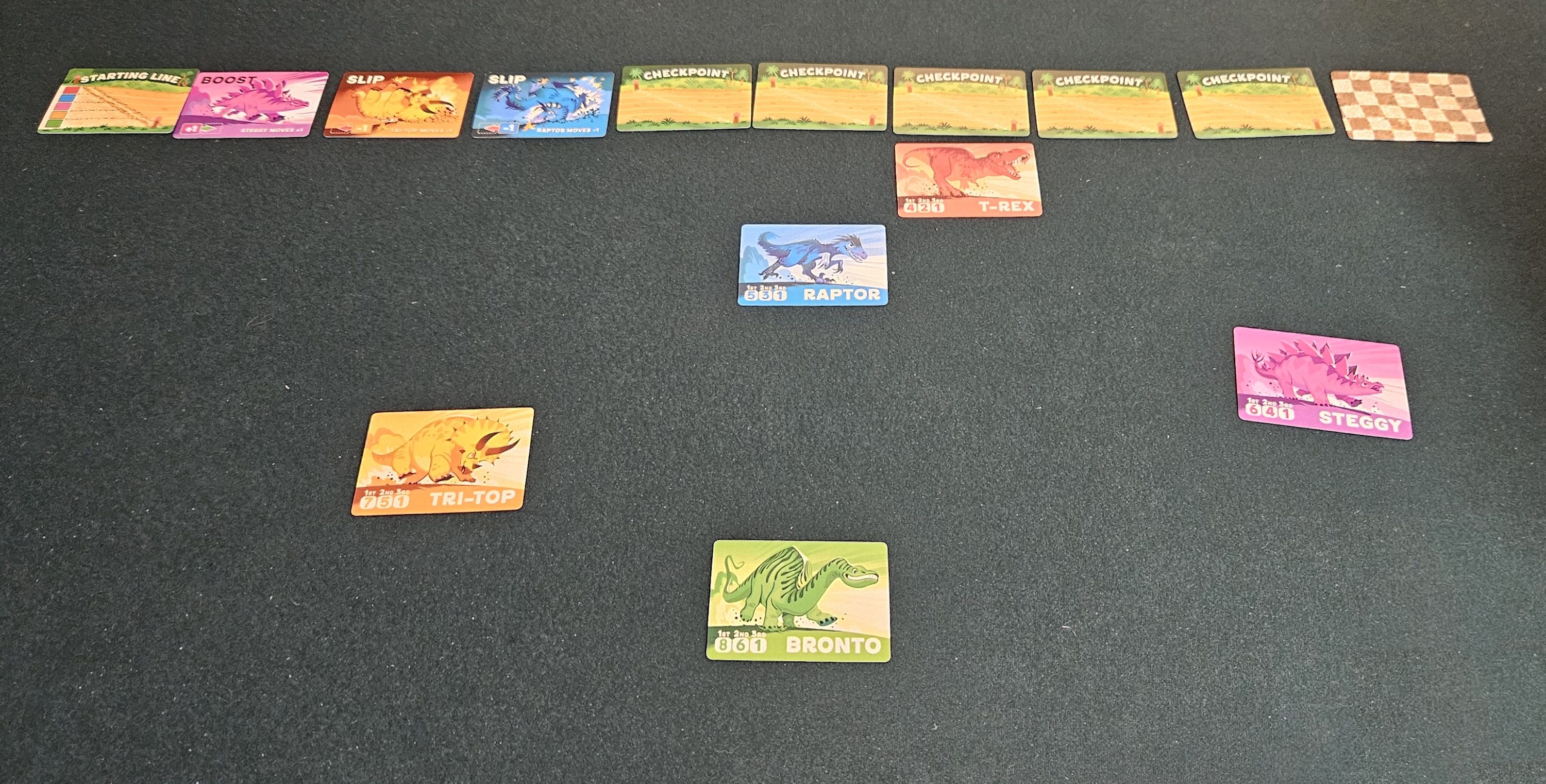
And down the stretch they come!
When we first played Dino Racer, the whole thing seemed broken. Thanks to a small rules error, the outcome of the races was all but foreordained, the wagers were obvious, and not even Eric Hibbeler’s charming dinosaur portraits could do much to make up the gap.
Okay, so maybe it wasn’t such a “small” error on my part. But the point stands. Even something as minute as reshuffling the deck in between matches, rather than letting it run its course and thus tweak the odds from race to race, was enough to scuttle this one. Fortunately, the right rules transform it into a zany good time — albeit one that might prove too light for some enthusiasts.
At the outset, Dino Racer seems like as much a spectator sport as its peers in the wacky race club. When the round begins, five dinosaurs stand hip to hip at the starting line. T-Rex has the best stamina, with diminishing probabilities of success for Raptor, Steggy, Tri-Top and Bronto. These odds are represented by each dino’s quantity of cards in the deck, not to mention their relative tiebreaker positions, but they’re close enough that the outcome isn’t wholly set in stone. T-Rex has one more card than Raptor; Raptor has one more than Steggy; and so on down the line. It’s enough to give some dinosaurs a statistical advantage, but such a slender one that upsets aren’t outside the realm of possibility.
The race itself is resolved in much the same manner as those in Jon Perry’s Hot Streak. Somebody picks up the deck, flips a card, and moves the corresponding dino one space closer to the finish line. Some of that game’s possibilities are left by the wayside; there are no trips or reversals, just a steady forward momentum.
For the most part, anyway. As soon as every dino has reached a column, the checkpoint card at the top of the track gets flipped over. These might produce new opportunities, such as a burst of speed for Steggy, a sudden stumble for Raptor, or a swap between the racers in first and fifth place. What initially seemed like a straightforward foot-race becomes… well, still a straightforward foot race, but one in which the racers’ fortunes are much tightly corded than they previously appeared.
The game’s bigger revelation is that it isn’t a spectator sport at all. Unlike Magical Athlete and Hot Streak, where the bulk of the decision-making occurs before the firing shot, players in Dino Racer are active participants the entire way through. As soon as a certain number of cards have been flipped, the proceedings pause while players take turns selecting from those same cards.
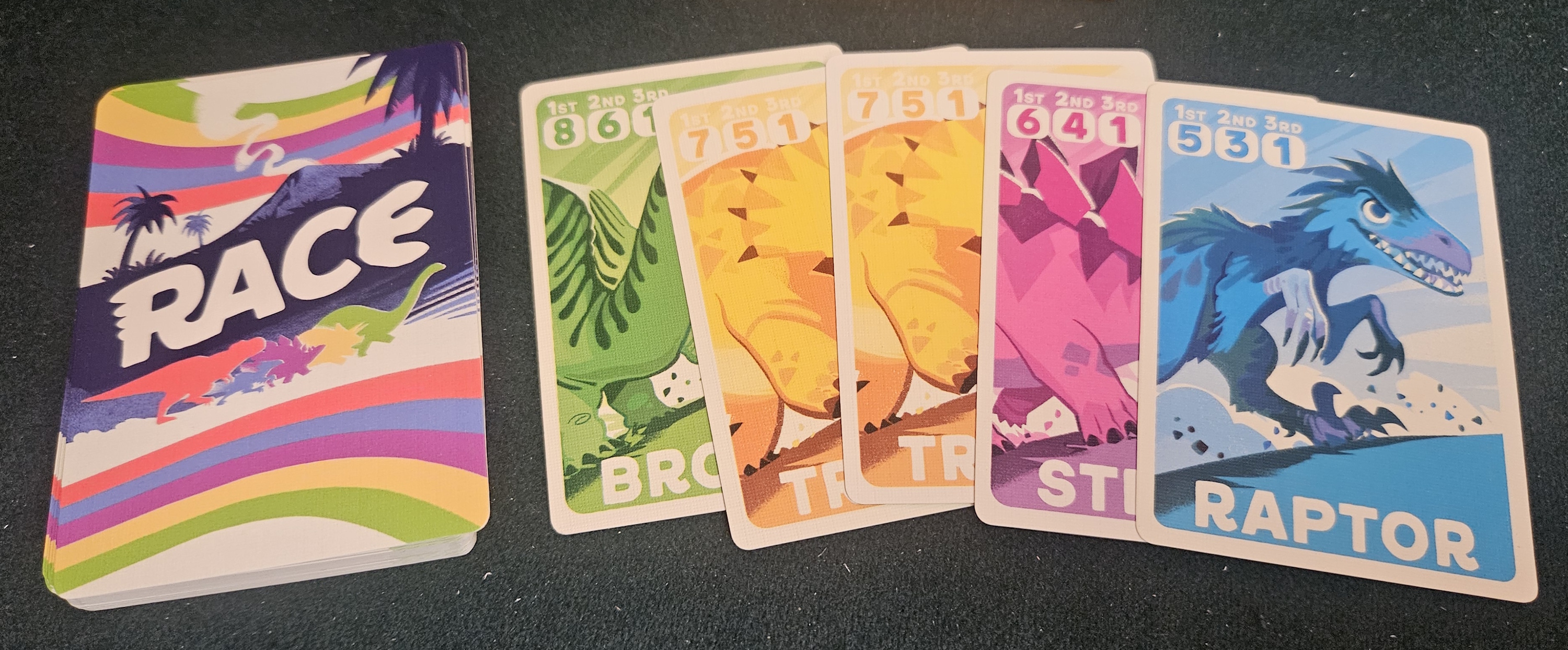
The cards govern both the race and its wagers.
These are the game’s wagers, and they’re informed enough to make smart decisions, but not so settled that you don’t run the risk of losing everything when a loser sprints to the head of the pack. Every detail becomes important. The relative standings between dinos. The cards they’ve burned in previous races. The stronger payouts for less-favored runners. Even the number of remaining checkpoints that are likely to throw the race into disarray. For all that, the way Leiman keeps these decisions constrained to only a few cards — one more than the number of players in the game — prevents anyone from fretting too hard over which dino to pick. It’s possible to play well, but we’re talking about play in aggregate more than turning players into Jurassic match-fixers.
It’s a real holler. Literally. I’ve watched crowds of staid players transform into screamers, bellowing at Steggy to pick up the pace or cheering as another Bronto card flips from the deck. My daughters complained that some of our guests were keeping them up at night; the game under consideration was Dino Racer. A week later, my kiddos gave it a try and screeched like banshees when their favored T-Rex cratered on his snout.
Is it a perfect game? Oh, I have no idea. I’m hesitant to do a compare-and-contrast to its peers. My wife has informed me in no uncertain terms that it’s better than Magical Athlete, which initially struck me as bananas, but I could see preferring it to Hot Streak, which sometimes I favor over Magical Athlete, so at this point it’s all one ouroboros biting precious calories from its own tail.
Because the thing is, these games aren’t actually all that similar. Hot Streak is about obsessive gambling and manipulating the odds. Magical Athlete is about the draft and rolling with the punches. Dino Racer, by contrast, is about placing smart bets, but not especially difficult bets. It’s the lightest of the trio, rules-wise. My kids, aged twelve and six, can play without worrying about special abilities, but there’s still enough for the adults to think about that nobody is getting bored.
It helps, too, that it’s so fast. There’s always something to be said for games that don’t overstay their welcome, and Dino Racer is downright skittish in that regard. Twenty minutes and it’s done. Even if I weren’t in the mood to watch a tableful of people scream at a Triceratops to pick up the pace, it would be over before the headache could form. I don’t even mean that as faint praise. Just, where a session of Magical Athlete means settling in for a while, possibly even a long while if the players settle into a feedback loop, I know what to expect from Dino Racer.
Screaming. That’s what I expect. Provided you get the rules right. Which shouldn’t be a problem, darn it, so I’m not sure why it was that one night. Done right, this game is worth every decibel. It’s cute, it’s fast, and it provides more meat than it might seem from a distance. That’s all good stuff.
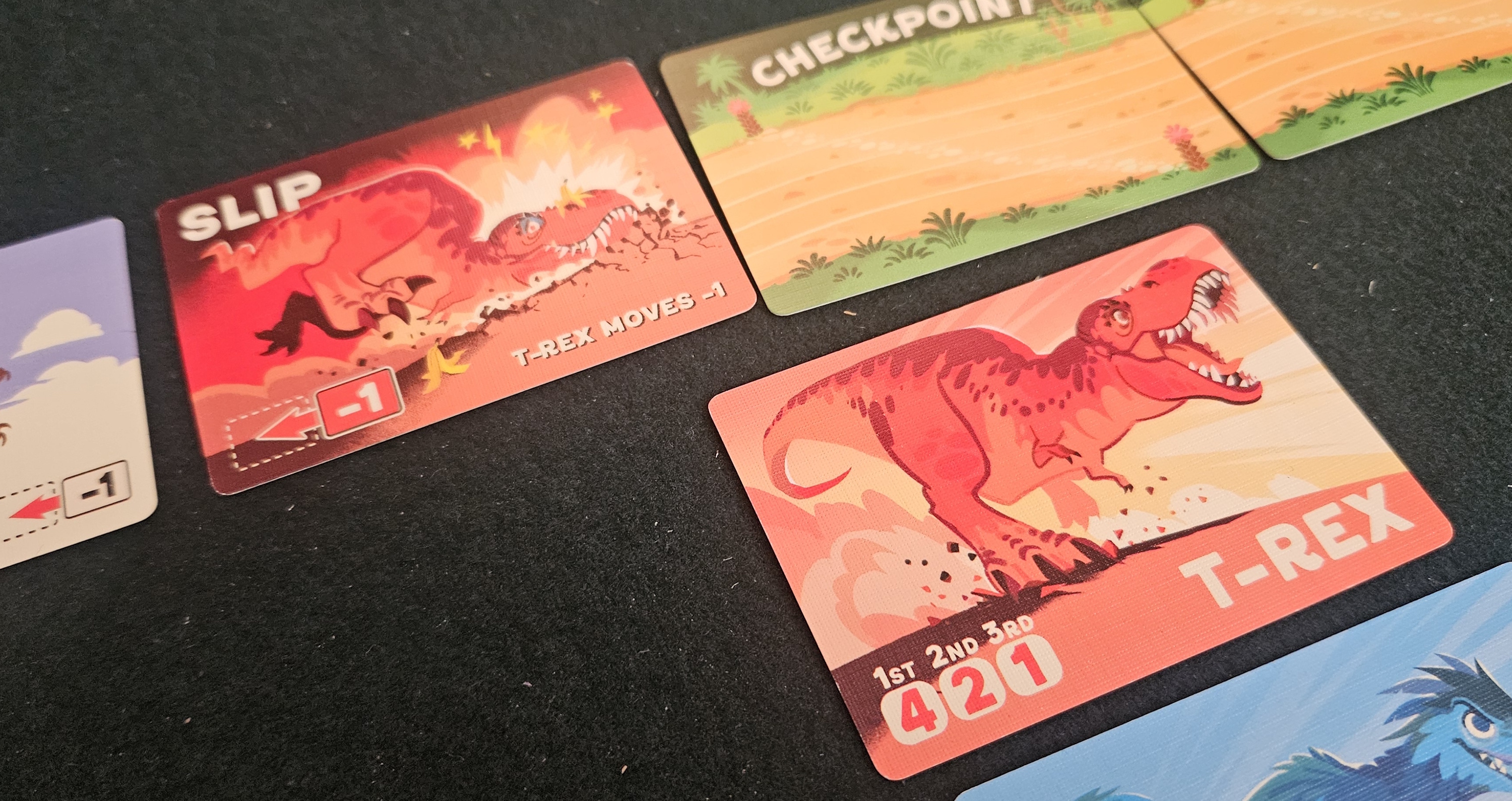
May it ever be thus to tyrants.
In the end, Dino Racer is about the highest volume one could pack into such a small box, plus a lovely addition to the expanding roster of wacky race games. It displays Leiman in yet another register, all shouts and immediacy, a far cry from the more intimate pleasures of High Tide or Nebular Colors, and even more finely tuned. Just writing about it makes me want to put it on the table all over again. I hope to do so with some regularity.
A complimentary copy of Dino Racer was provided by the designer.
(If what I’m doing at Space-Biff! is valuable to you in some way, please consider dropping by my Patreon campaign or Ko-fi. Right now, supporters can read my first-quarter update of 2026: the best board games, movies, books, and more!)
Posted on April 8, 2026, in Board Game and tagged Board Games, Dino Racer, Underdog Games. Bookmark the permalink. Leave a comment.

 SPACE-BIFF!
Leave a comment
Comments 0