Re;MATCH One, Two, or Four

It hasn’t been all that long since we took a look at Re;ACT: The Arts of War, an intriguing but imperfect game about various artists manifesting their crafts into the physical world in order to determine which medium is the most artsy of them all. It’s like Bloodsport but with calligraphy versus spray paint versus film stock.
MingYang Lu’s forthcoming followup, Re;MATCH, isn’t exactly a sequel, although its peculiar capitalization and errant semicolon might lend one that impression. Instead, it’s something even better: a match-three game in which one must never, ever match three.
Okay, it isn’t only that, although I’ll confess I find that part amusing.
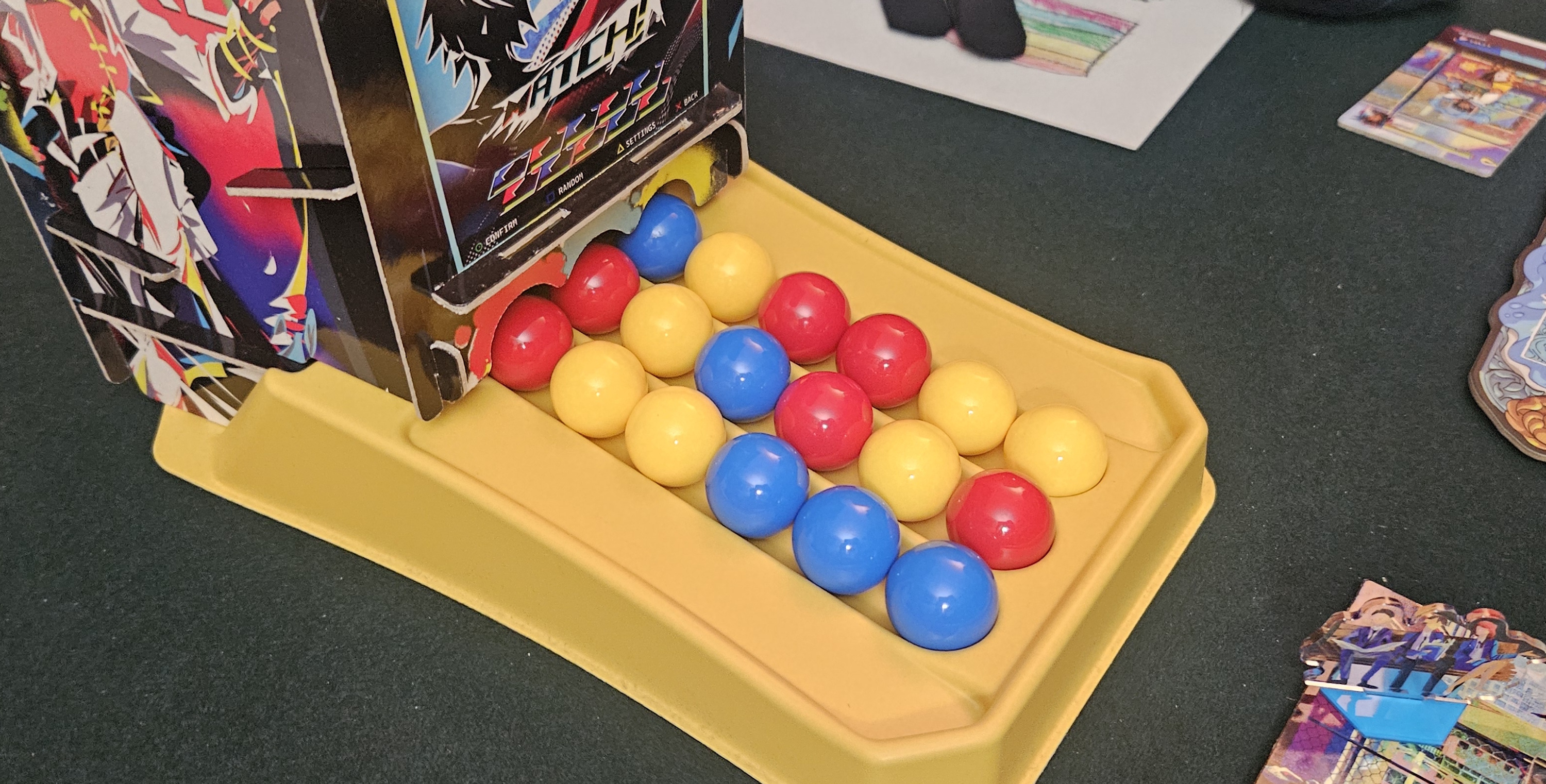
Match some number of balls, so long as you don’t match three.
Like Re;ACT before it, Re;MATCH begins with a settling of accounts between two careers, although this time the jobs are even more disparate. That’s right, no more squabbles between artists. Instead, one match might see an axe-wielding firefighter squaring off against a disc jockey. Perhaps that seems one-sided, but no, this is a competition of the minds.
Still seems one-sided? Okay, let’s leave the minds in the drawer. How about a battle of marbles?
The big visual draw is the marble tower. The closest touchstone is the box from Potion Explosion, which, if you’re in the mood to suddenly feel old, came out a lengthy eleven years ago. The marble tower in Re;MATCH is even simpler than that game’s, producing three lanes of balls in three colors. It’s marble-matching so simple a baby could do it, right before trying to eat the marbles.
But the matching is simple for a reason. For one thing, you aren’t permitted to use all three of those lanes. Instead, you’re always limited to two: the one closest to you and the shared middle lane. The decision space is compressed, but in such a way that even a fourth color would cause no shortage of problems.
And then, of course, there are the fighters.
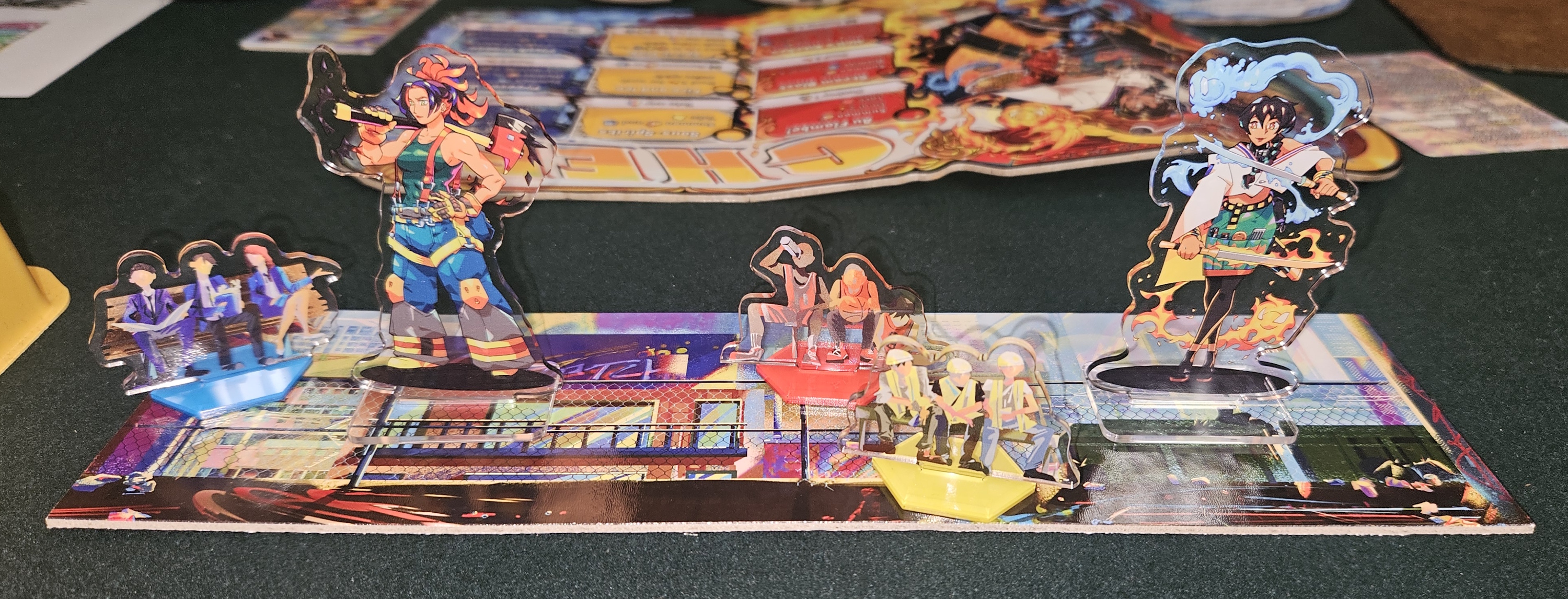
Whose career is better in a fight? Go!
The gist behind Re;MATCH is that every fighter comes with their own arcade cabinet, complete with a standee — whose function, it must be said, is principally aesthetic — a few special tokens, and a fold-out broad displaying a unique set of moves.
Those moves are the important part. By making color-coded matches in the marble tower, your fighter triggers various effects. Each color permits three levels, one that triggers when you utilize a single ball, another for two balls, and a third that skips over three balls to instead trigger when you manage to string together four marbles at a time. It’s simple, but not as much as it initially seems. Sometimes you’ll want to forego a powerful move for the sake of setting up an even more potent combo later — or because you desperately need to block a move coming down your rival’s lanes. It feels surprisingly close to the fighting cabinets it strives to evoke visually, despite the turn-based limitations of its medium.
Now comes the tricky part, because I can’t give examples without delving into the fighters themselves. This will come as no surprise to anybody who played or even glanced at Re;ACT. In that game, the duelists were so different that they often used entirely distinct mechanisms. Bag-building versus card management, for example. The contestants in Re;MATCH boast a more robust shared foundation, in that nobody leaps away from the marble tower to shuffle a private deck or anything like that. But the breadth of their personal expression is still quite the thing to behold.
Maybe I can limit myself to only one or two examples.
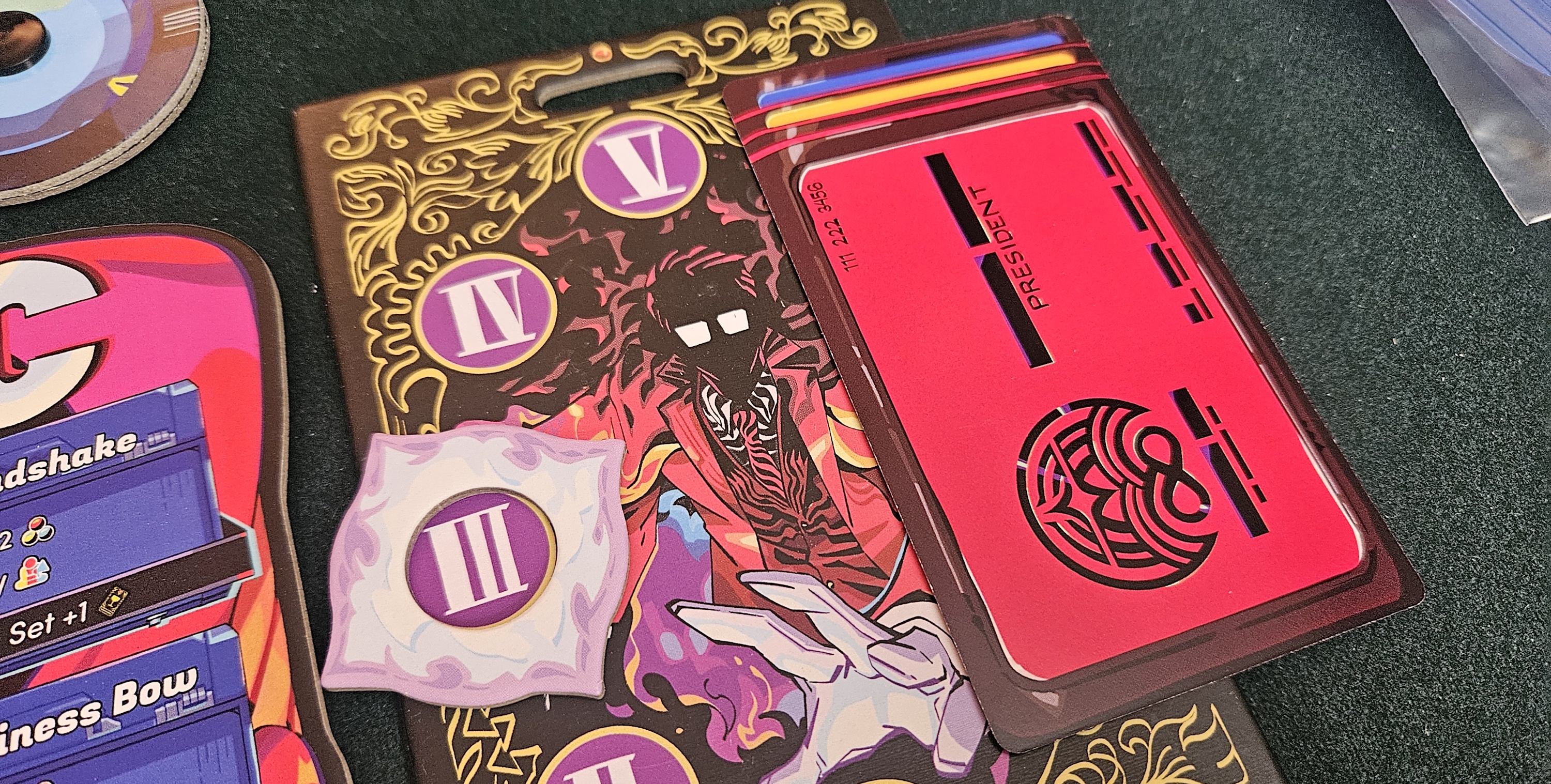
Predicting my opponent’s moves.
I wasn’t joking when I said there was a firefighter. That might sound silly. That’s because it is silly. But at the same time, this is a firefighter with a possessed axe that makes her take deadly risks, which pushes the character from silly to excellent. At various points, the firefighter’s moves might cause self-damage. This flips the axe to its other side, gains an “ironblood” token that can be spent to empower her moves, and changes how the firefighter operates in battle. Basically, she shifts between damage mode and defense mode, healing her injuries and destroying any combo-making balls in the marble tower before her opponent can pounce on them.
And this is reflected in those color-coded movesets. For instance, her red moves are all about dealing damage. One red marble deals three damage to her opponent and one to herself. Two marbles means she deals two damage, or else spends one of those ironblood tokens to deal twice as much. Four marbles deals only one damage, but does so to every color.
Did I mention that health is color-coded? It is. Both fighters have three health dials, one per color. Bottoming out a dial will “break” it, forcing its owner to spend a coin to stay in the game. This alters how the whole thing is played. Now the injured player can’t make matches with that color. Instead, it changes function for a bit. Instead of building matches, the broken color operates as a connector, letting its player trace through those busted marbles to connect other ones. This has the benefit of gradually ticking the broken dial upward, eventually restoring it to its healthy side.
In other words, as your moveset becomes more limited from suffering damage, your remaining colors grow even more formidable. At the same time, though, you’ll want to restore your broken dial as soon as possible, lest a second dial succumb. When that happens, it takes two coins to stay in the game. That’s bad. Coins are your “real” currency, you see. Lose all of them and it’s game over.
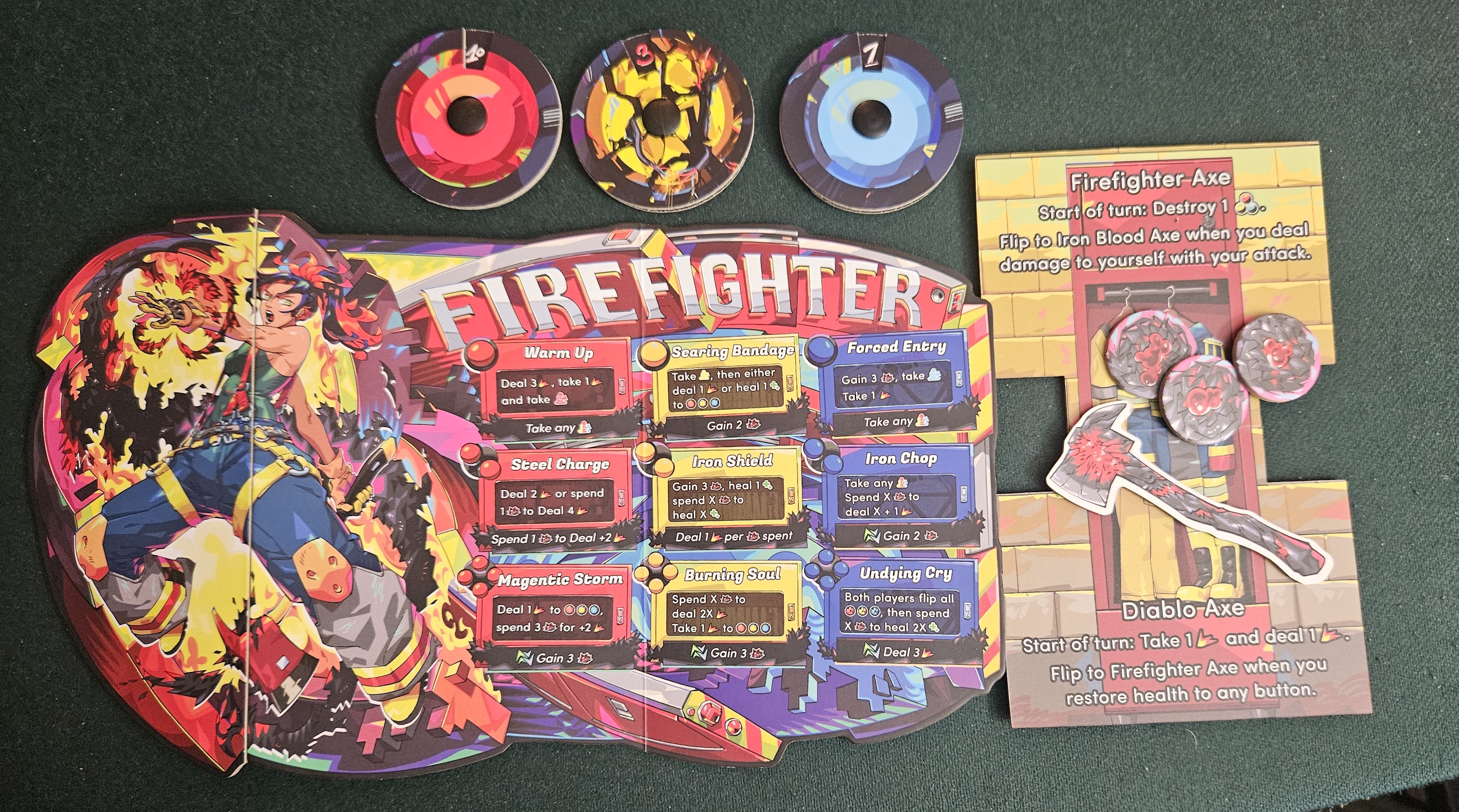
A closer look at the firefighter.
Okay, so the firefighter is all about tempo, switching between blasting both players and nursing her wounds. Let’s contrast that with another contestant, the D.J.
The D.J. loves to make noise. Her kit comes with a turntable and a selection of discs. Every so often, she’s allowed to drop a beat, physically taking one of those discs and placing it on the turntable. This might attract fans — a shared currency both players are grappling to control, and which increase the potency of every move in the game — or deal damage, or whatever. This also places a beat token on the marble tower. Row by row, the beat will advance. When it finally ends, another power triggers.
Naturally, the D.J.’s moveset includes normal stuff. She wins over fans. She deals damage. The usual. But her real abilities revolve around dropping, advancing, and killing beats. Her entire setup is one cacophonous wall of sound. Like the firefighter, she’s all about tempo. But the way those tempos function couldn’t be more different. The firefighter is all about managing two very different modes. The D.J. is the board game equivalent of a Shepard Tone, always ascending, always building momentum.
The other fighters tweak the formula in their own ways. Some, like the dancer and the chef, lay little traps on the marble tower, penalizing anyone who selects balls on the booby-trapped row. Others, such as the psychic and the trickster, are all about predicting and preempting their opponent’s moves. Like the firefighter and D.J., they share some similarities, but there’s an initial sense of discovery to seeing how they function, followed by the joy of figuring out how to leverage their strengths against an opponent with tricks and traps of their own.
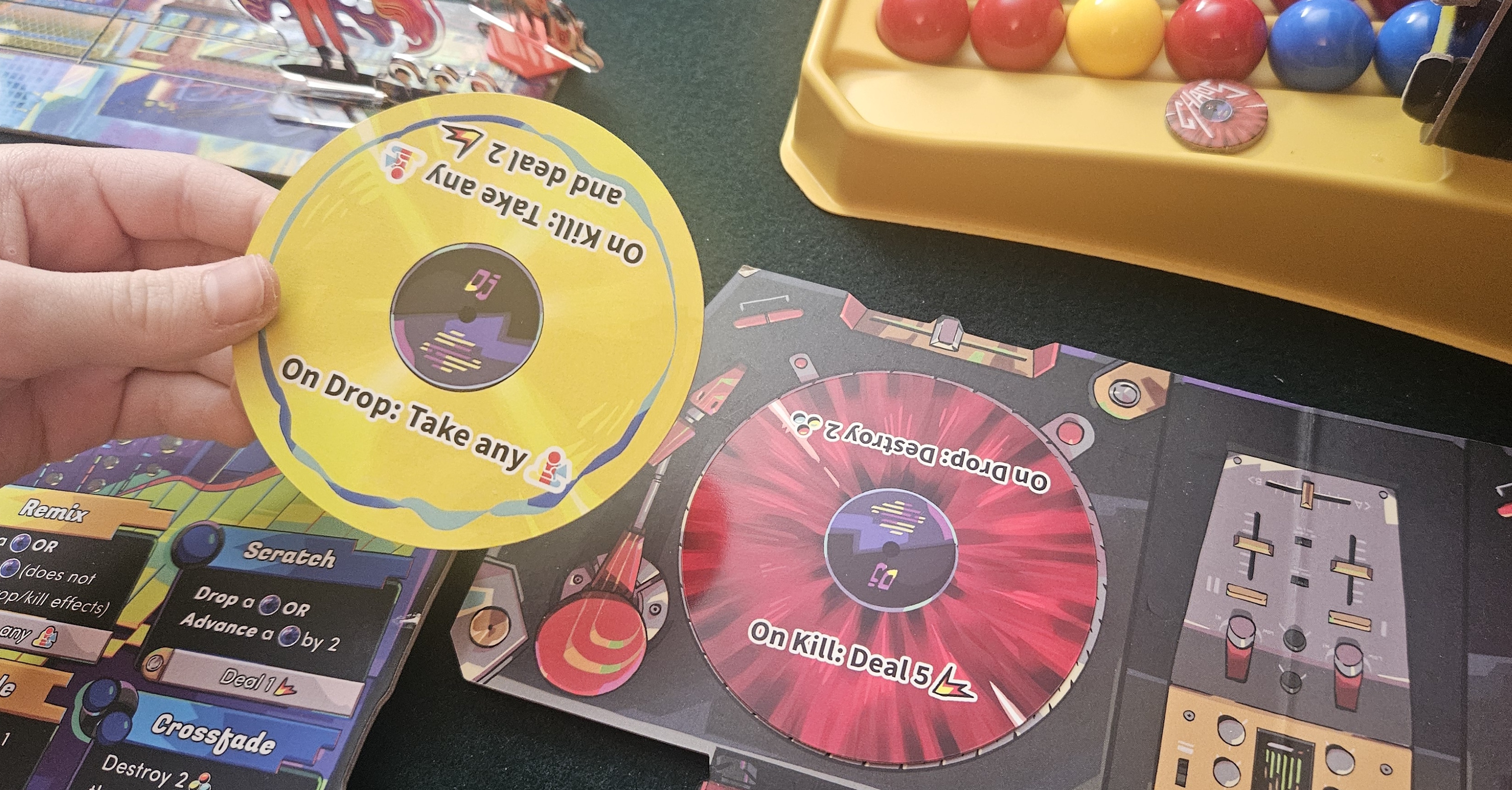
The D.J. battles via a turntable.
The effect isn’t all that dissimilar to something designed by Brad Talton, like some lighter marble-drop version of BattleCON or Exceed. Or, sure, Re;ACT, although Lu is in stronger form this time around. Unlike that earlier effort, which was full of sticky rules and questionable matchups, the fighters in Re;MATCH are sharply crafted — and I say this despite playing a prototype, with all the small tweaks and imbalances that always entails. Even so, my twelve-year-old was more than capable of figuring out the fighters’ intricacies. At the same time, they weren’t so breezy that she didn’t have to wrestle to overcome their various deficiencies, learning to mitigate a fighter’s shortage of healing or accurately predict my moves.
Are there depths here to plumb beyond the learning phase? I think so, although it’s hard to say after only a half-dozen matches with an in-progress prototype. I will say that I’m excited about the possibilities. Where Re;ACT was interesting to discover but also something of a chore, Re;MATCH doubles down on its strengths. Its systems are simpler, more tactile, and easier to master, but still reward clever combo-building. In the process, the randomization of the marble tower prevents it from feeling quite as process-bound as its predecessor. While some of the fighters still sport ambitious attacks, the game feels less like a race to trigger their two apparent combos.
Or maybe I just really enjoy fiddling with those balls. The game’s kineticism is admirable. Claiming marbles, studying your future options and those of your opponent, even jostling the prototype tower when the balls got caught within, everything about the production felt hefty and enjoyable. The game is pleasant in a way that Re;ACT only attempted.
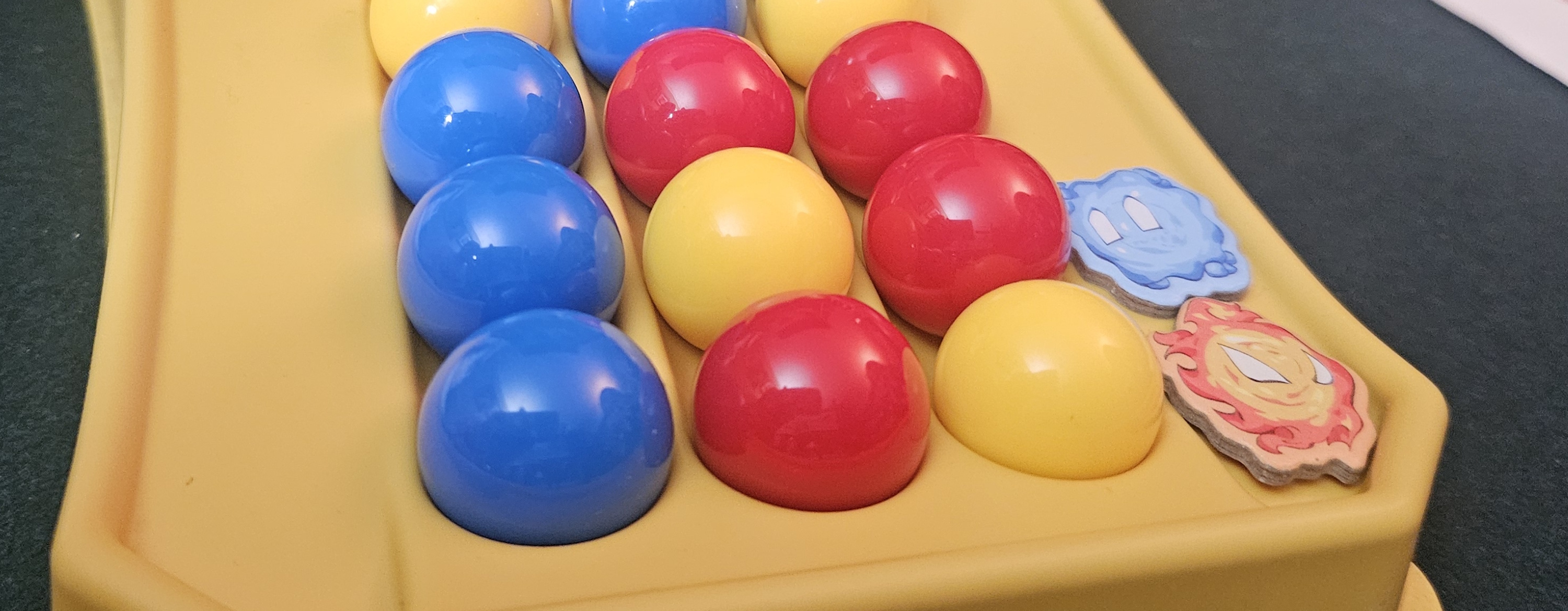
It’s about the balls.
But enough with the comparisons. Re;MATCH is one of those titles I’m excited to keep exploring. It’s colorful and diverse in its gameplay, fast-paced and hard-hitting, and above all, a pleasure to discover.
As a bonus, it made my kiddo go “wokka wokka.” I had no idea she’d ever seen a turntable. The more you know.
Re;MATCH launches on Kickstarter tomorrow.
A prototype copy of Re;MATCH was temporarily provided by the publisher.
(If what I’m doing at Space-Biff! is valuable to you in some way, please consider dropping by my Patreon campaign or Ko-fi. Right now, supporters can read about which films I watched in 2025, including some brief thoughts on each. That’s 44 movies! That’s a lot, unless you see, like, 45 or more movies in a year!)
Posted on March 2, 2026, in Board Game and tagged Board Games, Brother Ming Games, Re;MATCH. Bookmark the permalink. 7 Comments.

 SPACE-BIFF!
Thanks for this tip!
Not my usual fare so I am at least interested in their pricing😁.
Cheers.
Yeah, that’s a good thing to check. I have no idea about anything in that regard, unfortunately.
$100 is the base pledge! My word. I’m used to throwing down ridiculous amounts of money for games but that shocked me. For that price, it better be for ALL the marbles.
I obviously don’t know about the finished game, but the prototype came with extra marbles! Haha.
No problem, more an observation than a question.
Looking forward to your next piece.
All the best.
Interesante propuesta, me gusta mucho la idea de romper con la mecánica clásica de “match-three” y convertirla en algo completamente distinto. Ese tipo de giros en reglas conocidas suele generar experiencias frescas y estratégicas. Además, el concepto de enfrentamientos entre personajes tan diferentes le da un toque creativo y divertido. Definitivamente parece un juego que apuesta más por la originalidad que por seguir fórmulas tradicionales.
It’s definitely very interesting. It feels like a “match-three” without being entirely stuck to the format’s conventions, if that makes sense. You have to look for good matches, but it’s also important to keep your character’s moves in mind. For example, it’s pretty common to make smaller moves even when something big is available, because you might not be ready to trigger a more powerful attack. Neat stuff.