God Games
Between the old-world deities, satirical tone, and bean-sized mortals begging to be smited (or blessed), the forthcoming game Almighty feels like it was tailor-made with me in mind. This is the third title we’ve seen from Malachi Ray Rempen, following Roll Camera! and Power Vacuum. In more ways than one, this feels like the culmination of Rempen’s efforts to date; it’s smarter, more assured, and more inventive than its predecessors.
Or maybe I just like the theological implications of having my storm god honk his nose at the god of the underworld.
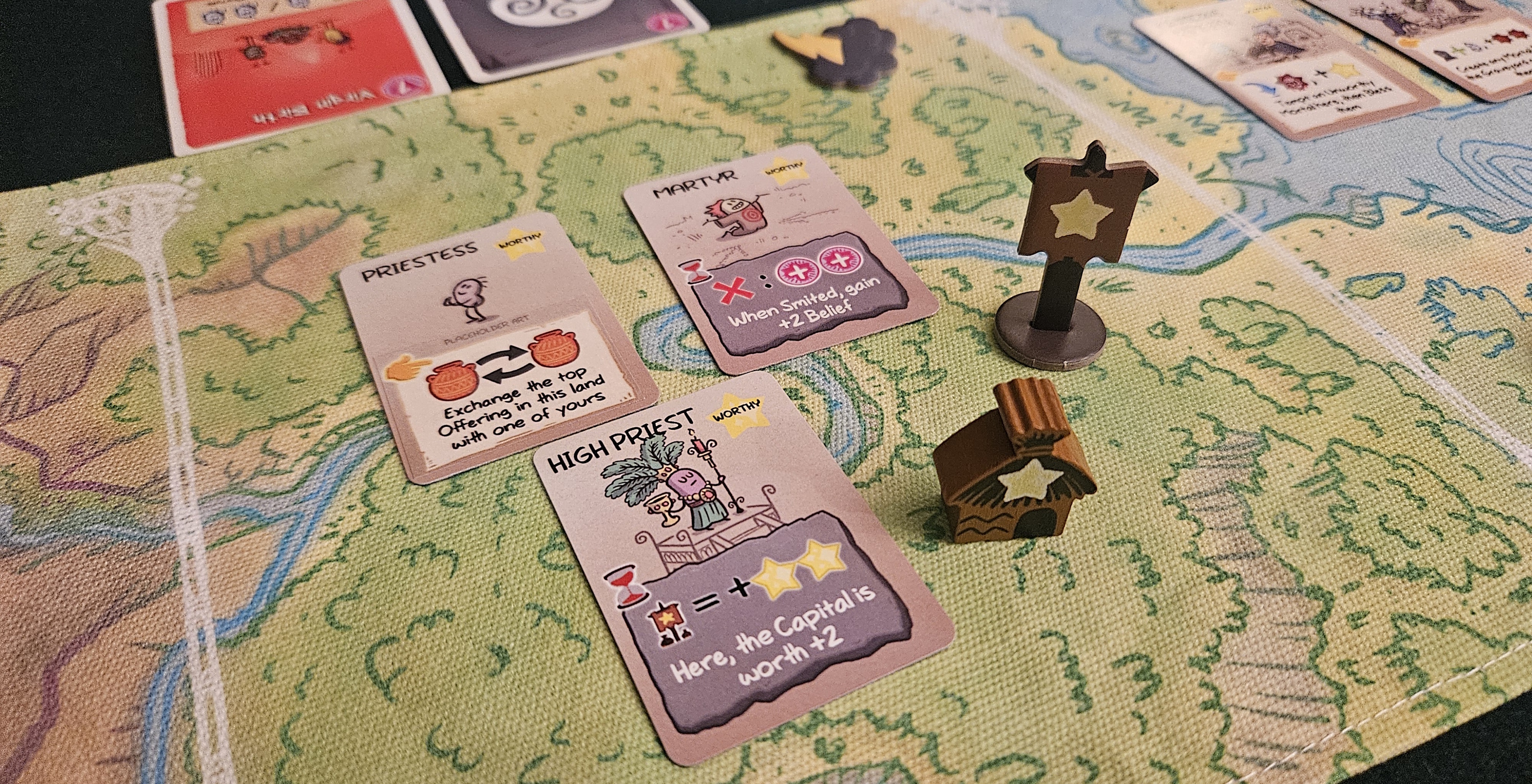
An early-game urban center.
As has been the case since Medieval scholars fretted over how many angels could dance atop the head of a pin, there’s still an ongoing debate over what’s meant by omnipotence. Theologians have classified multiple degrees of godly power, ranging from top-tier omnipotence — where a god can perform any act, up to and including those that are logical contradictions like squaring a circle — down to almighty status, in which the god just so happens to be more powerful than any other being, but not so impressive that he can decline to send a bunch of people to hell. Yes. People argue about this stuff.
In Almighty, your gods sit squarely at the bottom of the continuum. There are four in total, each eager to prove themself the most potent of all omnis, but not quite up to the task without a cosmic-tier rap battle.
Their world is presented as a scroll. A literal scroll, dowels and fabric and all. This is divided into four regions: islands, jungle, mountains, and desert, bookended by celestial skies that essentially function as spots for holding decks and tracking scores. Like everything Rempen has created, it looks fantastic, from afar and down to its smallest details.
And that’s before the place is populated by towns and believers. These quickly give the world its texture. Towns spring up according to your whims, with the largest concentration being named the global capital. Believers, meanwhile, allow Rempen to flex his artistic impulses. There are heaps of these little guys, each falling somewhere on a spectrum from worthy to unworthy, depending on how much they complement your divine plans. A smoke signaler, for example, might be a worthy occupation, while a pyromaniac, heretic, or yodeler falls into a more distasteful category.
These categories matter. Over the course of the game’s three rounds, those (up to) four jockeying gods will go about the business of raising or razing towns, birthing or smiting mortals, and then inspiring them to perform various functions. Controlling a region — accomplished by performing acts that build the local populace’s faith in your manifestations — awards points. That is, provided the locals are sufficiently pious. Commanding a realm of stubborn oafs and skeptics can prove subtractive to one’s divine score rather than bolstering it.
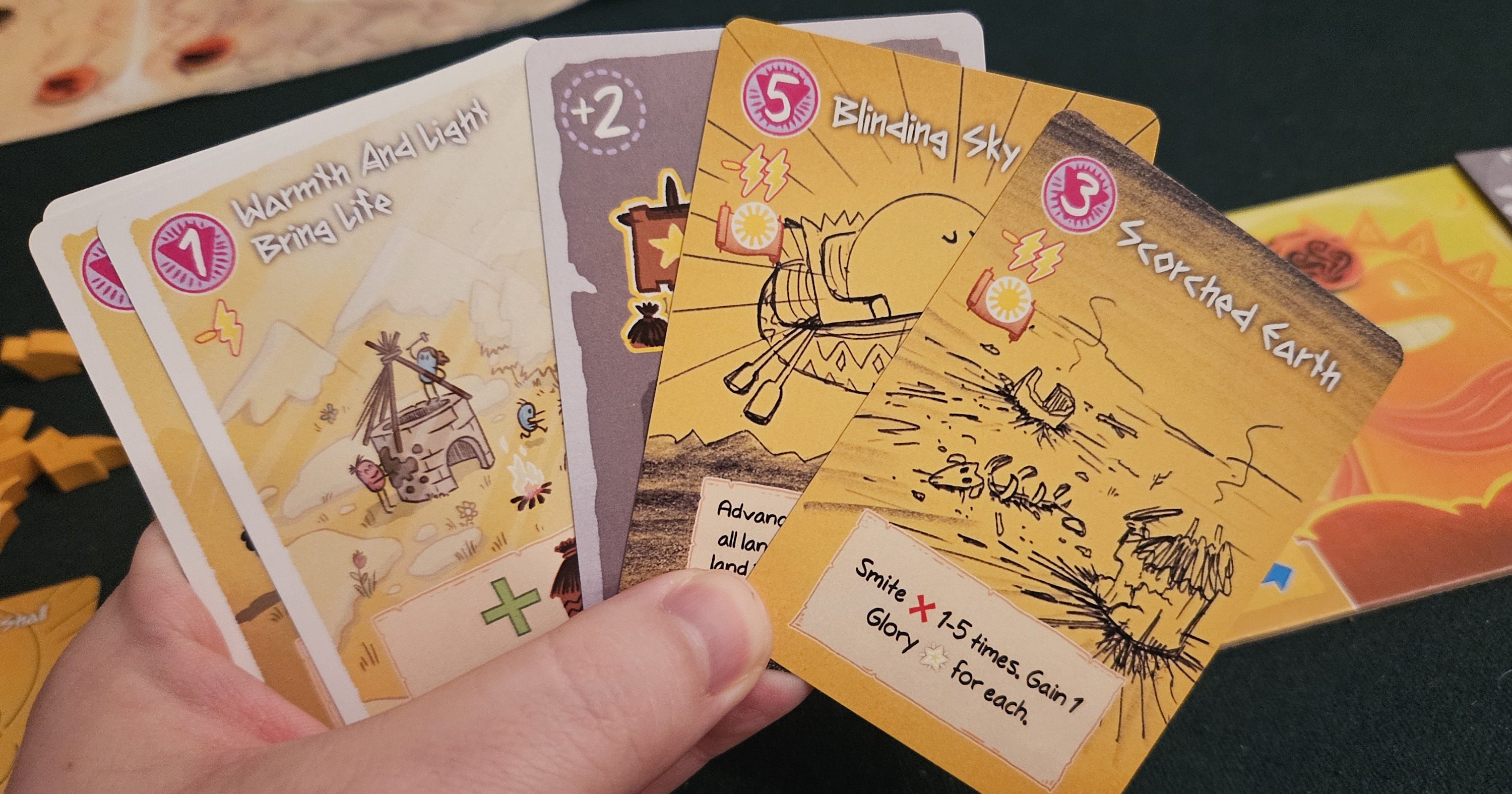
The god powers are varied and amusing.
In one sense, Almighty is an area control game, although it falls into the somewhat rarer category of an area control game where you don’t directly command any of the pieces. If you birth a necromancer into the desert, you can now “poke” that necromancer to raise deceased mortals from the grave. But so can everybody else. There’s no telling when another god will compel your skeptic to turn around and vocally doubt your miracles rather than their own. In some cases, you may find yourself smiting a follower who’s gone all Road to Damascus for another deity.
It doesn’t help that the gods are capricious. Each round assigns an objective. Like the best theologies, these goals are always comparative, forcing a struggle between two realms. For example, you might be tasked with ensuring that the jungle is better than the desert. In some cases, you might even face a logical contradiction of your own, such as being told that you need the capital to be worse off than another region, except at the moment the capital happens to be located in that same spot. To rectify such a paradox, you’ll need to first move the capital. Gird your loins for some ransacking.
To accomplish these aims, each god is provided their own selection of miracles, and this is where Rempen really cuts loose. Every god is distinct from their siblings, and that comes through not only in their color palette, but the way they function on the table.
Consider the God of the Sun. This guy begins the game with a sun token on the map. Each turn, it shifts to the next region. When it reaches the end, it “falls off” the map, revealing a nighttime side that recharges the god’s energy, before circling back to the other side. This god’s powers are incredibly potent, baking or warming entire civilizations. His limitation is that everything is bound to that sun token. There are ways to hasten its movement, but this still provides the Sun God’s nemeses with crucial foresight. If the sun has already passed overhead, there’s a good chance everyone else will be free to meddle in mortal affairs without much pushback from Big Yeller.
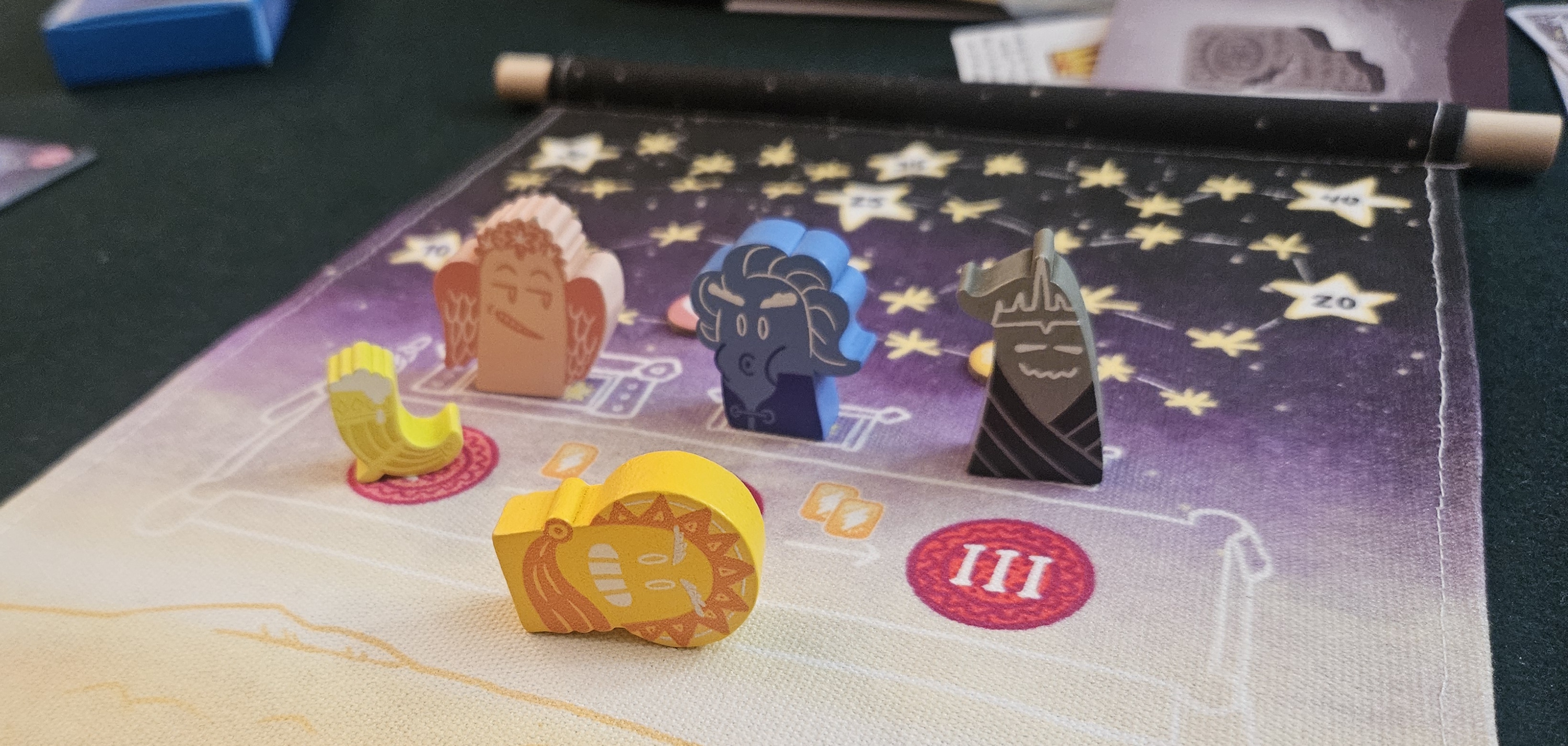
Strike a pose!
Speaking of meddling, the God of Love is all about hookups between mortals. Seductions, virgin births, crimes of passion, that sort of thing. Better yet, she can dictate the nature of these relationships, placing little heart tokens on the board to indicate great loves that increase the value of the region, or toxic disasters that tank its value. Playing matchmaker generates power, the little lightning bolts that most gods use as currency.
But only most. The God of Storms instead churns thunderclouds across the map, gathering them for more intense powers or scattering them across the land for more diffuse effects, and bypassing the need for power altogether. Meanwhile, the God of Death shepherds deceased mortals into the underworld. Depending on how they’re judged, they might generate power or points.
In all cases, the interplay between these gods soon creates a vibrant sandbox, one where cities can spring into existence and be erased within the span of a few turns. It’s possible to play defensively, but in most cases a passive god is also a dwindling god. You aren’t some distant parent figure. You’re a brash, in-your-face deity, one who slings lightning, forges epic romances, and burns mortals to a crisp because it looks cool.
I have some reservations about certain smaller details, balance and the merits of passing early and so forth. In the game’s current incarnation, you’re allowed to play two cards per turn. Once your hand is depleted, you can pass, and doing so early is a tremendous boon, netting you some points and functioning as a tiebreaker in contested regions. In theory there’s some tension between passing early versus staying in the round to continue manipulating regional loyalties, but in practice it’s often best to rush through your cards as swiftly as possible. These are minor issues, not to mention the sorts of things that usually get hammered out in development, but I’d be remiss to not mention that the prototype had a few hitches.
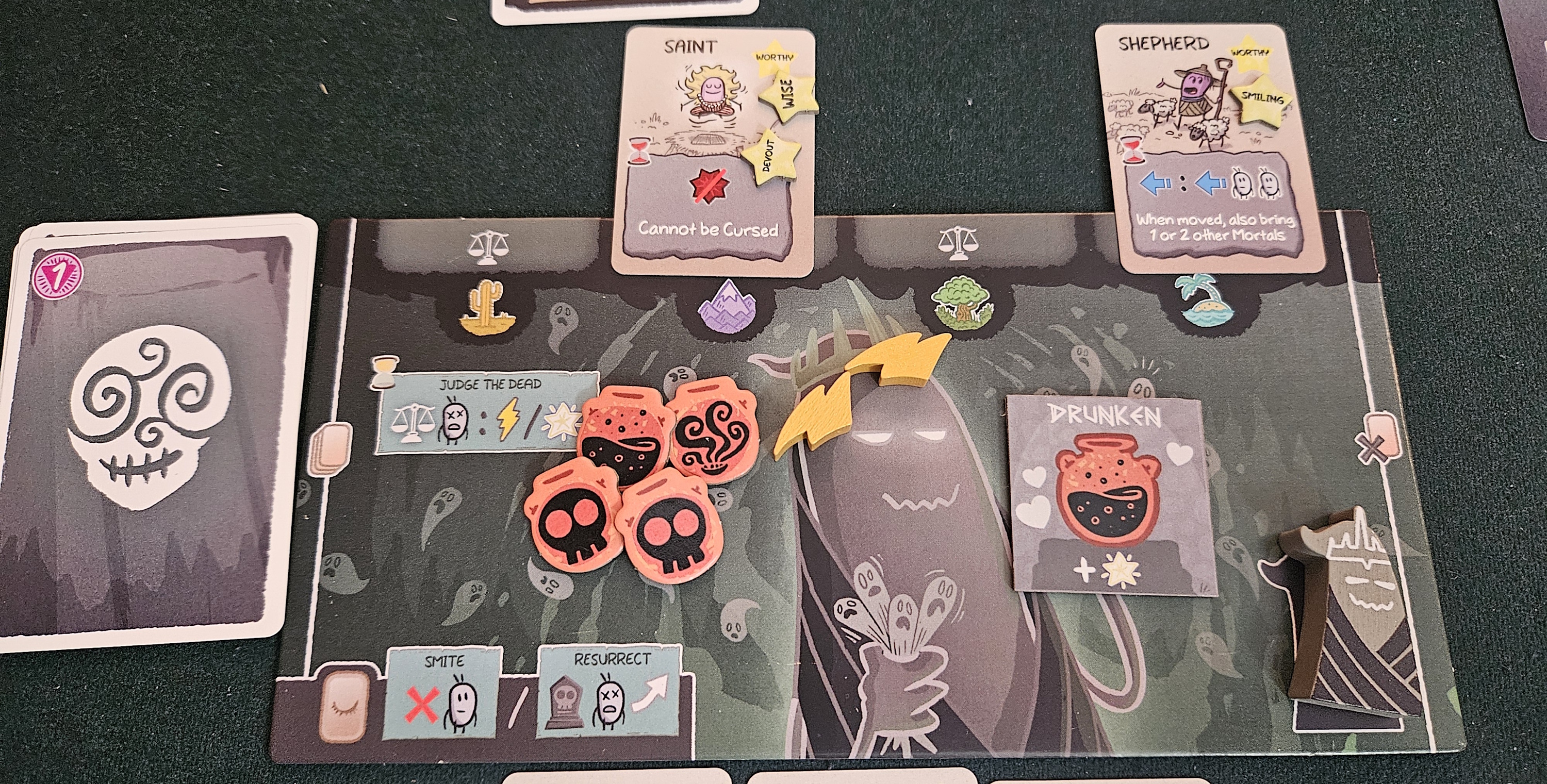
Honestly, he just wants to party. But you’re the catering.
On the whole, though, Almighty is filled with little touches that keep it lively. It even contains one of my favorite catch-up systems ever put to cardboard. At the end of the first and second rounds, gods gain access to new “mighty act” cards. Those who are in close competition with the current leader gain benevolent powers, while those who are trailing earn more wrathful options. Everybody gets something useful, but those who are struggling are given a bit of extra oomph.
The distinction is small, but it’s present nonetheless. As the Storm God, benevolent options might include Clear Skies, which see you parting any number of cloud tokens and blessing a matching quantity of mortals, or Eye of the Storm, which requires a precise arrangement of storms but brings three huts into existence at the same moment. If you can pull these off at the right moment, they can prove game-altering. But their wrathful counterparts are downright nasty. There’s Lightning Storm, which smites a mortal or hut in every single region with a cloud, or Tornado, which whips huts from far-off lands to a new destination. These result in similar outcomes, but are more disruptive of your rivals’ designs.
Okay, one last power: Shrieks of the Damned. I mentioned that the God of Death altered how the underworld works. Without him in the game, the underworld is a discard pile. With him, it becomes a multi-tiered pit, and Shrieks of the Damned continues the suffering of the no-longer-mortals residing within it. Three of them are cursed. The God of Death increases his power in a nearby region. And then, if you happen to resurrect those poor souls, they will now wander the land, scarred by what they’ve witnessed in the hereafter.
How cool is that? But that’s one power among many. Everything in Almighty is a font of intersecting powers, mortal frailties, relationships, and nastiness. Ever fostered a game-winning throuple between a high priest, a medicine woman, and a cannibal? Here’s one better: ever smote the member of that throuple holding it all together? I have. And the taste was sweet.
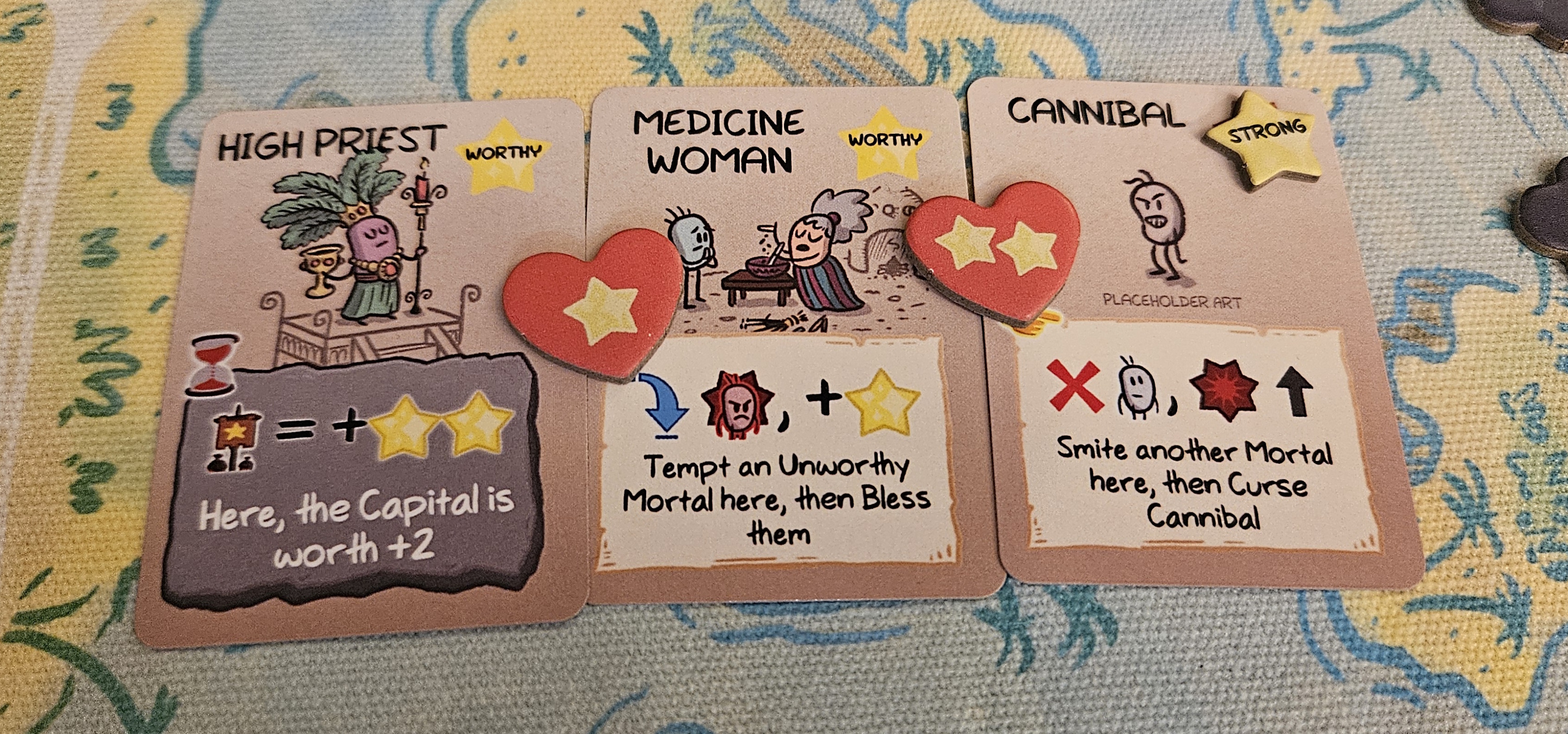
Beautiful.
Almighty is a delight. As an area control game, as satire, as barbed commentary, as a sequence of take-that moves that leave the table reeling, as a cosmological mess. Because when you get right down to it, this game is as messy as the pantheons it pays tribute to, and every bit as thrilling to experience firsthand.
Almighty is on Kickstarter right now.
A prototype copy of Almighty was temporarily provided.
(If what I’m doing at Space-Biff! is valuable to you in some way, please consider dropping by my Patreon campaign or Ko-fi. Right now, supporters can read about which films I watched in 2025, including some brief thoughts on each. That’s 44 movies! That’s a lot, unless you see, like, 45 or more movies in a year!)
Posted on February 10, 2026, in Board Game and tagged Almighty, Board Games, Keen Bean Studio. Bookmark the permalink. 23 Comments.

 SPACE-BIFF!
Inexplicably, the Kickstarter leads with the quote: “I really like Almighty.” and not “Ever fostered a game-winning throuple between a high priest, a medicine woman, and a cannibal?”
Cowards!
Momma didn’t raise no coward. Challenge accepted, KS page edited!
Haha, nice! I’m sure anything is more interesting than “I like Almighty.”
This sounds great
Malachi Ray Rempen sounds like a great Space-Cast guest candidate
I am considering it!
“I have some reservations about certain smaller details, balance and the merits of passing early”
what are the smaller details as you only write about the balance of passing early?
Those are the smaller details.
Haha.. and I thought there was more to it. Maybe I should not read your reviews the first thing I wake up…
Nah. I mean, I do think there are some balance issues, but they’re pretty minor and I believe they’re being hammered out. (Also, balance is often an uninteresting thing to discuss anyway.)
So true. Thanks Dan for yet another well written review.
Player count analysis? esp. 2?
would like to know this as well!
I didn’t get the chance to play it at 2p, unfortunately, nor with the solitaire mode, as my time with the prototype was a little more limited than I would prefer. It works very well at both 3p and 4p.
Here I was, minding my own business and promising myself I’d only buy games from my wishlist. Thanks, Dan -.-
I guess it’s typical of Kickstarter projects to feature such impressively produced prototypes. I can see how that makes sense; but before the context was mentioned, I was startled.
Honestly, I’m often startled myself. It’s gotten to the point where I sometimes can’t tell the difference.
This sounds intriguing! Lots of interlocking systems, as I understand it… but not a brain-burner in the strict sense due to its chaotic nature, right?
That’s the gist of it, yeah!
Can you give any context with other games? It screams Wehrle. Somewhere between Root and Arcs? I really WANTED to love those games… but games that typically require the same 4-player group until the 3rd playthrough to ‘click’… just don’t get played much at my table.
Sure. I don’t think it’s as “dense” as any of Wehrle’s games. It’s way easier than Oath, Root, Arcs… any of them, really. If anything, it might be a scooch closer to Pax Pamir, because that leans into the whole “you don’t control anything directly” conceit, but that’s more Pax than Cole. For what it’s worth, I think the rules to the prototype were simple enough that they clicked almost right away. No second play needed.