DoS That LLM Till It’s 404
There’s history to Deckers. Pedigree. Richard Wilkins — better known by the epithet Ricky Royal, the name under which he’s created a bunch of incredible solitaire modes for games that wouldn’t otherwise suit solo play in the slightest — designed a ditty called Renegade back in 2018. Before the plague years. Before the world’s billionaires started cramming robo-slop down our throats and calling it nourishment.
Before, in other words, cyberpunk felt quite so urgent. Back when the genre was a throwback to ’80s techno acceleration and not ’20s techno throttling.
Deckers is Renegade. That’s the short version. The slightly longer version is that Deckers is Renegade, but decoupled from the vulture who acquired it along with the rest of the Victory Point Games catalog, and with the expansion packs folded in, some additional clarity and development, and a new coat of paint. It won’t persuade anybody who didn’t get along with the original, but it’s just as fresh as ever. And as infuriating.
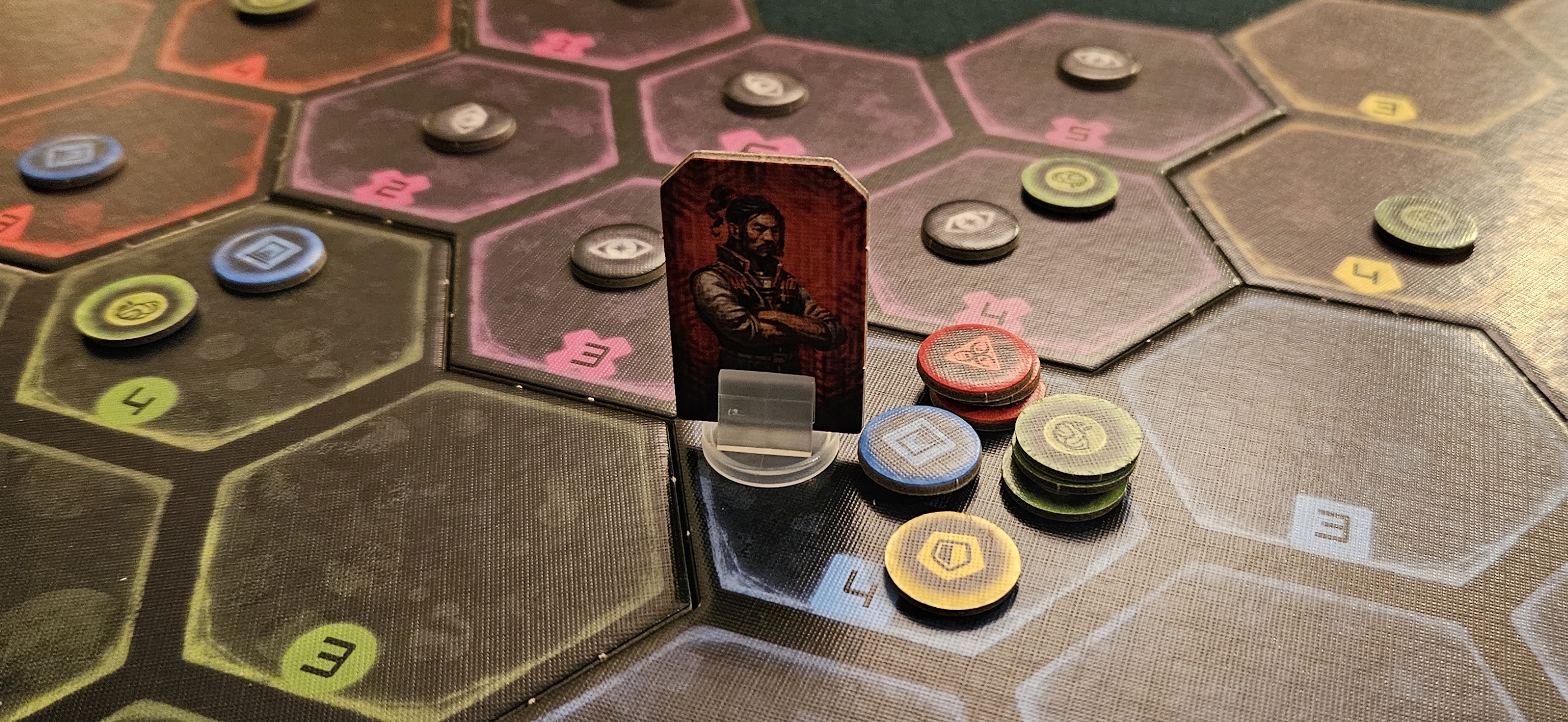
Man of mystery. And mood-setting backlighting.
Like all cyberpunk games, Deckers is about jacking into an encrypted network that’s inexplicably neon. There’s some technobabble about a supercomputer run amok, how society’s last chance hinges on a team of keyboard jockeys sticking it to the man by typing stuff on the internet. But we all know why we’re really here. To kill Grok. To murder OpenAI. To finally figure out how to remove the smart features from Windows 11. If we play our cards right, to fry the dopamine-jack in Sam Altman’s head.
The game’s first impressions are… let’s call them “mixed.” The network is a blob of color-coded hex grids. The game’s terminology is heavy with “SMCs” and “sparks” and “ghosts.” There are heaps of actions, and modifiers to those actions depending on the color of the icons you trigger them with.
And then there’s the mission structure. Scenarios in Deckers aren’t scenarios so much as they are accumulations of objectives. First you pick which SMC you’ll be decking. (See? I told you there would be terminology.) Then you populate that SMC with objective cards. These range from the simple to the confounding. Sometimes they’re clear enough, like generating a network keycode by installing four different programs on your decker’s entry point. Other times, they tip over the edge into a nihilism of iconography. A couple plays ago, we flipped the final objective and discovered we were meant to create a “mirror map.” Every server on the table, all five of them, were to have an identical configuration of programs, both friendly and rival, with at least one program of the four primary types. Such a goal might be easy or might be hard, depending on how well the mission had been going up to that point and whether the current SMC would add and/or shift lots of nasty counterintrusion programs, but it will never seem like anything other than the sort of busywork a teacher hands out to their fifth-grade students when there’s only forty-five minutes left in the day and she’s come down with another migraine, dammit.
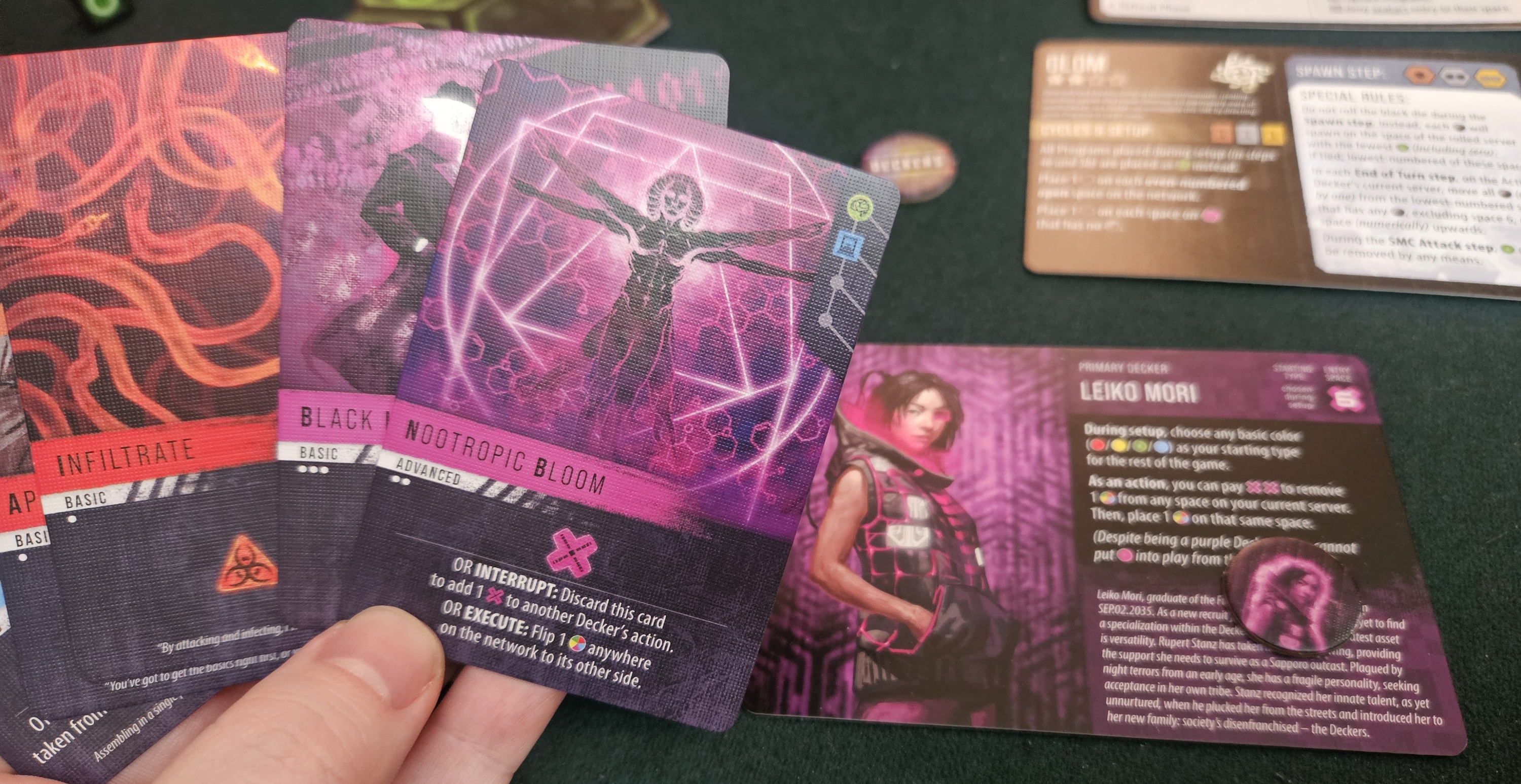
Bootin’ up my Win11 PC, callin’ it NOOTROPIC BLOOM.
Now, you might be thinking that I’m not putting Deckers on the strongest footing. You’d be right. But I want to emphasize this point. Deckers is not for the faint of heart. Despite resembling Pandemic in a few superficial ways, it’s crowded with icons and ideas and actions and colors and special powers and objectives that require a few re-reads before they make a lick of sense.
But it’s also modular. In the case of our misbegotten mirror map, we goggled at the objective’s preposterousness for a bit, then drew a much more reasonable replacement. There are loads of customization options. And as much as I’m can grow irritable at a game asking me to set its difficulty level rather than providing me with an intended experience, I can’t help but appreciate the way missions unspool on their own, coughing up new problems according to some imperceptible aleatory logic.
More than that, the game’s thicket of information is a not-insignificant part of its appeal. To play Deckers is to step into the boots of a troubleshooter. Where most cooperative and solitaire games present a puzzle, Deckers presents a problem. Often that problem is multilayered, difficult to discern, and seems impossible at first glance.
The other thing Deckers provides, though, is a toolkit. More than a toolkit. An entire tool shed, full of power appliances and extension cords and, oh, here’s a weed whacker and some fertilizer. Maybe a pool pump just in case.
At its most basic level, Deckers is a deck-building game, although like everything else this is an inadequate description. It’s not so much about deck-building as it is about deck-renovating. You have fifteen cards when the game opens. You’ll have fifteen when it ends. In the middle, you can purchase cards that swap into the place of previous cards. This keeps the game pacey, not to mention erases the usual bloat that accompanies deck-building.
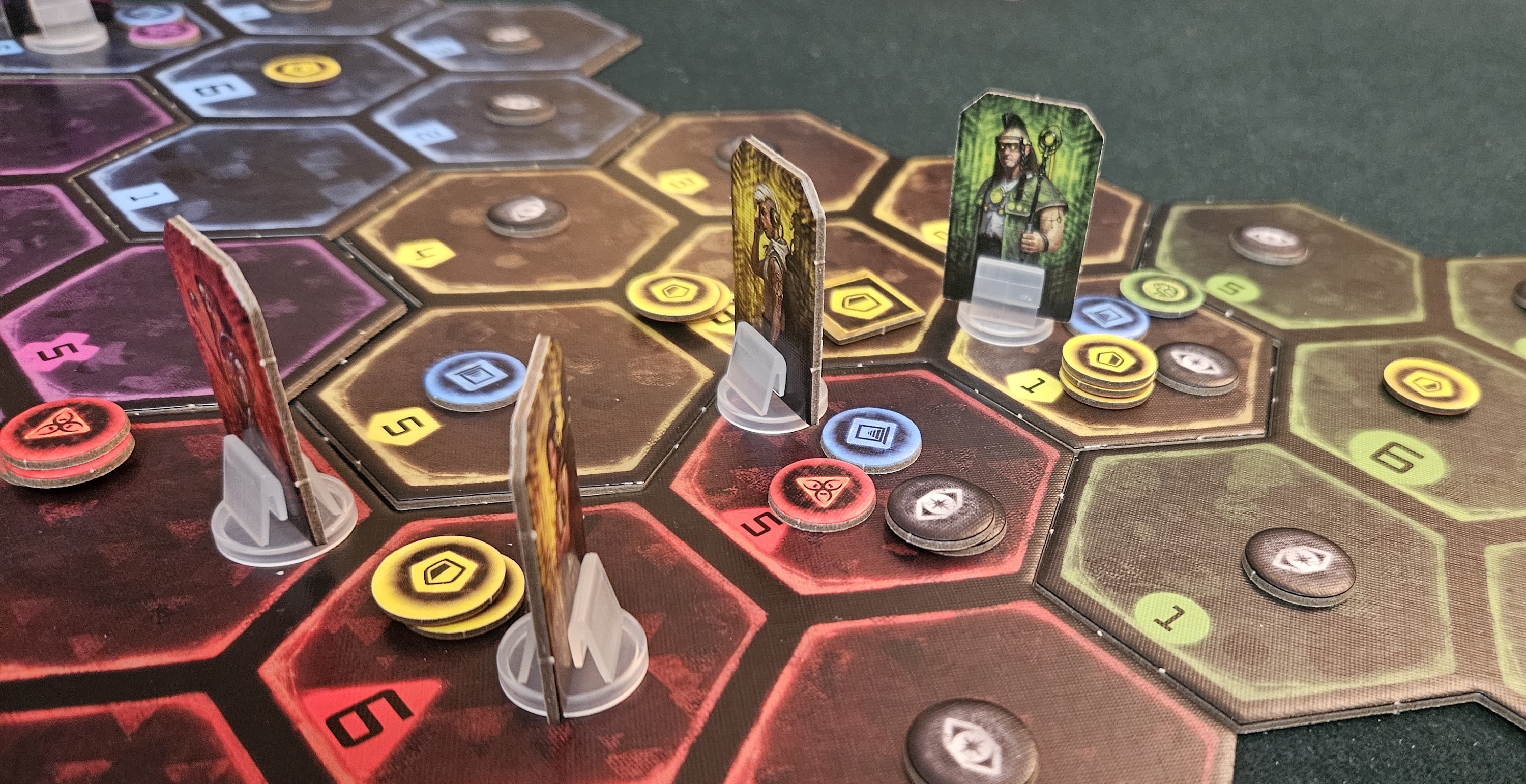
You do you, but my decker avatar wouldn’t be a middle-aged shlub.
What’s more, those cards put in the work. Before long, the network will be speckled with color. Programs, the little round tokens, each have their own functions, such as attacking enemy sparks (red and yellow), permitting easier movement through cyberspace (blue), or rearranging other bits of data (green). Programs eventually transform into installations, the larger boxy tokens, which are even better at attacking, permitting movement, or rearranging data. Sometimes they’re so much better that you can teleport around the network at will or project a ghost image of your character to another position entirely.
That network, meanwhile, becomes textured not because of any inherent topography, but thanks to the addition and movement of the game’s various threats and the consequences of your activities. Perhaps an information superhighway of blue and green tokens will take shape, allowing your deckers to race along it with impunity, shuttling programs where they need to go and dousing fires wherever they appear. Or maybe an incursion by the SMC will transform a corner of the network into a minefield of enemy sparks and guardians, necessitating a gradual campaign of reclamation lest they blossom, Pandemic-style, into an early loss.
The same goes for the game’s underlying problems and their various solutions. It’s rare that one of these problems will present a straight line from A to Z. Instead, the game meanders. In one mission, when a corporate decker appeared to ice our asses, we were prohibited from entering his space at all. How then, could we beat him? We eventually set up a green installation, ghosted into his space, pushed viruses into position from neighboring hexes, and then engaged in an epic roll-off. Everyone at the table was invested. Attention-wise, sure, but also because they had been churning their decks to find the cards that could massage the outcome of our climactic roll. The solution was messy, inelegant, and harried by ancillary problems. It took coordination, not to mention required everyone to work to mitigate the game’s chancier elements.
In the process, it became closer to real-world problems and their real-world solutions than most board games manage. We weren’t solving some graceful puzzle. We were patching over a memory leak and hoping it wouldn’t crash the whole network. Are those things? I have no idea. But that’s what Deckers feels like.
Hey. I never realized it until this moment, but “Deckers” is a pun. Decking-in. Deck-building. Heh.
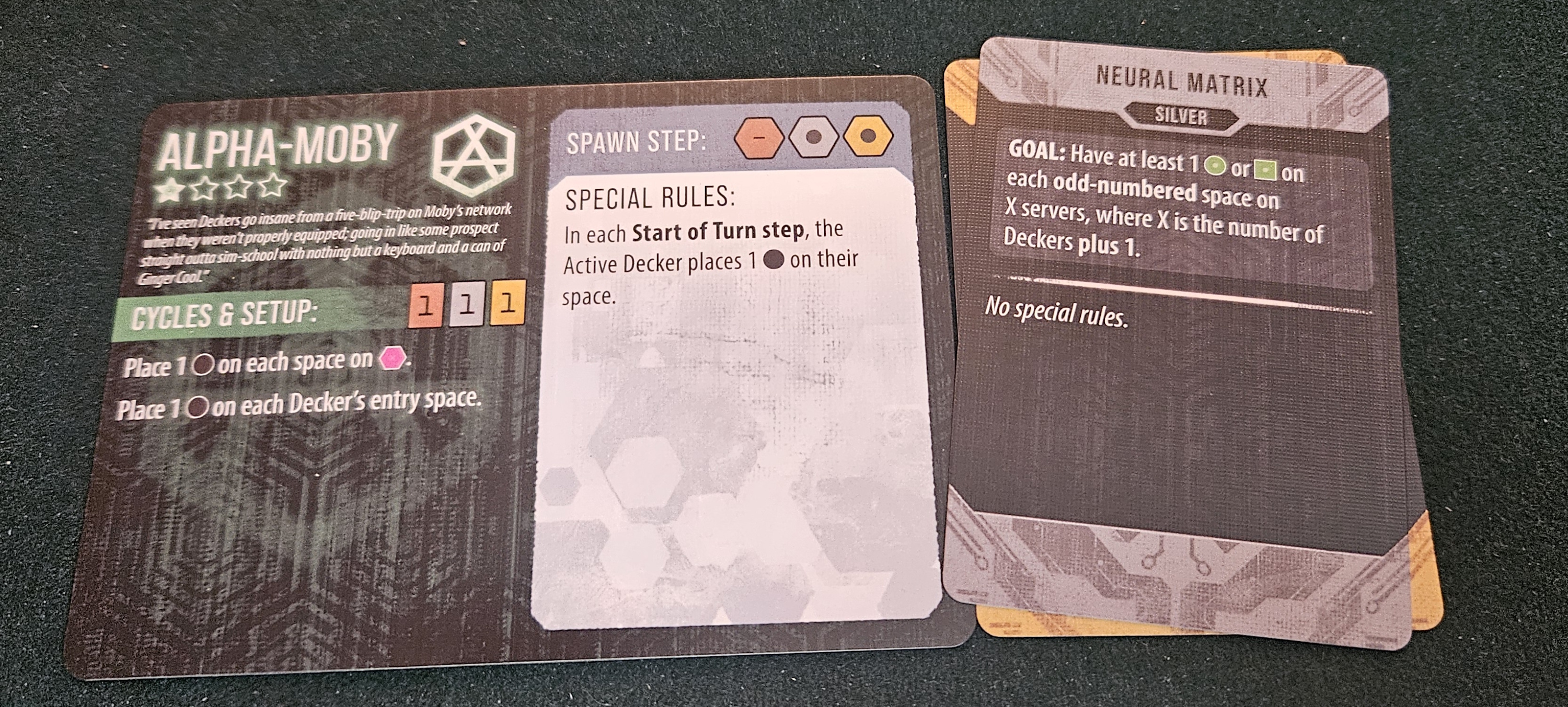
“I’ve seen deckers go insane from a five-blip-trip on Moby’s network…”
To be clear, Deckers never fully escapes its issues. Even at its best, it can grow fiddly with all those tokens, and there’s always the chance that a new objective will prove just an action or two shy of being solvable. Even the deck-building feels flashy but isn’t wholly interesting, more about fine-tuning cards into better versions of themselves than altering a deck into something new.
But maybe that’s how it ought to be. Even when it was called Renegade, Deckers was something of a throwback. I’m old enough to remember when the prevailing wisdom for cooperative games was that they should only be winnable one in three plays. Nowadays, most board games are tuned to provide a solid first session, because in all likelihood that’s all they’re ever going to get. The unfortunate trickle-down is that most cooperative games are easy, which is to say dull, which is to say they’re boring.
There are moments when Deckers is boring, but it’s a very different sort of boring. It’s not the boredom of tedium; it’s the boredom that arises when a problem is inscrutable and so our mammalian instincts tell us to hibernate rather than facing the issue with our whole chest. It’s like hearing that human civilization is killing the oceans or running out of freshwater. Why worry about that stuff? Easier to take a nap.
In a way, that’s what makes Deckers worthwhile. Because these folks could have taken a nap, too. Just look at them. Some of the game’s characters are classic cyberpunk. Leiko Mori is a chick in a leather vest illuminated by purple LEDs. Oshin Noro is more or less a samurai. Two of them are twins with USB-Zs plugged into their ears. But there’s an appropriate shlubbiness to the rest of the cast. Tilda Sweet cut my hair once. Monty Quantum is the guy who mains a druid. Hettie Magnetic is prediabetic. They’re a little more into body modification than the average Joe, but they’re surprisingly ordinary. It’s just that they’re willing to put their principles into practice when it comes to AI slop. Their solutions are messy workarounds. Sometimes they fall apart. And sometimes I cheat by drawing a different objective card because the last one read like a word problem. Hey, that’s why I play board games. Because they’re ours.
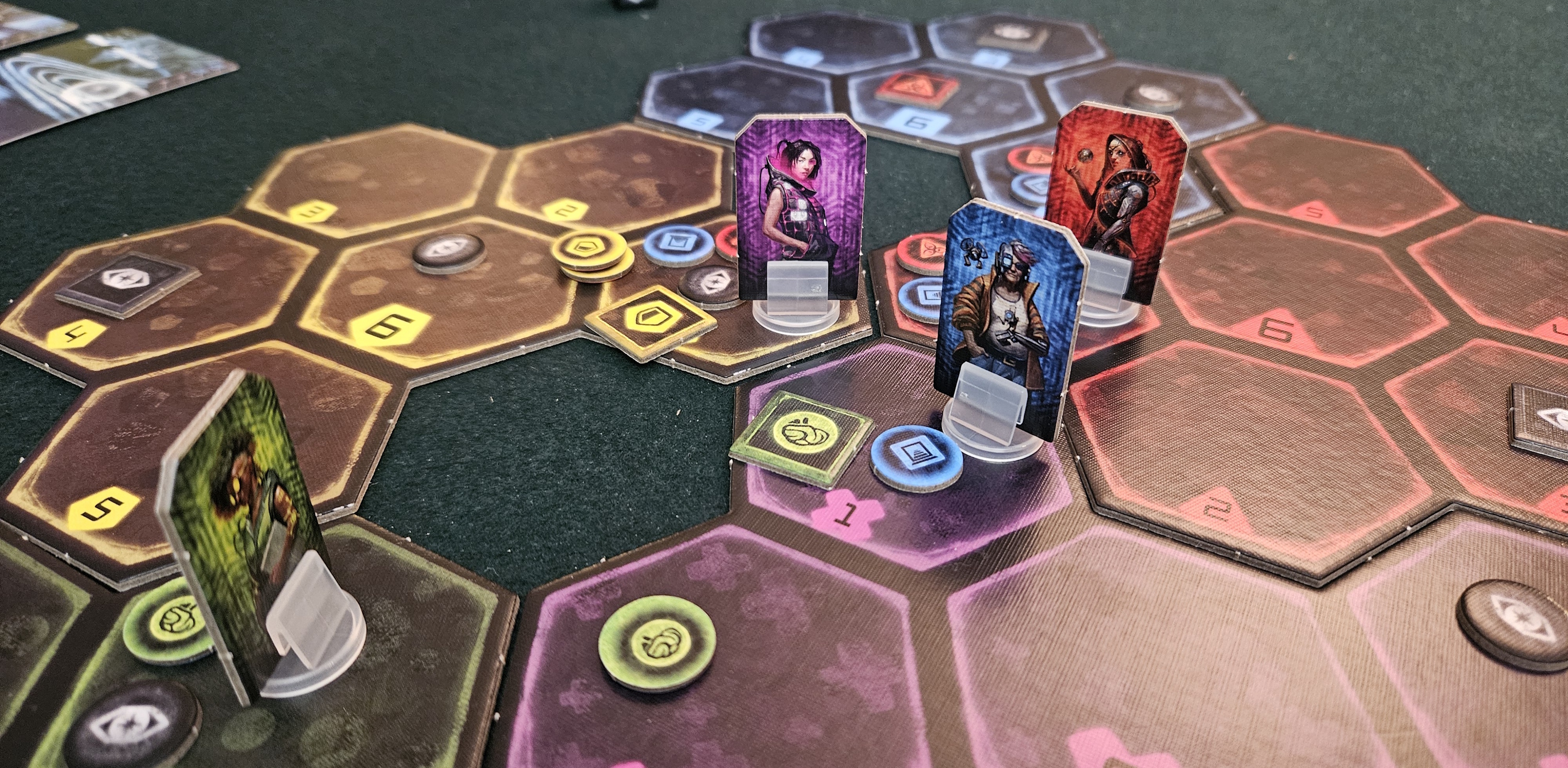
Check out these cool kids and their cool hobbies.
That’s all to say that Deckers is something special. Not only in spite of its problems, but because of them. In credit to them. This is a compact, dense game, produced and presented on a budget, and I like it all the better for that too. It’s a big rowdy mess that sometimes falls apart at the edges, and in fact is never better than when you’re asked to tug at its fraying strands. Down with the slop. Up with the folk who decided it was better to keep their avatar paunchy. Welcome to the revolution, pal.
A complimentary copy of Deckers was provided by the publisher.
(If what I’m doing at Space-Biff! is valuable to you in some way, please consider dropping by my Patreon campaign or Ko-fi. Right now, supporters can read about which films I watched in 2025, including some brief thoughts on each. That’s 44 movies! That’s a lot, unless you see, like, 45 or more movies in a year!)
Posted on February 3, 2026, in Board Game and tagged Alone Time, Board Games, Deckers, Deep Print Games, Pegasus Spiele. Bookmark the permalink. 13 Comments.

 SPACE-BIFF!
Thank you for this! I was a big fan of Renegade way back when, but was never going to get a new edition from the vulture publisher you mentioned. I’m super glad this found a better home and that it’s essentially the same game with a few positive tweaks.
And it’s surprisingly affordable! It would have been easy to “deluxify” Renegade with minis and whatnot. Instead, the package is wonderfully put together. Great storage, the standees look good, and all without breaking the bank.
Don’t be shy–name the company: Tycoon Games, a.k.a. Tabletop Tycoon, a.k.a. Game Salute. The owner keeps changing the name to hide his past sins committed during his company’s various incarnations, and sadly to a large degree it has worked. When you mention them nowadays people think of Everdell, but the knowledge of their mistreatment of fellow creators and customers in their Game Salute form will live on deep in the bowels of the internet.
To clarify for those unaware of the history, we’re talking about the previous company who owned the predecessor to Deckers, not the current publisher of Deckers.
It is a great puzzly game. Great review.
I’m wondering if you keep the objectives hidden until their round comes up? We play that we can plan ahead by looking at all of them and especially the final gold one.
The game is silent on the issue, but in a sidebar points out that looking ahead may ruin the surprise.
It’s on page 8, “you may look at the front of all objective cards in the objective deck.”
>>>Before the world’s billionaires started cramming robo-slop down our throats and calling it nourishment.
I read something about cheese a few days ago. All micro plastics, oils and crud. Its right put me off.
I’m really enjoying this game. It has a certain appeal that keeps pulling me back in. Especially after losing a mission, I just want to keep replaying it until I figure out how to win it. The game is essentially a puzzle with infinite variations and I love it for that.
Yeah! That’s what I like best about it. It’s incredibly tough, but lets you troubleshoot those problems in interesting ways.
Dang it. I should have used the word “troubleshoot” in my review.
You did, at least “Troubleshooter,” unless that was an edit made after the above comment.
Oh! That’s nice. Whew. Guess I have no idea what’s even in these things, haha.
Great review, you’ve convinced me to check it out. Did you only enjoy it solo or was it good as a multiplayer game too?
I like it both ways, yeah.