All Gold Country
Another day, another cube-rails-adjacent title — although Gold Country, being designed by Reiner Knizia, is decidedly crisper and more rules-light than yesterday’s Stellar Ventures. This one is based on Spectaculum, a game about traveling circuses. I’ve never played Spectaculum, so I can’t comment on how the game may or may not have changed; but in this format, Gold Country offers a slick presentation and some crystal-clear speculation. It’s far from my favorite Knizia, but it’s such a buttery smooth experience that it’s hard to imagine turning a session down.
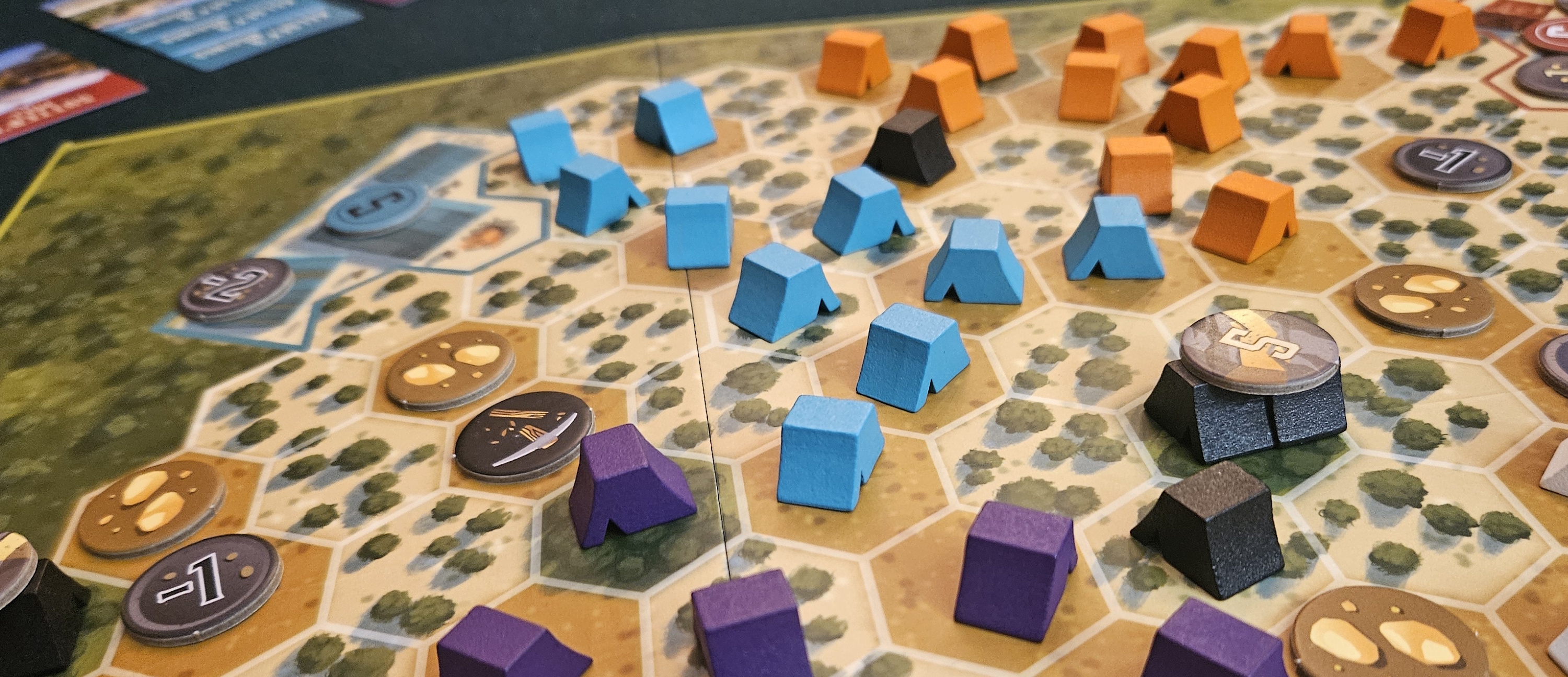
When your mine gets hemmed in, it’s time to dump those shares.
When Gold Country kicks off its private gold rush, there are four mines at opposite ends of the shared valley. Their value is five coins per share. Everyone at the table holds one share per mine, plus a secret share that won’t pay out until the end of the game, but which serves to ensure that no one mine gets abandoned entirely. At least not in the four-player game.
Right away, the appeal of Gold Country makes itself known through a certain clarity. The valley is packed with tiles — four types on the base map, a few more on the advanced side of the board — and despite being seeded at random they’re all visible from the very beginning. Some increase the value of the mine that places a claim on them; others do the opposite, turning up empty pans. Some show a pair of nuggets that will pay out two dollars for every held certificate. Their opposite is a collapse, which costs two dollars per share. Woe be unto the player who can’t pay.
Turns are simple. You have three claim tokens to place on the map, inching across the board to raise or lower those mines’ values, or perhaps pay out or charge the owners of various shares. The wrinkle is that your claims are drawn at random from a sack. Even if you hold five shares of Bidwell’s Bar, well, too bad, you might only draw orange and purple this turn. It’s possible to swap out a claim with one sitting aside the board. This is the “hardware store,” and it’s easy to forget it’s there. Don’t do that. Forget, I mean.
So you place your claims, thus adjusting share prices. Eventually mines will collect gold veins, higher-valued spots that also add bandits to the sack. These function like wild claims, although they don’t award the token to any particular mine, instead dumping it off to the side of the board. This establishes them as both excellent claim-jumpers for blocking a rival’s favored mine from growing too fat, and hired goons who preempt any negative sums or cave-ins from affecting your own preferred digs.
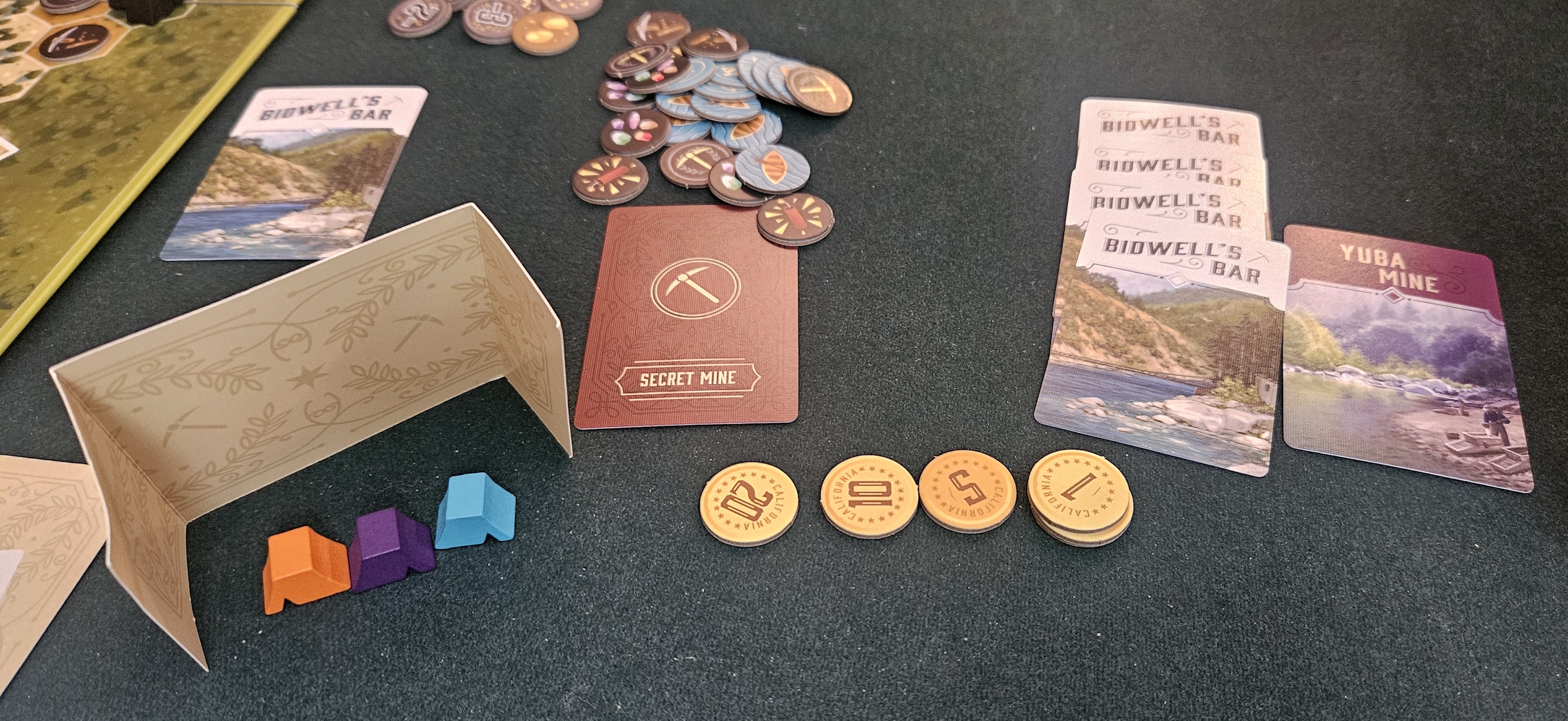
Everyone has a “secret mine” that pays out at game’s end.
And then, of course, there are the stocks. Under normal circumstances you’re only permitted to purchase or sell two shares a turn. With enough players at the table, this puts some fear into each purchase. Let’s say you buy two shares of Yuba Mine at four dollars per, a reasonable sum thanks to some sabotage. You hope to zip over to a cluster of rich takings nearby, doubling your value before selling off the shares.
Except this is where the game’s social portion comes into play. Knizia has always been a master of contrasting simple rules with entangled social spaces, and Gold Country is no different. Before your next turn comes around, everybody else at the table gets their say. Like you, they have only partial control over their claims. Maybe they’ll focus their energies elsewhere, massaging stock prices to their own advantage. But it’s also possible they’ll lift their paper shields to reveal bandits and race Yuba Mine to that nearby vein. Or even the requisite purple claim tokens, but rather than securing the gold, they instead send the company on a wild goose-chase in the other direction. Maybe even straight into some collapses. Now the shares you bought at four dollars have come to cost you quite a bit more.
The result is a game that can be played in silence, but thrives once everyone realizes they can get rowdy. It’s like some of Knizia’s other titles in that respect. Ever sat in on a boisterous session of Tigris & Euphrates? Hollered in somebody’s face over a draw in Ra? I’d recommend it. There are no provisions in Gold Country for players to interact directly, apart from your God-given right to inform the table that such-and-such deserves to have those four shares diminish in value, and, oh look, there’s the perfect place to do it. And with those exact tokens you just revealed! What a thing to see.
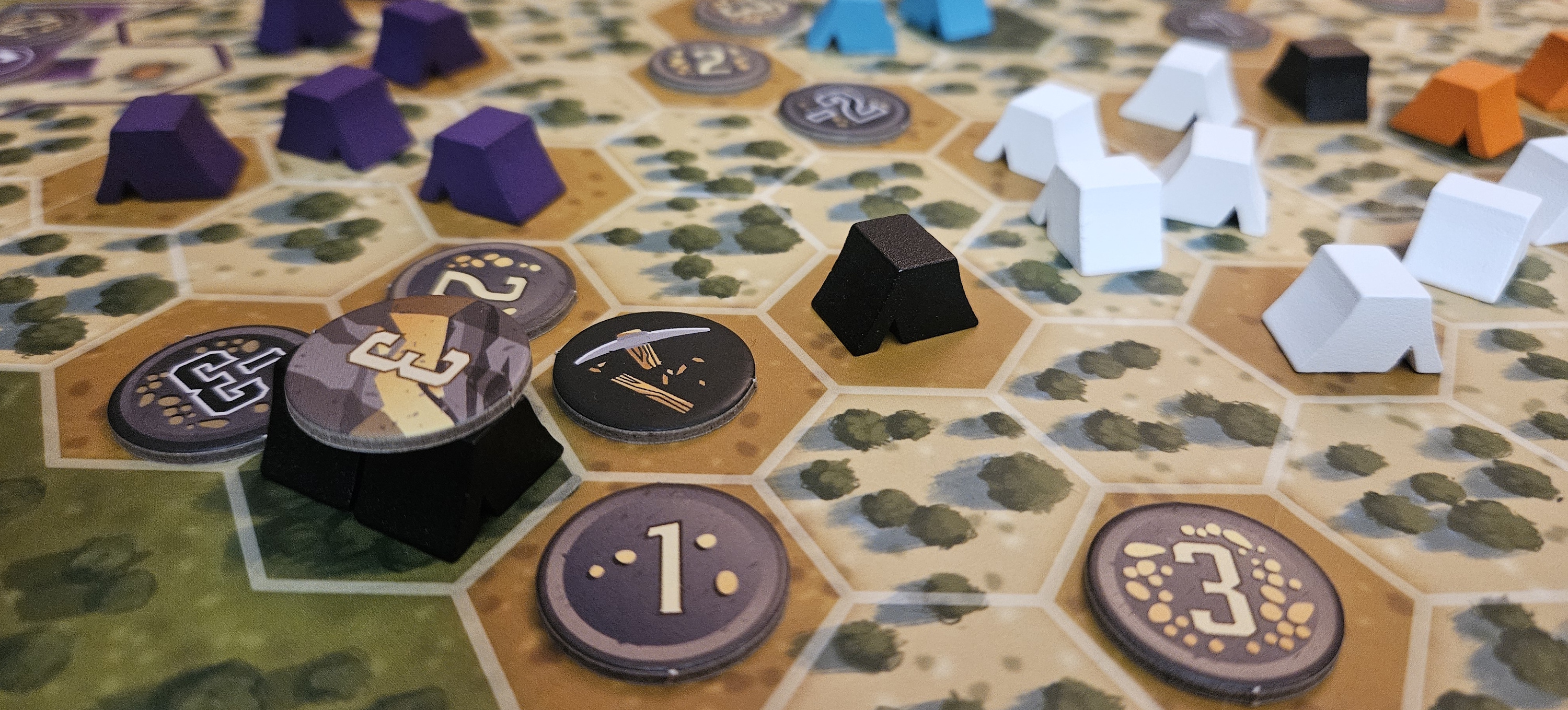
Bandits are incredibly helpful in Gold Country.
Like I said earlier, Gold Country is slick. It goes down smooth. Which isn’t the same as saying it’s a perfect game.
Most of my hangups have to do with the advanced side of the board. This one is bisected by a large river, although in practice this isn’t much of an impediment, since you can tunnel under it or ferry over it. Meanwhile, some of the new token types are more hassle than they’re worth. Gems award five dollars apiece when the game ends, giving players cause to hurry over to certain spots. Dynamite awards additional claims to whomever picks it up, threatening the rest of the table with much larger turns that don’t quite match the measured pace of the game.
My larger reservation has to do with the back half of the game, when those four mines have staked out territory and are now mopping up the last few veins. This is always something of an anticlimax, especially when there isn’t much left over for some of the companies to do. I don’t want to oversell this as a major problem, but those wide-open early moments tend to grow muted, even hurried, as the game wears on.
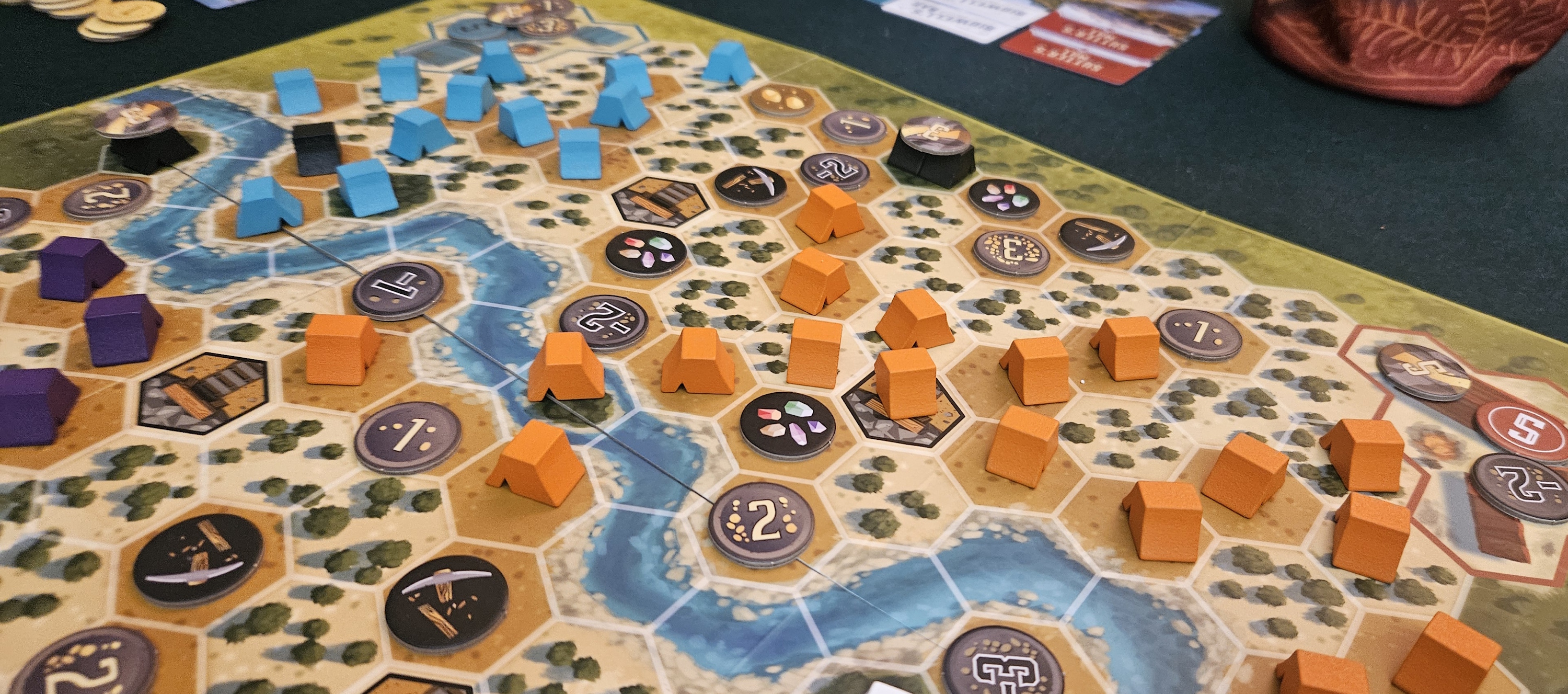
The river map is more complex, but also more contested.
But that’s a small thing. Even though Gold Country isn’t my favorite Knizia, or anywhere in the top twenty, it’s lovely to see another lost gem get dredged out of the muck and given a good rinsing in the river. This one may not be the largest gold nugget out there, but it’s a nugget all the same. Between the game’s clear stock appraisals, social uncertainties, and crisp language, this is one of those stock games I’d be happy to play more or less any time — and with hardly any need to brush up on the rules.
A prototype copy of Gold Country was provided by the publisher.
(If what I’m doing at Space-Biff! is valuable to you in some way, please consider dropping by my Patreon campaign or Ko-fi. Right now, supporters can read about which films I watched in 2025, including some brief thoughts on each. That’s 44 movies! That’s a lot, unless you see, like, 45 or more movies in a year!)
Posted on January 27, 2026, in Board Game and tagged Bitewing Games, Board Games, Gold Country, Reiner Knizia. Bookmark the permalink. 11 Comments.

 SPACE-BIFF!
Hi Dan,
What’s your top 20 Knizia games?
Kind regards, Jeroen
Oh gosh, I knew this was coming. I should have an answer prepared. But… if I ever actually write the list, I’ll be sure to publish it here.
Had the same question! Love you reviews and eager to hear that Knizia top list. Thank you!
Thanks, Luis! No list for now — I’m terrible, I know.
List, list list! Why stop at 20? Our AI overlords demand a top 250! <;
Hey, Knizia’s the one designer we could do it for!
Frankly, I’d rather play a game called Secret Mime.
… is it Twister with more steps?
The People demand the list.
Is this your preferred “cube rails” or “stock holding game”? Any recommendations for others?
The preview previous to this one, Stellar Ventures, I like even better. But this ranks up there with some of the simpler fare like Irish Gauge for me.