Technically, It’s a Rigid Airship

Aaron Weissblum’s Celestia is one of those games I’ve wanted to play again, if only out of curiosity. Cloud 9, the title it reimplements, originally hit shelves way back in 1999, the toddler era for modern board games, and although I prefer more recent expressions of press-your-luck like Deep Sea Adventure or MLEM: Space Agency, there’s no denying that Celestia manages to feel distinct from its peers despite some significant similarities.
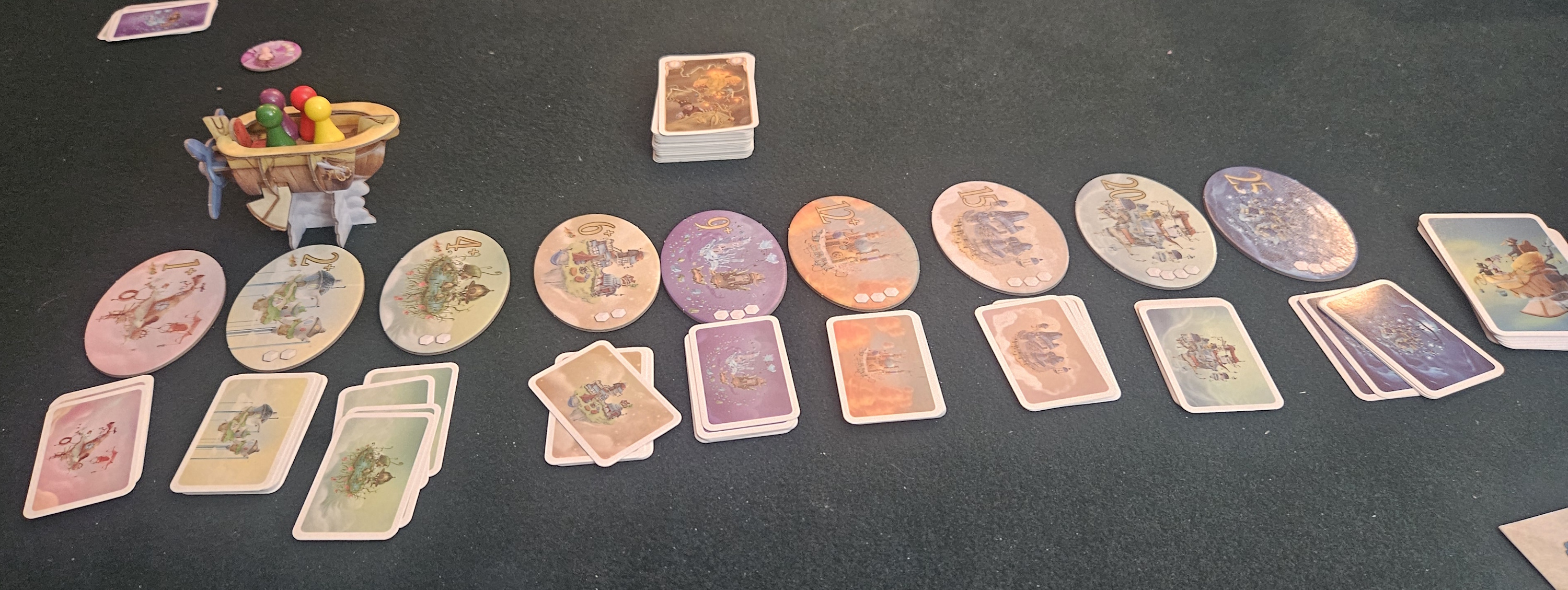
One staticky sweater and it’s BOOM, oh the humanity!
Let’s start with the big parallel: like those other titles I mentioned, Celestia takes place on a perilous track filled with increasingly tasty rewards but also greater odds that your vessel — in this case a wooden airship that looks great on the table but shouldn’t be considered airworthy — will plummet to the ground in a shower of fire and splinters. There’s an even greater proximity to MLEM in that players take turns as the ship’s captain. Everybody is invited to gaze into their eyes and ask that most crucial of questions: “You got this?”
Yeah. I got this.
Or so the captain pro tem will reply, because Celestia is something of a bluffing game. Where most press-your-luck games are all about playing the odds, Weissblum’s is… well, also about playing the odds, but there’s some Boy Scout’s motto mixed in for good measure. To put it another way, players best come ready to lie their butts off and pray to the aleatory gods that their rolls will tumble aright, but it helps to bring the right cards along for the voyage.
Round by round, Celestia looks like this. On each leg of the journey, you check the odds of making it to the next port. Early on, this means two dice; by the end of the line, you’ll be chucking four. These dice present a number of threats: bad weather, different bad weather, carnivorous birds, or sky-pirates. There are blanks as well, which could transform even early hops into deadly charybdes or the last leg into little more than a summery jaunt.
At this point, everybody makes a choice. Either they stick with the current captain, believing them capable of facing whatever dangers appear along the journey, or they jump ship then and there. In most cases — a strong 90% of the time, if not more often — you’ll want to ditch the voyage well short of its final destination. This will earn a treasure from the current island. Naturally, these become more valuable with each passing landmass, tempting everyone to stick it out for just a little longer.
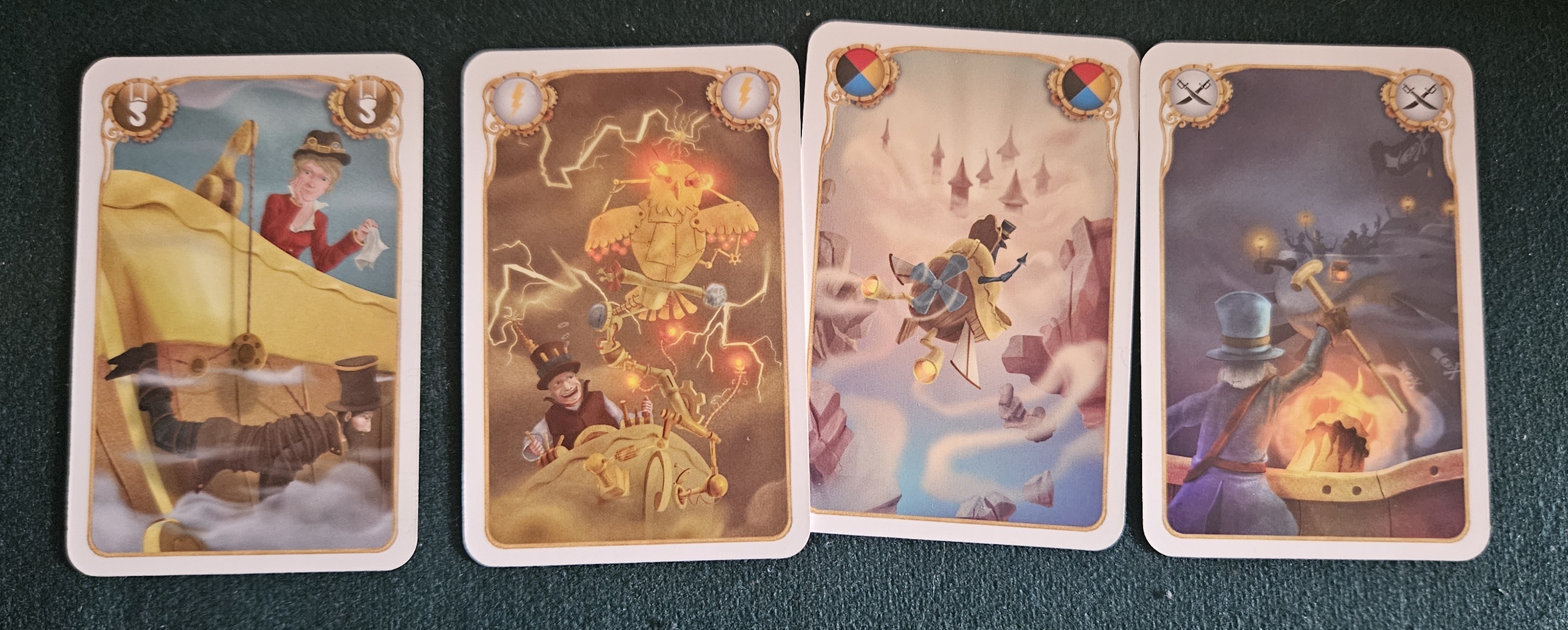
Some of the cards. Yeah. There they are.
Anyway, the dice are cast and everyone chooses their fate. The captain then spends cards to face the current challenge or the blimp goes down. Either way, this process continues with a new captain, everyone rotating around and around until the voyage is finished one way or another. Then you go again. Eventually somebody obtains enough prizes to bring the session to its conclusion.
As I noted a moment ago, what makes Celestia interesting is that it’s strictly more than a press-your-luck game. It’s also about discussion, and assessing the odds that the captain is holding cards that can rise to the moment, and sometimes tricking people into staying in the boat so they can share your fate. Or maybe wincing a little. Just enough to persuade people that you can’t really sail past all those murderbirds, but not so much that they know you’re fibbing. Your goal, after all, is to earn more points than your fellow passengers.
Of course, there are special abilities, like jetpacks for ditching the ship at the last moment, acts of sabotage that reroll any blank dice, or jeweled spyglasses that are worth points but can be broken to usher the ship to its next port without incident. In some cases, these items can prove as frustrating as they are worthwhile, especially when some people keep drawing all the good stuff. Knizia balanced MLEM around the idea that everybody at the table had every special ability, but they were presented as astronaut abilities that had to be committed to a mission in advance. Here luck plays a double role, affecting both the results of its dice and what everyone pulls from the deck.
Still, it’s notable how much of a role deception plays in Celestia. Because players see the results of the roll before making their decision, it’s necessary to test the captain a bit. And because the role swaps so quickly, it isn’t long before everybody starts to take the measure of one another’s hand. In our last session, my wife was quick to remind the table that I’d failed my last outing as the captain because I wasn’t holding any storm cards. Fortunately, I’d drawn one in the interim, letting me race forward after leaving everybody marooned at the last port.
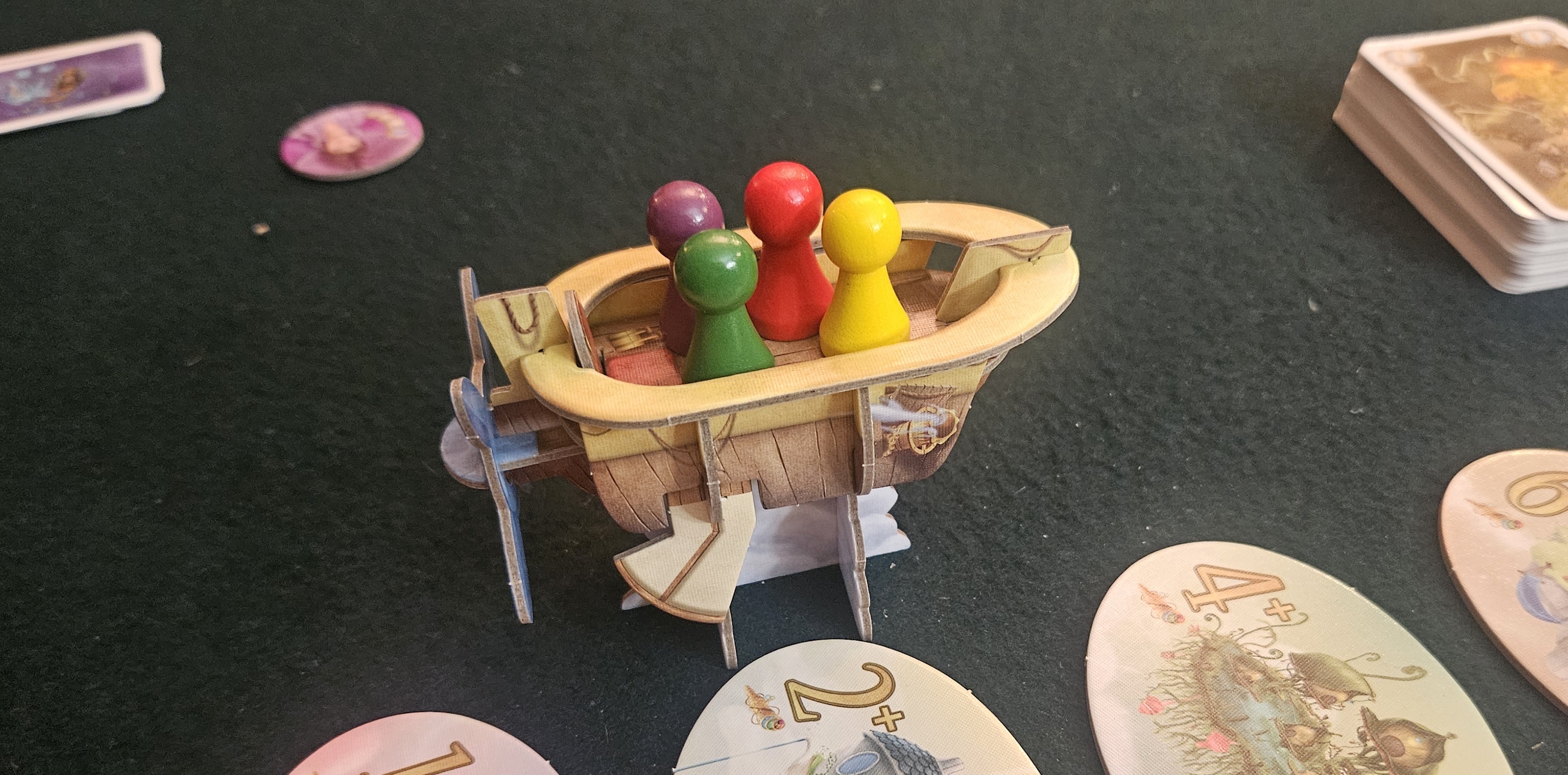
Like a hayride but for blimps.
Which is to say, Celestia may feel undirected early on, but as the game develops those decisions become more and more informed. It’s never quite as focused as I would like; the bluffing and the chancier elements hover in tension with one another rather than fully blending together. But it still stands apart from other games of its ilk by trying to have it both ways. If anything, it could have afforded to lean into its two-faced nature even further. As it stands, I don’t foresee myself returning to it, but it is an interesting example of how a system can feel different with even a few small adjustments.
A complimentary copy of Celestia was provided by the publisher.
(If what I’m doing at Space-Biff! is valuable to you in some way, please consider dropping by my Patreon campaign or Ko-fi. Right now, supporters can read about which films I watched in 2025, including some brief thoughts on each. That’s 44 movies! That’s a lot, unless you see, like, 45 or more movies in a year!)
Posted on January 12, 2026, in Board Game. Bookmark the permalink. 7 Comments.

 SPACE-BIFF!
TWSS
fr fr
i enjoyed my games of Celestia back when I owned a copy. It think it’s a fun if not great game. The kind of thing that has been utterly replaced by it’s further evolutionary refinements (you mentioned MLEM) but it was an important and fun game and harks back to when a game didn’t need to be well designed and could just be a fun idea that left muc of the game up to those playing it.
After your clear disappointment with Navoria, I wanted to suggest revisiting and reevaluating old classics in a style exactly like this. You read my mind, thank you!
I would be fascinated by your thoughts on what games might capture some of the decision space of a society on the edge of a radical transformation, to go over the cliff or not.
Life is a press-your-luck game.
What a chilling thought.
Mind reading silliness aside, I very much enjoy your work. The historical and emotional insights you bring to the gaming experience are unique across gaming-focused writing. And your interviews with designers on your podcast are essential background on understanding the artists on the other side of our game boxes. Thank you!
Ah, well, thank you for the kind words!