No More Mr. Mice Guy
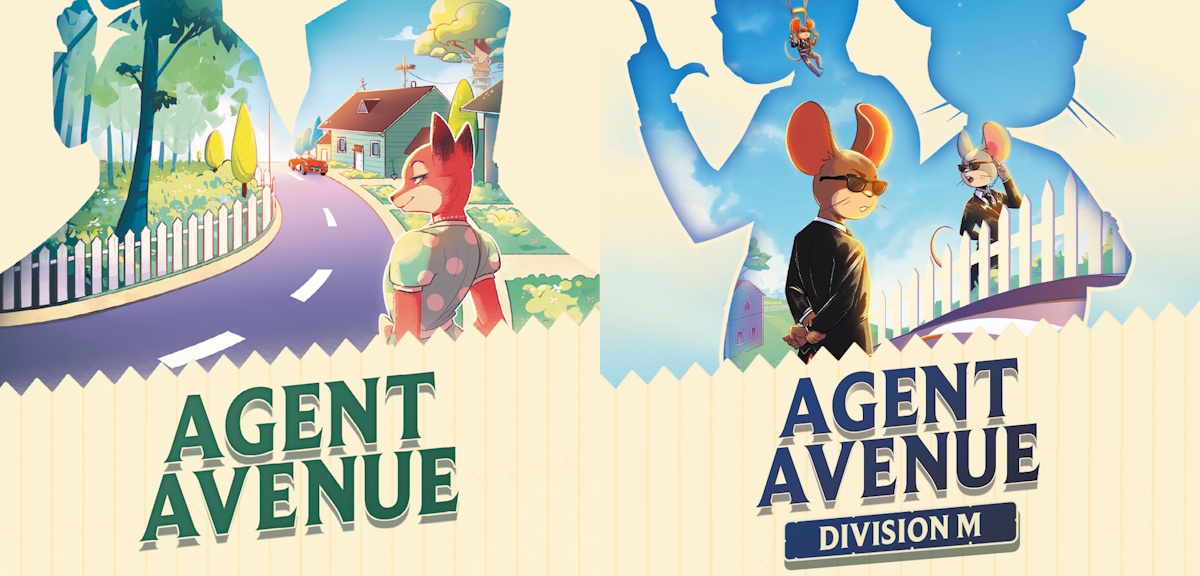
Sometimes one card makes all the difference. When I played Agent Avenue last year, I found it sharp but perhaps a millimeter thinner than I would like, resulting in an affinity for the four-player mode over the usual two-player duel. Now that I’ve added Division M to the mix, I can safely say the expansion functions like a shim under a chair’s mismatched leg.

There they are. The MIBs. (Mice in Black.)
I say “one card,” but rest assured that Division M includes more than a single card. This is no depot expansion to The Lucky Seven. Which isn’t to say it’s exactly sprawling. There are six copies of the new card, plus fifteen black market cards for the advanced mode. Still a slender expansion, then, but it’s not like it ships in one of those singlet baseball card sleeves.
As before, players take on the role of rival secret agents who have moved into the same suburban community and are now enlisting their neighbors in a race to corner their opponent, a conceit that speaks to high drama without requiring more than a sentence of introduction and a few furry illustrations. The stakes are immediately clear: the board is a clockwise circuit, and whichever agent catches up to their rival delivers a presumable double-tap that concludes the session.
Similarly, the poison-pill gameplay returns wholly intact. Turns are simple: one side presents two cards, one visible and the other face-down, then their opponent picks which card both sides will receive. It isn’t quite as involved as the antics of my preferred divide-and-choose title Pacts, but that’s also the point. With only a handful of options in circulation, the possibility space is constrained, which only makes the decision space all the more deadly.
But where the base game’s cards fell into two broad categories — those that moved pawns and those that could, once enough copies were gathered, win or lose the game outright — Division M’s addition makes everything else more fraught. It’s an assassin. A mouse assassin. When first played, this adds an extra pawn to the board. As further copies are acquired, that assassin shifts its position like a shadow version of your main agent. If ever your rival shares a space with the great mouse assassin, it’s lights out for them. And vice versa, of course. Because there are six copies of Division M in the deck, it’s entirely possible for both sides to chase their rival while also dodging pint-sized bullets.
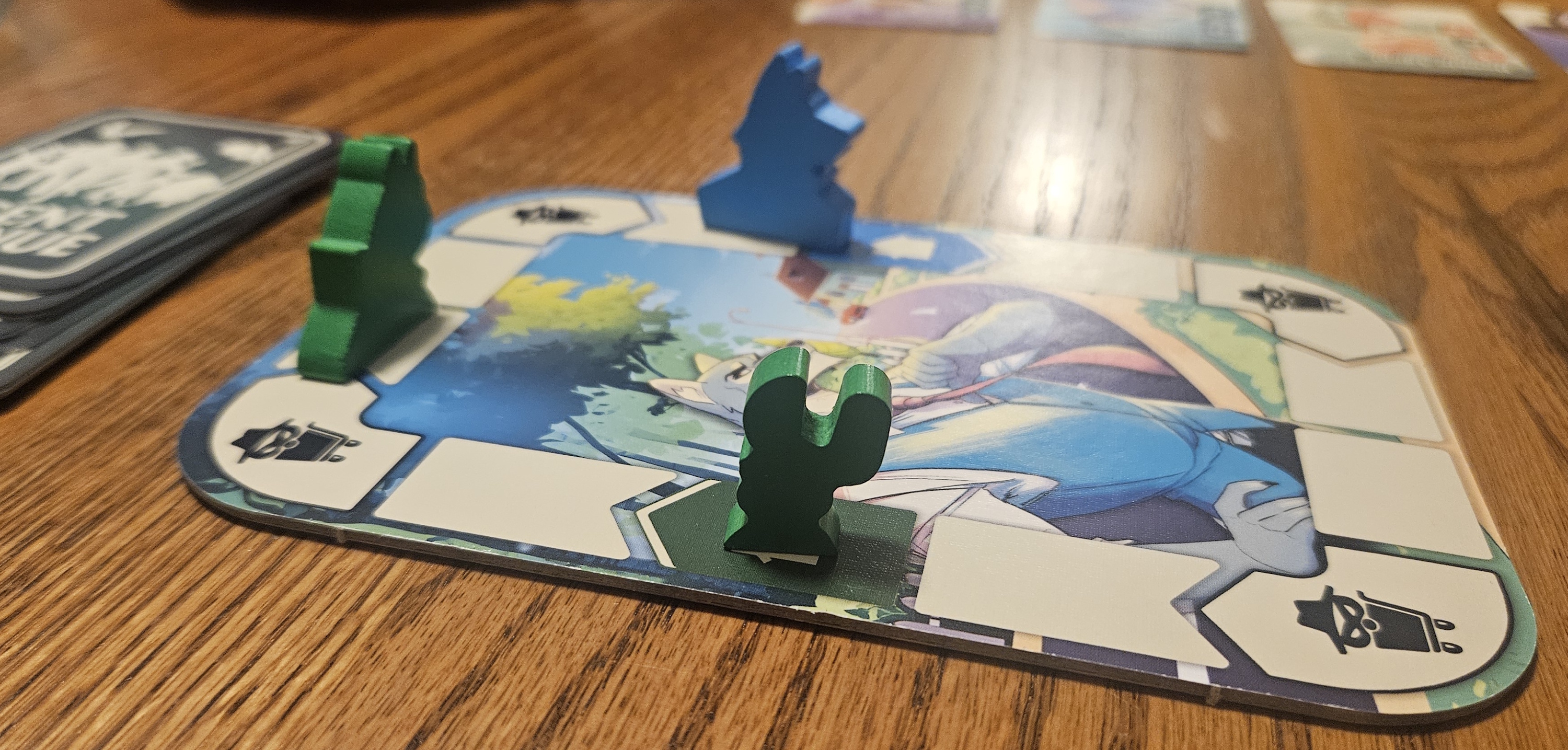
Mouse assassins add some extra danger to the roundabout.
What this adds to Agent Avenue is an essential landmine. It has always been possible to “checkmate” one’s opponent, offering a pair of cards that will both cause them to lose, or, barring that, to weaken their position. With Division M in the mix, that’s a little more likely, but in both directions. It isn’t uncommon, for instance, to see a Division M card put up for offer right as you approach your rival’s side of the board. By claiming the concealed card, you might move right into the freshly-spawned rodent killer. Or is that what your opponent wants you to think? And so forth.
This makes matches punchier, which is exactly what I wanted. Despite my affection for the base game, I’ve suffered through the occasional match that ran a little too long for its own good, both agents circling again and again until one of them lost out of exhaustion more than maneuvering. Those days are over.
It helps, too, that the new black market cards are stellar. Nothing has changed in the advanced mode, rules-wise. Landing on a corner space still lets you select one of three offerings, and those cards are still nasty little things. It’s just that they’re a little more barbed than before. There’s the Turncoat, which lets you recruit a card from your opponent’s hand at random. Will you get something they’ve been hoarding for the right moment? Or maybe an ill-timed saboteur? Some of the new options even manipulate your new pawn, like Call Backup, which lets you move your mouse up to three spaces. That one’s counterpart is Secret Passage, which gives you a one-time dodge when your diminutive killer would put you on ice. Those fifteen extra cards double the size of the black market deck, ensuring that each session now has its own set of considerations.

Just that one extra card adds a lot to consider.
Still, the real draw is the Division M card. The short version — short, geddit? — is that I already liked Agent Avenue, but Division M shapes it into an all-timer. It’s a perfect game for filling ten minutes, which includes when the kiddos want to play something quick before bed or we’d like to cap off an evening with something that’s still pleasantly thinky. I can’t foresee a time when I won’t want it on my forever shelf.
A complimentary copy of Agent Avenue: Division M was provided by the publisher.
(If what I’m doing at Space-Biff! is valuable to you in some way, please consider dropping by my Patreon campaign or Ko-fi.)
Posted on January 8, 2026, in Board Game. Bookmark the permalink. 3 Comments.

 SPACE-BIFF!
As someone who had a very similar feeling about the base game this is now a must have for me.
I hope it works for you!
I adore this small bluffing game and look forward to adding the expansion to the mix. (Your furry reference made me laugh.)