Lovers’ Quarrels
Who was it that said that every tale is a tragedy, it’s only a question of when the story ends. I bet that person was a real hoot at noon tea. Personally, I think every story is a comedy, provided the punchline is a trillion years of black holes and fading background radiation. (I, too, am fun at teatime.)
It’s been three years since we took at look at Persuasion, the relationship game by Xoe Allred. In the time since, Allred has given us Velocirapture and Vibes, imperfect little games that peel into our assumptions about victory conditions. Now it has two new games out: the Hollandspiele version of Persuasion and the self-published Conviction. Put together, we’re offered a two-act tale about the beginning and (potential) end of a relationship. I couldn’t speak to their suitability over tea, but together they offer contrasting — and sometimes all too familiar — perspectives on what it’s like to chase one’s Happily Ever After.

Seeking love, but only showing the occasional glimpse of ankle.
Act One: Persuasion
It’s a wonder Persuasion took this long to publish. As it was when I reviewed it the first time, this is a biting but energizing social game, closer in form and feel to Jenna Felli’s Bemused than anything with actual deduction in it. Which is to say, deduction plays a part, but only rarely does it tell the complete story.
That story, should you be wondering, begins as a theoretical framework. A fantasy, even. Everyone at the table receives two possessions. The first is a page torn from your personal diary that lays out your ideal match. “In my heart, I am an Outlaw,” one reads, before revealing that your ideal suitor will have great wealth but a somewhat wobbly standing in polite society. Those icons — wealth, standing, romance — are printed on the trait cards that become your second possession, laid in a row before you, all concealed but for one face-up offering. The sole piece of yourself revealed to the world.
Again, this is only the beginning of your tale. Your goal is to find a match who meets your hidden expectations. Or, barring that, to achieve your independence by filling the discard pile with the same icons you once preferred in a mate. Not unlike a romcom, a third-act realization is baked in, the possibility of abandoning your childish fantasies to embrace a truer version of yourself. Unlike those same romcoms, Persuasion puts its toxicity front and center. Your objective isn’t to find a match. At least that isn’t the only way to go about a courtship. It’s to shape one. You’re here to mold people like putty until the object of your affections resembles one of those body pillows with the fold-over cuddle arm.
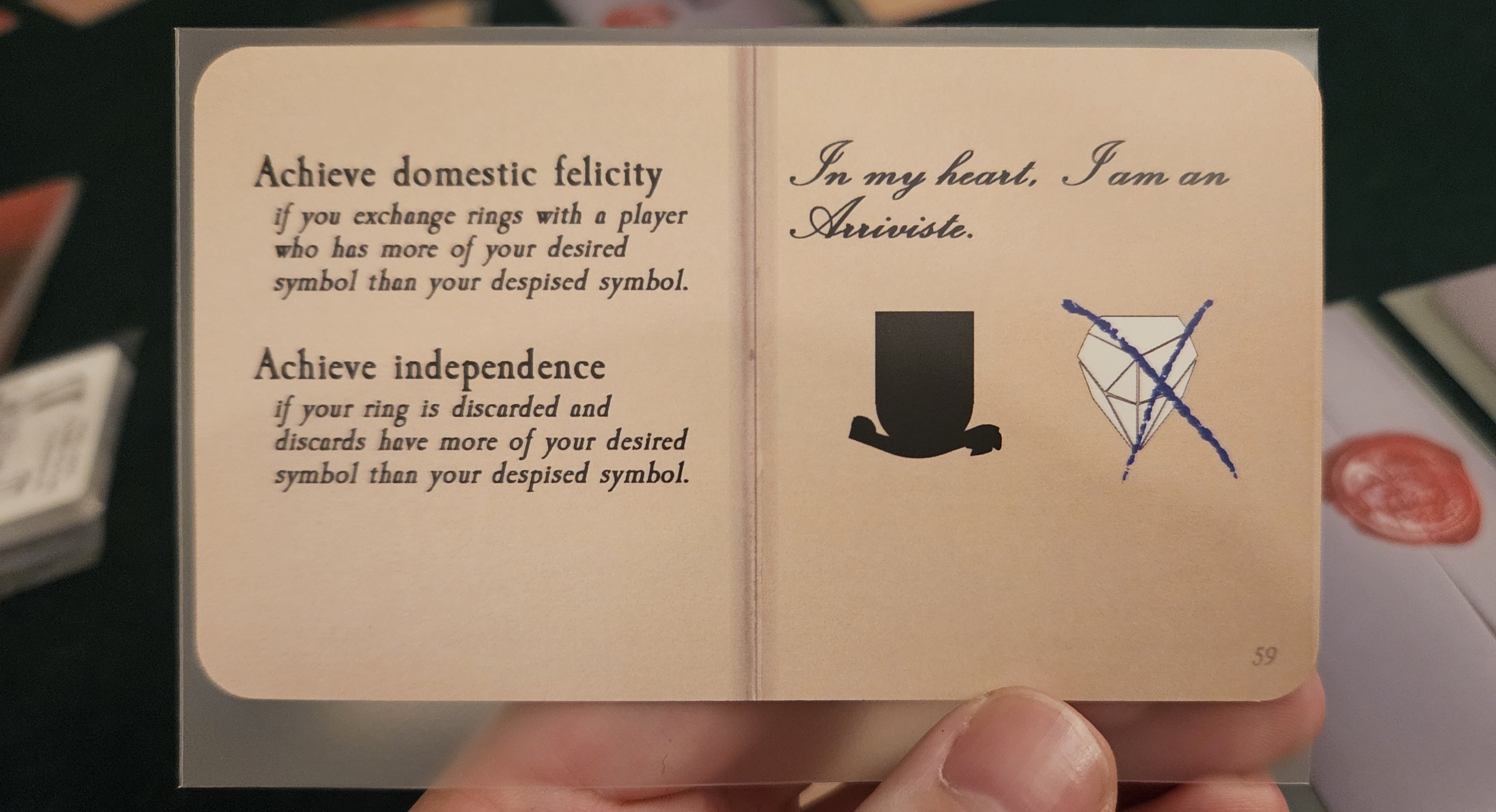
Always keep your standards in mind!
In Regency fashion, these manipulations are presented as an epistolary. Every round revolves around a single flurry of letter-writing. You take one of your concealed trait cards and send it to somebody else. Then each recipient performs an action. These are limited to the sender’s cards — you never use your own traits, a detail that bears emphasizing during the teach — to rearrange the personality traits on the table, prune unsatisfying attributes from your peers, maybe shoehorn a new hobby into somebody’s life because otherwise they’re a crushing bore, and otherwise play the part of a messy bitch who will stop at nothing to drag everybody into their drama and get what they want. You are, in other words, every nineteen-year-old to ever hit the dating scene. Especially the people who are right this very minute winding themselves up to drop a “Not me!” comment down below. Yes. You. Ya messy bitch.
Before we continue, let’s take a breather to discuss the production. Where Allred’s self-published version featured little stamps that were slipped into the card sleeves, Hollandspiele’s edition sees players marking cards with dry-erase pens. This is smoother and less fiddly than the stamps, although the ink can smudge off onto felt tabletops and the sleeves aren’t provided. That will frustrate some folks. What will frustrate even more folks is that the cards are a tarot cut that struggle to find a proper fit. Or maybe my local store just didn’t have the right size. Personally, this didn’t bother me, although we should acknowledge that I didn’t actually buy the thing, and don’t care much about production in the first place. But there you go. Make of that what you will.
As a game, Persuasion touches on a whole range of topics. The appreciable toxicity of bygone romance novels, which can be a joy to experience through reading or play, but is probably best avoided here in reality. The expectations that must be navigated whenever two parties begin a courtship. The restrictive dances and customs built up around those courtships, which themselves feed back into our expectations and our incapability to live up to them. The perils that arise whenever we seek to know somebody, and by extension the perils of opening ourselves up to be known by others.
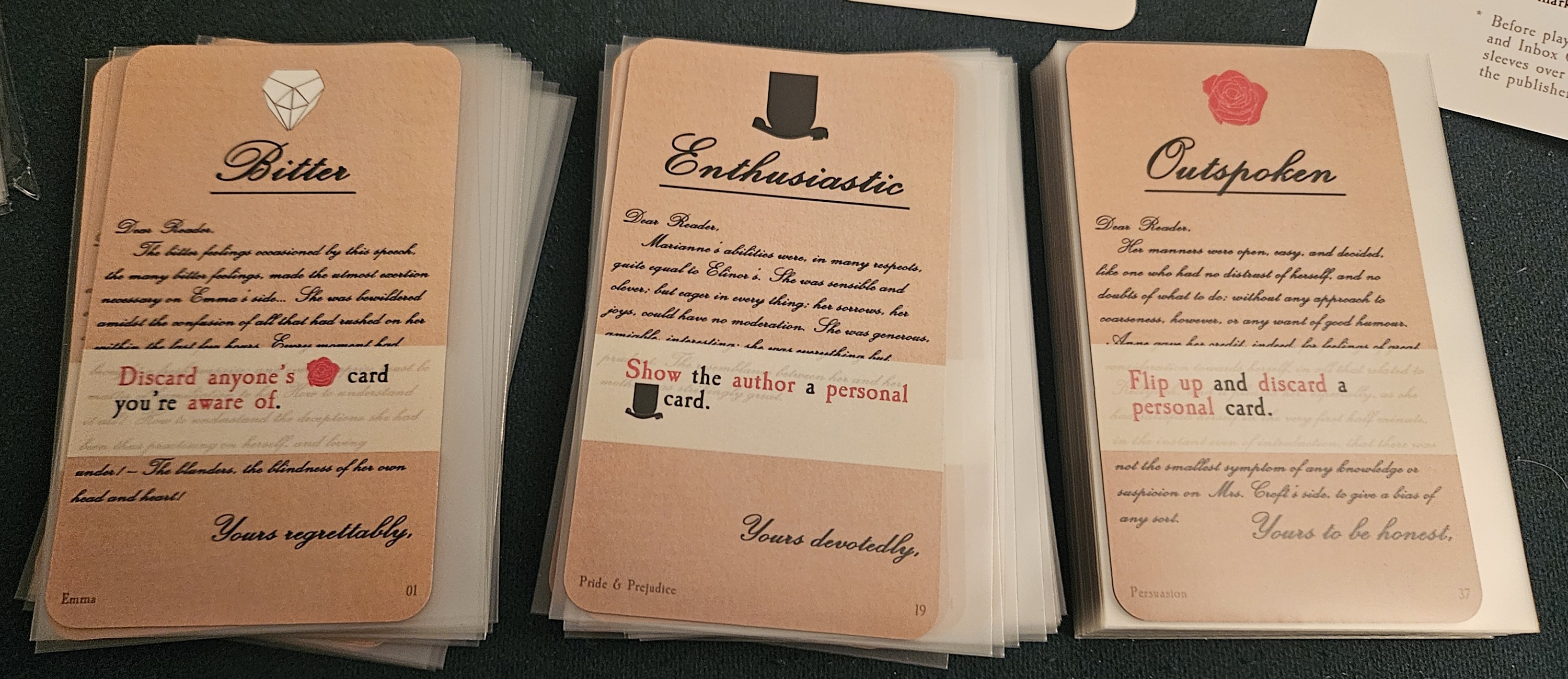
The cards are lovely, but I haven’t yet found the right sleeves.
It’s a messy game, in other words, and I mean that entirely as a compliment. Persuasion can end with everybody successful. Some may find domestic felicity, their partners discovered (or crafted) in precisely the right image. Others might find themselves happily single, striding boldly out into a world that once seemed to hold no appeal.
But that’s the ideal outcome. More often, only some people win. Some marriages become lopsided relationships where all of one party’s needs are met while their partner withers in silence. Others are loveless and cold for everyone involved. Some people, meanwhile, maybe those who would have made the warmest partners, find themselves alone. Even in “winning,” there might be a note of sourness. Did you really want your partner to strip-mine you for constituent parts? Maybe. We can’t help but transform each other. But some people don’t know when to stop rooting around under the hood.
The result is perhaps one of the most incisive games about relationships and dating ever created. I would call it optimistic, although in the realist sense rather than the starry-eyed one, and maybe that speaks more about my sensibilities than the game’s. For a while, when Wehrlegig was considering it for publication, I felt it would make a tremendous companion piece to Molly House. The cis to that game’s trans, so to speak, although Persuasion isn’t gender-bound. Here are the perils of love, and the expectations around love, and the customs around love, and how they clash with our needs and wants. Happily Ever After, hopefully, maybe, ideally, but not always.
Smash Cut: SEVEN YEARS LATER.
Act Two: Conviction
To my mind, Conviction begins after a short fade to black. Or maybe a smash cut. The happy couple from Persuasion, the pair that met all of one another’s needs, has suddenly awakened to realize that their tale just kept going. And going. And going. And now the bills are due, the baby is going through a sleep regression, and you know what, maybe I didn’t want to give up horseback riding so that we could embrace your outlaw lifestyle, Eliza. God. It’s all affectation anyways. The swords. The highway robbery. The leather vests. Ugh, the vests! Have you ever seen yourself in a vest? You look like a half-shorn ewe.
Ahem.
Presented as an argument between lovers, Conviction puts Allred back into the mode of questioning what exactly “victory” is supposed to mean. Even though it functions as a spiritual sequel to Persuasion, that edges it a few steps closer to Velocirapture and Vibes, although it’s more structured than either of those titles. The game opens with some light roleplay as the players agree on an argument. One, the Idealist proposes a change that strikes them as necessary. Time to have a baby. Let’s move off your mother’s estate. Have you heard the word throuple, my darling? Then the other player, the Stalwart, offers their argument for why things ought to remain as they are. Babies are loud and smelly. My mother is aging and needs my assistance, plus there’s that whole awkward codependency thing we have going. And as for a throuple — my sweet-bun, all my sexual urges are sated every time I visit London.
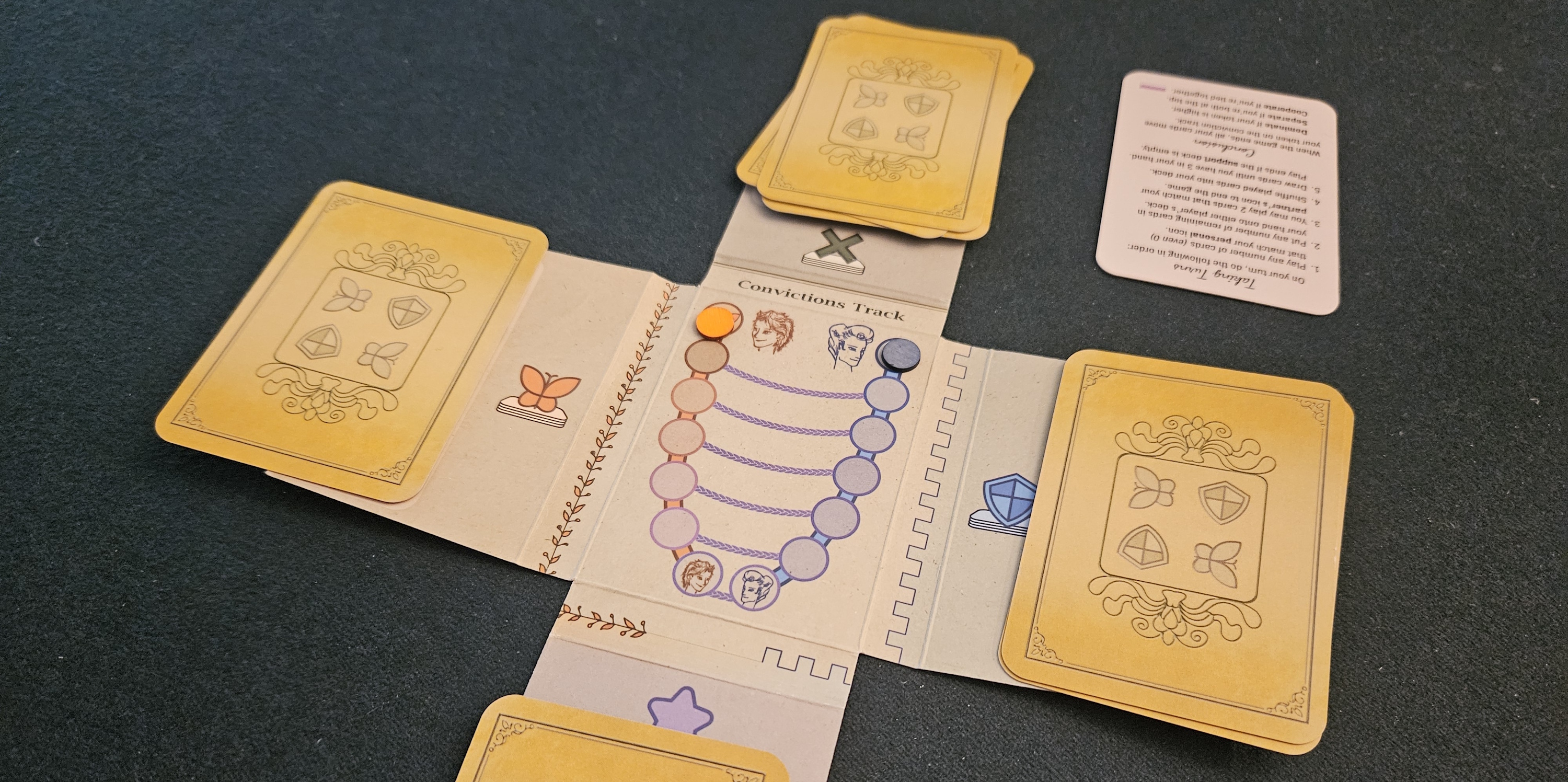
Once the stakes are set, players begin the argument in earnest. As in Persuasion, the particulars are abstracted down to cards representing the beats of our quarrel. For the most part, these shift cards between piles. My pile and yours, both representing our current stance on the issue under discussion, as well as our emotional and mental resources, how worn down we’ve become, and so forth. Two other piles, one for support and another for rejects, function as both game timers and sources of additional cards.
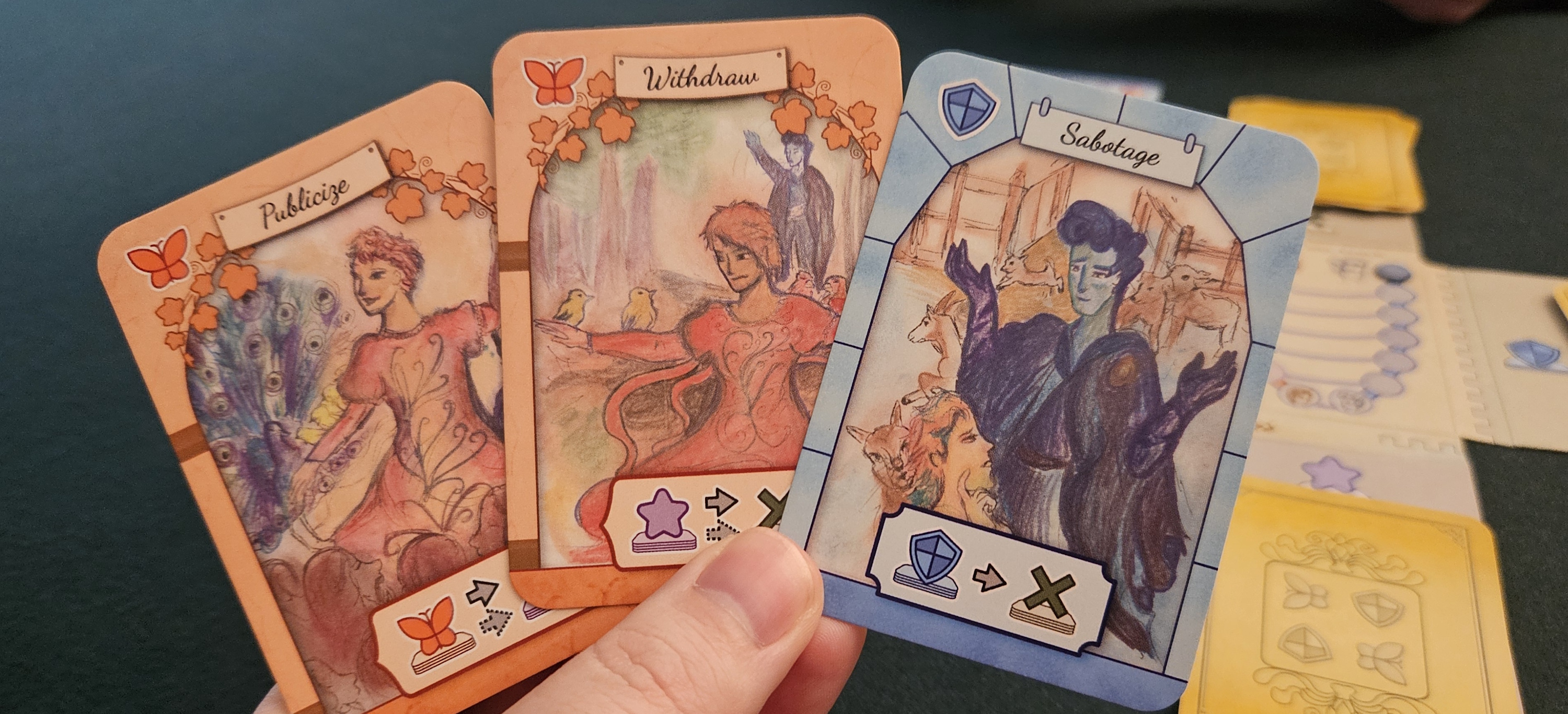
Each card represents a beat in your ongoing quarrel.
It goes something like this. Perhaps the Stalwart decides to listen, shifting a card from the support deck to his own pile. Since these cards are unseen, whether he has hardened or softened his perspective is yet unknown. Then the Idealist makes an argument. She publicizes some detail, shifting her own grievances down to the support pile. In response, the Stalwart withdraws, hastening the end of the game before his partner can erode his stance any further.
In a vacuum, this sounds terribly abstract. It isn’t until one sees the game in motion that it starts to make much sense, and even then it more or less requires a willingness to engage with the role-play elements as players define what each verb means to the ongoing quarrel. When I “publicize,” does that mean I’m telling my partner something they didn’t know before, or am I airing my grievances to wider society? When you “pry,” is that a reasonable and even caring response to my stonewalling, or is it a violation of my privacy?
Allred doesn’t answer these questions for us. Nor does it answer the question of what victory looks like. There are multiples outcomes, and the game is careful to avoid assigning any of them supremacy over the others. When we tally our scores, ticking down on the convictions track for every one of our partner’s cards in our pile and ticking upward for our own, there are three possibilities. One, our tokens are now aligned, in which case we have cooperated to solve our problem. Two, both tokens remain at the top of the track where they began. In that case, we split up. Call it a Practice Happily Ever After. Or three, if one partner’s token is above the other, they dominate the argument.
Does this represent abuse? Could it be the proper outcome to a partner’s unreasonable stance? As with Conviction’s role-play, the devil lies in the details and the players’ willingness to meet it on its own terms.

Oh ho ho, look who’s cooperating.
In other words, Conviction follows in Persuasion’s footsteps by sometimes getting real. It calls to mind actual arguments, some of which have become safe over time and others that are still raw. I’ve been on both sides of these quarrels with Summer, playing both the role of Idealist and Stalwart, and sometimes I’ve yielded and sometimes I’ve pressed the point and sometimes we’ve collaborated to find a middle ground. The latter outcome sounds like the best one, but the middle ground doesn’t always leave everyone happy. What’s the middle ground for “Let’s have a baby”? It’s a cat, right? Sounds like a win for the no-baby lobby.
But that’s the point of all this ambiguity. Growing up Mormon, it was common to hear the older generation boast about how they couldn’t remember having a single fight in their marriage. Which, first of all, always sounded a lot like one of them was railroading the other. But also… disagreements are part of life. They happen. Sometimes over little things, but also over big things too. And unlike the advice I was given as a youngster, sometimes winning is the good outcome. Sometimes splitting up is the good outcome. To reach the end of life without a single argument under your belt isn’t something to boast about. All you’re telling me is that you never really engaged with this person you had committed yourself to.
So maybe Conviction is an optimistic game, too. Or maybe it’s just me. Either way, this represents a synthesis for Allred. Continuing from Persuasion, Conviction dissects relationships to their connective tissue. But in the tradition of Velocirapture and Vibes, it’s willing to reserve judgement. After all, this is another note in the same story. The Happily Ever After, sure, but also the And What Then? It’s a reminder that life just keeps going. And going. And going. Sometimes a romance. Sometimes a fight. Always, maybe, hopefully, ideally, an adventure.
A complimentary copy of Persuasion was provided by the publisher; a complimentary copy of Conviction was provided by the designer.
(If what I’m doing at Space-Biff! is valuable to you in some way, please consider dropping by my Patreon campaign or Ko-fi. Right now, you can read my third-quarter update on all things Biff!)
Posted on December 9, 2025, in Board Game and tagged Board Games, Conviction, Hollandspiele, Lunarpunk Games, Persuasion. Bookmark the permalink. 7 Comments.

 SPACE-BIFF!
Dan, thank you so much for these reviews! I played Persuasion back when you reviewed it the first time, and now I need Conviction in my life.
I saw your thread on bluesky about the cis/trans line, and I was wondering if you could possibly copy-paste it here as well. Because I think it’s a beautiful summation of this game re Molly House. If we aren’t going to get that crossover piece, this is the next best thing!
Sure! That’ll be better than just erasing that line. I might still write that piece. I’m noodling with the idea of doing something on games that examine gender, much the way I’ve written about games that examine religion. But, well, I’m very slow at actually writing things. Haha.
COPY/PASTE:
I’ll try to keep this short, but that’s hard for a long-winded kid like me.
Back when Xoe’s game was under consideration with Wehrlegig, I had some notes on a theoretical Molly House / Persuasion piece.
“Cis/trans” have their roots in Latin, specifically Latin geography. “Cis” means “on this side of,” while “trans” means “on the other side of.” That’s the literal meaning, but colloquially they often just meant “here” and “there.”
I’ve been fortunate to teach both Molly House and Persuasion to a number of groups, including as a volunteer in a youth outreach circle that uses games in a therapeutic and exploratory setting.
In teaching Molly House, it comes across as explicitly trans. Our groups, even when they’re filled with trans or nonbinary players, are largely aware that they’re experiencing something “over there.” Georgian sexual identity is already somewhat alien, and therefore non-conforming identity more so.
But in teaching Persuasion — which I haven’t been able to do as often as Molly House, so my selection sample is somewhat more limited — my players don’t report that separation. They feel at home. They feel “here.”
The game’s erasure of gender is so successful that people don’t feel they’re inhabiting a gender role the way Molly House asks them to do. They just feel themselves. And whomever they’re sending letters to are targets of affection, regardless of sex or orientation.
Which permits the game to critique “cis” identity in the same way that Molly House examines “trans” identity. Where Molly House says, “Look, these people were unjustly excluded by their society,” Persuasion says, “And so were you, no matter who you are.”
That’s a powerful statement! It emphasizes that even people who were “baseline” often felt alienated and othered by the mores and restrictions of their society. They, too, were repressed. The Society for the Reformation of Manners polices *everybody*.
To be clear, this isn’t meant to erase or ease the repression felt by the Society’s targets. Rather, it’s meant to foster empathy. When teaching Molly House, I’ve found that some people pull away. When teaching Persuasion, they don’t, at least not as often. They get pulled in.
So that’s what I mean when I say that it’s “cis” to Molly House’s “trans.” It’s the “here” to that game’s “there.” It’s a reminder that nobody fully escapes the wardens they put in place to enforce a hierarchy. Even those who fit the mold will find their edges snipped by its press.
Ha! Dan is not beating those elitist academic allegations. I definitely did not clue into the Latin pun he was going for there.
It’s a really good mini essay providing clarification. Probably easiest to just link here: https://bsky.app/profile/danthurot.bsky.social/post/3m7nhtubbjk2d
Even the puns have layers…
Never mind. Dan to the rescue above! Feel free to delete my comment.
Doh, I shoulda just linked it. I’ll keep it, if you don’t mind. Probably better as a record of the ongoing conversation.
For those reading this review and worried about the right sleeves. Sleeves for 70×120 mm tarot cards fit great.
Pingback: Best Week 2025! The D.T.R.! | SPACE-BIFF!