Respond or Re;ACT
We’ve rightly developed some suspicion around the suffering artist trope, but I think deep down we’re all holding onto the idea that our art becomes a little bit tastier with some angst mixed in. I think the artists of Jenna Felli’s Bemused, wracked by doubt and dread. Or Jasper de Lange’s Bohemians, all penniless syphilitics. Want to create a masterwork? Sure. Go right ahead. But it’ll be better if you wedge a needle under your toenail.
But then there are the artists of Re;ACT: The Arts of War by Chris Lin, MingYang Lu, and Eric Zeringue. These folks are out here dueling each other in an arena, and although it might seem like the footrace between calligraphy and animation was settled long ago, here they both are, having the time of their lives. Step aside, suffering artists. This one’s for the artists who can’t wait to get back to the drawing table.
As for the game? Oh, right. That.
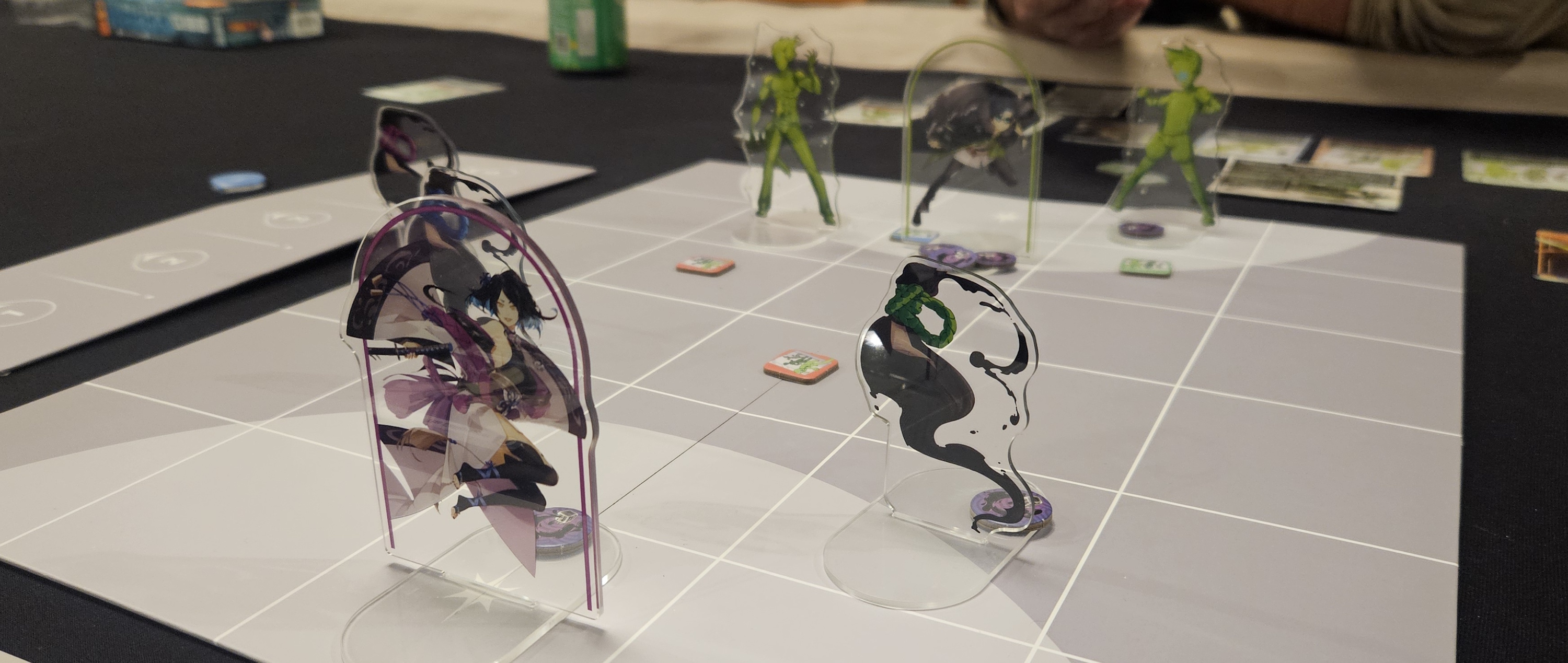
Calligraphy versus Animation… which will win?
I’m sure there are antecedents aplenty for Re;ACT. I’ve seen it compared to classic table games like Chess, collectible card games like Magic: The Gathering, or more modern duelers like Unmatched.
For my money, its closest kin is something designed by Brad Talton, and more his older BattleCON than the more recent Exceed or Joshua Van Laningham’s Bullet. It’s the determinism of the thing. Both players pick a fighter, which in Level 99 fashion are shockingly differentiated, not only in color palette but in actual mechanisms. Most artists work from a deck of cards, but not all. One plays a chit-pulling minigame. Another rolls and assigns dice. In every case, these fighters — pardon me, these artists — hand over a reference card to their opponent, a handy cheat sheet that spells out their relevant moveset.
That cheat sheet speaks volumes. This isn’t a game where you merely try out the characters. You’re meant to master them. Manage their quirks and peccadilloes. Speed-run their combos. If Re;ACT celebrates the act of creation, this thing is NaNoWriMo. Anybody can take part, but you’re expected to put in your thousand words a day.
For an inveterate toe-dipper like myself, the reality is that I simply don’t have the spare hours. Re;ACT is a game out of time. I don’t say that negatively. One of my favorite titles ever designed, Summoner Wars, which I collect religiously and play like a lapsed devotee at Easter and Christmas, is also a game out of time. I know I’m part of the problem. Maybe I’m the avatar of the problem. I play something like two hundred games a year. Despite my policy of playing a game at least three times before I write about it, that still isn’t very much, especially for a game like Re;ACT, with its emphasis on deep knowledge and clashing matchups. It isn’t enough to take a peek at each character, to see them in motion once. They beg to be examined under a lens, to be tooled until the sculpture reveals itself from the marble. I’m a different sort of artist. Namely, a hack.
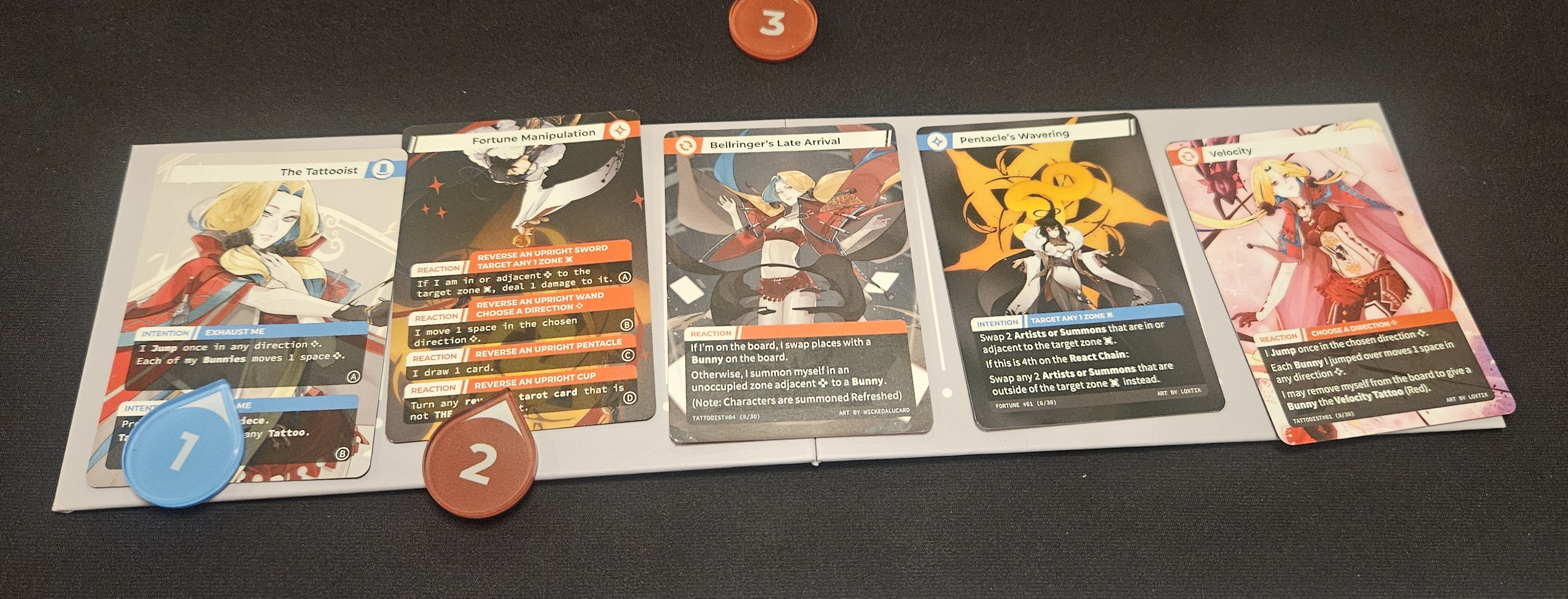
The React Chain, where reactions happen.
The centerpiece of the design is the React Chain, and this is where the comparisons to something like Magic come to the fore. Every single action begins with an intention. And I mean every. single. action. Moving, summoning, attacking, everything. The acting player lays out an intention, at which point both players are given the chance to respond.
Nay, to Re;ACT! Reaction cards are added and then resolve on a last-in first-out basis. There are nuances aplenty to this system. If my Dancer intends to slug your Tattooist in the nose, this means you have a chance to dart out of the way. Except, aha, maybe I’ll add an attack card after your move card, which means it will resolve before you can slip away. But then your reaction to my reaction steps a summon into the gap to absorb the shot. And so forth.
It isn’t quite as complex as it seems thanks to a few clever limitations. The React Chain caps at five cards, for one thing. Players can only call-and-response-and-response for so long. This means individual turns are a little longer than expected, but the actions that make up those turns don’t devolve into lunacy.
For another, there’s the limited moveset offered by each character. My biggest hangup with Re;ACT — again, as a toe-dipper who might not fully grasp the game’s intricacies — is that the characters, as colorful as they are, each sport two or three major combos. Often, our matches came to a swift resolution, determined by whichever player most rapidly cobbled together the relevant cards, summons, and moves. Hence the cheat sheet. It isn’t enough to pull off your own combo. Mastering this game is also about keeping a watchful eye on your opponent.
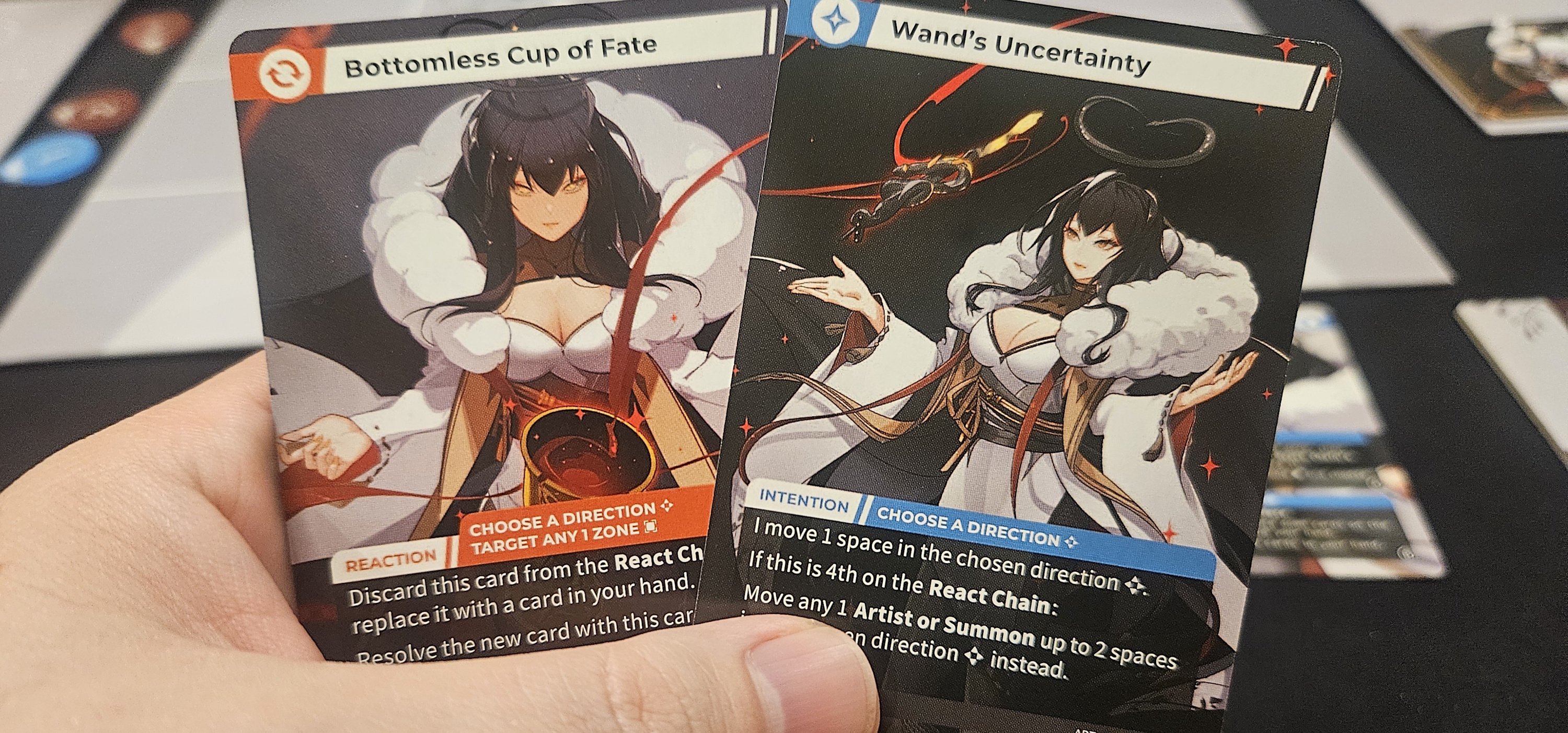
Intentions and reactions are the two main types of actions.
At a certain level, that’s precisely My Sort of Thing. There’s a lot to love about Re;ACT, and some of it pushes my buttons like a cat walking across a keyboard. I’ve always had a soft spot for asymmetry, and the sheer creativity on display is impressive. It’s a delight to witness how the Tagger differs from the Painter differs from the Fortune Teller.
But I’d be lying if I didn’t admit to some fatigue. Early on, matches tend to resolve too quickly thanks to those aforementioned combo sprints. But as the artists grow in familiarity, so too do the game’s duration and mental load. It isn’t long before Re;ACT disappears into the same I-know-that-you-know-that-I-know headspace that transformed BattleCON into an object of distant admiration more than one of repeated play.
If Re;ACT has one thing going for it, it’s that there’s some randomness to break up the fatalism. Which is to say, it shifts into territory that’s closer to Exceed than its grandpappy. Because many activities are reliant on the luck of the draw (or chit-pull, or roll), not every misstep will be your fault. Just, y’know, most of them. It isn’t quite enough to pull me out of the game’s predictive fugue, but I appreciate the direction.

House of Flying Sabres.
In the end, Re;ACT remains a game that I appreciate for reasons other than the actual experience it engenders on the table. The design in abstract; the colorful art; the fact that these artists are having a ball. If these artists are suffering for their art, it’s the kind of suffering that leaves one with a grin on their face. A visage to aspire to.
A complimentary copy of Re;ACT: The Arts of War was provided by the publisher.
(If what I’m doing at Space-Biff! is valuable to you in some way, please consider dropping by my Patreon campaign or Ko-fi. Right now, you can read my third-quarter update on all things Biff!)
Posted on December 4, 2025, in Board Game and tagged Board Games, Brother Ming Games, Re;ACT: The Arts of War. Bookmark the permalink. 9 Comments.

 SPACE-BIFF!
If nothing else I’m glad to hear someone else has the same exact relationship with Summoner Wars that I do…
There are at least three of us, then….
I had high hopes for re;act. I expected it to have Exceed-level of card variety and options. But the fact that decks (for characters that have them) only have 4 unique cards, and often each character only has 2 different reactions robs the system of the promise of back-and-forth chains.
You simply don’t have the cards in hand in general, and (different!) reacts to make “the stack” as interesting of a focal point as the game promises it to be.
Right, that’s kinda what I mean when I say that each character has two or three combos and the game is a race to assemble them. I prefer a little more openness.
It’s more than that. It’s specifically the sparsity of reactions.
You typed in your example above:
But most characters can’t do that. The Tattooist, who has 3 reactions and one of which can attack is an exception. Once a character attacks, you react to move away, they react to move back to you, and then you could repeat the chain once more each, using the same cards – because they’re the only reactions you have.
And even in the Tattooist example – so she attacks you, you react to move away > She reacts to damage you > You play the same reaction card to move away > She plays the same reaction to damage you.
This is a gimmick-based design – you didn’t even touch on the pretty pointless Masterpiece mini-game, which usually ensures after one person ascends, the next player will pretty immediately after.
They were so busy making sure each character is unique, that they didn’t actually do the work on designing the game’s most important aspect – the cards themselves. And since the game is supposed to be all about the reactions, there being such a paucity of them is especially damning.
I was sold on this being a game designed all around “The Stack” from MtG. It is anything but that.
A game that does reactions way better, even if they aren’t “chained,” and also occurs on a board, is Ivion.
P.S. As one of the original playtesters for Bullet, I’d be remiss to not point out that while Brad Talton’s Level99 games did publish the game, the developer is Joshua Van Laningham, not Brad, for that one.
Oh, I very much appreciate that correction! Bullet is just such a Talton-esque game, if you know what I mean. I’ll add a note. Thanks.
I know what you mean – aesthetic is a mix of 90s arcade and 2000s anime, fighting game inspired, numerous asymmetrical characters. The complexity isn’t in the ruleset but in how it is carried out.
Pingback: Re;MATCH One, Two, or Four | SPACE-BIFF!