Paper Planes, Coupons, Stencils

We’re only a few days away from the Indie Games Night Market at Pax Unplugged. Funny how time gets away from us. Don’t worry, that’s less a plaintive cry about my fading youth than a statement on my incapability to properly schedule these things.
Fortunately, three of these titles fall into roughly the same category. The same two categories, even! These are tactile games that play best with family. Let’s take a look.

Fold…
Fold & Fly!
Taylor Shuss’s paper airplane game has been a long time coming. I first played it on ‘rona’s eve, which calculates to roughly forty years ago in subjective time, in the lobby of some prototype game convention, and ever since I’ve periodically wondered why it hasn’t found a home on a shelf at Barnes & Noble. Preferably one close to checkout.
I’ve always had an appreciation for games that do what they say on the tin — or in this case, the booklet — and very few games are as plainly rendered as Fold & Fly! The gameplay is divvied into two phases. You’ll never guess what they are.
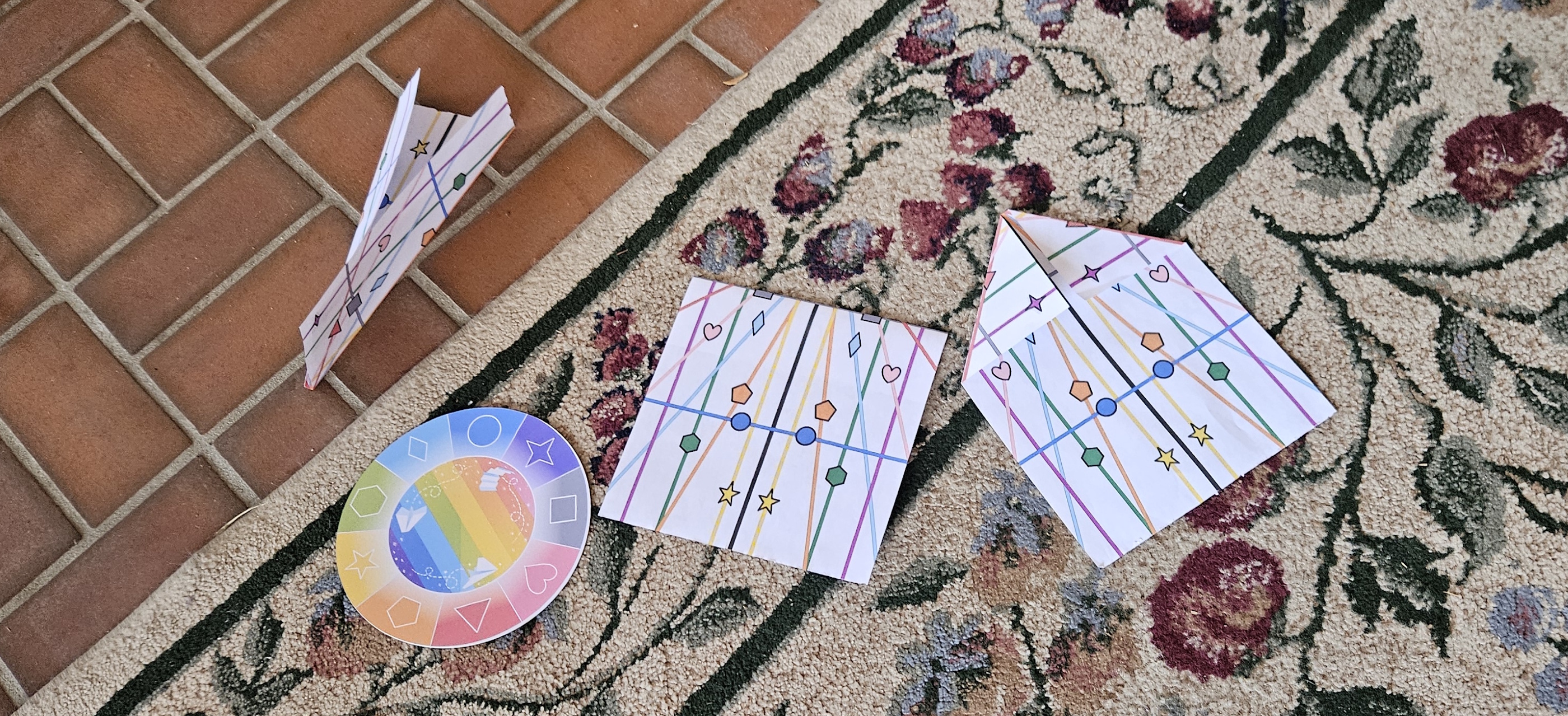
Oh, shoot, you got it. Fold, then fly. There are a few subtleties to the process. Folding, for example, isn’t entirely free-form. The paper from which your airplanes manifest is pleasantly thick, but your inaugural fold is made according to an article of clothing you’re currently wearing. As in, wearing blue jeans and a denim jacket means you’ll be folding along the blue line, while tie-die affords a wider range of starting options.
Flying the planes is a testy affair, in no small part because these airplanes are nearly always rubbish. That’s the point. Everyone flings them from a starting line. The airplane that flies farthest sets the benchmark for the win condition, with the finish line laid down one large step beyond its landing spot. Cross that line on a future throw and you’re declared the victor. The victor of paper airplanes.
… and fly!
But these airplanes are just as likely to become doubly susceptible to gravity as they are to gain aerodynamicity halfway through the session. Depending on where your plane landed crashed, a color wheel radiates commands for which line gets folded next. Does this impart an element of strategy? Are you a paper Sully Sullenberger, navigating your paper US Airways Flight 1549 onto a paper Hudson in order to ensure you can give your wing that purple crease it needs to truly soar?
Ehh. Sometimes. Perhaps some of my reservation for Fold & Fly! is derived from my ineptitude at crafting functioning models. As a kid, I came in dead last at my Boy Scouts Pinewood Derby, and I still contend that the most reliable paper airplane is a crumpled ball.
But thinking about Fold & Fly! in competitive terms is the wrong framing. This is the lightest entry in the tactile trio. The most disposable of the group, too. It’s a pleasant activity that requires ten minutes, gets everybody laughing, and then it’s over. Which makes it a fine family game, if not one that will appease kids raised on heavy euros.
For us, it received a mixed reception. The eleven-year-old shrugged; the six-year-old shrugged. Personally, I did a fist-pump because, for the first time in my life, I had just won at paper airplanes.
Check out my dirty thumbnail.
Coupon Clipper
On the other end of the technical spectrum, we find Chris Lawrence’s Coupon Clipper. Another game that does exactly what it says on the box!
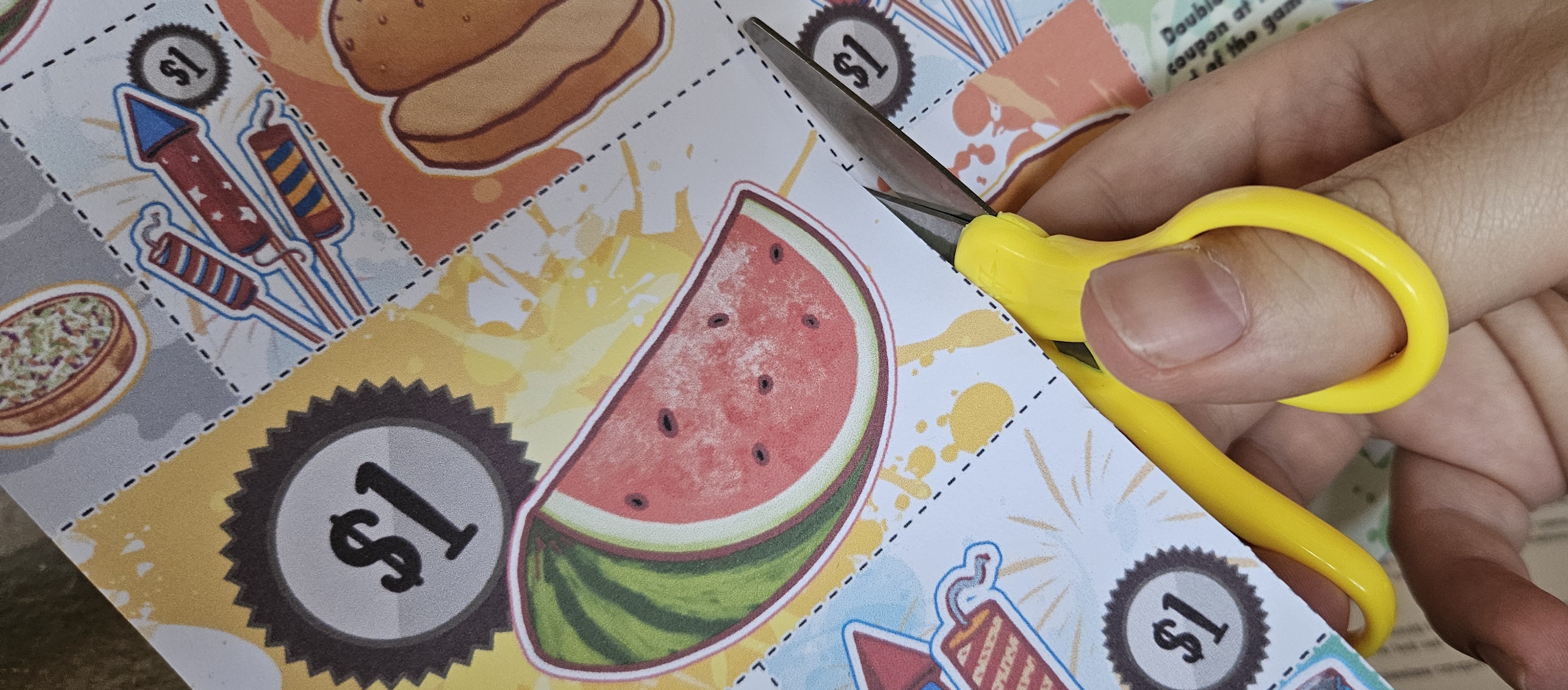
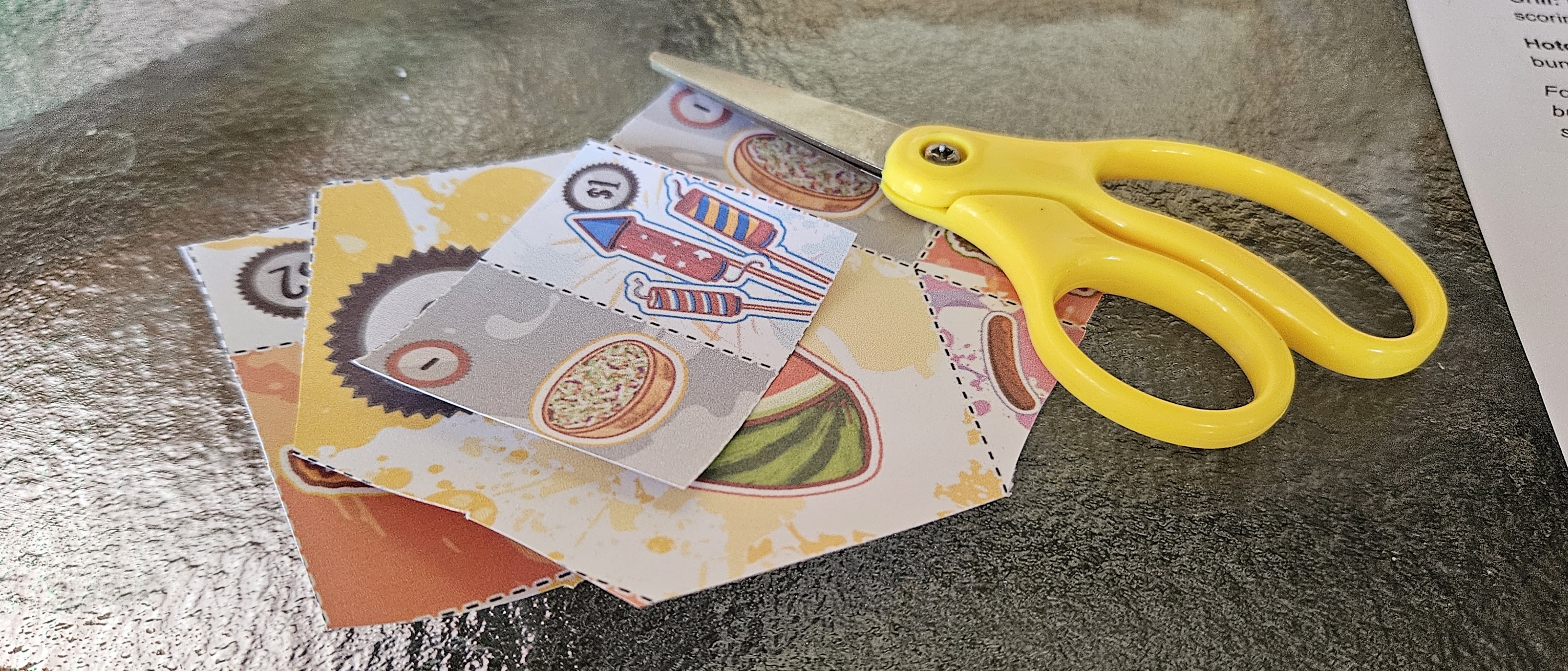
Right away, Coupon Clipper is a harder sell for littles. There are actual rules to this one, rules that need to be explained up front lest you fumble through to the end without understanding the import behind any of those cuts. Which matters, because the gameplay is deceptively simple. Played simultaneously, everybody takes their own sheet of coupons, makes two cuts, and then passes their sheets — which may have become a pile of half-snipped papers by this point — to the next player. Around and around it goes until all coupons have been claimed.
Two things. First, the victory conditions are important. Where Fold & Fly! had the easiest objective imaginable, Coupon Clipper offers a tangle of competing incentives. Coupons confer their printed value, but also sport individual rules. Watermelons are worth extra points if you have enough of them to form a complete melon. Fireworks award a big bonus to whomever puts on the most impressive show. Grills are valuable, but trash another of your coupons. Hot dogs and buns score in pairs, but lose points when you have leftovers of either the breading or meat variety.
Results are mixed. My eleven-year-old internalized the scoring right away, while the six-year-old enthusiastically claimed all the coleslaw. Coleslaw is worth negative points. Because coleslaw is disgusting. While I was grateful to see my kiddo remove all that mayonnaise garbage from our coupon sheets, it was clear she hadn’t quite wrapped her head around the game’s many valuations. Perhaps this isn’t as much a family game as the others, then. Or maybe my six-year-old has developed the wrongheaded notion that coleslaw is edible. Whatever the reason, we found this one more suitable for older players.
The tricky part is remembering which pile to pass.
That said — and this is the second thing — it cannot be overstated how great this game feels to handle. Snipping along dotted lines with scissors that don’t quite fit your hand is a flashback to simpler time. But where an actual rewind to kindergarten would prove mind-numbing by naptime, the scoring keeps Coupon Clipper lively. These elements work well in tandem, reminding us why kids love to snip paper into a thousand fragments that soon work themselves under every baseboard in the house. It’s just that Coupon Clipper is better at mentally stimulating developed minds as well.
It helps that there’s more game here than you might expect. Everyone gets a few tokens for making extra cuts, which adds some minor resource management, and it’s possible to create little traps for later players by leaving a coleslaw next to that coupon they really want. To be clear, these shenanigans aren’t necessary. But they’re there for those of us who prefer our games with some bite. Or some paper cuts.
On the whole, I dig this one. It’s tactile in all the right ways, provides enough for an adult to think about, and doesn’t overstay its welcome. Just be aware that there’s a cognitive weight to Coupon Clipper that isn’t demanded by its peers.
+1 for the spinner.
Paper Pencil Stencil
Of this tactile trio, by far my favorite is Paper Pencil Stencil. Created by first-timers Jestin Brooks and Jeremy Schichtel, this is a cooperative drawing and guessing game that’s funny, smart, and helps bring spinners back into fashion. And while it’s tempting to say that the spinner is the most important part, it’s probably the least essential component of the bunch.
[NOTE: This one will be available at Game Market West, not the IGNM. Too many indie markets! That goes in the “good problem” column.]
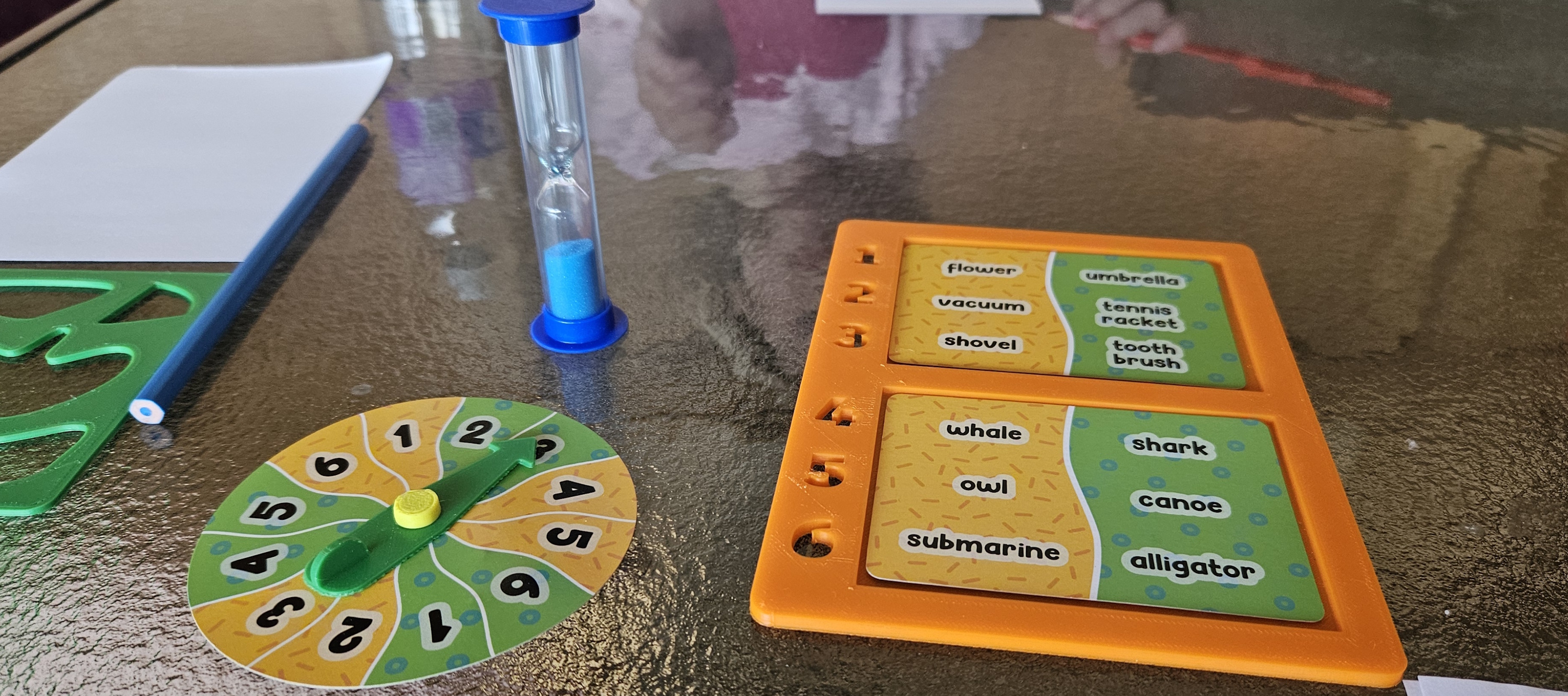
Drawing on countless classics wherein vague images are created and interpreted, Paper Pencil Stencil is all about drawing and guessing strange shapes. Using that spinner, everybody receives an assignment from the same rubric, a pair of cards with yellow and green columns. Some of these assignments are easier than others: a duck, a bridge, maybe a mushroom. Others, like a haunted house or a garbage truck, require a bit more oomph.
Regardless, now it’s time to make some art. Working at the same time, everybody traces some approximation of their assigned image with stencils and pencils. Both are passed around the table, marking time and forcing everyone to do their best with what they’ve got. It’s an excellent conceit, allowing the game to be fully cooperative without allowing the pictures to be all that specific. Can you convey a campfire with four traced shapes, or will it resemble a pretzel? I grimaced at the prospect of tracing a chainsaw with nothing but loopy blobs and wobbly parallelograms.
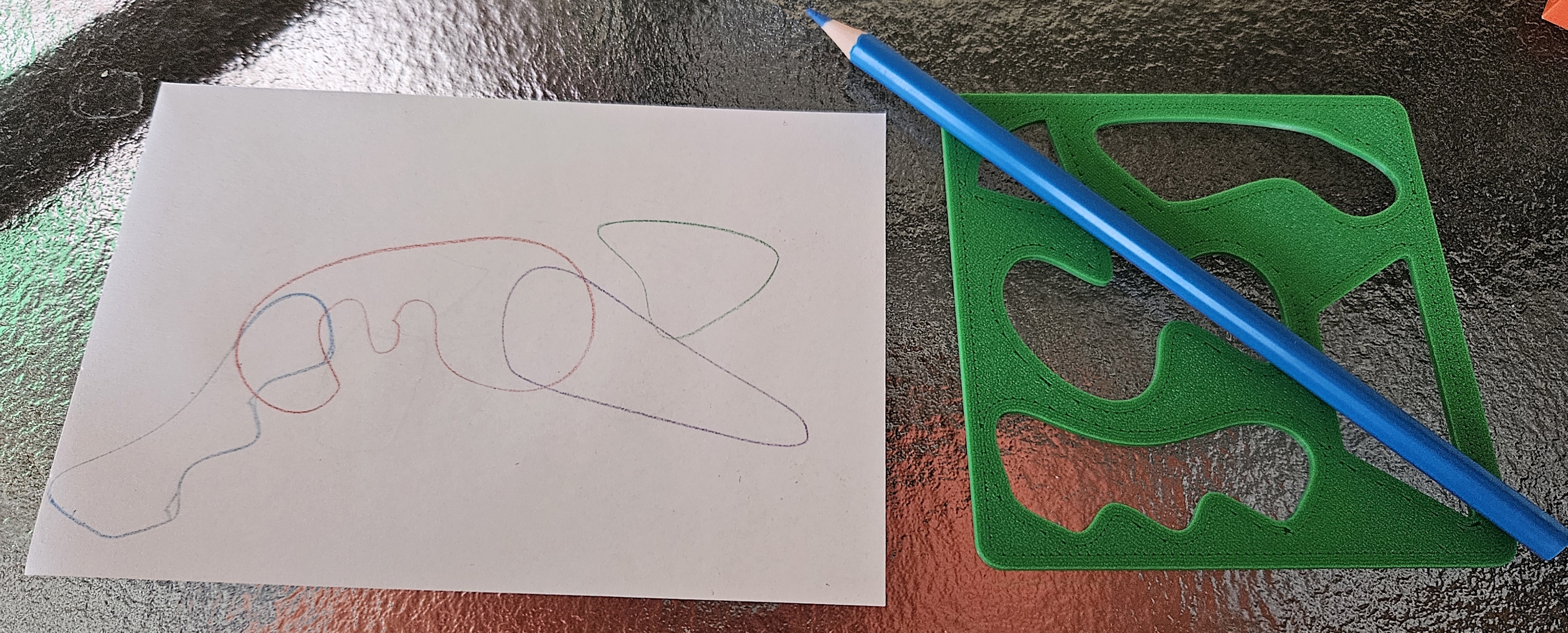
What is it?
The guessing phase is no slouch, either. Played with a sand timer, the table’s objective is to correctly guess everybody’s image without accruing too many demerits. Every time the timer is flipped, that’s a demerit. Every time an incorrect image is guessed, another demerit.
Nicely, though, incorrect guesses allow the artist to narrow the range of options, singling out either a card or column from the opening rubric. So rather than flailing around, guesses get considerably easier with each flub. Deciding which of twelve subjects your rainbow spaghetti most closely resembles is tough, but after two misses slim down the options to a snowman and a jackhammer, well, that’s doable.
It’s wonderful, is what I’m saying, in no small part for how it lets player be creative without imposition or even judgment. There’s a target objective, but as befits Paper Pencil Stencil’s breezy aesthetic, it isn’t all that prescriptive about the distinction between a win and a loss. In our case, the kids demanded a second play immediately after the first, so we set a goal to do better than the first session. We failed, but seeing two separate interpretations of a “mask” was delightful. Cate’s mask was a theater mask with one of those holder-sticks. The six-year-old’s was… not that. I’m still not sure what it was.
To the game’s credit, we weren’t deflated. Even when our demerits piled into quite the impressive pyramid, we were glad to play this one. The kids declared it the bunch’s keeper. Which isn’t necessarily fair, since these games aren’t intended to compete side by side. But the little critics insisted it was the one we had to keep.
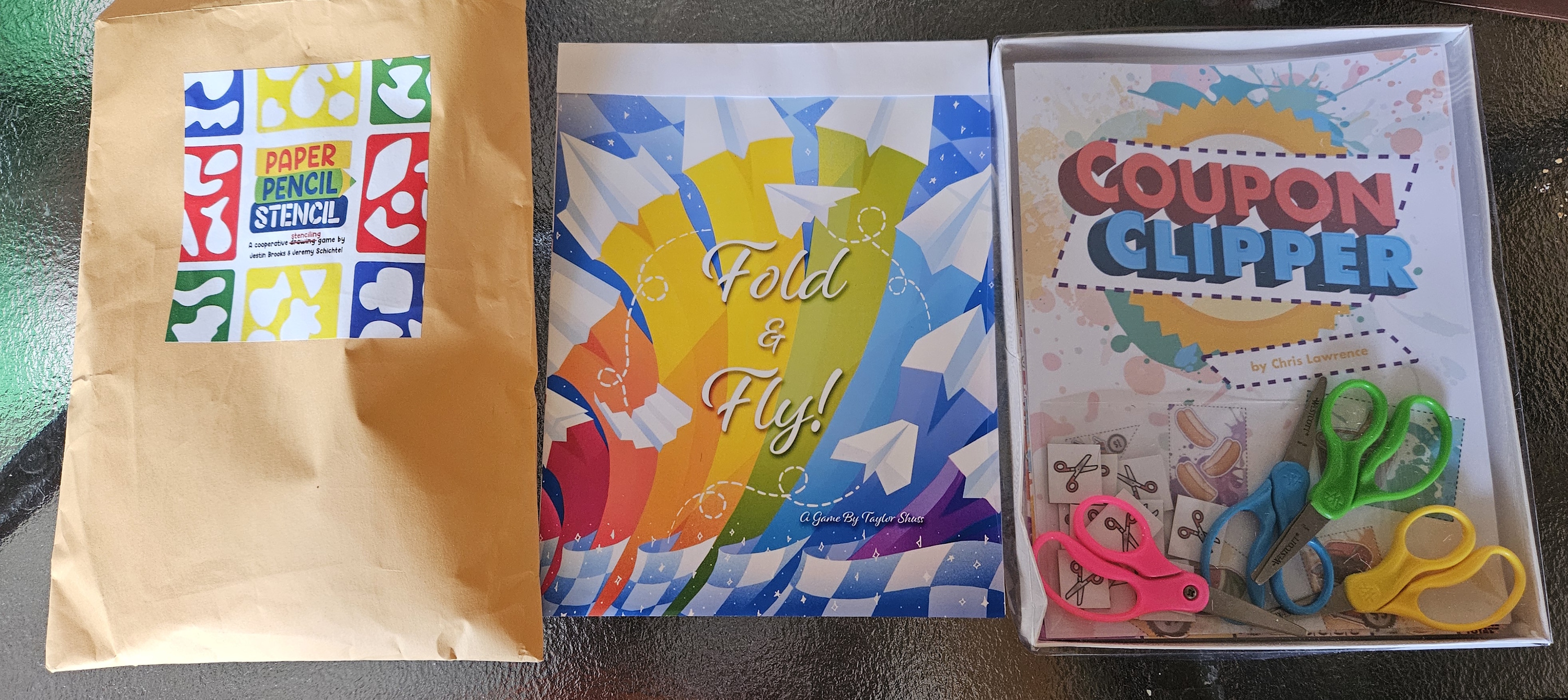
The tactile trio.
There you have it! Three tactile titles. We tackled all three in a single sitting, making a family game day of it, and even with multiple plays the entire event took less than two hours. The kid had a good time, despite some fumbles with airplane folds and one child who will soon be brainwashed into identifying and avoiding coleslaw. Best of all, we escaped without a single papercut.
Complimentary copies of Fold & Fly!, Coupon Clipper, and Paper Pencil Stencil were provided by their respective designers.
(If what I’m doing at Space-Biff! is valuable to you in some way, please consider dropping by my Patreon campaign or Ko-fi. Right now, you can read my third-quarter update on all things Biff!)
Posted on November 17, 2025, in Board Game and tagged Board Games, Coupon Clipper, Fold & Fly!, Indie Games Night Market, Paper Pencil Stencil. Bookmark the permalink. 4 Comments.

 SPACE-BIFF!
The masks… so funny. We’re over the moon hearing that your family had fun! The compliment from your kids means the world.
In case this catches anyone in time: Jestin will be at PAXU testing some new content Sunday 12-12:30 in the unpub area.
All three of these sound awesome! I have played so many games that are really just variations on something else I already know and, honestly, neither the original nor the variation is going to draw in the people I mostly play games with (people who do not self-identify as gamers who seem to think that the latest engine builder is not something worth glancing askance at yet alone drooling over). But these games? These would have them pushing granny out of the way to get a seat at the table.
Yeah, I think that’s their greatest strength. These are fantastic options for families, grandmothers, kids, school groups, etc.