Putting on a Row

Rowin is… not about rowing. Sorry, rowing enthusiasts. You’ve come to the wrong place. Again.
Instead, Rowin is about getting five stones in a row. I suppose that’s how rowing works, if you squint real hard and treat your brain to a few slaps. Designed by Matt Ward and debuting later this month at Pax Unplugged’s Indie Games Night Market, this one’s a standout if only for one reason: it’s not a trick-taker.
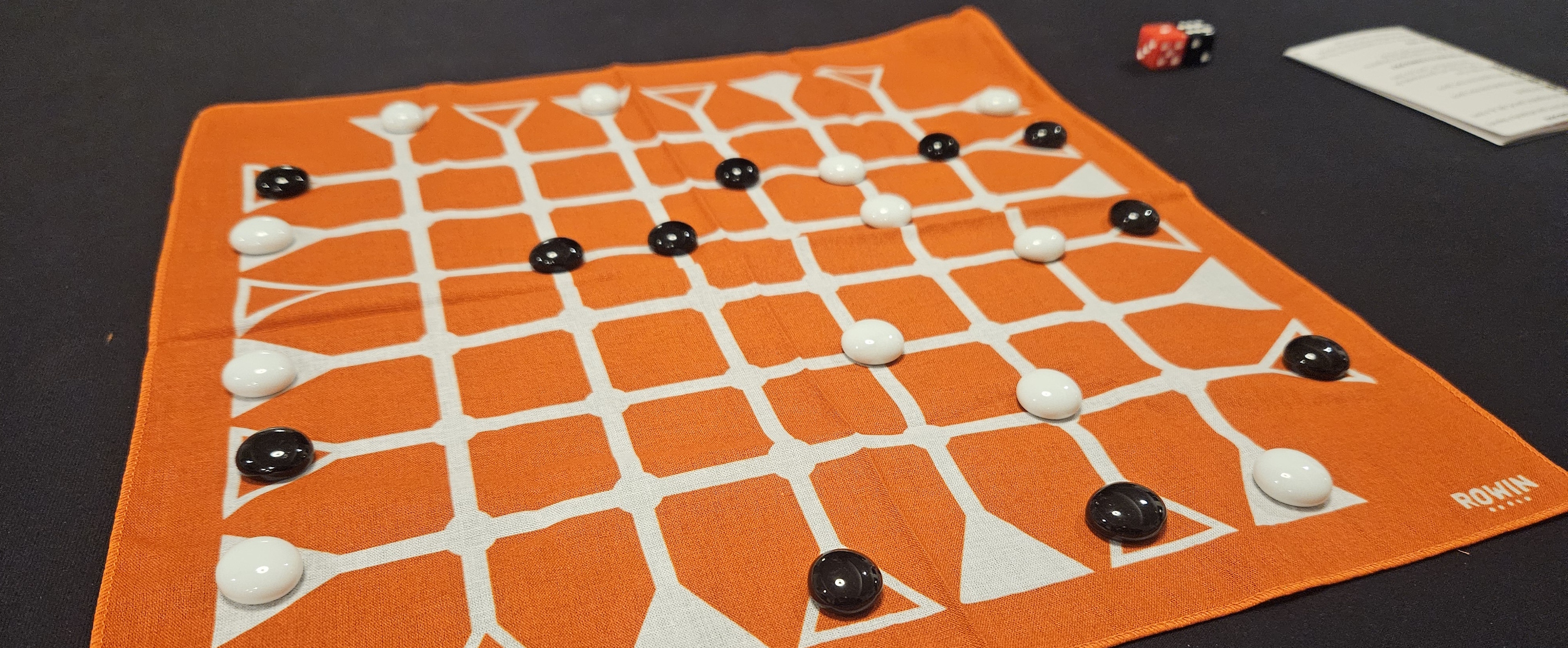
Ah yes, the open sea.
Welcome to the open ocean. It’s orange. One might even call it wine-deep. As noted, your goal is to put five stones in a row.
Right away, Rowin sidesteps the problem that dogs these games. Basically, why would I ever allow you to make five in a row? Tic Tac Toe is about getting three stones in a row, and it’s awful. I don’t know if you’re a math whiz, but five is more than three. Which should make Rowin three-fifths (or is it five-thirds?) worse than Tic Tac Toe. Right?
Nah. Rather than letting Rowin’s dueling players have the run of the place, Ward offers a few small correctives to keep the game on track. First of all, the board is divided into two types of spaces. There’s the grid, the dot-based middle realm, where stones can move normally. And then there are the triangles, the spaces on the edges where your stones begin. While it’s possible to use a stone on the edge to make your match-five, moving your stone back to these destinations is somewhat tougher. Which makes the initial moves rather loaded. There’s no shuffling pieces back and forth until your opponent throws up their hands in surrender.
That’s not all. These stones don’t move normally. Instead, their possible movements are dictated by dice roll followed by a draft. One player rolls all three dice and picks one. Their partner picks the next die. Then back to the first player, who claims the last die. Back and forth it goes, those triplicate rolls determining the range of possible moves.
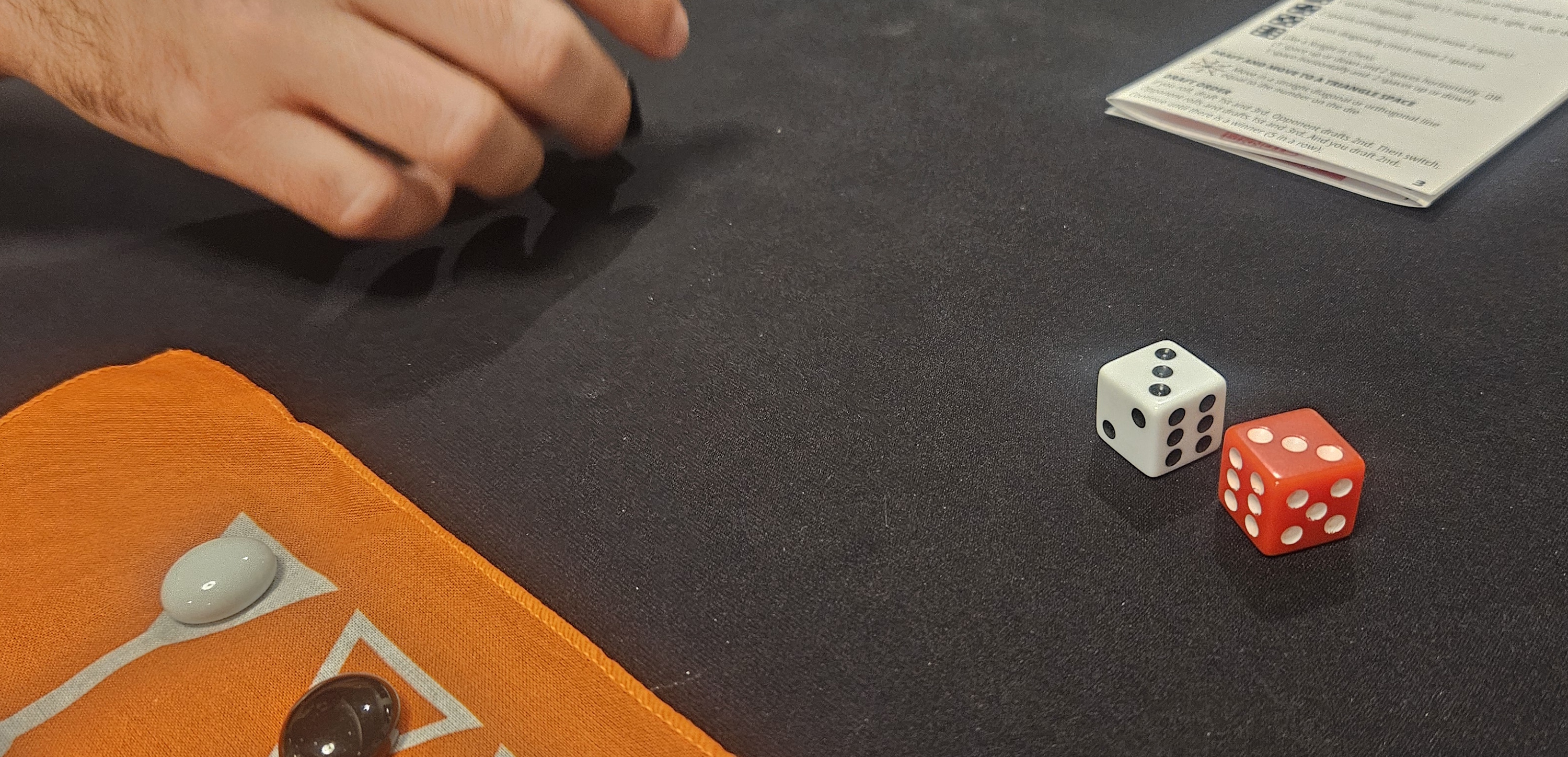
Drafting dice.
Unsurprisingly, these movements are the heart and soul of Rowin. The range of possible moves corresponds more or less with the natural arrangement of a die’s pips, so that a 1 means you can move a stone like a king from chess — one space either orthogonally or diagonally — while a 4 lets you move twice orthogonally, a 5 twice diagonally, and a 6 hops you around like a knight. (2 and 3 are boring, only letting you move one space in their designated direction, so let’s not focus on them.) Meanwhile, moving back onto one of those edge-triangles requires some counting, as you can only draft a die if it’s exactly that many spaces away from the edge in a straight line.
On its own, this leads to plenty of interesting situations. Sitting two moves from a winning situation is one thing; getting the right dice is another. There’s no small measure of hate-drafting, especially as the board develops and both players close in on their own wins. There’s the pleasant whiff of press-your-luck, even. More than once, I’ve hunted for a specific roll, only to be denied time after time.
It’s a simple thing, really, but compelling all the same. A handful of variants shake up the format. One of those variants, Rowin Red, turns the red die into a forced move onto a triangle space. Rowin Black prohibits the rolling player from using the black die on their first turn.
By far my favorite, though, is Rowin Prime. Here, the rolling player is required to use the die that matches their color. This ablates much of the first-go advantage by locking in that player’s options. It isn’t enough to land the best rolls. That first move is forced, and then your opponent gets a draft — maybe even a hate-draft — before you claim the leftovers. I doubt there’s any other way I’ll play in the future.
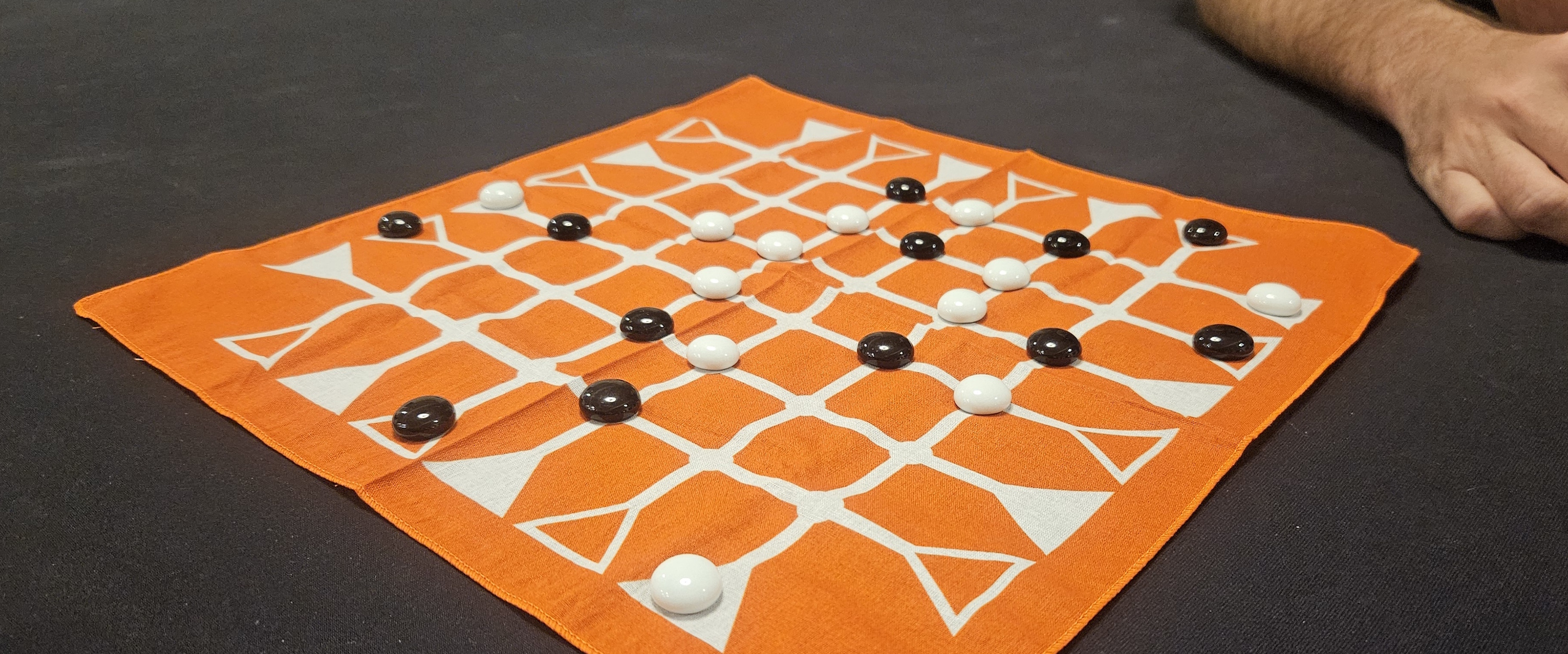
Competing matches begin to take shape…
Regardless of the specific mode, Rowin is precisely the sort of game that benefits from the indie format. It’s moveable in the same way as mancala or checkers, the sort of game that could be played furrowed onto sand or reproduced in lacquered maple. It has that classic feel, like something you’d dredge out of an old monastery’s archives.
Unlike most recovered monastery games, though, it’s rather good for a twenty-minute abstract with heaps of luck. Maybe even better, it’s a game that leverages the traditional weaknesses of its dueling formats — the deterministic abstract versus the chancy roll-a-thon — into something that’s more than the sum of their parts. Yeah. I dig it.
A complimentary copy of Rowin was provided by the designer.
(If what I’m doing at Space-Biff! is valuable to you in some way, please consider dropping by my Patreon campaign or Ko-fi. Right now, you can read my third-quarter update on all things Biff!)
Posted on November 3, 2025, in Board Game and tagged Board Games, Indie Games Night Market, Rowin. Bookmark the permalink. 3 Comments.

 SPACE-BIFF!
This nails why Rowin feels distinct: tight tempo, clean incentives, and an endgame that sharpens without theatrics. I like how you frame “posture” — the social stance a game asks of its players — as part of design. Even if Rowin isn’t for everyone, your review argues persuasively for deliberate, small-idea games that reward attention over volume.
Came for the rowing. Stayed for the jokes at my expense.
Deep down, every joke on this site is secretly at my expense.