Tricker Taker Soldier Spy

It’s that time of year again. The days are getting shorter. The air is starting to nip. And the Indie Games Night Market at PAX Unplugged is only a month away.
After the success of last year’s Indie Market, a greater number of contenders are stepping out of their comfort zone to offer small-batch titles to the public. One of those previous successes, Torchlit, now has a younger brother. And here’s the buried lede: David Spalinski’s followup trick-taker is probably the best example of the genre I’ve played all year.
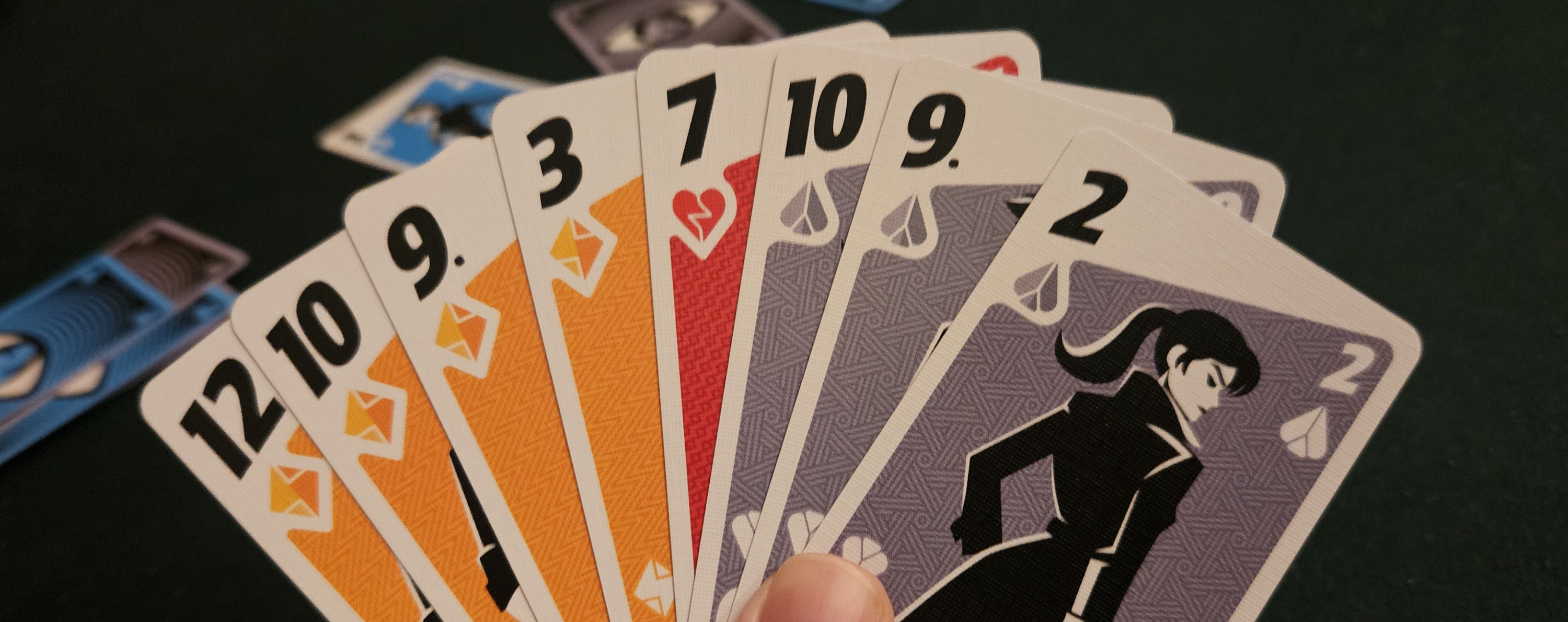
Planning my next move.
Spies sure are a squirrelly bunch. Not exactly a career where “forthrightness” works its way onto many resumes. Maybe it’s appropriate, then, that Chasing Shadows is one of the wormiest trick-takers I’ve ever played.
Let’s start with the familiar stuff. Like a few other trickers, Chasing Shadows puts your suits front and center. As in, they’re printed directly onto the back of the cards. Everyone at the table can see precisely what you’re holding. Which is perhaps ironic, given how it characterizes you as a bunch of liars and cheats. I prefer to think of it as appropriate. When you’re a spy, it’s best to consider yourself under constant surveillance.
Here, though, those suits don’t play the usual role. In a customary trick-taker, the lead player would determine the suit that everybody else is obligated to follow. Nothing of the sort happens here. Rather, each trick opens with a few cards lined up on the table. One of these is the spotlight. I promise we’ll talk about the spotlight in a moment. But the others, the face-down cards, set the suits you’re allowed to utilize this trick. The lead player plays anything they like. Then, going around one by one, everyone follows using one of the suits in that line. Even more crucially, you throw out the suit you chose. This gradually constricts the noose for the next player, and the next, until the final player in the trick has a sole suit they can play.
Meanwhile, winning a trick isn’t as easy as you might imagine. First of all, “winning,” heh, this is one of those trickers where winning tricks is a rather barbed proposition. But second of all, the trick is awarded according to punctilious rules that only make sense to those who’ve been in the game a while. Remember the spotlight? That face-up card in the middle of the table? That’s your target. The highest rank under that target wins the trick. Unless there is no rank under the target. In which case the highest rank wins.
Ah, but what does it mean to “win”? Here, you want to avoid winning. Cards are worth points, and points are bad, and spies are weaselly people who want to avoid attention.
So you start going out of your way to avoid taking tricks. This is where the game’s spycraft comes in handy. Because you can see which suits everybody is holding, there’s nothing preventing you from nudging your fellow spies into little ambushes. Oh, you have plenty of hearts? How about I take the last heart, leaving only a spade for you to choose from? Meanwhile, since the spotlight’s target is somewhat moveable, there’s more opportunity to slough than in most trick-takers. Holding a high card can be deadly, a consignment to unwanted attention. Unless you play it when somebody is under the spotlight. Then you can prance about and sing and your high card won’t raise a peep.
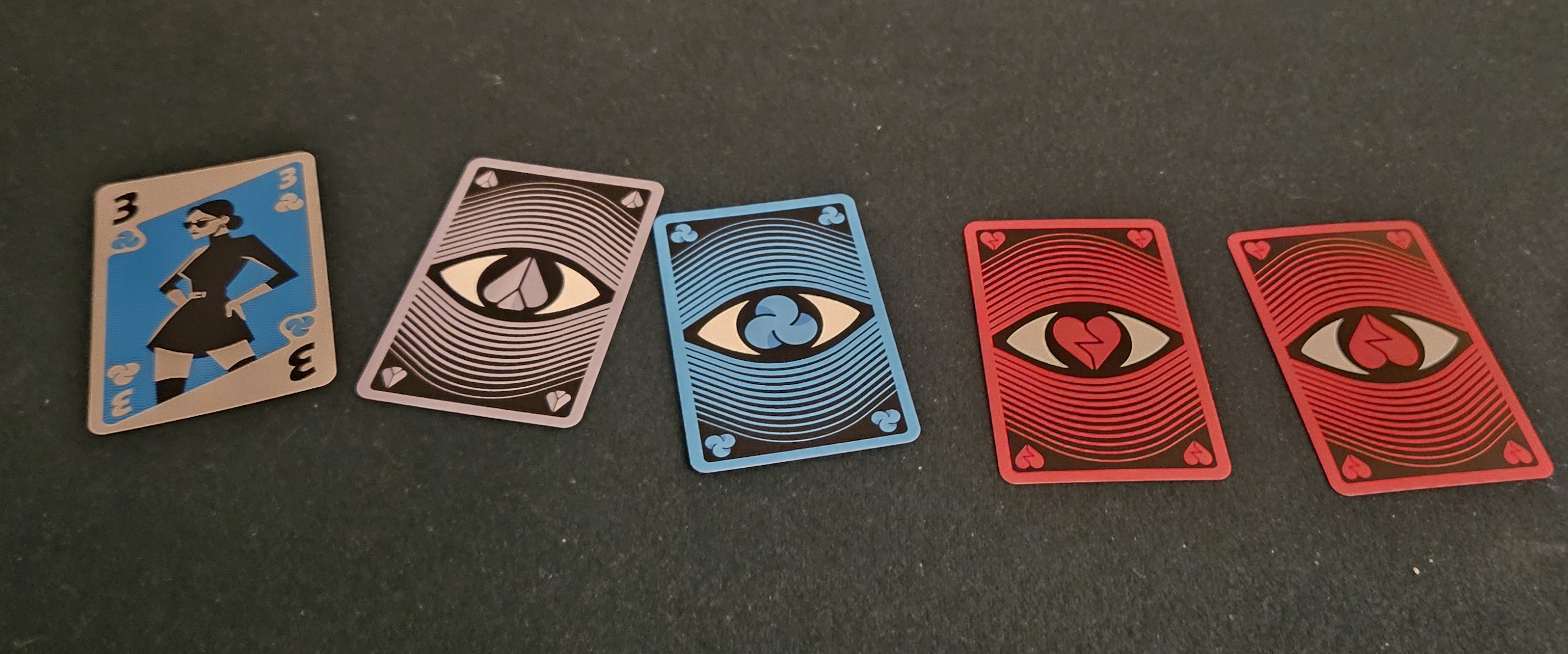
The spotlight card… and the permissible suits.
But what if I told you that sometimes you want to take points? This is where Chasing Shadows gets really clever. When the hand ends, your leftover card, the one you were still holding, is added to your score pile, and you tally the values of all your cards according to their various suits. But! If you were holding an even number of cards in a suit, you get rid of half of them. This means you can eliminate a high card by claiming a lower rank. Only once those points are scribbled onto your scoring card do they count.
Maybe not even then. Chasing Shadows is played over three rounds. And if, when the game ends, you’ve scored a particular suit twice — not once, not thrice, but twice — then its earlier tally is scratched out altogether. This means that sometimes, counterintuitively, taking a trick is how you lower your score. But only sometimes. And always a risk, the possibility of drawing extra heat if you happen to take yet another card later.
Perhaps this sounds impenetrable. Well, it is impenetrable. I would even say it’s deliberately inaccessible. That first time, maybe even the first couple times, Chasing Shadows feels overwhelming. You’re a newcomer to a circus that’s actively hostile to young bucks. Even doing your best can feel insufficient, slugging you with card after card. I’ve seen new players accrue some truly horrible scores. My mother-in-law even asked if we were pulling a prank on her. Wait, so why did I win this trick?
Over time, though, you learn the ropes. This is a game that can be mastered. You learn when to take the limelight and when to melt into the shadows. You learn how to mitigate a poor draw. You learn how to pin a nasty spotlight on one of your peers. You learn to be a bit of a bastard.
It’s marvelous. As with Torchlit, Spalinski has managed something truly impressive. Chasing Shadows is one of those unicorn trick-takers that uses its setting as more than a daub of spackle. The illustrations are one thing, they’re nice, but it’s the sensation that does it. Playing Chasing Shadows provides some glimmer into the headspace of George Smiley. Every trick has its angles. Every player at the table is as much a component as the cards. Every bad hand can be played well.
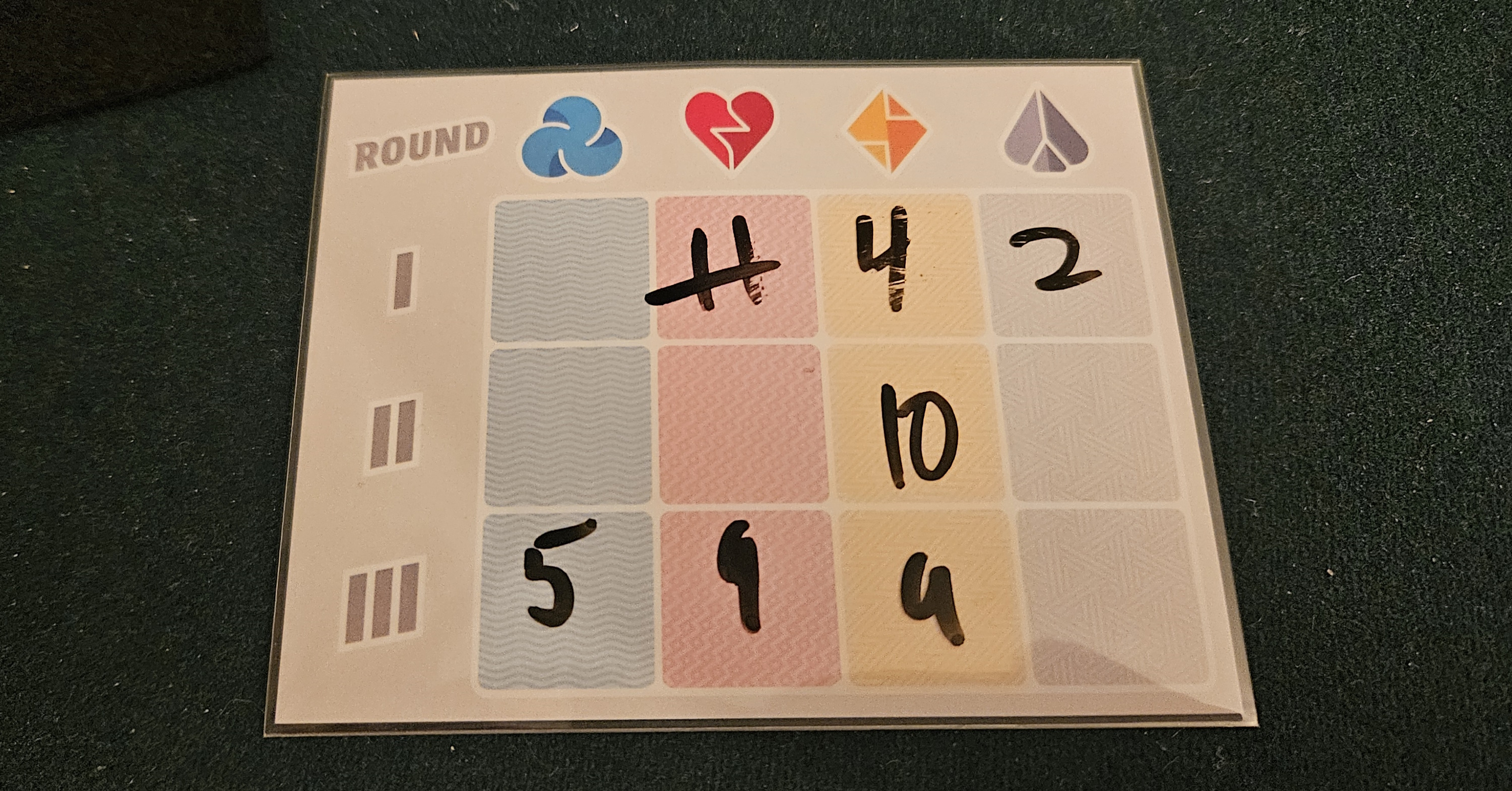
Careful scoring can erase points altogether.
The rest of the time, there’s nothing for it but to take the fall and hope you can recover later. That’s where Chasing Shadows really succeeds. There have been plenty of trick-takers about avoiding tricks. But this one is about recovering after the trip, about directing the heat toward somebody else. In an overcrowded genre, any given title risks fading into the crowd. In an ironic twist, it’s this little game about spies trying to blend in that deserves to be outed.
A complimentary copy of Chasing Shadows was provided by the designer.
(If what I’m doing at Space-Biff! is valuable to you in some way, please consider dropping by my Patreon campaign or Ko-fi. Right now, supporters can read my next essay, on the competing strands of history and criticism that are present in my work. That’s right, it’s the Death of the Author, bay-bee!)
Posted on October 21, 2025, in Board Game and tagged Board Games, Chasing Shadows, Indie Games Night Market. Bookmark the permalink. 10 Comments.

 SPACE-BIFF!
there seems to be pretty minimal info about availability of this game – I found an import site w/ a preorder, and that’s it. Any idea why?
It’s a self-published game that will only be available at the Indie Games Night Market at PAX U, barring any future publication deals.
ah, that’s too bad. Thanks!
Hiya, I’m the game’s designer. Similar to Torchlit, this will be available first at Indie Game Night Market @ PAX U, and then become available on webshops afterwards. I’ll create a thread on BGG for latest info on where it can be acquired.
Whew! Is there any chance you can update us here too?
I sure hope this one also gets picked up!
Oooh, sounds fun! I hope it gets a wider distribution.
Your comment about your mother in law made me laugh, because I once tried to teach mine Sheepshead (or, Schafkopf in German, which isn’t that complicated of a trick-taker, maybe a bit more than say Euchre), and she accused me of making up the rules as we were going along…
The few times I’ve played Schafkopf, it has indeed felt like Calvinball…
Torchlight has become one of my group’s favorites. I hope I can either make it to PAXU or find someone to snag a copy because this sounds really thought provoking.
Pingback: This Is Not a Review of a Pipe | SPACE-BIFF!