Anti-Fun
There’s one word I try to never use when writing about board games. The F-word. No, not that one. “Fun.” There it is. My critical curse word.
Today I want to talk about why “fun” isn’t an especially useful word — and more than that, why it can be misleading or even counterproductive when discussing board games as cultural artifacts. Along the way, I want to propose some alternatives. Nay, some improvements.

With deep apologies to this well-meaning commenter.
A couple months back, I cross-posted a tranche of reviews from Space-Biff! over to BoardGameGeek. This is always an arduous task, hampered by BGG’s weird text editor and incremental approval process. At most, I can move over three or four reviews at a time before I’m locked out for ten minutes, transforming a dull task into an overdrawn one. I wind up procrastinating, resulting in a negative feedback loop where I delay cross-posting more reviews until I have even more reviews to cross-post.
But my main hesitation has very little to do with BGG itself. Yes, you pegged where this was going, Sartre would approve, it’s the people who are hell. But I’m not even talking about the weirdos who put insults under every review or send nasty personalized notes about my appearance. There’s a more benign strain of comment, well-meaning and inevitable, but still frustrating because they speak to our hobby’s inability to think about board games as anything other than objects of entertainment.
Here’s the most recent example. Under one of these reviews, somebody asked, “I’m sorry, but after reading this review, I don’t know what your concluding thoughts were on the game. Did you enjoy it? Is it a fun experience or purely a deep and thoughtful one?”
Again, this question is well-meaning. It probably comes from a place of sincerity. It’s also an entirely reasonable question, within the bounds we’ve set for ourselves in this hobby. Still, it baffles me. Every time I’m asked this question or some variant of it, I stare at it for a little while. I type out one or two abortive comments. I think about it in the shower.
The problem is that I can’t answer that question. For a few very big reasons.

My family looking at pictographs. This was a fun experience.
You might have heard of the Fun Scale. Traditionally attributed to Dr. Rainer Newberry, a professor emeritus of geology at University of Alaska, Fairbanks, the Fun Scale is often used to explain how outdoor activities like hiking, canoeing, skiing, and bungee jumping might be considered “fun” even though, in the moment, they might also be utterly miserable.
Dr. Newberry divided fun into three types. When we think about fun, the version we mentally conceptualize most often is Type One. This is fun that’s enjoyable in the moment. We’re laughing, we’re having a good time, we have smiles on our faces. This is “fun.”
But hold on, because there are two types still to come. Type Two describes activities that are miserable or challenging in the moment but fun in retrospect. This is why the Fun Scale is often applied to outdoor activities; anybody who’s gone on a hike, bouldered some rocks, or biked a causeway can attest to those moments when you need to summit a particularly steep hill. You’re huffing and puffing. Your calves and forearms are burning. You’re sweating down your butt crack. You’re falling apart. But then you reach that summit, the breeze hits your face, the dopamine of achievement kicks in, and the hard work is suddenly worth the effort. Fun.
Or there’s Type Three, an activity so miserable that it’s painful to think about even once we pass through the other side. But there’s an exception. When you recount the activity in the right setting, it becomes “fun” as a story. Not to get all gooey on you, but I have fond memories of the time that I, a victim of sudden gallbladder death, engaged in a cathartic hour-long conversation with a celiac about our respective past gastric distresses. We were laughing. We were having a good time. We had smiles on our faces. And we were basically talking about the times we’d pooped ourselves. Fun.

Apropos of nothing.
Not in some ironical way. It was hilarious. And I’ve had similar experiences where other painful memories, some of them significantly more horrifying than a little bit of poop, were turned on their heads because they were allowed to peek out in the right company.
What’s useful about Dr. Newberry’s Fun Scale is that it’s easy to slot into all sorts of human experiences. With even a little bit of thought, most people can come up with plenty of examples from their own lives of both Type Two and Type Three fun.
In some cases, our capacity to find enjoyment in our misery seems like a brand of madness. What are we, we strange mammals, who deliberately stress ourselves through unnecessary exercise and competition, who scare ourselves with frightening films that scrape across the plaque of our psychoses, who leap from bridges or airplanes in pursuit of squirts of survival hormones, who deliberately engage with art we despise for the sake of mocking it? Once, when somebody apologized for hosting a game that I plainly disliked, I replied “Oh, no, this was great, I love playing games that I don’t like,” causing my host to look me in the eye and reply flatly, “What the heck is wrong with you?” (Yes, he said “heck.” As a Mormon, this is his birthright.)
But this is the reality of “fun.” “Fun” is a real thing. It is a definable thing. We recognize it when we see it. But it also happens to be many things at many times, not all of them easy to distinguish in the moment.
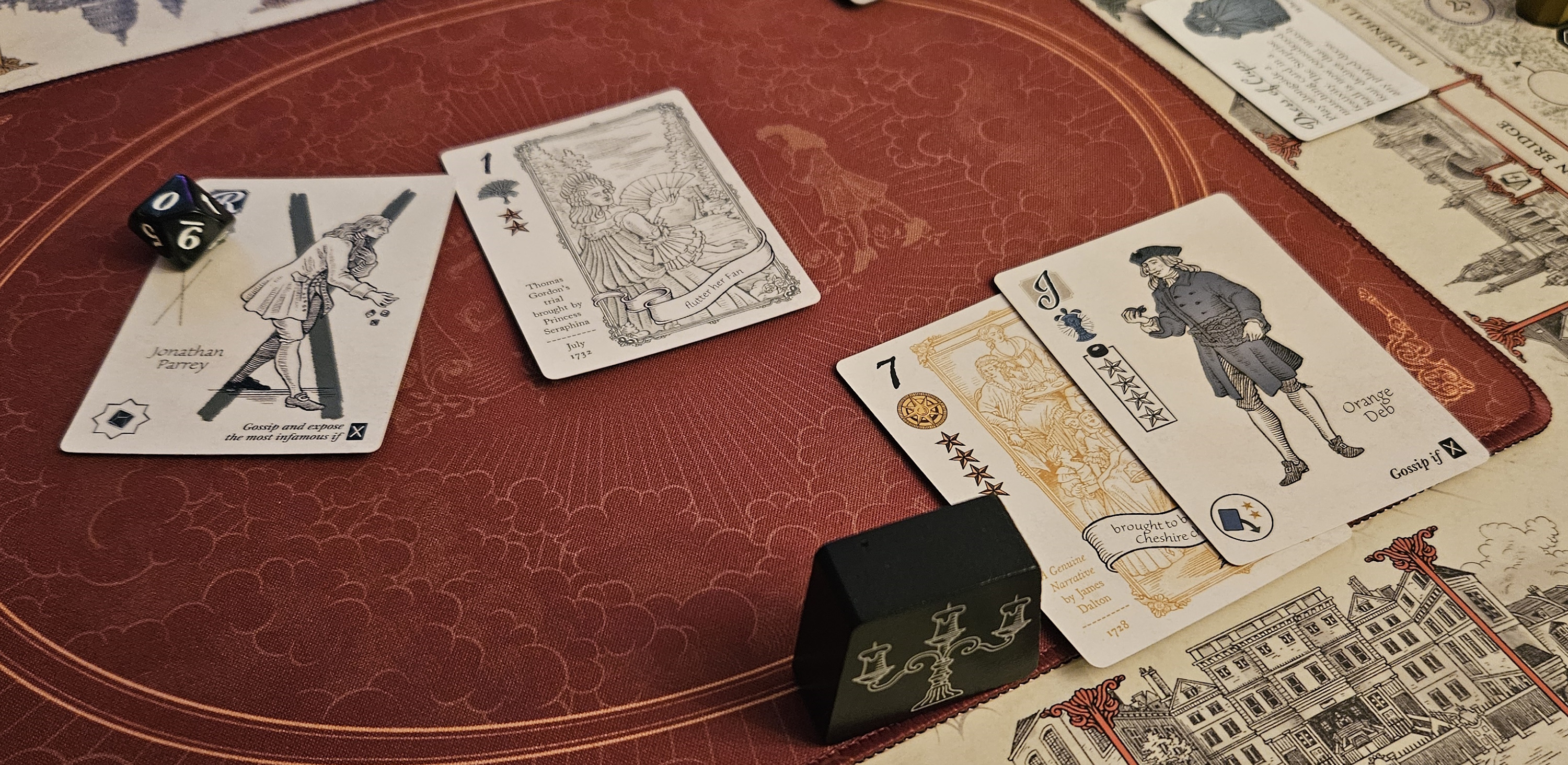
Molly Housing.
Let me share a memory that’s simultaneously precious and painful. Maybe the process will even be fun.
A few months back, I was asked to host a play of Molly House, Jo Kelly and Cole Wehrle’s game about queer joy, community, and betrayal in 18th-century London. Normally I look forward to teaching and discussing board games — bet you wouldn’t have guessed that — but this time I was borderline terrified. Instead of being asked to teach the usual table of weathered gamers, this particular group consisted of three transgender Mormon kids and their parents. Both the kids and their parents had been pitched on the idea of using this board game as a springboard to discuss queer identity. The kids were hoping to connect with the history of folks who, like them, didn’t fit the usual gender mold. Their parents were hoping to connect with their kids despite hailing from a religious tradition that’s very, to repeat the word for emphasis, traditional when it comes to gender and gender roles.
In other words, there was more riding on this teach than usual. Under normal circumstances I might flub a rule. Today, my catastrophizing brain was sure any flub would ruin a family.
Because there were too many players for everybody to have their own pawn, I divided us into teams. I was a player, as was the moderator for the event, followed by the three parent-child groups each commanding their own character. I settled into my usual rolling teach. Here are the pawns. Here is the map of London. Here are your cards. Here is a festivity. I took my time, pausing for the occasional digression to explain the Society for the Reformation of Manners, the activities of the molly houses, the ways gender roles had developed along various lines in differing times and places, the prominence of courtship rituals in London society and its parallels to queer folk cruising arcades and alleyways for prospective partners. When somebody wanted to get something off their chest, we paused the game. One of the kids talked about how they had never felt at home in their own skin. Another talked about how they had been bullied for wearing differently-gendered clothes — just like the constables of the Society had bullied the mollies. One of the parents admitted that he, as a priesthood holder in the Church, sometimes felt like he was encouraged to be a bully when he would rather leave people to make their own decisions. Sometimes the room resembled a knotted cord. Other times it felt like the cord had been picked loose, fingernail aching but triumphant.
The moment I had been dreading finally arrived. In Molly House, it isn’t enough to pursue one’s own joy. Eventually the bullies get their hooks into you. When that happens, the threats metastasize into real danger. Indictments threaten to ruin your reputation, or worse, put a noose around your neck. When that happens, players are given a choice. Forge ahead, defiant to the end. Or turn traitor, tattling on one of the molly houses in order to wriggle free of the hangman, but possibly ruining their standing with their fellow players in the process.
Here’s the problem. This is key to how Molly House functions. It raises important questions about how communities require trust in order to function, with the caveat that communal interest is always being weighed against self-interest. It’s the hinge upon which the game turns. But this requires a certain degree of mastery before everything clicks into place. That first session will be fumbling. Exploratory. And this particular group did not have the luxury of exploring through to the other side.
Again, my answer was to take it slow. When the Society raided the first molly house, I explained the implications of our indictments. I explained that we now needed to decide, each of us alone, whether we would stay true to our community or sell out a segment of it for our own safety. We were a good two hours into the session at this point. I could see that some of our players were flagging. My pulse was racing.
In my nervousness, I made the mistake. Not an in-game mistake. An above-the-table mistake. I turned to one of the kids and… totally misgendered her.
For a second, everyone froze. Shoot, I thought. Shoot shoot shoot. I’m still thinking it right now. Shoot shoot shoot.
I apologized. She shrugged it off.
Gosh. I felt like the most awkward person in the world. But then we kept playing. We talked about betrayal. One of the kids talked about how she had betrayed someone like her, had laughed at them behind their back, so she could keep fitting in with her cis friends. “I guess I already know what I’d do, back then,” she said, and her father said that she was courageous to recognize that she’d done something wrong.
In the end, we wrapped the game up early. According to the moderator, it had gone great. I imagine they say that to all the volunteers.
Is this fun? Are we having fun now, recounting this awkward, tense, uncomfortable experience? Was I having fun then, feeling like a jerk for trapping these people in a game they normally wouldn’t consider a good time, making an ass of myself by misgendering this at-risk kid?
Here’s the thing: I think so. I think this was fun then. I think it’s fun now. More than that, it was (and is) all three types on the Fun Scale jumbled together. But to explain how that could possibly be, we need to expand our scope. We need to talk about what “fun” means in the first place.

I don’t actually know why I picked this image.
There are plenty of possible sources for peeling apart the idea — or rather, the ideas — of what “fun” can mean, but since we’re talking about board games, it seems fitting to invoke the critical language of our sister genre: the video game.
Marc LeBlanc is best known for his design work. Ultima Underworld II, Terra Nova, Thief, System Shock — those Looking Glass classics that defined the ‘90s all carry his fingerprints. At the same time he was contributing to modern video game design, including helping invent the immersive sim genre, LeBlanc was also developing his own taxonomy of fun.
Called the “8 Kinds of Fun,” LeBlanc’s point is that certain words, such as “gameplay” and “fun,” are hopelessly vague. Rather than talking about something being “fun,” it’s more useful, both as designers and critics, to dig deeper into our taxonomical reservoir. To meet that aim, he lists eight kinds of fun that appear in games:
Sensation: These are games that seek to elicit a certain emotion, whether we’re talking about a horror game making you check over your shoulder even though you’re safely seated on your couch or Guitar Hero selling you on the idea that you’re a rock god. In terms of genre, these are about as far apart as you can get. Keep that in mind. We aren’t talking specifics, or even quality.
Fantasy: Games as make-believe, role-play, escapism, and immersion. When a game asks you to fiddle with your inventory, invests you in a wacky cast of war-teens, or zaps Link with lightning because he was carrying a metal shield, these help sell the idea that you have been whisked into different circumstances.
Narrative: Drama! Romance! Walking simulators! That last one is especially important, because it sidesteps one of the usual questions that comes up around games, digital and analog alike, where essentialists insist such-and-such isn’t a game because it’s linear, doesn’t contain decisions, or whatever else. We’ll talk about what is or isn’t a game in a future installment of this series — spoiler: I’m not on the essentialist side of the debate — but for now it’s enough to establish that plenty of people play and enjoy linear or decision-light games.
Challenge: This is the category for Dark Souls and its bazillion children. Whether we’re talking about difficult single-player games or multiplayer shooters, this is the type of fun that arises from mastering a system or butting your head against a problem. Puzzle games abound.
Fellowship: Interestingly, this is more prominent in tabletop than in LeBlanc’s space, although of course there are no shortage of examples over there either. Any game that’s played principally to share space with other people falls under this category. See, for example, multiplayer-solitaire games or those awful “say the most racist thing” party games.
Discovery: Do you enjoy seeing what’s around the next corner, over the next hill, or which Renaissance figure Ezio Auditore will flirt with next? Sure you do. We all do.
Expression: Sandboxes! In LeBlanc’s formulation, something like Minecraft would be the pinnacle of this category, although there are now enough survival-crafters out there that you can hardly scroll through Steam without accidentally downloading one. In tabletop, I would include tableau-builders like Santa Monica, Scream Park, Among the Stars… any game, really, that makes you want to photograph your creation.
Submission: The final of LeBlanc’s categories is probably my favorite, because it describes a brand of gaming that outpaces both digital and analog games by an enormous margin, but which is often excluded from critical evaluations. That’s right, I’m talking about gambling. LeBlanc uses the notion to talk about games as pastimes, anything that’s grindy or farmy, but the term “submission” is apt for any play-state that sees its players zoning out and just enjoying themselves. In addition to gambling, we’ve got sports-watching, a bunch of just-one-more-turn civgames, puzzle games that don’t actually require much puzzle-solving, and a whole lot more.
Now, one of the things that I appreciate about LeBlanc’s framework is that it isn’t exclusive. Unlike all those tedious is-it-a-game-or-isn’t-it discussions, this isn’t meant to pigeonhole any one design. Rather, its function is descriptive. Going down that list, there’s a good chance you thought to yourself, “Oh, this game I like fits this category perfectly!” only to later say, “Oh, that same game also fits this other category!” With some squinting, you could scrape certain titles across the whole spreadsheet.
Skyrim, for instance, is open enough, sandboxy enough, and bland enough that I’ve heard different sources slot it into every one of those eight categories. That isn’t necessarily a compliment — it’s just a description. One could argue that Skyrim kinda-sorta fits into each category, but isn’t all that great at any of them. Or maybe we think it’s the bee’s knees and nothing has ever been better at being immersive and an example of submission-style gaming. Again, this isn’t a value scale. It’s a range of description that helps us pick into different ways that players have fun.
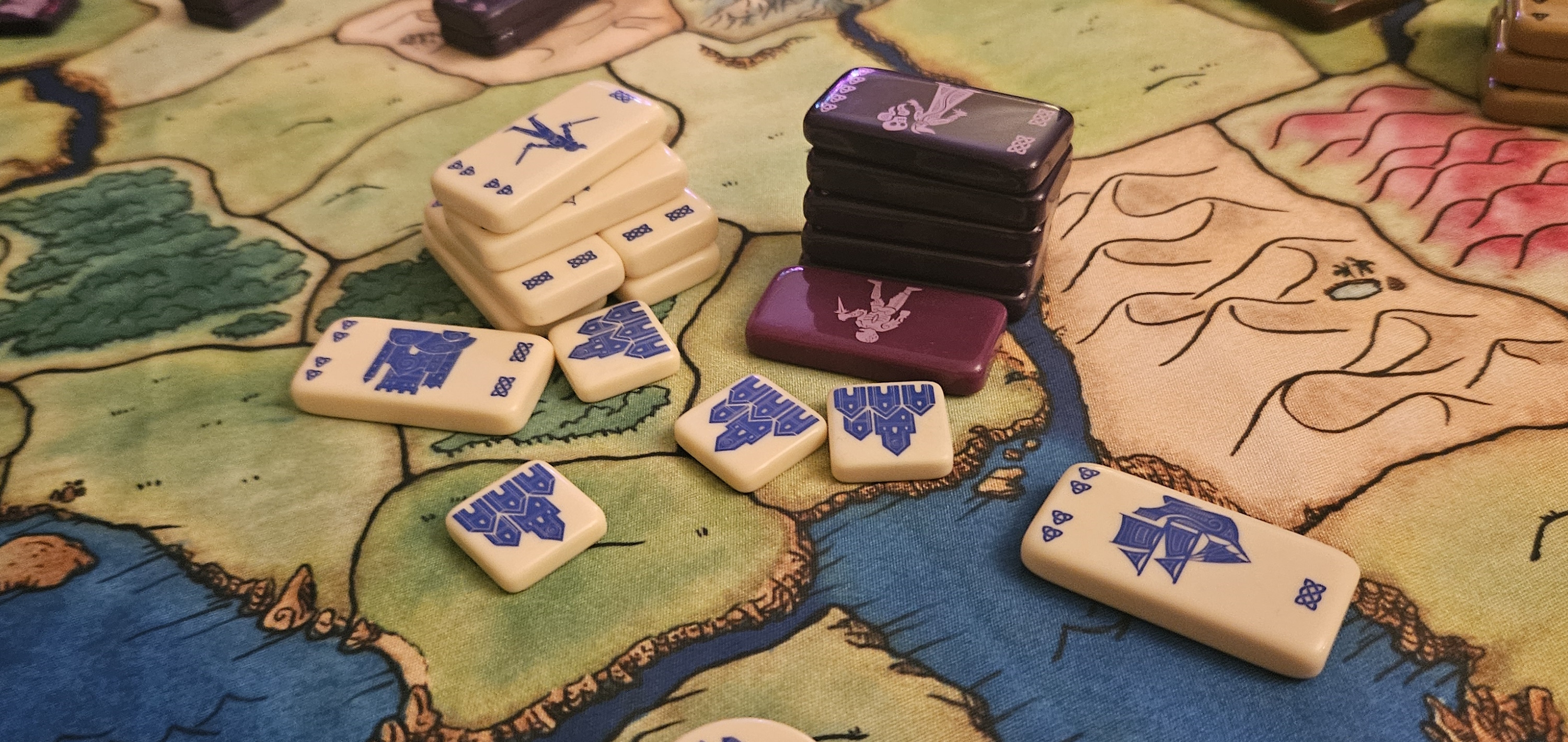
Anti-fun. Not that way.
In that spirit of non-exclusivity, here are a few additional brands of “fun” that I often think about when playing and critiquing board games.
Modeling: This is a type of fun that revels in experiencing a model. Not in the immersive sense; the artifice of tabletop is such that immersion often poses novel challenges to designers and players. Rather, in how this type of pleasure arises from engaging with and examining a model. Any game that includes designer notes is probably trying to tickle your model-maker brain.
Rhetorical: Connected to the above category in that rhetorical-pleasure often derives from modeling-pleasure, this type of fun emphasizes the engagement between player and designer. It’s conversational, sometimes open and sometimes not, and sometimes feels more like a discussion than anything else. In a sense, this is my preferred style of fun, the fun that arises from critiquing a thing. Thanks to their crystallized rulesets and relative simplicity, board games inherently invite critique, and anyone who’s tried to write a review, including something as simple as a rating on BGG, has engaged with this brand of fun. Or tried to. Sometimes it results in a no-good, awful, terrible time. I’m looking at you, BGG Reply Guy.
Ambiguity: I would consider this the inverse of LeBlanc’s fellowship-fun. There are video games that have tackled social ambiguity, of course, but there are heaps of board games that directly center the uncertainty between the players gathered at the table. Molly House, for example, includes major notes about fellowship-fun, but also leans hard into questions around ambiguity-fun, the risk of not knowing the intentions of the people seated to your right and left.
Profundity: I cannot be the only person who enjoys philosophy, descriptions that make me see a topic from a fresh perspective, or games that shine a light into the deepest recesses of my mind. Sometimes we enjoy things because they make us think more deeply, or at least imagine we do. Don’t believe me? Fine. But literally everybody I know can quote at least one treacly speech from The Lord of the Rings. Boom. Proof, baby.
To really strum this banjo, these also aren’t exclusive! Rather, these are spheres of thought that are more useful descriptions than merely saying that something is “fun.” Which brings us back around to the question somebody posed to my review.

He’s back, the BGG Reply Guy.
I’m sorry, but after reading this review, I don’t know what your concluding thoughts were on the game.
Did you enjoy it?
Is it a fun experience or purely a deep and thoughtful one?
That question, which opened our discussion today, was deposited in response to my final review of Molly House. As I stated earlier, I understand why somebody would ask it. The idea that fun is one particular thing, a sort of whee! I’m on a rollercoaster style of fun, is deeply rooted in our hobby.
But what is fun, anyway? Why would I say that a game was deep and thoughtful but not fun? Oh, sure, it might not have been fun in other ways. Maybe Molly House is Type Two fun rather than Type One fun (ehhh). Maybe Molly House isn’t all that exciting (although it is) or vibrant (it’s literally about throwing sex parties) or immersive (again: sex parties). But if it’s “deep and thoughtful,” isn’t that also worthwhile? Isn’t that also fun?
I think it is. I think a lot of things are fun. I think playing bad board games can be fun. I think awkward play sessions with apprehensive youths and doubtful parents can be fun. Challenging? Uncomfortable? Unfun in some ways? Those too.
But that’s what I mean when I talk about fun — or rather, when I don’t. Fun isn’t one thing. It’s many things. Many complicated, intersecting things, sometimes bound up with other things that are no fun at all. And when it comes to something as multifaceted as human play, we deserve a wide-ranging and questing vocabulary to describe what’s going on at the table. “Fun” just doesn’t cut it.
Next time, maybe we’ll tackle a word everybody can agree on. How about “art”?
(This article was only possible thanks to generous donations by my supporters. If what I’m doing at Space-Biff! is valuable to you in some way, please consider dropping by my Patreon campaign or Ko-fi. Right now, supporters can read my next essay, on the competing strands of history and criticism that are present in my work. That’s right, it’s the Death of the Author, bay-bee!)
Posted on September 30, 2025, in Board Game and tagged Board Games, Talking About Games, What We Talk About When We Talk About Games. Bookmark the permalink. 44 Comments.

 SPACE-BIFF!
An interesting read, this, but it’s not very clear whether you liked writing it or not. Was it fun? 😉
get outta here you salty bastard!
I figured you’d take that in the Spirit intended… 😁😉🤣👍
I did a talk at a conference years ago on this topic (it’s still on YouTube: https://youtu.be/dWR42Q0PrYs), and it’s great to see this concept discussed further. Games are a powerful medium, and discussing them with a fun-centric approach only helps nobody.
Thanks for sharing that Ruger, I’m really looking forward to watching your talk.
Thanks! It has 6+ years, so perhaps it should be updated, but I still stand by most of the things I said there.
Thanks for sharing, Rugerfred!
No, thank you for your incredible articles, as always.
Dan, I’m really glad to read this as I’ve also been feeling some dissatisfaction with the word ‘fun’ and have been considering it through the lens of designer as well as player. I’ve started collating some of my thoughts in a document called 25 Forms of Fun (started out as 20 and keeps growing of course!). I was also inspired by Marc Le Blanc’s list as well as Nicole Lazzaro’s and Pierre-Alexandre Garneau’s writing, as well as others. It’s here, if you’re at all interested https://docs.google.com/document/d/1BPkG7ZL2hrKz6Lhej9ZFmVolsYVPzIKsd4DuepazWwg/edit?usp=sharing
I’m now going to think about your other contributions, like ‘Modelling’ and see where they fit into my framework. I’ve been simultaneously having an interesting chat on the Board Game Design Lab facebook group about how something like ‘Historical Fidelity’ could fit in, which seems to have some overlap with that. Thanks for all you do!
Thanks for sharing your doc! I’ll take a look later today.
I think ‘fun’ is well-defined if it’s kept more to the light-hearted enjoyment connotation in gaming (ie. King of Tokyo is fun, but hiking or a serious game of Brass are not). It’s too vague if extended to any kind of enjoyment.
To be fair to the commenter, that person was contrasting ‘fun’ with a thoughtful experience, so I think that was the intention, (ie. did the game have elements of light-hearted enjoyment throughout the thoughtfulness, or did was it only intellectually enjoyable.) I think that’s a fair question, as some players are looking for at least some playfulness in their game nights.
(Beautiful writing and insight, as always, Mr. Biff.)
Right, and to be clear, I’m being somewhat provocative here. I don’t really hold it against that commenter, I think I know what they meant by their question, etc. I just get a LOT of questions about whether something is fun, but those queries always leave me a little unsure. And that’s before we really dig into the issue of subjectivity!
>>> Next time, maybe we’ll tackle a word everybody can agree on.
“What is a wargame?” 🤣
Ha! You probably won’t be surprised that I have an old article asking exactly that question… which will likely forever remain in the drafts folder because I don’t need old grognards shouting at me.
Release the wargame files!
Recently I’ve been trying to develop a play test simulator using coding to speed up initial play testing of a game I designed. My hope is that I can spot actions in the game that never get chosen for one reason or another by running hundreds of simulations and analyzing what happened across all of those simulations. I’m still in the early stages, and lately I’ve been working on measuring the utility of actions in the game to develop a model for simulated player decisions.
While you can turn most decisions into a mathematical utility equation, this doesn’t address at all whether a game is “fun.” I’m going to take the criteria you discussed in your post above and try to do some work with it to see if I can translate any of the above definitions into a quantifiable or measurable utility. Prior to this I was thinking, “how the heck do you quantify and measure fun???” Maybe you’ve given me some clues. I doubt much will come of it, but I’m going to try. I’m going to save this article as inspiration for designing games. Fantastic article, Dan. Thanks so much for this.
You know, even if nothing comes of your efforts to encode these definitions, I think there’s real utility in how we request and assess playtesting feedback.
I try a lot of prototypes, and often the designer will ask for feedback afterward. Sometimes they come prepared with a list of questions. (Always appreciated!) In some cases, though, those questions are hopelessly broad, like “Did you find the game fun?” or “Which parts did you find interesting?” This results in a lot of hemming and hawing from the playtesters. Some strong alternatives we could glean from LeBlanc’s list might include “What did this game make you feel about your fellow players?” or “When you did X, were you excited to see what came next?” Concrete questions that might guide the playtesters to recall specific events, rather than considering the game so holistically (and so ambiguously) that they’re left flailing.
The question makes me wonder, has the commenter never played a game where some people were clearly having fun, and others weren’t (and it wasn’t entirely due to how well they were doing)?
A good review, for any medium, should help the audience determine if the subject would be of interest to them, regardless of the reviewer’s preferences. I’ve read plenty of reviews that were positive but told me I probably wouldn’t enjoy it, and plenty that were negative but told me I might be interested.
In my experience , your reviews are detailed and well thought out enough to be “good” reviews by that metric, so I don’t know if the commenter needs to be more self reflective about their idea of fun, or were they just being passive aggressive by framing it in terms of “fun” vs. “thoughtful” as a way of dismissing the game as a game? Hmm, I started with one question about the commenter and ended up with a completely different one. lol And your column works nicely as a response to each option.
Right, and I didn’t even really dig into the subjectivity issue all that much. I think pretty much everybody has sat down with a group where one person had a bummer experience even though everybody else was having a good time. Good criticism, I feel, should do exactly what you’ve mentioned, and try to dig into the whys behind the emotions.
A tought provoking AND fun read! Thanks, once again!
Thanks for reading!
Great post! I was delighted to find recognition of “modeling”, as you term it–a sort of enjoyment that underpins my love of many of the more elaborate games.
I also find myself musing on the degree to which this question exists as a response to game reviews. Within that context, “but was it fun?” often seems to come from the consumerist mindset. It’s a proxy for “is this worth my time?”, but the asker has put “having fun” as the core measure of “worth my time”. A question of whether the design is fit for consumption, and I think that’s the core issue with it. To begin with “is this fit for my consumption” is to collapse any reverence for a game.
Yep. I’ve written about how we need to disentangle games criticism from their now-customary role as a buyer’s guide. Funny how many people got riled up by that one!
Great article, as usual, but in a post about board games you picked Guitar Hero as the example of being a rock god?
I’m wounded, Dan. Please send a healer, stat.
Oof, you’re so right.
I should have used Famous: Stage I instead.
KABOOM!
(more seriously, I am so sorry!)
Transfemme here with a religious background
Thank you for running that game of Molly House
Ah, that’s very kind of you to say. Thank you.
Thanks for another thoughtful piece. The bit about “submission” made me think–these days I have small kids, so I mainly get my board game fix by listening to other people play board games on YouTube while I wash dishes. I never thought about it this way, but really the joy of that is not so different from the joy of being in a game when it is someone else’s turn.
Interesting! There’s a lot of game-watching these days, whether video game Let’s Plays or those RPG groups that make millions of dollars. I think those strike a lot of old-timers as weird and newfangled, but really it’s not that far off from watching sports. Spectation, I would argue, is also a form of play, albeit one that’s a short distance removed.
Love your thoughtful writing, as always.
One of my favorite writings out there about a game that wasn’t necessarily fun (at least in the colloquial sense), but was definitely impactful and worthwhile, is the Shut Up and Sit Down review of Dog Eat Dog by Pip and Brendan. I see elements of your ambiguity and profundity in there, for sure.
Have you ever read A tehory of Fun for Game Design by Raph Koster? It also, unsurprisingly, talks about fun and the play of games. And… seems to take a different angle than the sources you cited. It was certainly a book I’ve enjoyed reading more than once.
Not sure if it was fun, mind.
I have! It’s something that will probably come up in a later installment of this series.
Could you tell me what is that anti-fun game with dominoes-like pieces? It is inspiring (and I’m drawn to this idea of blocks because the haptic sensation of moving Mahjong pieces around is my special kind of fun)
That’s Bloodstones by Martin Wallace.
Thank you!
I’m enjoying your thought process on this subject.
The notion that rings true for me when considering all of these fun senses is memorability.
Personally, specific prescriptions of “fun” that delineate the games people will sit down to play often confuse me. Sometimes when fun is prescriptive I imagine that it is possibly an issue of control, or maybe emotional scaring. I was treated to a parable of a fool, presumably on behalf of our table, to chasten me after I disturbed that player’s sense of “fun” . Deserved or otherwise the person felt strongly enough that punching me in the face with words was justice served to this surprised and shamed transgressor against fun.
Cheers.
Huh! I’m sorry you were subjected to that… very strange display.
Thanks, it’s okay. I’m hoping there is some pertinence…not perhaps directly with the categories you have outlined more on internal arbitrators of fun.
Appreciate your reply.
Cheers.
Thanks for this thoughtful take, Dan. I recently started a project looking into the shared concerns and “problems of practice” that teachers and game designers share. My students (future 6-12th grade teachers) often express “fun” as a central goal for their teaching. While I understand what they mean, fun distorts the goal of teaching – it should be learning. As you note in type 2, there can be fun from effort/challenge. But thinking about those other dimensions of fun is also helpful. Look forward to the next – will you be drawing at all on C. Thi Nguyen’s Games: Agency as Art? On my TBR pile for after I finish the aforementioned A Theory of Fun by Koster.
Yes, I believe I’ll talk a bit about Nguyen’s book. Personally, I like his definition, even if I find it slightly too restrictive.
Hehe reminds me I recently finished a game and I said to my wife “well, that was fun”, and she (not a native English speaker), a bit confused and dead serious replied “then why aren’t you laughing?”. Yeah… fair enough.
As I’m reading this, I have my BGA profile open where I can easily see the Elo on all my games, and those of my friends. There’s another type of fun that I might call Mastery or Competition. There’s the fun of winning a thing, sure, but I think more than that there’s also fun in getting to really understand a thing.
In my corner of adult education we talk about creating self-directed learners. I don’t think we put enough emphasis on how deeply learning something is fun. Is doing review questions to study for the boards fun? I submit that the answer is yes.
Definitely! I suspect I’ve probably been lumping that emotion into a different box… satisfaction, maybe? But I agree that mastery/competition is a useful conceptual category of fun, one that I’ve happily applied to study and education.