Distant Rumble Train

Despite all outward appearances, Lightning Train doesn’t include any magic. Which is something of a double statement. I went in expecting locomotives propelled by atmospheric violence; instead, we got a rare Paul Dennen miss. It isn’t that I wanted another Empyreal: Spells & Steam, exactly. Just something with spark. Even a little zap from the light switch after walking on the rug with my socks would have done.
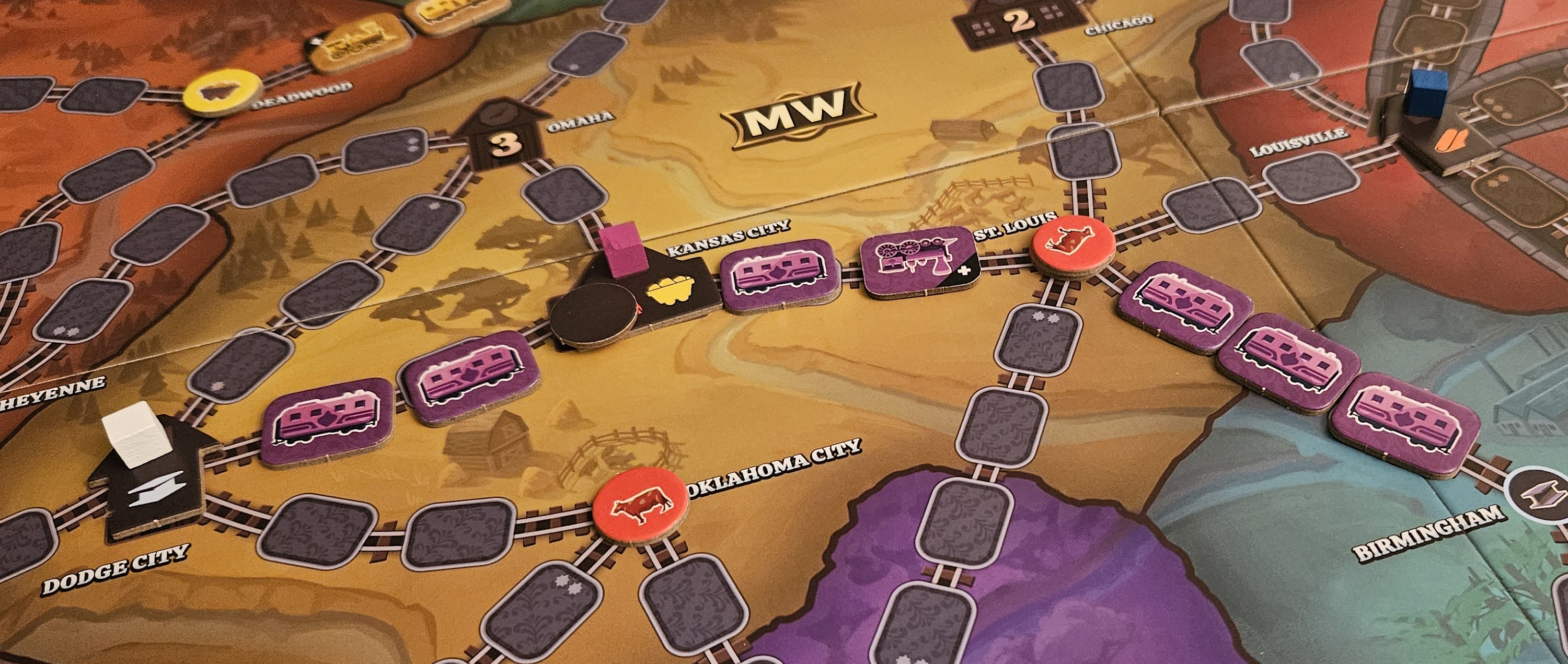
Building routes. Ordinary non-magic routes.
“It’s like Ticket to Ride,” she said.
It isn’t like Ticket to Ride. But I get why she said it.
Spread out on the table, Lightning Train looks like Days of Wonder splurged on some ink. Here’s the United States, stylized so Denver is south of Salt Lake City and the Great Lakes are somehow even greedier. Here are those train-housing lines spanning the continent. Here’s your sinking suspicion that this is a train game based on luck instead of stock speculation.
That’s where the comparisons end. Lightning Train is about very train-like things indeed, building routes and erecting stations and delivering cattle or oil or passengers to their destination. In a nod to other train games, it even features shared incentives, those deliveries benefiting everyone who owns the lines and stations used to ship or receive the map’s various goods.
The fire that stokes this engine, though, is Dennen’s take on the bag-builder. Turns revolve around chits pulled from a bag, at least five but maybe as many as nine — or even more, depending on how you count them. This is thanks to a system where some chits accumulate off to the side of your usual draw. This requires players to pull chits one at a time, inspecting each one to determine whether they’re added to the boarding area as normal or slipped into one of two bonus slots. Eventually, if you prioritize the right upgrades, two more of these slots become available.
And then there are the titular lightning trains. Certain chits show an icon of a train with a lightning bolt on its side. Aha! There they are! Perhaps this is where the magic begins? Alas. Drawing such an icon adds yet another chit to your boarding area. These are your railcars, the pieces that must be spent on the game’s various actions. Routes, stations, upgrades, blowing your way through mountains. If an action has a cost, you’ll be spending trains to do it.

Drawing chits to do ordinary non-magic things in my ordinary non-magic… gopher company.
This system quickly establishes its own tempo. Early on, your boarding area clogs with those bland starting chits. A dollar here or there for buying new chits from the market. One or two railcars for early actions. Perhaps a contract, those color-coded chits that allow you to tap a region for one of your lines or stations.
Over time, draws start to generate heat. Better contracts, maybe even with stronger purchasing power. Extra bonus draws. Little conductor hats, redeemable at the uninspiring rate of two for another (you guessed it) lightning train. And, if you’ve purchased the right chits, maybe a tidy stack of railcars for triggering actions.
It ramps up nicely, provided you’ve selected the right stuff from the market. In my last session, I was whipping through my entire bag almost every turn, generating five or six lightning trains at a pop. That translates to at least one solid rail line, plus usually another, or else a station for receiving deliveries. The actual process of building such a line requires a few different things: the requisite trains, a regional contract, maybe some explosives. Oh, and adjacency to a station or a previous line. A buncha stuff. So much stuff that the game’s reference cards are sadly unsuited to the task. But with the right draws, you’ll be wondering why the transcontinental railroad was such a fuss. I laid track from Los Angeles to Albuquerque in under a week. What is this itsy-bitsy continent? Europe?
Then again, you might draw duds. While Lightning Train is a game about building velocity, Dennen only provides so much fuel. Your starting chits are subject to some winnowing, of course. Those three starting contracts get burned the first time you use them, and upon establishing your third station you’re allowed to trash one chit. But that’s it. This keeps many of your worst chits in the bag from setup to breakdown. And there’s nothing quite as frustrating as leaning into the final turn with nothing but a few dollars and a spare locomotive to your name.
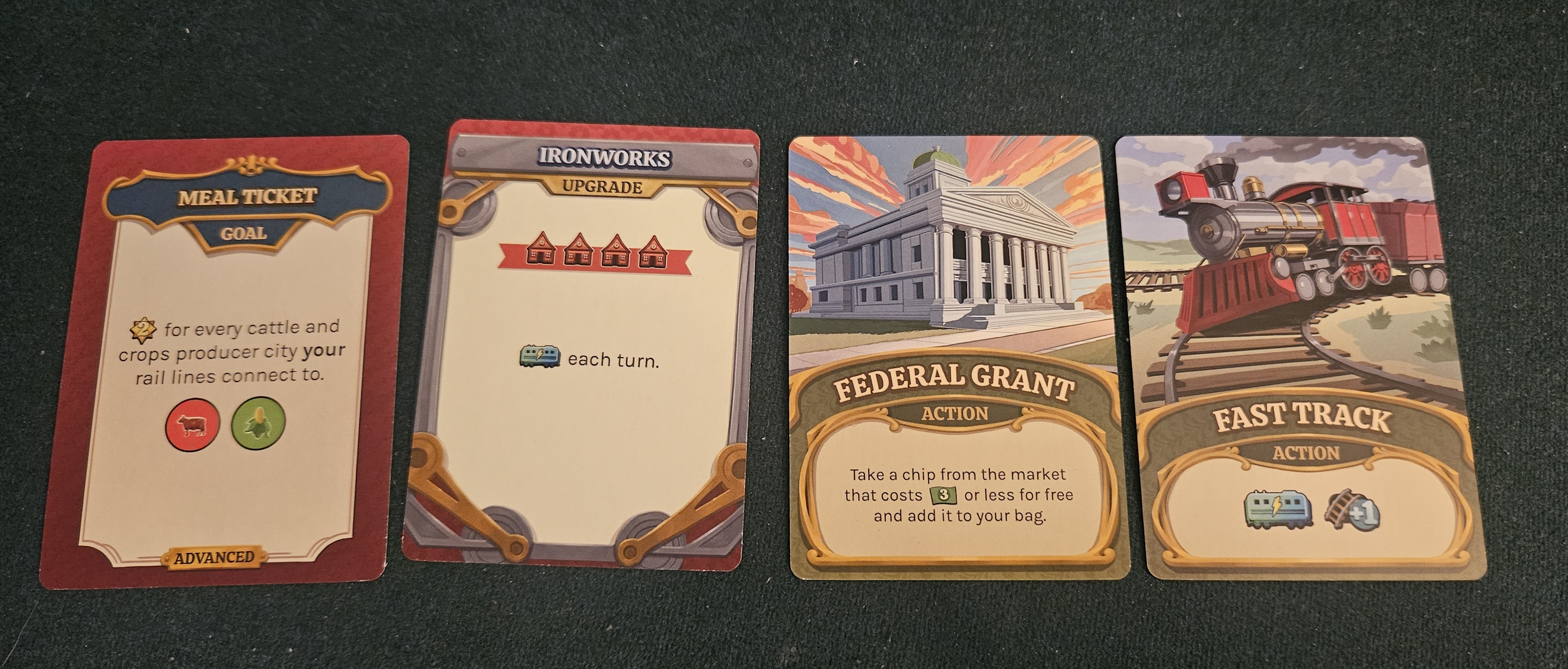
Red and green cards.
Of course, this is Dennen’s wheelhouse. He’s played with luck many times before. Dune: Imperium asks you to build a deck that will dominate both the map’s worker-placement game and its ongoing battles. Clank! sees your hapless adventurers knocking buckets down chasms to awaken monstrosities better left slumbering. Even Wild Tiled West, which I had previously considered the low point in Dennen’s oeuvre, requires some crossed fingers to get the right market roll.
But those games leveraged their long odds to their advantage. Dune: Imperium is, in many ways, a game about mitigating the possibility of poor outcomes, and both it and Clank! feature a number of ways to craft the right deck for the job — or focus your attention elsewhere and run the risk of suffering the consequences. Wild Tiled West might cough up a bad roll, but you can spend gold or follow the river to acquire a desirable tile. In each case, these titles allow the player to fail, but also offer the tools to overcome or mitigate those failures.
Lightning Train is more impulsive. You can decline to fill your bag with chaff, and the market system, which sees tiles gradually dropping in price, feels like a response to some of the criticisms levied at Dune: Imperium. But these steps are so limited that Lightning Train never quite overcomes its worst tendencies. Right up until the final turn, the possibility of a flub hangs over the entire experience. There are too many ways for a turn to go wrong. A missed contract, not enough trains, too many wimpy chits. The equivalent in Dune: Imperium would be if an ordinary move required two or three complementing cards rather than only one.
And those tendencies aren’t alleviated elsewhere. There are two separate sets of cards to draw from, a red deck for objectives and upgrades and a green deck for bonus actions. Over the course of the game, you’ll only draw from each deck a couple of times. If you happen to pull a card that meshes well with your goals, that’s great! Free points! A rubber stamp for cutting through all that red tape! Whee! We’re ridin’ that lightning train, baby! But you’re just as likely to receive a federal grant that lets you select a crappo chit from the market, which in some ways is less than worthless because it clutters your bag further, or an objective that’s already out of reach. If these were errant draws in an otherwise robust card economy, that would be one thing. Instead, each card is one of the few you’ll ever acquire. The entire thing feels mistuned.
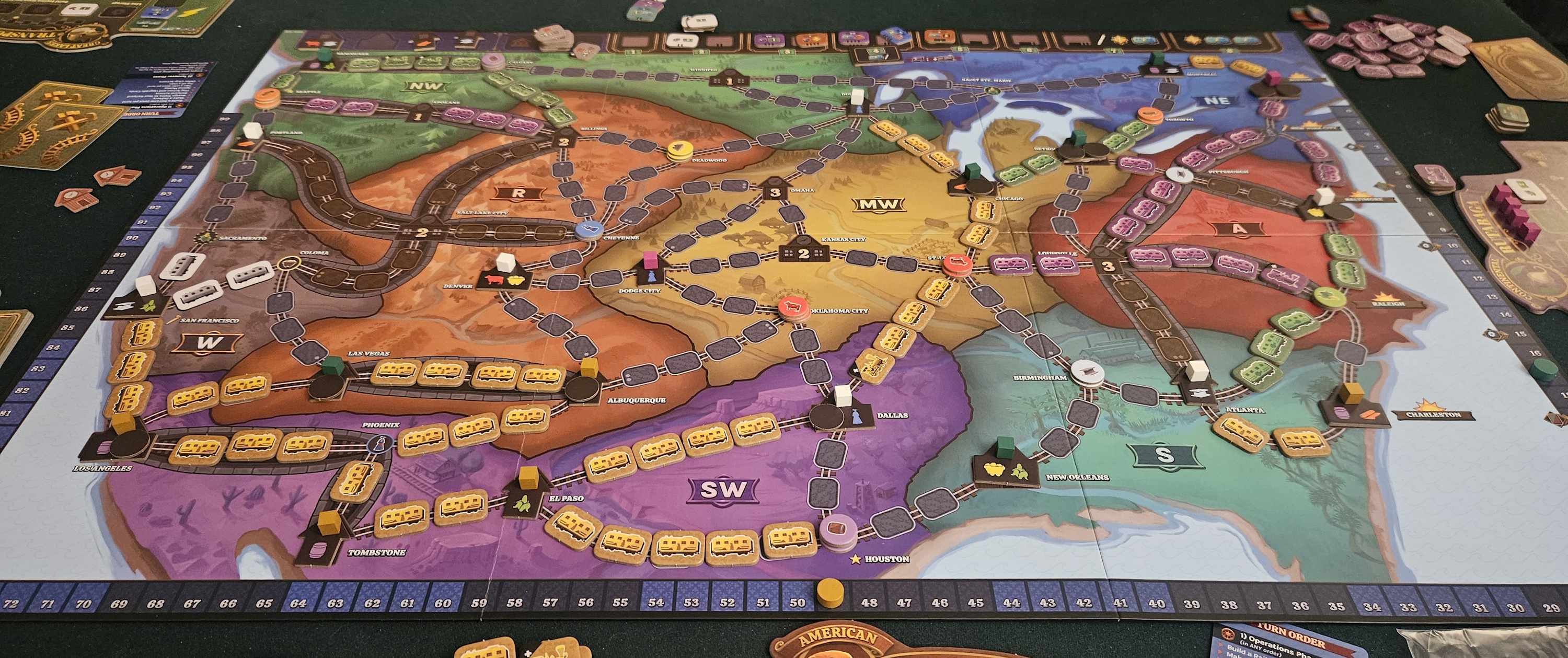
As the yellow player, I really dominated this one.
The result is a game that feels slack and baggy, sometimes rewarding players with a veritable station of locomotives, cash, and contracts, and other times burdening them with turns that aren’t much better than skips. Naturally, turns of the former sort take longer to resolve, increasing the downtime for the rest of the table. Way to slice off a damsel’s legs when she’s already tied to the track, Lightning Train.
This game didn’t need to include magic spells to be good. But it would have benefited from some electricity. Instead, it offers ill-timed jolts that might as well cramp your abdominal muscles as propel your train forward. When it comes to lightning and trains, that’s the wrong kind of static.
A complimentary copy of Lightning Train was provided by the publisher.
(If what I’m doing at Space-Biff! is valuable to you in some way, please consider dropping by my Patreon campaign or Ko-fi. Right now, supporters can read my second-quarter update!)
Posted on August 20, 2025, in Board Game and tagged Board Games, Dire Wolf, Lightning Train. Bookmark the permalink. 9 Comments.

 SPACE-BIFF!
So, the game’s called “Lightning Train”, but does the “lightning” part even do anything? From your review it looks like a “Regular Train”, so the supposed theme is not even in the game?
Also, it looks really ugly and dated.
“Lightning train” icons give you normal trains. There are also special locomotives, which are the same as normal trains except they have plus icons, so you can draw them as extras.
But yeah. It’s regular trains all the way down.
Got it, thank you. It seems like a massive waste of a theme. I’d expect to have some light(ning) speed travel or something.
Thanks for the review, Dan. I’ve been watching this game quite a bit, and I’m sorry to hear it’s a bit of a flub. It seems like there may be some good “bones” in this game, however, that would benefit from some targeted house rules. While some eschew house ruling games, I’m actually a big fan of it. I wonder if this game would benefit from creating a mechanism to trash chits from your bag? This would support better moves, and may speed up the game? I’m not sure; just guessing.
Also, maybe consider ways to draw more than the cards allowed from the two decks? Instead of just drawing 1 card, maybe draw 3 and keep 1? Or maybe draw enough for all players plus 1, and the player who drew the cards picks 1 and passes left and then gets the last card as well? That would introduce a pseudo drafting mechanic, which seems much needed in this game. Like I said, I understand if you’re not into house rules, but many of us are, and I’ve been able to turn average games into really great games this way.
I don’t have anything against house rules, but it strikes me as critical malpractice for a reviewer to attempt to fix a game. It’s my job to talk about the game as presented. If somebody else wants to fix it, more power to them.
Hi Dan, no, I totally agree with you. It’s not your place to suggest house rules to fix a game in a review. Totally agree with you on that one! I was just trying to start a “sidebar” conversation about how to fix the game in the comments here. No worries. Thanks for all of your great reviews. You’re the best and I always enjoy reading your thoughtful reviews.
Thanks, Stephen!
Played it last week with Candice. I agree with everything you said. I desperately wanted this to be amazing, but it was just tedious. Sadness.
I wish it weren’t so, but yeah.