PHANTO

So you’ve died. Only, rather than disappearing into the inky black, the way any sensible modern atheist would anticipate, you have been relegated to an eternity as a ghost trying to communicate nouns to lexically obsessed mediums. Dang it. Your mother was right all along.
That’s kinda-sorta the premise behind Phantom Ink, the word game by Mary Flanagan and Max Seidman. Phantom Ink has been kicking around for a few years now, one of those sturdy team games one can count on to make an appearance at gatherings once everyone is too tired for anything more taxing. It’s an unassuming plaything, redolent of any number of parlor games. That’s its greatest strength. Despite its simplicity, even despite its sleepy-eyed coziness, it’s the sort of game you can rely on.
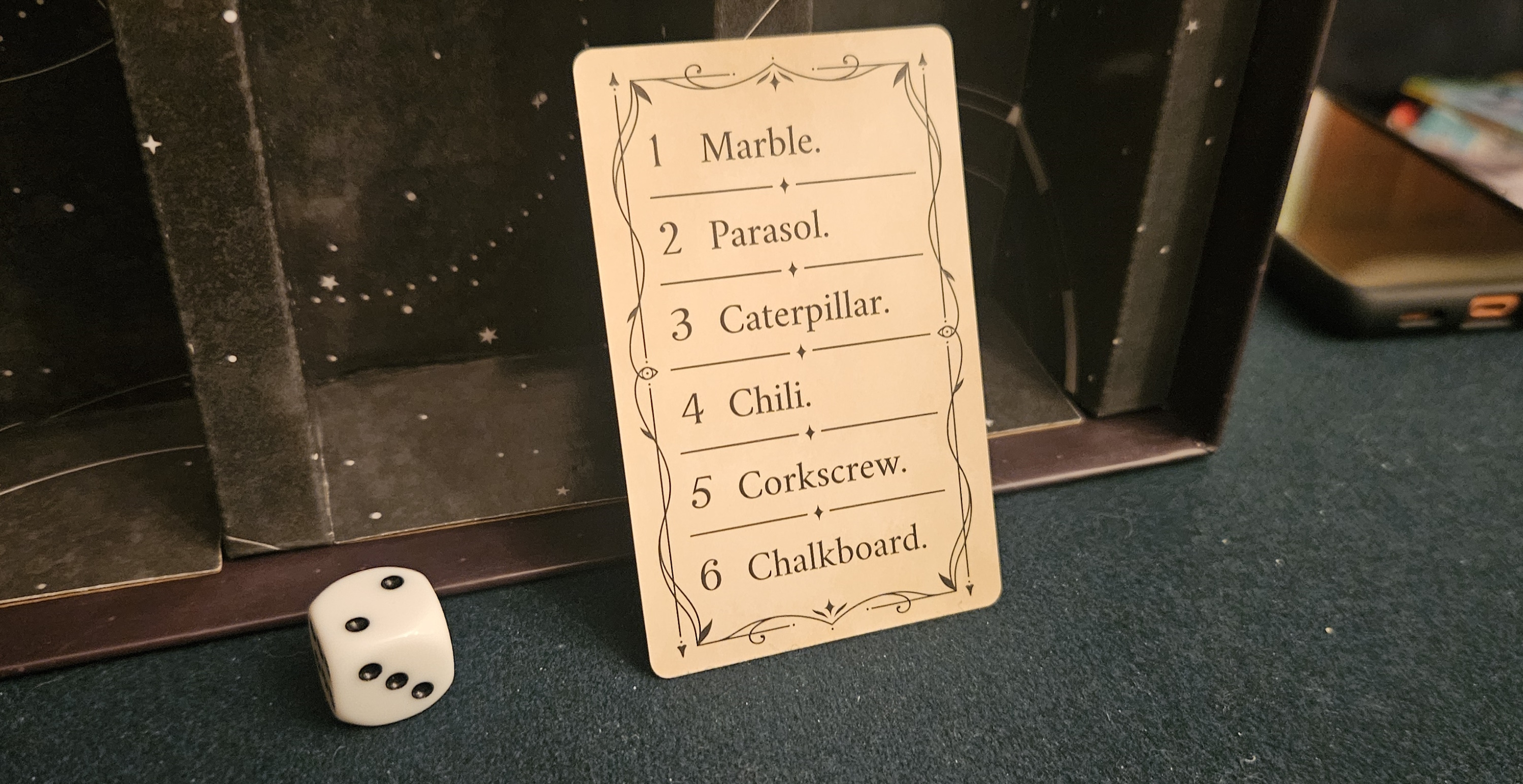
Both spirits share a single word. In this case, PARASOL.
Okay, so somebody has died. Two somebodies. Lexical spirits, et cetera. Everybody else at the table is divided into two teams of competing mediums, one per spirit. Now these mediums will use the power of automatic writing (no, not really, but I think that’s what we’re doing in the game’s “background”) to decipher the word these spirits intend to communicate.
The spirits share a word. Starfish. Missile. Cloud. Broom. Treadmill. Seesaw. You know. A word. The first team to communicate the word from spirit to medium(s) are declared the winners.
What makes Phantom Ink interesting, though, is the way those words are translated across the borderland from the spiritual to physical. The mediums have a hand of question cards that they pass over to their corresponding spirit. These are studiously hidden from the rival team, preventing them from knowing that you have asked, for instance, “What country is it most associated with?” or “What noise does it make when dropped?”
Much of the game’s strategy is found in the selection of these questions. It’s easy to pick the safe option, but that’s also the riskier move. Because what happens next is that your team’s spirit writes out the answer, one letter on a time, on a pad. At any point you can command the spirit to stop. This halts the word halfway written, only a fragment of the answer lingering on the page. But since these answers are public, unlike the question you asked of your spirit, this also prevents your rivals from gleaning too many clues.
Remember, both teams are working toward the same word. Thus, the fewer letters you let your spirit scribble on the wall, the better. There’s real tension to watching your spirit scrawl out those letters one by one, each addition narrowing the range of possibilities, and wondering when to shout “Silencio.” (Because, yeah, this game asks you to say “Silencio” instead of “Stop.” It’s a real cool kid like that.) This dichotomy, between a full clue and self-enforced paucity, is never far from mind. If a spirit has written “LOCK,” there are quite a few possibilities remaining in the dictionary. “LOCKH,” on the other hand, starts to point rather conclusively toward words like “Missile.”
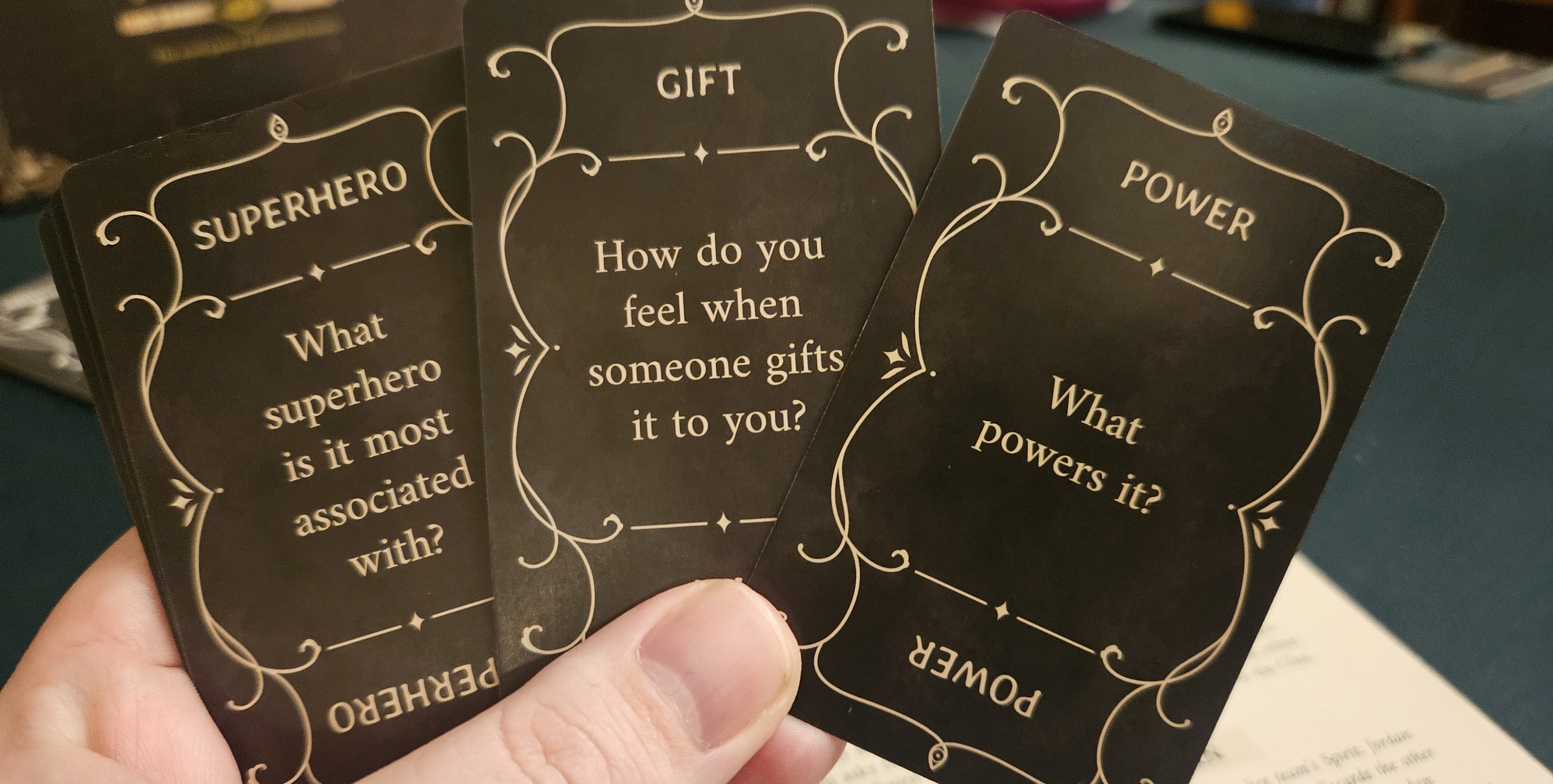
Asking the right question. Or the safe question.
Periodically, teams receive the opportunity to reveal one additional letter. In most cases, this can be used to clarify some earlier clue and cement the spirits’ intended message in your mind. Phantom Ink is, above all, a brisk game, and not always in a good way. More than once, a session has ended on only the third or fourth go-round, like a carousel that doesn’t believe in the fortitude of its riders’ inner ears. For what it’s worth, I have yet to see a medium attempt a word, inverting the usual format by writing it out one letter at a time and receiving table-knocks of affirmation from the spirit, without hitting their target. While there are some real toughies among the prompts, most of these ethereal communiques are so boilerplate that they don’t put up much fuss.
Maybe that’s the point. It isn’t like Phantom Ink is striving for complexity. Its emphasis on team-play and shared clue-spaces calls to mind a few touchstones, most notably Codenames and Decrypto, with shades of Mysterium thrown in for good measure. The more recent Typeset does the one-letter-at-a-time thing as well, although that title takes the concept in a different direction. Phantom Ink is the least flashy of its peers, not to mention the easiest to teach. That gives it a reliable quality; like I noted earlier, it’s a sturdy sort of game, appealing enough to everybody even if it doesn’t set itself apart as anybody’s favorite.
At the same time, it doesn’t inspire much of a response. “That was nice,” one of my friends noted the last time we played, before declining a second session. She was right. Phantom Ink is nice. It works. It feels good in the moment. But like its spirits, who are determined to speak through the veil but only in pedestrian terms like “Bowl” and “Ticket,” it doesn’t really summon one back to the game table. Phantom Ink calls itself “the word game of unfinished business.” We’re decoding the last utterances of those who have passed to the other side. Only these spirits’ big secret isn’t the solution to that unsolved murder that tore apart this tiny town five years back, but rather what they had for breakfast one morning. Speak “oatmeal” and they will be released from bondage. Any pirate doubloons buried in the yard? No? Hmm.
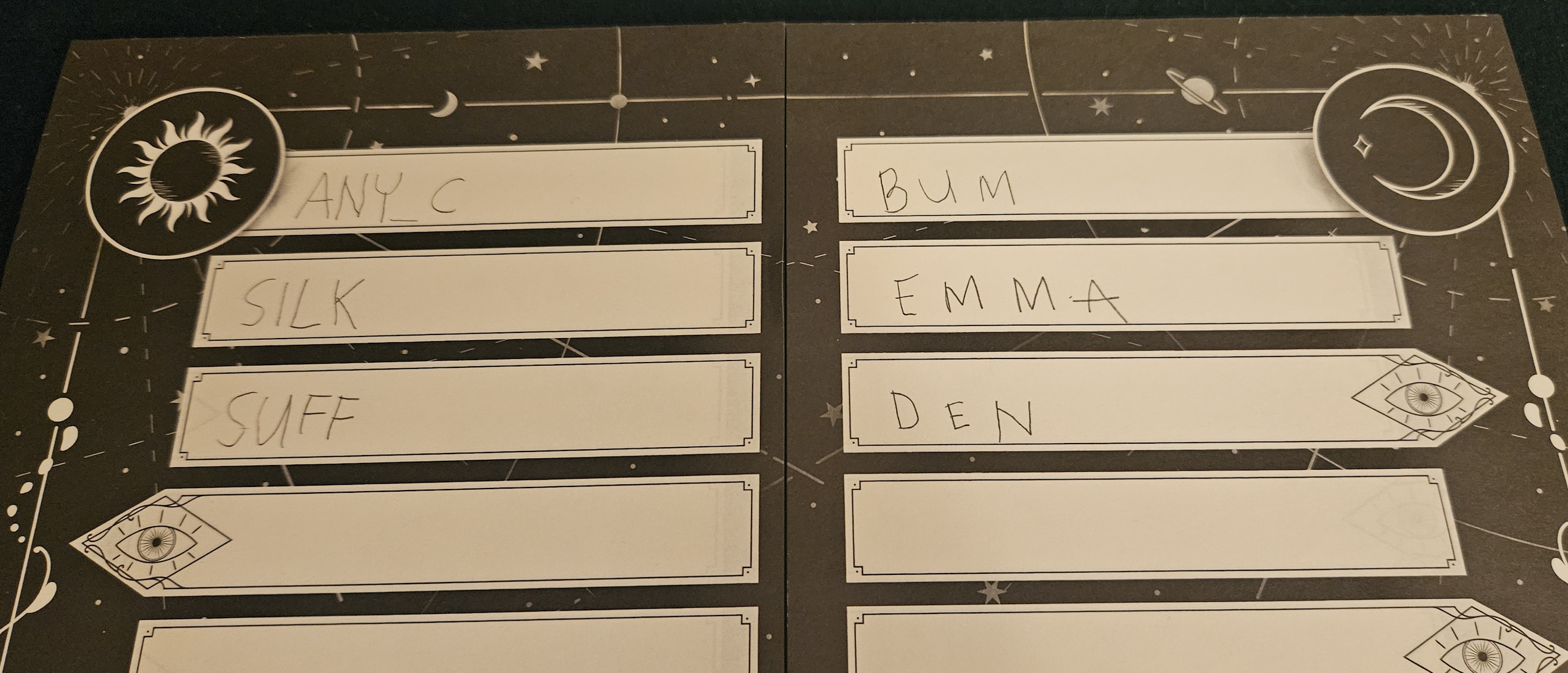
Slowly putting together the pieces.
Lest you assume this is an error of setting alone, it goes deeper than that. The decoding process itself is muted. There’s a shade of the press-your-luck found in Codenames, but only a shade. There’s some of the joy in the construction of words from Typeset, but not much. As for Mysterium, well, there’s none of that game’s eerie sense of place. And no, saying “silencio” doesn’t qualify. Not when I’m out here shouting “Silencio!” every time somebody looks at me askance.
Phantom Ink, then, is serviceable. I like what it’s doing, it’s pleasant, it’s easy to teach. But when you get right down to it, I’d rather take an extra minute or two for a game that does a whole lot more.
A complimentary copy of Phantom Ink was provided by the publisher.
(If what I’m doing at Space-Biff! is valuable to you in some way, please consider dropping by my Patreon campaign or Ko-fi. Right now, supporters can read my second-quarter update!)
Posted on August 19, 2025, in Board Game and tagged Board Games, Phantom Ink, Resonym. Bookmark the permalink. 2 Comments.

 SPACE-BIFF!
I have to admit I selected the whole title to see if you wrote M INK in white on white.
I’ve done that before! I’m not sure I can do it in an article title, though.