How Was the Gameplay, Mrs. Lincoln?

I know it’s far removed from today, but the assassination of Abraham Lincoln makes me sad in a way that most historical events do not. Thanks to my father’s interest in the topic, the Civil War was my first real foray into both history and wargames, and the Gettysburg Address was the first speech I ever memorized. Not original for an American schoolkid, I know, but still.
There is some small upside: playing Wes Crawford and Ryan Heilman’s The Pursuit of John Wilkes Booth, I had that extra motivation to nail the bastard. Some part of me approaches the subject reluctantly. It’s a game about the early history of American policing more than anything, staffed with military detectives and Pinkerton agents and Secretary of War Edwin Stanton pulling strings to put more federal cavalry under my command. Like the Civil War that had ended only five days before the traitor’s bullet found its mark, this is America’s Old Testament period, its belly fired with vengeance and fury. I know the problems. I have my hangups. And yet there is nothing I want more than to catch the assassin before he crosses some remote frontier.
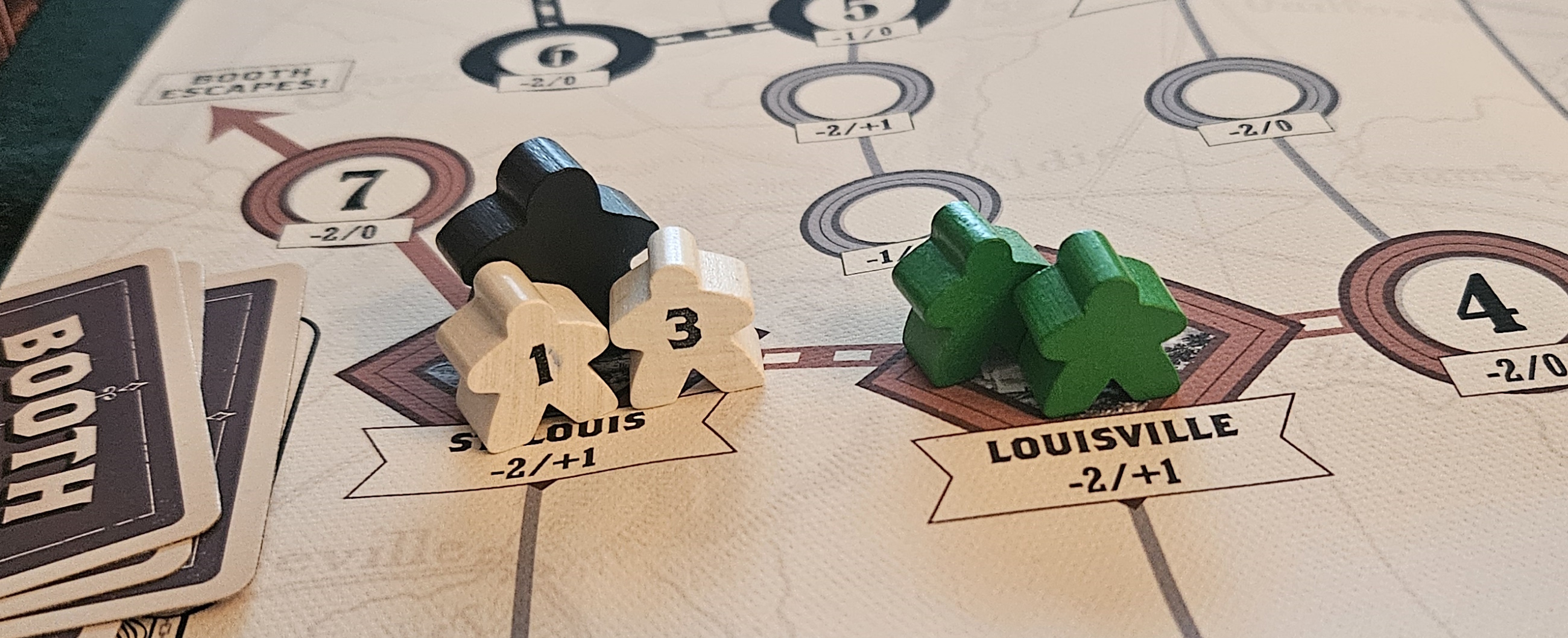
Cops and cavalry dog John Wilkes Booth’s heels.
The game opens the morning after. President Lincoln is dead. The assassin is at large. The scope of the conspiracy is yet unknown, as just a few blocks away Secretary of State William H. Seward and his family have been assaulted by another would-be killer.
Only a handful of resources are at hand. A pair of military detectives, drawn at random from a pool of six, occupy the environs of the White House and Ford’s Theatre. They are accompanied by policemen, and cavalry stand ready on the city’s outskirts to gallop into the countryside. Edwin Stanton has promised his aid. Maybe don’t rely on that too much.
Right away, Crawford and Heilman imbue their pursuit with a sense of urgency. Booth intends to escape, although his intended route is unknown. Rather than sticking to the actual outcome, there are many routes from Washington he might follow, heading to Canada or Europe or South America, lying low in barns and the homes of accomplices, and perhaps even doubling back or crisscrossing between paths. The card system governing his movements are simple. The first card dictates his starting escape route, then sees him moving forward along that path or shifting onto others.
For now, though, you don’t know where he’s gone.

The system governing Booth’s path is well done.
If we want to look at The Pursuit of John Wilkes Booth holistically, there are two broad portions to the design. Much of your detectives’ investigative work is confined to Washington, D.C., where leads appear from a deck, two at a time, to offer new clues. Once a lead has been concluded, clue chits are drawn from a bag, accumulating on Booth’s concealed path cards until some leg of his route is revealed. Meanwhile, you can press your luck a bit, bringing policemen along to roll a die that might yield an extra draw from the bag. The risk is that both sources of clues, whether the clue chits themselves or the die, might result in ambushes that wound your detectives and leave them in the hospital for a couple days before they can rejoin the manhunt.
Meanwhile, out in the country and cities surrounding Washington, it soon becomes necessary to zero in on Booth’s position. There policemen can conduct searches and eventually raids, hopefully bringing the assassin to justice. We’ll circle back to this portion in a moment. For now, it’s enough to know that movement is slow both in Washington and outside it, encouraging players to send their detectives and cavalry in advance of Booth’s suspected position in order to head him off. Of course, the tradeoff is that he might veer off his current path when you least expect it.
Most turns, then, revolve around moving detectives, police, and cavalry, and then drawing clue chits to whittle away at Booth’s trail even as he continues to flee. Complicating this process is the possibility of reaching out to Edwin Stanton for assistance. This is… risky. Not so much because the Secretary of War isn’t amenable to helping. It’s just that you don’t know what you’ll get. My easiest session concluded almost prematurely when Stanton turned over extra detectives and cavalrymen in approximately the right location. But in other cases, he’s promised assistance in New Orleans even though Booth was out past Richmond. Great. Thanks a bunch, Mister Secretary.
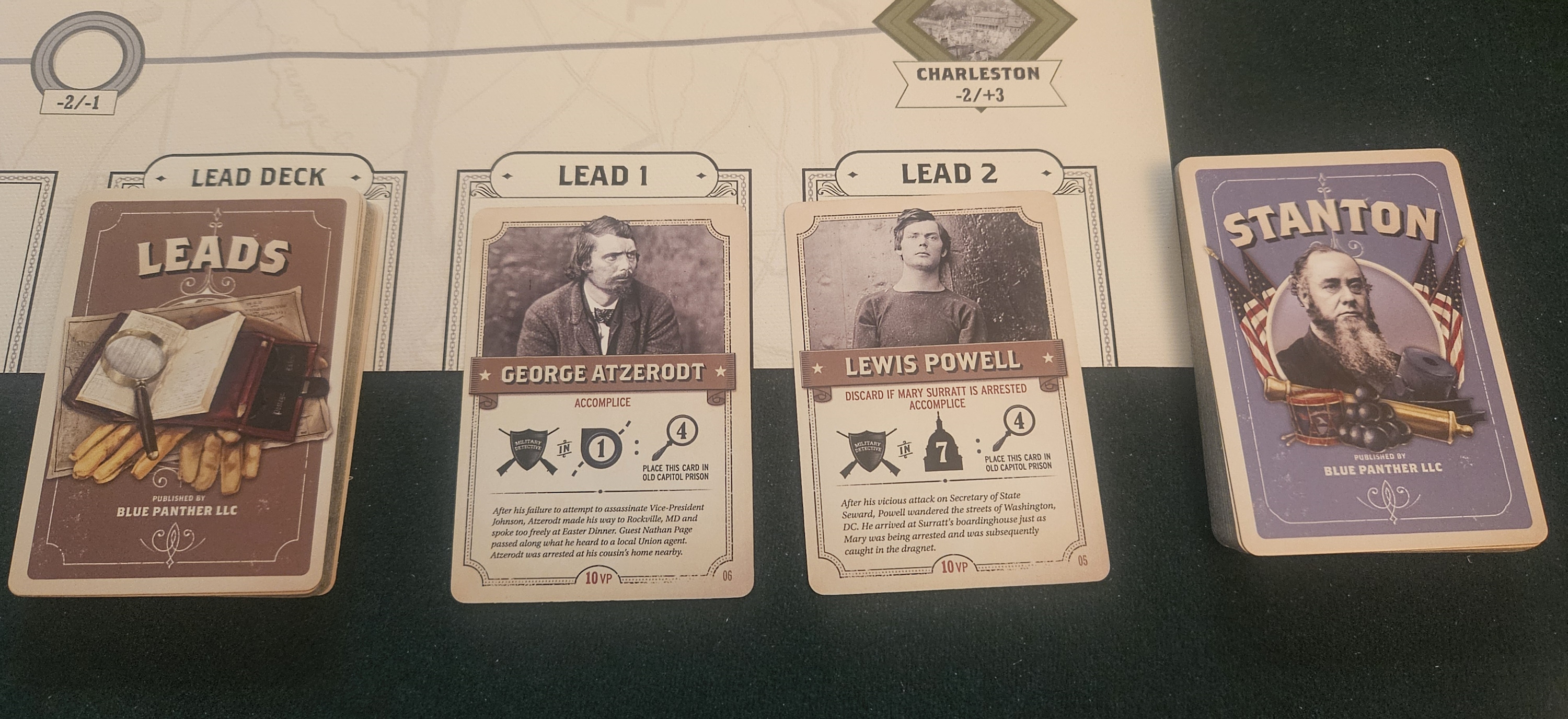
Pursuing leads to earn clues.
Reaching the conclusion of Booth’s trail is a temporary measure. This is when things get a little too cluttered for their own good. In old wargame fashion, you now conduct searches and raids on Booth’s location itself. This requires a series of plus and minus modifiers. Cavalry are good at raids, but not so much at detective work! Detectives are mere men, not suited to storming barns! Nighttime is bad for searches, but good for raids! If you haven’t arrested certain of Booth’s accomplices — represented as leads — then they might appear to render him aid! There are heaps of modifiers to consider, including random chit draws that, again, threaten ambushes.
It’s a little long in the tooth, is what I’m saying, although I appreciate the texture. Arresting an accomplice feels good, not only because you’ve stuck somebody in prison, but also because this robs Booth of actual assistance.
At the same time, these search and raid checks dispense with the decision-making that marks the design in other spots. At best, you have the choice of whether to conduct a search or raid. But even when you risk losing a police token, it’s often worthwhile to conduct a manhunt just to deplete Booth’s ever-growing pile of cards. Regardless, the tally is just that — a tally, little more, with nary a thing to do but wait and see if you’ve caught the man. I would have preferred to see some use for those late-game clue chits, possibly as a resource to tweak the outcome of a search. But there is no such system. After all that work, it often comes perilously close to settling the game on a roll. Erm, a chit draw.
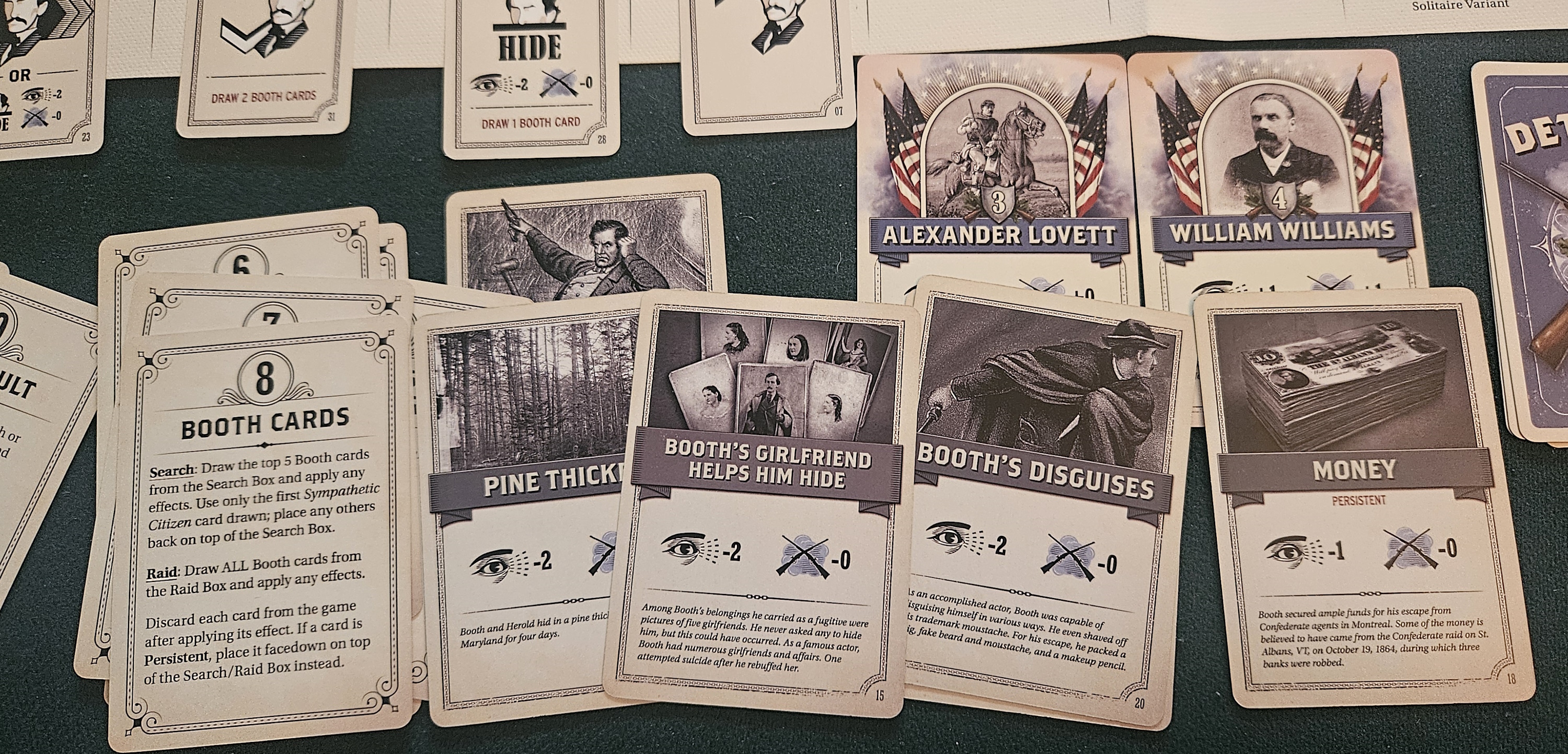
Tallying a buncha modifiers.
The short version is that The Pursuit of John Wilkes Booth is a game that plays you, as the popular saying goes. Nearly everything is reactive, with precious few branches to the game’s decision tree. Most of the time, your only real option is saying “no” to whatever options the game has provided. Leads appear at random; you can pursue them or not. Booth appears in the countryside; you can chase him or not. His position is revealed; you can conduct a search and raid or not. Even choosing to plead for help from Stanton means receiving cards that either help or not.
Which isn’t to say that this is a bad game, as these things go. It’s interesting, to be sure, and I enjoy the process of chasing down President Lincoln’s killer. Even the tally is nice enough, in its own way, spinning a little tale about your attempted apprehension of the assassin. Oh no, Booth met a helpful civilian! Oh no, now he has a carbine! But this shouldn’t be mistaken for a game that sees you performing any sort of actual deduction, making any large decisions, or carefully managing the resources at your disposal.
Perhaps to ameliorate these issues, there are a handful of alternate modes. One sees players cooperating to catch Booth, another sees them semi-cooperating to catch Booth — everyone is competing to secure the bounty for themselves, basically — and a third permits an additional player to control the assassin first-hand, selecting path cards and occasionally misdirecting detectives with their accomplices. These are nifty inclusions, but don’t significantly alter the core experience. At any rate, this is one of those games that benefits from its solitaire format, keeping the playtime under an hour in most cases and telling its story, then dutifully packing back into the box until you’re ready for another attempt.

Now I have a handy paper map for when I visit D.C.
On the whole, The Pursuit of John Wilkes Booth is strongest as a slice of history. I appreciate the snippets from the playbook and the cards that describe the various men and methods that cornered the assassin. Similarly, the gameplay is nicely restrained, keeping its manhunt abstract rather than delving into too many particulars. The result is an interesting and cathartic experience, albeit one that could have let us produce the drama rather than merely witnessing it.
A complimentary copy of The Pursuit of John Wilkes Booth was provided by the publisher.
(If what I’m doing at Space-Biff! is valuable to you in some way, please consider dropping by my Patreon campaign or Ko-fi. Right now, supporters can read my second-quarter update!)
Posted on August 4, 2025, in Board Game and tagged Alone Time, Blue Panther, Board Games, The Pursuit of John Wilkes Booth. Bookmark the permalink. 7 Comments.

 SPACE-BIFF!
Solid review but a fantastic title.
Ha, thanks.
Too soon?
My bad. Everybody knows the proper threshold is 161 years.
I would agree with much of this review. In my two playthroughs so far, I won VERY quickly the first time, partly due to Staunton cards helping out a LOT and the search cards having a lot of the repeats that go back onto the pile, allowing me to track down and successfully search and raid with only 5 trail cards revealed.
Then my second game went the complete opposite, hitting three ambushes before I even got the first trail card flipped, leaving me with a detective in the hospital and no police officers. Next 2 Leads cards I flipped? Both required police officers to clear, which I now had none of! So basically only way I could even progress in the game would be to pull Staunton cards until it gave me more police officers. I didn’t bother to waste time playing further but just flipped through the deck to see how many turns that would take, and it was a LOT.
Basically it’s laughable that this is described as a game of investigation and deduction. I felt I had very little agency in the game at all, and that is NOT something I personally enjoy in my games, solo or otherwise.
Yep. Sometimes it hits that sweet middle spot. But that’s entirely a factor of how the cards come out, not the result of player behavior.
Well at least I did figure out that I missed the fact that you can also use Staunton cards to get new police officers! I thought I had to draw until I found that one that stated it specifically but makes sense if you can just discard a card to get one, there aren’t many in there that do that, LOL. So that wasn’t quite the game-ender I thought it was. I’ll definitely give it a few more tries, but for me I prefer solo games where I have a lot more agency over what’s going on.