Apex Card Shark

Sometimes I joke that every board game about evolution is really about intelligent design. We are, after all, streamlining these creatures for maximum survival, carving out niches with great forethought and consideration. This is not meant as a substantive critique. Board games give us control over all sorts of things that normally fall outside the realm of human agency. Anyway, if these games accidentally argue that a thinking mind must direct the evolution of species, then it’s a polytheistic bash of many gods competing to secure the most calories for their preferred fuzzies.
And then there’s Nature. Eleven years after Evolution, nine after Evolution: Climate, and five after the spinoff Oceans, Dominic Crapuchettes has taken the system that cemented his reputation as a serious designer and honed it into an apex predator. This is the sleekest representation of evolution ever put to cardboard. But there’s a bigger question lingering behind those grandiose claims. Namely: is it worth it?
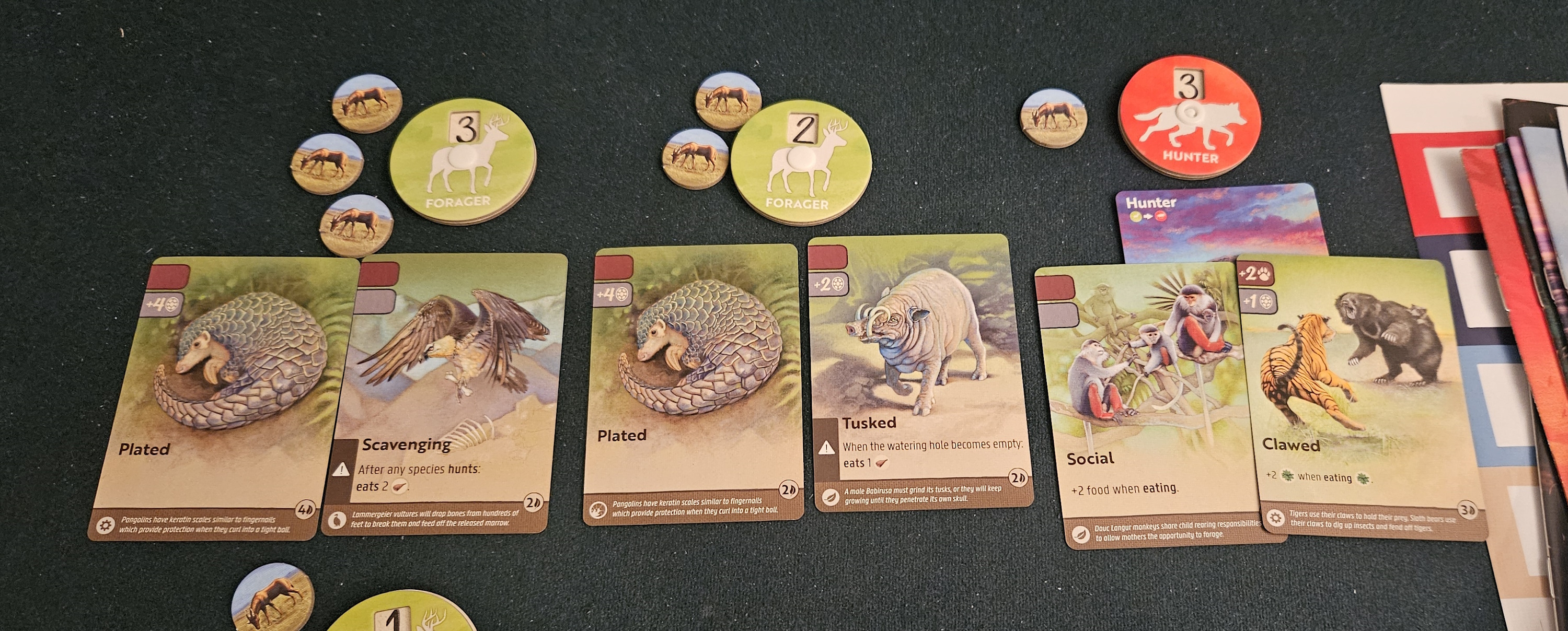
The basic game of Nature is good, but sometimes feels sparse.
To write about Nature is really, when you get right down to it, to write about the game as a series of modules. In more ways than one, Nature is a deconstructed Evolution. Cards that were important to the base game — whether Evolution itself, the Flight expansion, or standalone Climate — have been carefully isolated and transformed into distinct experiences. “Fat tissue,” for example, is now one of the defining cards of the Arctic Tundra module. “Climbing” and “Fertile” show up in the Amazon Rain Forest module. Going through them in sequence, it’s like meeting cameos from that game we loved many years ago.
A cynical mind might call this a cash grab. To properly play Nature requires those modules, at least for anyone who wants to experience this game at its most dynamic and interesting, and I don’t say that lightly. In a hobby scene dominated by expansions, where publishers are known to strip out essential components in their rush to fashion brands rather than self-contained boxes, it would be easy to say that Crapuchettes and North Star Games are doing something similar here. Why sell Nature on its own when you could instead sell Nature and five additional sets?
Assessing the base game by the numbers lends credence to that interpretation. The card pool has been winnowed down to eight essential traits — nine if you count the “hunter” card, which is always available in its own separate stack — a rather steep reduction from Evolution’s pool of seventeen traits or Climate’s twenty-three. After all this time, all those intervening years, you mean to tell me that Nature includes a mere half of the traits from the game it’s based on?
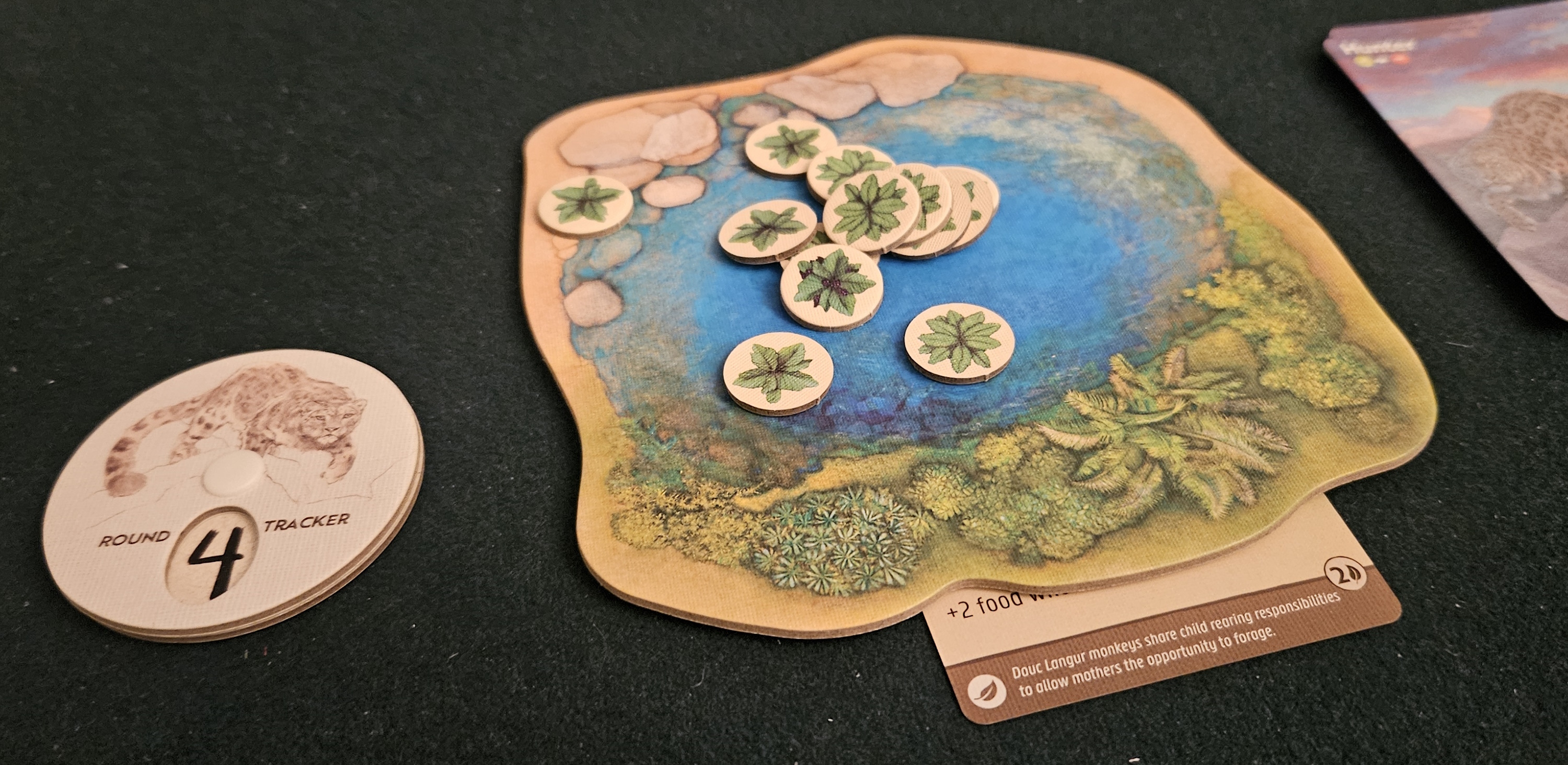
The watering hole is where creatures congregate to eat. Sometimes to eat each other.
Yes, although using numbers as our sole metric is misleading. I understand this line of thought, just as I understand the cynical instinct, but I don’t believe it applies to Nature. The base game, in this case, is not only playable, it’s also a much sharper experience. Those eight traits — nine with hunter — don’t come across as sparse so much as streamlined. To some degree, this is thanks to the way many traits now double up on their abilities. Adding “clawed” to a species makes them a better hunter, as one would expect, but also helps a herbivore dig for extra food. “Tusked” is a solid defensive trait, but can also help a species supplement its calories whenever the watering hole empties of plant matter.
Similarly, there’s now a much greater emphasis on letting players double or even triple up on traits. For the simplest example, look no further than “fast.” A quick-footed herbivore can’t be hunted unless its pursuer is capable of matching their speed. That could mean one copy of the fast trait, or it could mean two. In extreme cases, a species with three fast traits will resemble a pronghorn… driving a Koenigsegg like they stole it. Other traits become similarly game-bending when applied multiple times. Having trouble snatching any loose leaves from the watering hole? Turn your species into a multi-classed scavenger and feed four of your population every time a hunter goes prowling. Feeling the heat from a massive predator? Grow two sets of horns. Why not? Nature is lit.
Meanwhile, even base Nature demonstrates the game’s profoundest changes (one might say evolutions, hardy har) from its original incarnation over a decade ago. Put simply, Nature offers a tighter competitive space, one that’s simultaneously brutal on your final score but not nearly as punitive as its source material. Where in Evolution it was possible to get backed into a corner — your species ill-suited to the current ecosystem, one claw already over the line of a mass extinction event — Nature takes great joy in letting players rebound. Each turn, everybody receives a new species. When you lose population, those sun-bleached skulls bounce back as fresh youngsters. If a species goes extinct entirely, its size is transmitted to your newest creation and its cards are refunded to your hand rather than getting discarded forever. The hunter trait, previously mixed into the deck, sits to the side, a free adaptation you can freely apply rather than waiting for fortune to bestow it on your head like a kiss. Even the game’s duration feels like an overhaul. Where Evolution tended toward the longer side, especially with four or five players, Nature keeps its proceedings fresh and pacey.

Jurassic adds apex predators and huge body sizes.
The result is a game that evokes its roots but doesn’t feel entirely bound to them. Nature works in both directions. As a portrayal of evolution, it’s every bit as fierce as the original game, penalizing players who overreach or show lapses in attention. But it also succeeds more as a contest, as a chase to keep your species alive and chow down on as many calories as possible, but without as many hiccups or setbacks that threaten to ruin somebody’s session. Every added or discarded trait matters. The tight card list keeps the growing tableau crisp and legible. It feels good.
That said, the base game is not the best way to play Nature. Nor is it a significant step from Oceans. That spinoff is better suited to the sensibilities of heavy players, with its interlocking food chains and the interplay between its normal deck and The Deep, its wellspring of random mutations that provided the game’s dramatic final act. Oceans is still my favorite of Crapuchettes’ productions. By contrast, Nature is all about simplicity and taut, one might even say tournament-level, competition.
The game’s five modules don’t overturn that truism. Even the most complex of the set are hard to master but a breeze to play. Just, you know, less of a breeze. Or a warmer, muggier breeze. Look, there’s a spectrum of breezes. The point is, the modules add onto the experience without adding much in the way of overhead. Each addition pulls the experience outward, covering some additional slice of the natural continuum, while still holding to the core experience presented in Nature’s base box. As an artifact of design and development, it’s downright impressive how smoothly these modules integrate with the base set and one another.

Flight adds… look, you can guess, okay?
Of course, most people aren’t here to marvel at feats of design and development. We’re here to play a board game, dammit! Good thing, then, that these modules are nearly perfect.
I’ll start with my least favorite, Natural Disasters. This is maybe the simplest offering, adding no new traits or really any rules at all, but instead shaking up the formula with a deck of random events not far removed from the shifts in temperature found in Evolution: Climate. At the start of each round, you draw an event. Some of these are surprises, like a tsunami that prevent players from discarding cards to add food to the watering hole. Others have delayed effects, such as an impending ice age that will reduce your population after the conclusion of the adaptation and feeding phases, prompting players to bulk up their species’ size or numbers before the snowflakes begin to fall.
Sometimes these events are transformative. In one session, the watering hole become dangerous thanks to lightning storms that would zap any creature unfortunate enough to wander over for a snack. This spurred an explosion of hunters and scavengers. Another time, a radioactive meteor shower permitted every species to temporarily function as a hunter. As in, every single one. Just like that, our carefully arranged niches succumbed to a carnivorous orgy.
It sounds more amusing in retrospect. As much as I enjoy games that force me to think on my feet, the rapid-fire alterations of Natural Disasters don’t always suit the game’s already rapid sense of play. As for the competitive angle… well, that ice age killed off every small-bodied species on the table. So much for not backing players into a corner.

The Amazon Rain Forest adds an abundance of food and population booms.
The other four modules, I’m happy to report, have sturdier bones. (Or, in the case of Flight, more hollow bones.) Each module adds a compact set of five traits, always in a separate deck that players can choose to draw from alongside their picks from the normal deck, and a few minor alterations to the rules.
Let’s start with Jurassic. This module increases the species size limit from four to ten, allowing players to craft some truly jaw-dropping megafauna. As you might expect, this lends itself to both massive super-predators and massive super-herbivores. In addition to the hunter cards, there are now two additional hunters mixed into the deck. There are “clever predators,” which reduce the population loss from defensive traits like “horned” or “thagomizer” (named after the late Thag Simmons). Yes, this lets you create velociraptors, clever girls who overcome their prey through smarts rather than brute force.
Not that brute force is such a bad way to go. Jurassic also sees the advent of the “apex predator.” Now, this card is nasty. As long as its size is at least eight, the first time this species hunts it’s allowed to ignore all defensive traits altogether. Fast? Nope. Horned? Nah. Climbing? We ate the whole tree, along with all those meaty niblets clinging to the branches. This is the module that believes the philosophy that the best defense is a good offense, and it isn’t uncommon for a session to become a kid-pleasing deathmatch between predators. I love it.
On the polar opposite end of the spectrum is the module descended from the dinosaurs. That’s right, it’s Flight. Flying species are their own breed, almost impossible to hunt unless their predator is also winged (or, again, an apex predator). But they’re also strictly limited in body size, making it tougher for them to feed a booming population.
This brings in the module’s other addition, a distant watering hole that only flying species can reach. This might sound overpowered, but like everything else in Nature it’s been carefully tuned. Flying species can only migrate to this watering hole after their hunger is sated, earning bonus population that in turn makes it harder for them to reach the same space in later rounds. It’s a smaller-scale arms race than the bigger feast on the ground below, one that keeps even these defensive creatures hopping on their toes.

The Arctic Tundra is sparse and deadly.
The final modules are set in specific locations, which means they can’t be mixed. No surprise there. They swim in entirely different waters.
The first, the Amazon Rainforest module, is all about population booms, a huge abundance of food, and big surprises. Rather than revealing traits at the end of the adaptation phase, everybody keeps their cards concealed until they come into effect. This can be a boon or a hindrance, especially when hunting. More than once, I’ve witnessed a series of comedic reveals where somebody tries to hunt, their prey reveals they’re a climbing species, the hunter reveals that they can climb too, and then the hunted turns out to be so venomous that the hunter turns blue and goes belly-up. It’s dangerous and silly in equal measure.
Meanwhile, the Arctic Tundra module is about scarcity. Only a few measly twigs are added to the watering hole each round, and even discarded cards, rather than being worth their printed value, only add a single token. Oh, and occasional cold snaps will kill off any species that hasn’t invested in either physical bulk or kidneys that recycle their urine to let them sleep through the winter. This might sound unworkable, but migrating species, both grazers and predators alike, add new ways to gather calories, while our old pal “fat tissue” (my heritage!) lets species store energy between rounds.
By now you might have noticed a trend. With each module, Nature offers some wrinkle that seems insurmountable. Gigantic predators! Distant watering holes! Ambushes! Starvation! In each case, the wonder of Nature is that life, uh, finds a way. Often, a combination of modules leads to new surprises, as when a flying species discovers they’re vulnerable to climbers or when a social species empty the tundra’s watering hole in a single bite. Nature’s degree of interconnectivity is impressive.
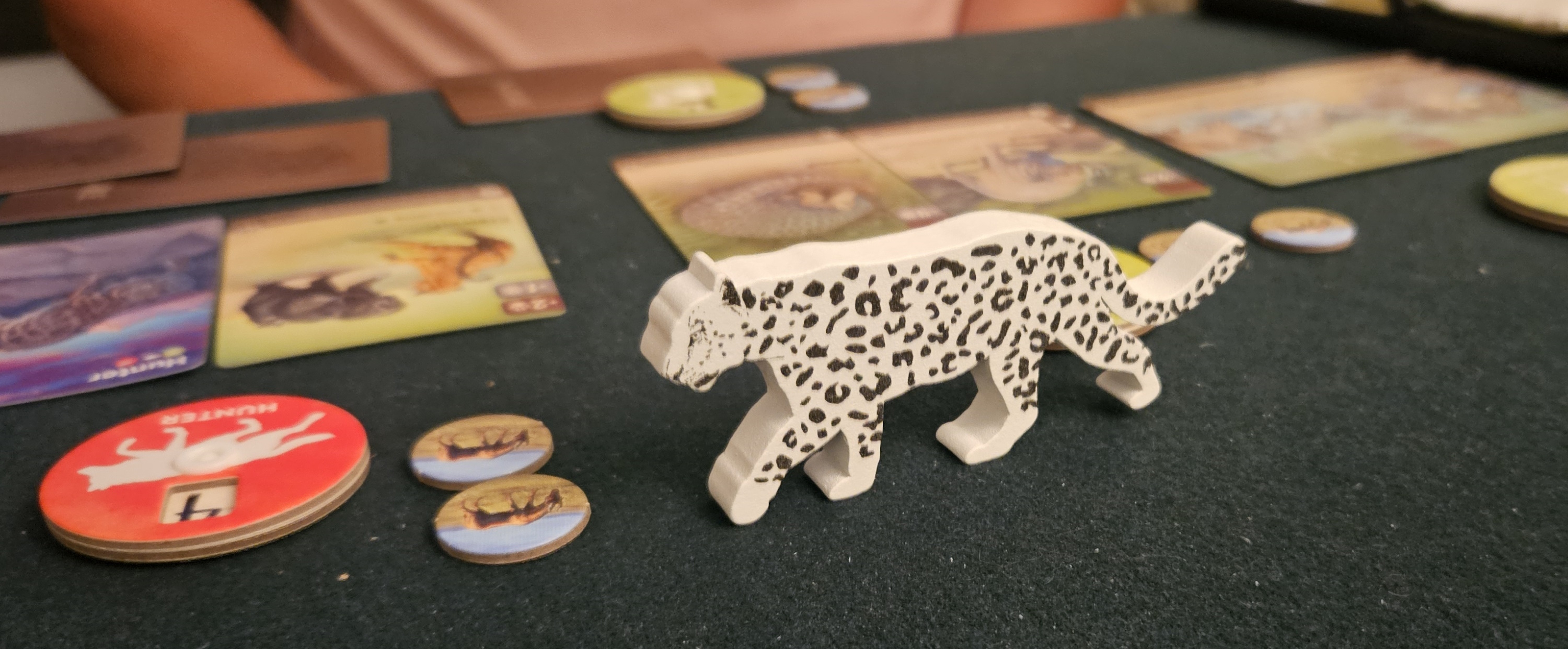
Good choice!
More than that, it’s wonderful to play. Again, Nature is a strange beast. Its basic format is streamlined and functional, pleasant to handle, but it’s only once you get your paws on those modules that it becomes excellent. At the same time, it offers a radically different experience from Oceans — which I feel duty-bound to remind you that I still prefer — one that understands both the limitations and possibilities of its source material at the deepest possible level.
Was it worth the intervening years? Is it that much better than Evolution and its offspring that it’s worth playing all over again? Will Dominic Crapuchettes now move onto something else?
I think so, at least in response to the first two questions. I can’t vouch for Crapuchettes’ intentions, but Nature is a stronger and more robust version of its progenitor, with more flexibility and depth. For fullest effect, it leans on its modules, which may well prove too exclusive for some players. Either way, it’s so very good to be back at the watering hole.
A complimentary copy of Nature and its first five modules was provided by the publisher.
(If what I’m doing at Space-Biff! is valuable to you in some way, please consider dropping by my Patreon campaign or Ko-fi. Right now, supporters can read my second-quarter update!)
Posted on July 23, 2025, in Board Game. Bookmark the permalink. 10 Comments.

 SPACE-BIFF!
Hi Dan, would you still say Oceans + expansion is your favourite compared to Nature + modules?
I haven’t actually played the Oceans expansion! But yes, I prefer Oceans to Nature, including with the modules. It isn’t like I would turn down either game, but the second act of Oceans is really compelling to me.
Thanks for the reply. Do you think there is a hypothetical module in the future that could replicate the compelling parts of Oceans in Nature?
Absolutely. Not one-to-one, of course, since the way species develop in Oceans is so different. But I actually mentioned to some friends after a recent play of Nature that there was nothing preventing them from doing a “Deep Evolution” module that replicates the Deep Deck in some way.
Hi Tom, this is Dominic, the designer.
I know you’re interested in hearing Daniel’s opinion, but I thought I’d chime in about the purpose of Nature.Nature is a lifestyle game with an accessible gateway. The gateway is designed so you can share your hobby with friends, families, and loved ones.
As a pro Magic player for nearly a decade, I tried over and over to share my passion with the people I loved, but failed every time. Nature is my answer to hobby gamers that want to share their passion with the people they love.I was hoping that Oceans could do this with it’s dualistic design, but it couldn’t. Oceans is a hobby game for hobby gamers.While the Nature game system is a lifestyle game for hobby gamers, the core game is an accessible gateway to others (and pretty darn good on it’s own right as a quick 30 – 40 minute game).
Hi Dominic, thank you for the reply. I’m currently playing a game of Nature on BGA and really enjoying it so far.
I’m in the UK so it seems retail preorders for Nature are not open yet. I’ll keep my eyes out.
Thanks for the review! I love evolution in games, and the observation about intelligent design being a kind of accidental byproduct of gamifying it is interesting.
It’s why I like the Legends expansions for Oceans despite at first thinking it ruined the sciencey vibes. I remember when first playing Oceans I would joke that we were playing as gods of the sea, Poseidon, Neptune etc. And then they actually made it. Something that was implicit in the design became explicit in an interesting way (even though you’re not 1 for 1 playing as a god).
I’d like to respectfully point out that this statement
“Eleven years after Evolution, nine after Evolution: Climate, and five after the spinoff Oceans, Dominic Crapuchettes has taken the system that cemented his reputation as a serious designer”
is not entirely correct. Evolution and some of its expansions reimplements this game https://boardgamegeek.com/boardgame/71021/evolution-the-origin-of-species and some of its expansions.
Thanks, Dima! I considered getting more into the game’s background, but eventually settled on being kinda vague instead. I think it’s fair to say that Evolution did cement Crapuchettes’ reputation as a serious designer, even if it was building on what Knorre and Machin produced. But given the piece’s angle on the evolution of Evolution, I probably should have included some extra note on its origins.
Pingback: Best Week 2025! Picture Perfect! | SPACE-BIFF!