Manifest Sudoku
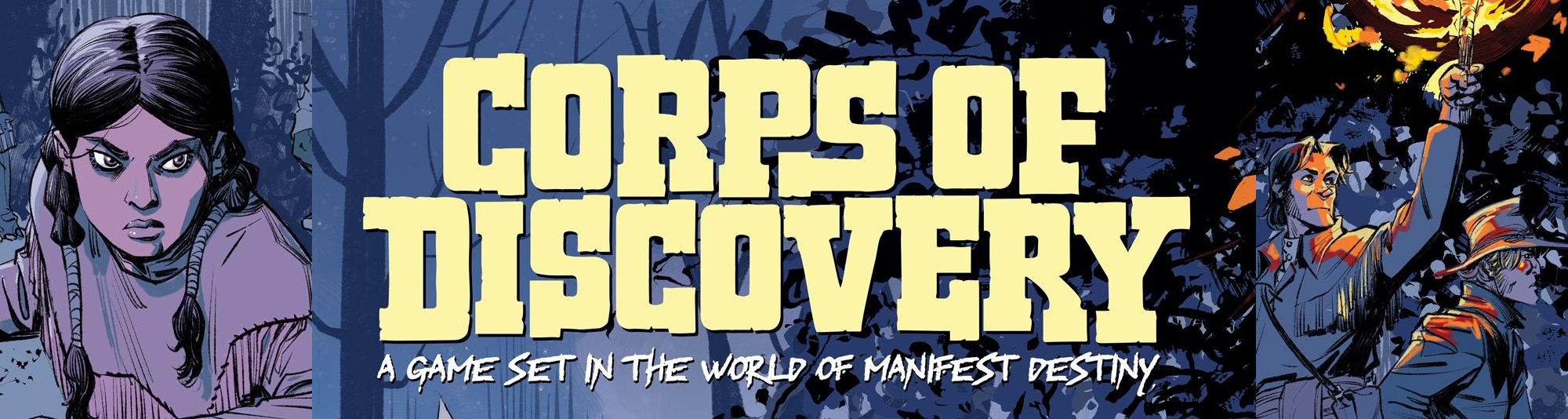
Manifest Destiny, the sprawling, brutal comic by Chris Dingess, is a tough read. Pitched as an alt-history version of the Lewis and Clark Expedition, one where minotaurs and head-snatching pterodactyls pose as much of a threat to the survival of its battered Corps of Discovery as starvation or the weather, it’s both a rollicking adventure and a mouth-covering gasp at the westward roll of genocide. And if those elements don’t sound like they blend as smoothly as chocolate and peanut butter, you’d be right on the money.
But I’m not here to review the comic. Corps of Discovery: A Game Set in the World of Manifest Destiny is the third title from Off the Page Games, Jay Cormier and Sen-Foong Lim’s follow-up to both Mind MGMT and Harrow County. As a game — and in terms of quality — it hobnobs more with the former than the latter, presenting one of the best exploration puzzles I’ve ever witnessed. As an adaptation of the comic, unfortunately, it leaves the tale only half-told.
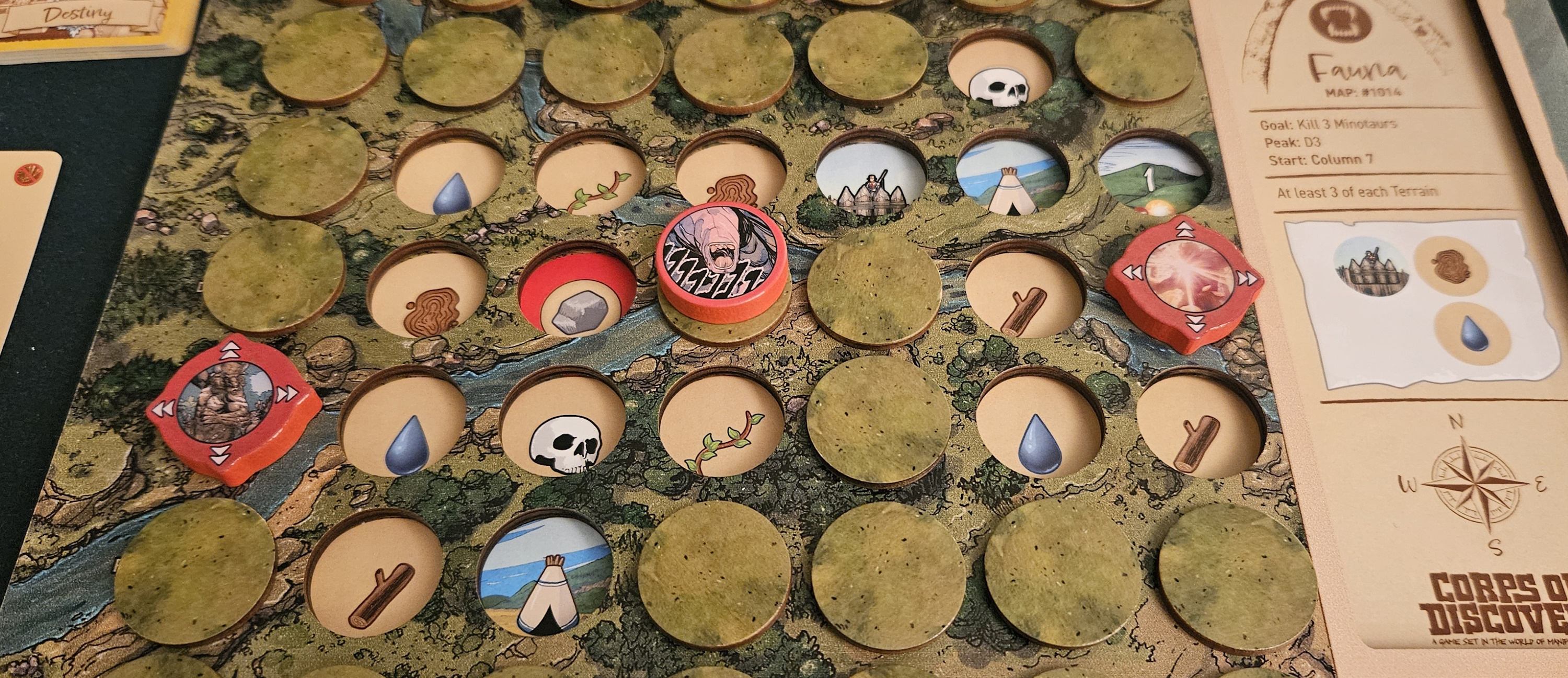
Exploring the Louisiana Purchase.
I can squarely say there’s nothing quite like Corps of Discovery. Presented as a riff on board-clearing games like Minesweeper or Sudoku, the map offers an uncharted frontier of concealed up spaces. Most turns focus on the flipping of a single disc to reveal some portion of the landscape underneath. Most often, these swaths are portrayed as resources: wood, water, flint, bone, native tribes, all alike to your band of colonizers in their potential to be extracted and used. Notably, these spaces only trigger the instant you reveal them. The passage of the Corps is a great iron rake digging its furrow into the frontier.
Along the way, however, Cormier and Lim introduce countless obstacles. Some of these are geographic, like a mountain range that’s impossible to summit. More often, these problems are presented directly: the need to consume rations every day, challenge cards that must be surmounted lest you incur some penalty, shelter and fire and the occasional trip back to camp to secure some sample or another. The map itself is presented as a puzzle, complete with an expansive rubric that informs how you approach each step into the unknown. If you’ve uncovered timber, that means water can be found nearby. Mud is formed by a confluence of water and mountain. That sort of thing.
And then, of course, there are the monsters.
As in the comic, Corps of Discovery is about more than charting the Louisiana Purchase on orders from Thomas Jefferson. There be dragons, out here beyond the margins of the budding United States, and your mission is not only to chart the terrain but also to clear it of lurking terror. Each of the game’s scenarios — there are two in the base game, plus four more courtesy of expansions — offers some further objective that’s liable to leave your men not only hungry but absent a limb.
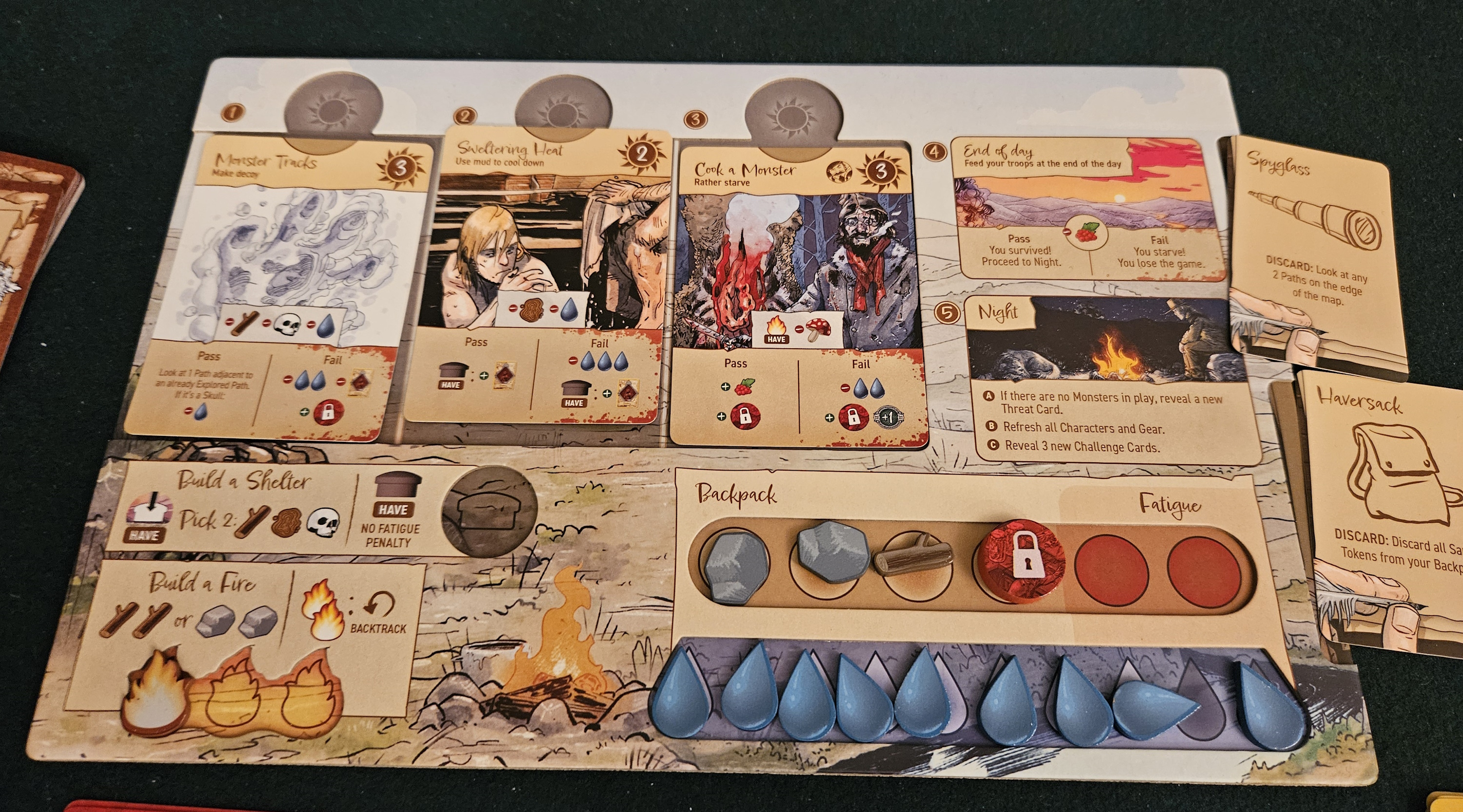
Living rough has its downsides.
For example, the first scenario puts the Corps on the back foot against rampaging minotaurs. At various intervals, usually when you uncover a space marked by a skull, a threat card is drawn. Some of these threats are generic, such as the occasional mutiny by your soldiers or howling worms that must be crushed in their burrows. Others, like the aforementioned minotaurs, are scenario-specific. These brutes are added directly to the map. There they remain, demanding you expend a resource any time you explore a space in their row or column. Given how precious your resources are, this is a direct threat to your continued existence. Surviving a windstorm is hard enough when you have enough timber to erect a shelter; when you’ve spent all your wood fending off bison-headed cannibals, affairs grow more dire.
In this scenario, you’re also provided with a solution. By searching out local border forts, you can learn how to ensnare and kill the minotaurs. These solutions are costly, but at least they extend some breathing room by ridding the map of the corresponding minotaur token. Bit by bit, the frontier becomes secure.
As systems go, the one in Corps of Discovery is a doozy. All at once, there’s the logic puzzle of uncovering the terrain, the survival horror puzzle of parceling out your resources to survive the game’s copious threats, the inventory-juggling puzzle of which resources to collect or hoard or discard, and the current scenario’s puzzle of how to slay this region’s monster. At times, this conjunction becomes dizzying, especially when considering your character’s abilities and items, and it doesn’t help that some abilities are over- or under-powered.
Far from being a problem, though, this also presents Corps of Discovery at its best. Survival is tough. Killing a monster is tough. Doing both at once sometimes feels borderline impossible. Figuring out how to thread that fishhook is a delight. This is, by the way, why I prefer Corps of Discovery as a cooperative game rather than a solitaire outing. It thrives on letting multiple players bounce ideas off each other. More than once, our expedition’s bacon was saved when somebody caught an overlooked detail or realized we’d been making a wrong assumption about some nearby terrain. I’m sure there are geniuses out there who will never miss a beat, but for us mere mortals there’s joy to be found in poring over a map and sharing our theories and observations.
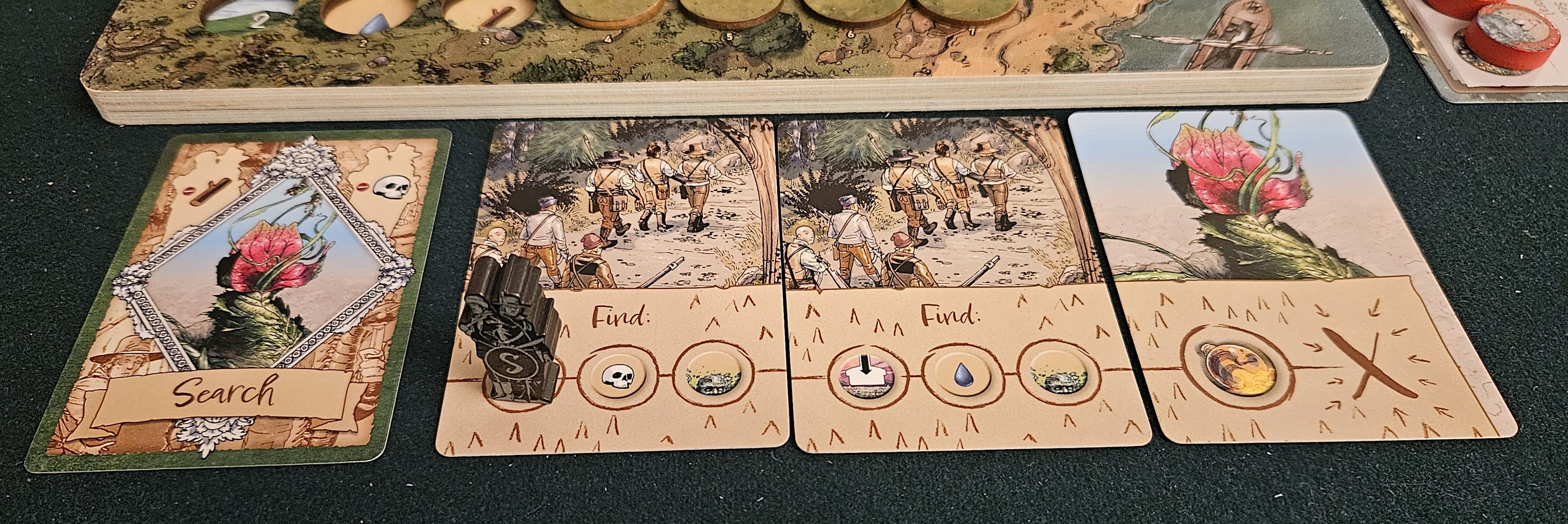
Hunting a plant monster.
More than that, the scope of this system also gives Cormier and Lim room to tinker. Every scenario feels fresh. Here, I’ll micro-review each of them:
Chapter One: Fauna — This is the minotaur-slaying one. Basic, but sturdy. Find the forts, build some traps. Nice and straightforward.
Chapter Two: Flora — You’re mounting an expedition to burn a mind-controlling flower, but the flower keeps sending minions after you. This one forces you to uncover spaces in sequence, making each new discovery all the more dangerous. Fire is important, but you can spend your men’s lives to make up for its absence. Be wary of losing too many troops, though, otherwise the finale, where you pump Greek fire all over the flower, will be outright impossible.
Chapter Three: Insecta — Bugs. Big bugs. Also a big frog. You need to shuttle resources to your barge in order to synthesize an insecticide, but can only do so during slender windows when the big frog is distracted. Enemies tend to pile up on the map in this one, resulting in some nasty claustrophobia.
Chapter Four: Vameter — There’s a head-snatching bat-thing flying around. It appears on the map and moves dynamically according to random chits. You need to position your crew so that they preempt its movement, gauging the range of their weapons against its appearance — and keeping them out of its clutches — while also exploring routes to flush it out. This one is gripping. Probably the best scenario in the whole game.
Chapter Five: Maldonado — This is really two separate scenarios, one of which is well-intentioned but dysfunctional and another which is well-intentioned but hard as balls. Basically, the ghost of a conquistador is trying to manipulate your crew. This introduces a potential competitive mode where one of the players is a traitor. Everybody contributes to little Battlestar Galactica-esque card pools. It’s a fantastic idea, but it doesn’t work. The problem is that these pools are only revealed at the end of the game, so there’s no dribble of information to base your accusations on. The cooperative mode is better, pitting everybody against randomized card pools, but is still rather nasty in terms of difficulty. Despite being an incredible concept, it doesn’t quite work.
Chapter Six: Fog — How about playing Corps of Discovery except you don’t know the rules? That’s Fog. It’s super hard, requiring you to finish the scenario while also deducing the placement rubric. Intriguing, but only recommended for veteran players.
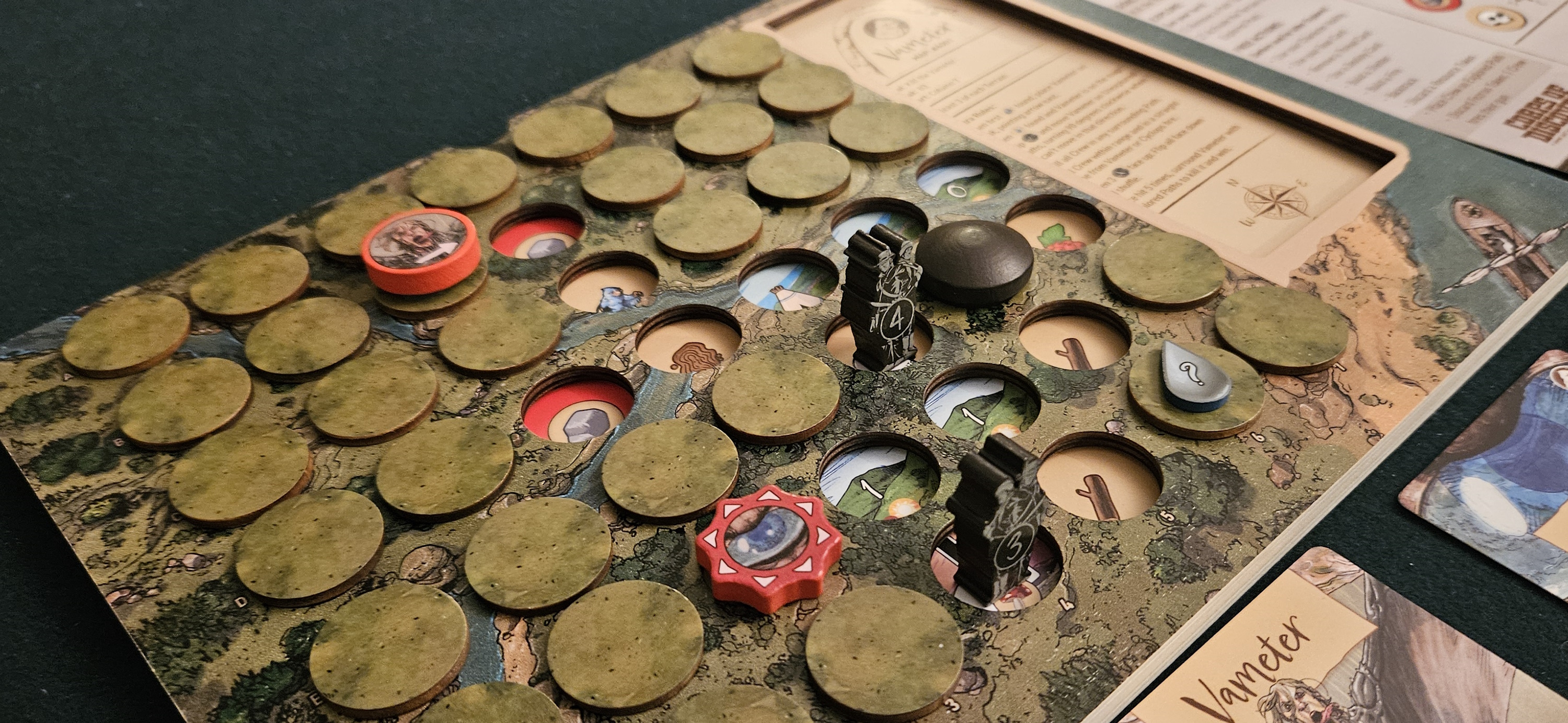
Setting traps…
Oddly, this sequence stops short of actually finishing the story presented in Manifest Destiny. Which is peculiar. It walks right up to the edge. One more chapter could have done it.
I wonder if this speaks to the difficulty of adapting the source material to the tabletop. Not as an aesthetic — the game nails that, including the comic’s awkward early portrayal of Sacagawea as a warrior sex goddess — but rather in terms of Dingess’s story and motifs. It probably won’t come as a surprise to newcomers that Manifest Destiny is a rather loaded work of art, grappling with the legacy of not only this particular expedition, but also the larger ramifications of American expansionism. Its portrayal of westward expansion is nasty, brutal, and long, and hangs on the idea that genocide is a pact that taints even national blood with lingering venom.
As more than one commentator has noted, the series eventually underwent a tonal shift from “killing monsters is cool” to “these foundations are slippery with sacrificial offal.” That shift was sometimes uneven, and perhaps it arrived too late, but also lent new dimensions to the comic.
Corps of Discovery, as a board game, remains forever trapped in that first mode. This is a game about uncovering what lies over the next hill — and very likely shooting it between the horns. That’s a blood-pumping endeavor, with one of the smartest and tightest blends of deduction and resource management I’ve ever had the pleasure to play. But it’s also disappointing that the board game should restrict its efforts to the source material at its weakest. Its most badass, too! But also its emptiest.
Is there a version of this game that’s badass but thoughtful, that walks the line between monster-slaying and the interrogation of national memory? Cormier and Lim are both Canadian, and have talked about how the full weight of the comic’s original title was lost on them. In altering the title, they sought to escape its ramifications.
Maybe that was the right call. Or maybe they should have leaned into what made the comic such a blood-soaked terror. Because it wasn’t the blood itself that made the comic’s conclusion so shocking. It wasn’t all those lovingly illustrated images of rib cages protruding from lumps of gore. It was the way the blood persisted from one generation to the next. It was the horror of realizing you had built something pretty atop an edifice of cruelty. Can that be communicated in a tabletop adaptation of a comic book? Maybe. Maybe not. For now there’s no telling, because Corps of Discovery didn’t try.

Not every module is created equal.
Personally, I think Cormier and Lim could have had their cake and eaten it too, although to delve into my reasoning would involve more spoilers than this review warrants. Anyway, perhaps it’s greedy to wish for more. In the course of this game’s moment-to-moment play, there isn’t room to consider more than the map, those interlocking symbols, your waning stockpiles, the monster prowling on the periphery. There’s so much to discover here. All the same, I wish it had gone a little further in adapting not only the appearance and characters of Manifest Destiny, but the reason they were summoned into existence in the first place.
To be clear, though, this is a sour note in an otherwise exceptional game. Corps of Discovery’s interlocking puzzles are all the richer for how they coil together, evoking resource management, survival horror, and Minesweeper-esque deduction in a potent blend. Every option is another possible solution, every spent resource poses another agonizing decision, every flipped disc is another horizon waiting to be crossed. Even the occasional dud scenario can’t dispel my fondness. Like its source material, Corps of Discovery is a gem — brilliant, flawed, and crimson.
A complimentary copy of Corps of Discovery: A Game Set in the World of Manifest Destiny was provided by the publisher.
(If what I’m doing at Space-Biff! is valuable to you in some way, please consider dropping by my Patreon campaign or Ko-fi. Right now, supporters can read my second-quarter update!)
Posted on July 21, 2025, in Board Game and tagged Alone Time, Board Games, Corps of Discovery, Off the Page Games. Bookmark the permalink. 4 Comments.

 SPACE-BIFF!
Cool. Any chance you’ll be reviewing their game currently on KS, Grendel?
Grendel just showed up on my doorstep! So: Yes.
Excited to read your thoughts on Grendel. From images, it looks like it’s most comparable to Harrow County but still very different.
Whereas CoD seems closest to Mind MGMT.
Pingback: Best Week 2025! Heart of Darkness! | SPACE-BIFF!