The Year of Living Boringly

Ever wanted to make a year seem as long and tedious as possible? Boy, have I got the game for you! Meet 365 Adventures: Cthulhu 1926: 2026, a title filled with too many damn numbers. Designed by Lee Ju-Hwa, this is the sequel to this year’s 365 Adventures: The Dungeon. Some have called the idea of letting you play a microgame every day “innovative.” That’s a heck of a thing to say when daily peel-off crossword and sudoku calendars have existed since Ancient Roman times. But, sure, let’s go with it. 365 Adventures is innovative for anyone who wants to make their year seem as long and tedious as possible.
Oops. I already wrote that. My bad. Forced repetition is more of this game’s shtick.

Pow! Take that, woman in need!
We’ve never done an unboxing here on Space-Biff! Let’s rectify that. Here’s what you get when you open your brand-new copy of 365 Adventures: Cthulhu 1926: 2026.
- 1 stand-up monthly calendar, color squamous-green, spiral-bound, too small for recording birthdays or other life events
- 5 dice, three black and two green, with custom faces that represent a Cthulhu, a revolver, a magnifying glass, and what I think is supposed to be a flashlight but looks like a AAA battery
- 1 investigator magnet for tracking your day, but which is also just big enough to obscure the vital symbols you will need to see in order to play the game, causing you to clasp and unclasp it regularly
- 1 rulebook, weirdly verbose
Alternatively, here’s what ought to be contained when you purchase a used copy of 365 Adventures: Cthulhu 1926: 2026.
- 1 stand-up monthly calendar, color squamous-green, spiral-bound, too small for recording birthdays or other life events, the first two months marked by permanent ink
- 1 rulebook, crumpled
Sadly, the magnet and dice will have been pilfered. No big surprise. The best thing about playing 365 Adventures: Cthulhu 1926: 2026 is that you’ll at least be able to salvage some custom dice and a magnet from its remains when you give up on it after two months of slogging through its Yahtzee-But-Dumb gameplay.
Because I am a consummate professional, I played the entire thing. That’s right. Three hundred and sixty-five microgames, each of them so small that even other microgames think they shouldn’t qualify. Basically, you roll the dice up to three times. Then, maybe, if you had sufficient luck, you mark one of the days of the current week. Some days require a certain symbol, like a flashlight. Every day requires a particular sum. Say, 11. So you roll the dice, lock one or two, and then roll again. Then, get this, you might roll again. Mark a space. Woo.
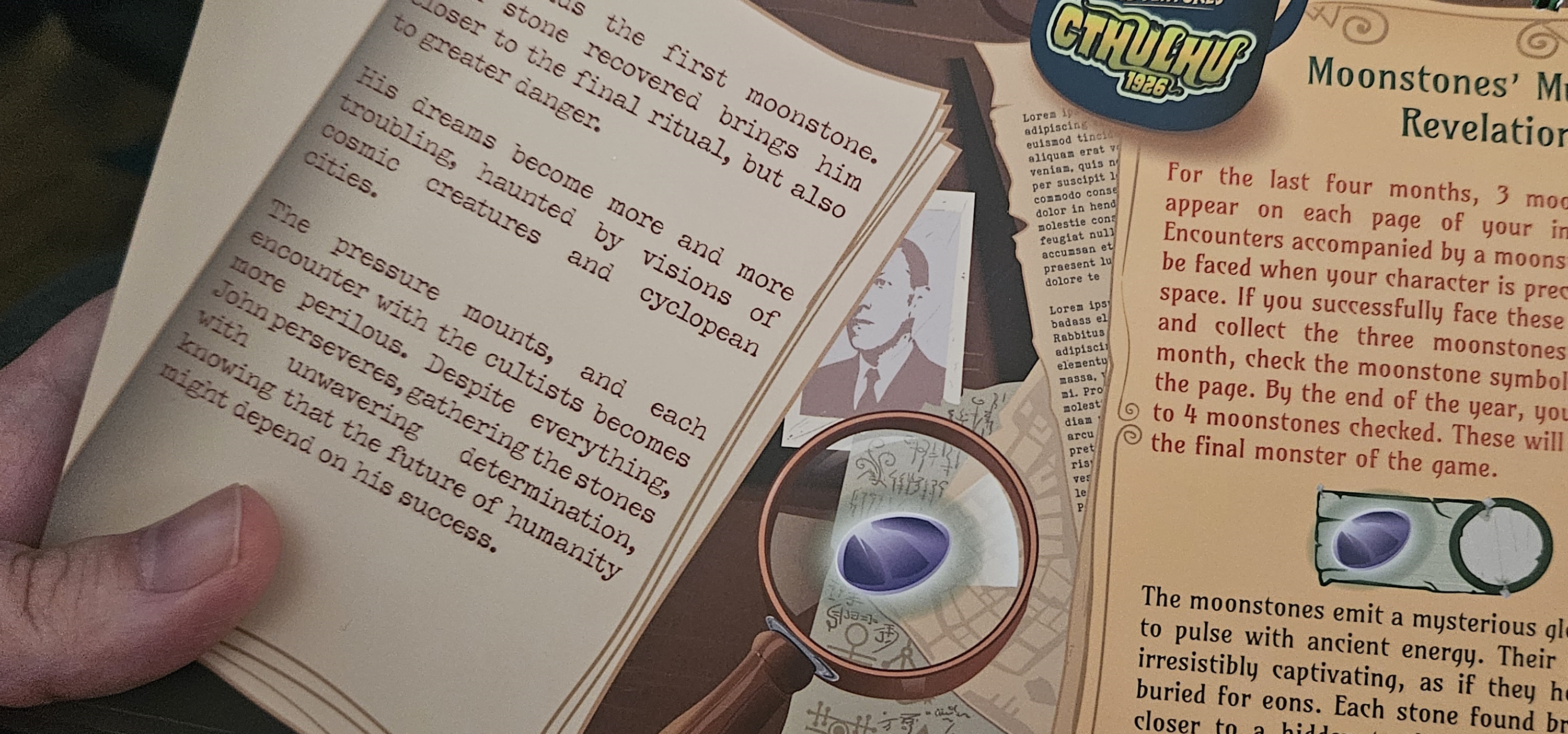
Wanna look at a racist’s face every month?
The problem, right from the mi-go, isn’t that rolling dice is bad. Oh no. It’s that 365 Adventures: Cthulhu 1926: 2026 doesn’t even tinker with probability in interesting ways. It’s like playing Yahtzee, sure, but even Yahtzee assigns some value to rolls other than “high number good.” Here, a good roll is a good roll, a bad roll is a bad roll, and a middling roll is a middling roll. So you aren’t even playing the odds. Okay, fine, there’s some small measure of playing the odds early in the week, when there are still seven days to fill in. This means you can settle for a wimpier result or chuck the dice again in hopes of getting something better. But as the week progresses and your options grow more constrained, there’s no need to assess the variable merits of one roll versus another.
That goes double for the week-ending boss fight. The more days you’ve marked off, the easier the boss is. If you’ve marked off enough cells, you stand a chance. Otherwise, the boss will require a high sum, sometimes even a sum that’s literally impossible to roll under the current conditions. What a way to make me want to play your game.
As the months drudge past, new rules are added. “Oho,” you might be saying. “Oho,” like grandpa used to. “So the game just needs some time to warm up through the late winter months? Then it will get good?”
No. It will not get good. Rather, it will get worse. The little rules additions are frustrations more than anything. Rolling a Cthulhu makes you go mad and potentially lose points, but oh, look here, now some enemies are tougher unless you’ve welcomed in a little madness! Fine. That’s interesting, I suppose. At least now you won’t immediately reroll every Cthulhu result. If only these requirements presented an actual tradeoffs instead of a simple check that ratchets up throughout the month. Early enemies require one or two pips of madness; later enemies might require three or four. Like everything else in 365 Adventures: Cthulhu 1926: 2026, this subtracts decisions rather than encouraging them.
Later, you earn limited abilities, like reading a grimoire to turn Cthulhu dice into numbers, a librarian who can reduce your madness (with no way to track the reduction), or a Tommy Gun for doubling your roll. Fine. Other updates, though, commit such unforgivable errors as reducing your madness cap (boring), adding extra icons to certain challenges (further reducing the game’s wisps of press-your-luck), or asking you to secure little moonstones to make the final boss — the final final boss, not the normal final bosses — a little easier. Oh, and these moonstones are sort of hidden. Sort of. There’s nothing as interesting as hidden images or autostereograms in this game. Just little rocks that either you remember to notice or you don’t.
My goodness. I’m yawning right now. I suppose one could say that’s thematic. My mind is being assailed by the mere conception of this game. I cannot possibly describe it without descending into madness. It isn’t a barrel with tentacles. It’s an indescribable lamellar muckety-muck from out of space.

The dice are dice, I guess.
What truly grinds my gears about 365 Adventures: Cthulhu 1926: 2026, though, isn’t the way it misunderstands probabilities, Yahtzee, or the appeal of dice. Nor is it the fact that this is a calendar that cannot function as a calendar. Nor, even, is it the game’s usability problems, its inexpressive snippets of narrative, its copy-paste illustrations, its cheapness as a product.
No. It’s the laziness. “An adventure a day” is a wonderful hook. As a hobby, we’ve seen advent-calendar-style boards, hidden envelopes, information that only reveals itself under a black light, heat-sensitive ink… countless inventions. And here, instead, we get one of the worst dice games I’ve ever had the misfortune to play. And far from being a novelty, the daily calendar is a storied format. You could be solving a puzzle, learning a new word in Japanese, looking at pictures. Heh. “Pictures” means swimsuit models.
Look, I’m not going to tell you how to spend your money. But please please please do not spend it on this. You can buy a better calendar for twenty bucks at a mall kiosk during the holidays. Some of them tell jokes, or have Far Side comics, or whatever. Anything is better than rolling these dice.
A complimentary copy of 365 Adventures: Cthulhu 1926 was provided by the publisher.
(If what I’m doing at Space-Biff! is valuable to you in some way, please consider dropping by my Patreon campaign or Ko-fi. Right now, supporters can read my second-quarter update!)
Posted on July 16, 2025, in Board Game and tagged 365 Adventures, Board Games, Pandasaurus Games, Sorry We Are French. Bookmark the permalink. 8 Comments.

 SPACE-BIFF!
The “right from the mi-go” right after the “Wanna look at a racist’s face every month?” Really made me laugh out loud. Thank you! Great review!
I can’t say I had a good time playing 365 Adventures. But I had a great time writing about it.
Nice review!
I own the 2025 dungeon one. The rules seem different, but I’d say the feel is the same. Dumb Yahtzee with a bottleneck of possibilities, repetitive as can be, and doesn’t work at all as a calendar. That you can cross anything within a week makes it even more disjointed with respect to a regular calendar. I usually play it one month at once, because rolling three times a day is just unfulfilling. And the additional rules… don’t really add anything.
For a while I played with my 6yo son, who enjoyed rolling the dice, but his interested waned pretty fast. I can’t fault him.
I think the worst of all is the atrocious and pedestrian narrative. I’d rather have nothing than this pretense of a story.
And the dice aren’t custom in mine.
People seem to enjoy it on the game forums though. I felt I was dumb because I couldn’t understand their enjoyment. I now feel much less alone after reading your review.
There aren’t custom dice in the adventure one? What’s even the point?
I’m always happy to hear that somebody is enjoying a game that didn’t land for me. Even when I’m also utterly baffled that any human with a working brain could derive pleasure from something this broken.
No, just plain wooden dice, red and blue (because the blue one is “special”, oooh: you can unlock the power to flip it, once per month! game-changing! a 5 turns into a 2!).
I also appreciate the diversity of opinions regarding board games. The contrary would be terrifying, to be honest. I once played a game that I consider to be one of the most awful I have ever played (it’s called Dungeons & Dragons: The Adventure Begins). One comment on BGG was utterly positive: it was from a dad who played it with his sons and they were making tales and having fun. I thought it was nice that someone could truly enjoy it for what it was even though it’s the rare game I wouldn’t mind dumping in the trash (I still sold it to someone but not without some degree of shame). So I understand your point as well.
But when you hear nothing but praise for a product that doesn’t seem to provide any hint of actual worth, you start wondering. Did I miss something? Do I play it wrong? Am I even a real human being? The usual stuff.
And by the way you nail a perfect point when highlighting that the rules unlock constrain the decision space rather than enrich it. At least it’s also very true in the Dungeon one.
For instance, one month introduces “invisible” monsters, they can only be fought the exact day you encounter them rather than any day of the week they belong, therefore reducing your decision space.
Another month introduces “elite” monsters that you can only beat within two rolls. What’s the point? It means if you can’t slash one within two rolls you need to focus on another monster, but if you can you should go for it because it’s less likely to happen again.
Finally, a game which has found a way to unleash true cosmic horror on its players!
All the Outer Gods had to do was bore us to death…