Frank in the Woodland

In Frank West and James Tomblin’s latest title, fully clothed animals travel between forest clearings and initiate battle in order to restore their chosen power structures to the woodland. Hmm… where have I heard this before? Ah, I remember — it’s Defenders of the Wild!
I kid, I kid. To be fair, Emberleaf bears only the most superficial of resemblances to Root. I wouldn’t dare invoke Foucault to describe its depiction of biopower or sexuality, for one thing. On a somewhat less onanistic spectrum, Emberleaf is an optimizer’s board game, jam-packed with sequences of actions that spool into other actions, resources that must be spent in precisely the right order, and conflicting objectives that each award their own variable numbers of victory points. It’s an intriguing, persnickety, and sometimes gummy title, either a deeply flawed masterpiece or a mess with pretensions. I’m still trying to determine which.
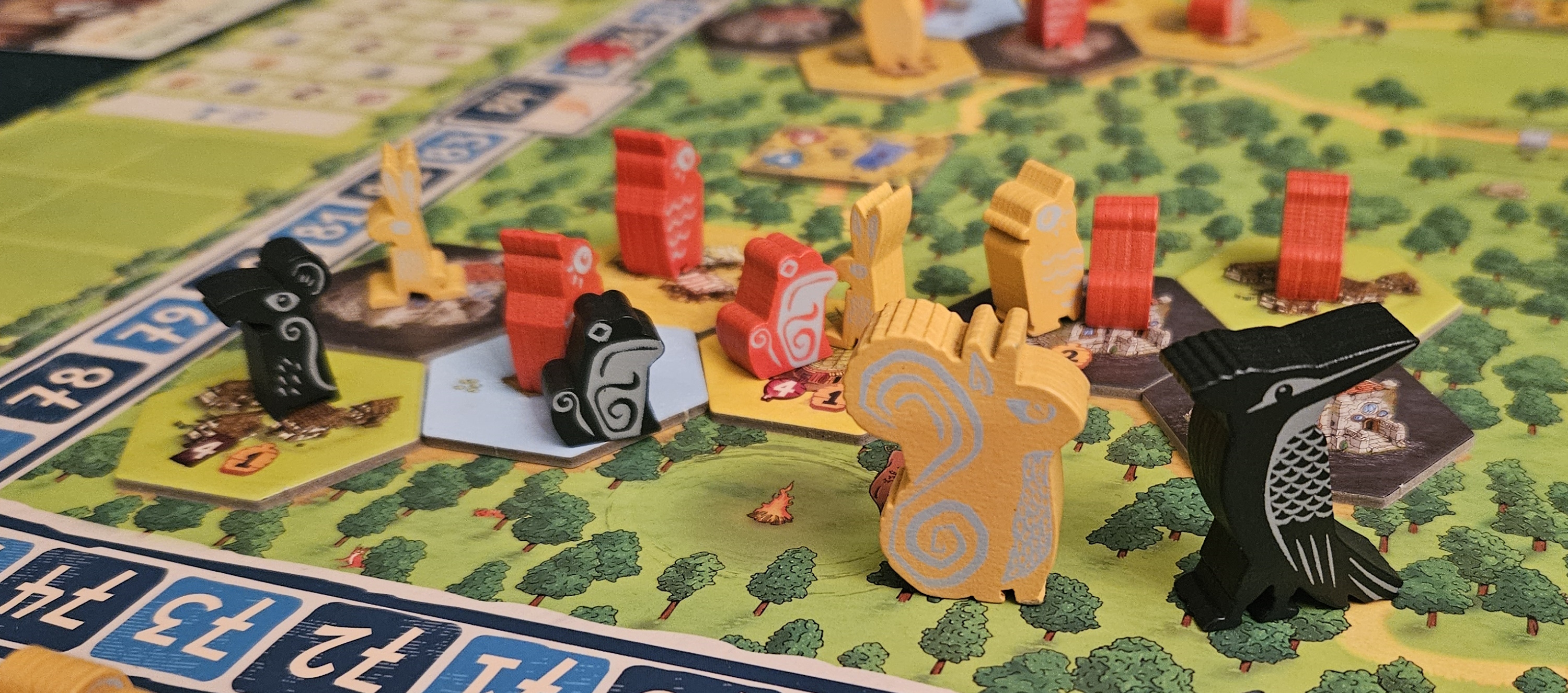
Repopulating those clearings.
Rather than diving into the mechanisms that chug under this vehicle’s hood, I want to open with an example of something that happens relatively often in Emberleaf. It’s an anecdote, but it also happens to illustrate what makes West’s most ambitious title to date both so interesting and so periodically frustrating.
Much of Emberleaf revolves around filling clearings with buildings, which in turn are then used to home the woodland’s displaced creatures. This is a multi-step process, the most phase-heavy action in the game, prone to misplaced bullet points. If I earned a wooden nickel for every time I’ve had to remind somebody to tally their points, spend their resources, or trigger their chosen creature’s bonus, I’d have quite the heap of sawdust.
It goes like this. You have the right combination of food, timber, stone, and honey to place a building. So you affix the structure into the proper hex. You earn points for the size of your neighborhood, the connected structures that contain your re-homed animals. Depending on which animal you place in your newest structure, you trigger some bonus. Maybe extra resources. Maybe another goal card. Maybe something big, like a bunch of points for every clearing you’ve now populated. Something like that.
But there’s an even bigger possibility. If you’ve filled that clearing’s final space, you earn a trophy. Now, trophies matter. They offer quite a few points. More than that, though, they’re the timer. Once all of the trophies have been claimed, the game is over. In every single session I’ve played, this conclusion is as unceremonious and as startling as a tree falling on your leg.
So you parcel out your actions. You avoid undertaking that second-to-last construction project. You journey your hero to far-flung clearings that rivals surely cannot reach before you plop down the final structure.
And then, as often as not, somebody takes four or five actions in a spree. Their hero pads onto the scene, bypassing bandits and other pristine building slots. They pile up the necessary resources, absent only a moment ago, and then, oh, and then, they materialize a town hall or windmill out of nowhere. The last trophy is theirs. On the eve of your biggest move, the tree has fallen and your knee is bent at the most distressing of angles.
“You gigantic ass,” my sister-in-law said to me the last time I did that.

The market shifts rapidly, which is usually a good thing.
Emberleaf is full of sticky contests like this. Populating clearings with structures and woodland refugees is the big one, the dominant consideration behind all those markets and neighborhoods.
But there’s a second source as well. Bandits populate the land, making it difficult for your hero token, the in-game avatar that determines where you can take actions, to travel to and fro. Slaying bandits awards some points and clears the roads. It also moves you along a little reward track. Only the track keeps getting better and better. The final reward on the track, the one that resets it back to the beginning, is a trophy. Which, yes, might fell that game-ending tree.
So you tiptoe along the track. Sometimes, you avoid beating bandits even when you wouldn’t mind the points. Because you’ll be damned if your rivals are going to claim any honeycomb off the back of your hard work.
To be clear, these contests, so potent and so loaded, are utterly fascinating. They engender a rare social space, one where you need to repopulate those clearings or de-bandit those roads in order to get ahead, but also one where you don’t want to get ahead at the wrong moment lest somebody play tortoise to your hare. It’s a game of building tempo, true, but it’s also a game of withholding tempo. Of choosing when to sprint and when to rest. This is a race. But it’s a marathon, not a sprint.
Nowhere is this more obvious than in the game’s card system. This is the flashy part, the underlying engine that people will undoubtedly identify when asked what Emberleaf is all about. That isn’t quite the case. The system could have been anything that allowed players to veer between tempos. But I’m getting ahead of myself.

The card-placing/card-sliding system is a real draw.
The card system works like this. Most of the cards in your possession are the plucky clothes-wearing creatures that make up your fellowship. On your turn, you can do one of two things.
The first and most common option is to play a single card to your fellowship board, a three-by-two grid — eventually, pending the right upgrades, a four-by-two grid — of slots for holding your animals. Most cards, but not all, will trigger some minor bonus when placed. These actions are small. In most cases, a turn will last all of ten seconds. Gather some wood. Travel across the woodland. Build something. That last one takes more than ten seconds, but it’s still reasonably self-contained. Just make sure you remember all the steps.
The second option is the sprawling one. Now that your fellowship board is full of creatures, you can slide them all one slot to the left. This activates a whole spate of abilities. Some trigger when the card shifts; others when the card falls off the board entirely. There are others, too, ongoing perks or abilities that only spring to life for a resource, but they’re the exception.
Much of Emberleaf’s moment-to-moment gameplay comes down to the combos you trigger when you take one of those slide actions. With the proper arrangement of creatures, an empty storehouse can be made to brim with materials. Your hero, previously stationary, can warp across the map. Bandits will be slain. Buildings will be constructed in unpredictable locales. Trophies or desirable market cards will be stolen. Improprietous words will be uttered.
These turns often consume quite a few more than ten seconds. Whole minutes, in some cases. It’s possible, for instance, to set up a turn that lets you construct multiple structures, sometimes in different clearings, or attack two bandits at once, or any number of other achievements that previously seemed far-fetched. Manufacturing such a turn feels utterly wonderful.
But they can also be infuriating. Especially when so much of Emberleaf is about those spiky tempo-measuring contests where second place so often feels like being named the first loser. Keep in mind, everybody is building those powerful combos on their fellowship boards. Those powerful, fragile combos. Powerful, fragile combos where cards must resolve in exactly the right order. When somebody comes along and inserts themselves into your plans, and in the process kicks the bottom block from your carefully curated sequence of actions, the entire thing topples.
And let me tell you, taking a slide action where your builder can no longer build, your warrior can no longer make war, and your resource-gatherers come home to find the granaries already full to the very top — that feels uniquely crummy.
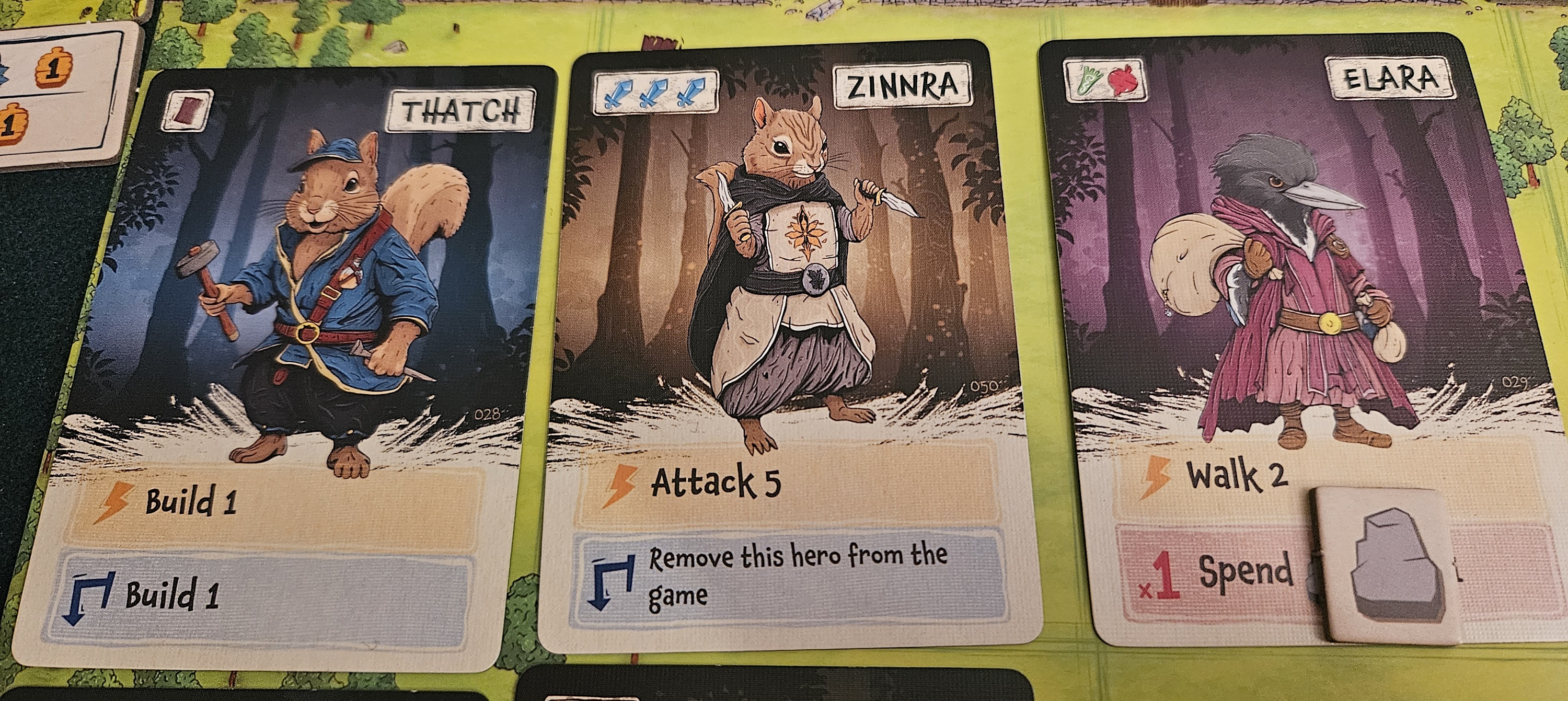
Most of the animals are cute. Most.
That’s what makes Emberleaf special. Those crummy moments, and the wonderful ones too, and the slender light that shines between them. It isn’t enough to build and then resolve a powerful engine. You also need to build a transmission into the thing. Because if somebody comes and flips you around, it would behoove you to shift the whole vehicle into reverse.
Here’s another example. Every so often, you’ll get to take a favor card. In the fiction, these are promises (oaths?!) your hero makes to the woodlanders. In practice, they’re scoring opportunities. And there’s a wide range of possibilities on offer. Perhaps you want to build every one of the special structures on your fellowship board, settle a certain number of owls and rabbits, or even more specific options like settling three rabbits in windmills or murdering more of a particular bandit clan than any of your fellow do-gooders.
Naturally, some of the favors in the market will suit your progress better than others. If I already have a bunch of frogs in boathouses, well, by dang, the appearance of a favor to house three frogs in boathouses might as well be eight free points!
Only it isn’t so easy to claim a favor. Homing certain animals will get you there, as will various rewards scattered around the board. But these are intermittent. Anyway, the markets for new fellows and new favors both churn at a rapid pace. As often as not, when your chance to claim a card rolls around, there won’t be anything suitable.
Again, flexibility is key. Emberleaf is about long-term planning, but it’s about making plans with elastic joints. It forces players to occupy that rare headspace between strategic and tactical, always on the move, hoovering up little spills of points wherever they leak out of somebody else’s plans, but also moving toward your own scoring stockpiles in the meantime.
Along the way, sometimes it feels great. Sometimes it feels bad. If you couldn’t tell, Emberleaf is an unusually emotional game. That speaks to the depth of its engagement, how much it permits its actions to matter. It also, at the same time, speaks to how fragile some of its moves are, how much downtime there can be in between turns of significance, how galling even offhanded rival actions can be. Like I said at the beginning, this is a masterpiece with flaws. Or else a mess that sometimes shows sparks of genius. Even here, two thousand words later, I’m not entirely sure which headspace it occupies more fully.

The map looks like a browser-based isometric open-world MMORPG from the mid-2000s.
Where does that land Emberleaf? It’s hard to say. From Frank West, this is an uncommonly dense and spiky plaything, a briar patch in cardboard. I have loved and despised my time with it, often within the same sitting, and felt the warmth that comes from an exceptional slide at the very same moment that I feel like a real jerk for bumbling over somebody else’s best-laid plans. This is not a game for those who have been lulled into false security by too many multiplayer-solitaire titles.
Rather, it’s a game that revels in its thorns as much as in its rosebuds. That’s special, I think, even when it sometimes stings. At the very least, it’s quite the thing to behold.
A complimentary copy of Emberleaf was provided by the publisher.
(If what I’m doing at Space-Biff! is valuable to you in some way, please consider dropping by my Patreon campaign or Ko-fi. Right now, supporters can read my second-quarter update!)
Posted on July 10, 2025, in Board Game and tagged Board Games, Emberleaf, The City of Games. Bookmark the permalink. 2 Comments.

 SPACE-BIFF!
ALERT: No pun detected. Object punknown.
This sounds like a bomb-builder game, in the sense that you spend most of your turns building a bomb (drawing cards, amassing resource tokens, building an engine, etc.) and once in a while you set it off and the explosion propels you towards the goal.
I kind of don’t like those games, because the very large shift in player position as a result of turn actions (the “bomb”) means it’s hard to address other the other players’ actions or even to influence them really without mechanics specifically meant to do it. So it’s mostly about however-many people playing solitaire games and whoever finishes their game first wins.